






This video discusses the political entry of Jonathan Pollard, a convicted former US spy who served 30 years in prison for selling classified military intelligence to Israel. The host outlines several key points regarding his background and current platform:
- Platform and Goals: Pollard is running for the Israeli Knesset with a platform centered on the forcible removal of Palestinians from Gaza and the West Bank, advocating for the annexation and repopulation of these areas (0:00-0:34, 3:57-4:55).
- Controversial History: The host highlights Pollard's past statements, including his admission that he encouraged Israel to threaten the United States with nuclear weapons during the 1973 Yom Kippur War to secure military aid (0:56-3:08).
- Espionage Details: The video emphasizes that Pollard was not a low-level operative but was involved in a massive espionage operation that funneled thousands of classified US documents to Israel, some of which the host alleges were shared with the Soviets (8:51-9:36).
- Political Context: Despite his past, Pollard immigrated to Israel in 2020 and received a hero's welcome. He is now entering politics as part of a new party, though he remains a critic of current Prime Minister Benjamin Netanyahu (7:40-8:37).
Transcript
This video from MeidasTouch, featuring host Ben Meiselas and former federal prosecutor Harry Litman, details the ongoing hiring crisis at the Department of Justice (DOJ) following mass resignations and terminations within the agency (0:00 - 0:20).
Key takeaways from the discussion:
- Operational Breakdown: The DOJ is reportedly struggling to handle cases due to the departure of thousands of lawyers (estimates range from 5,000 to 10,000), resulting in missed deadlines and the dismissal of cases (0:00 - 0:58).
- Ineffective Recruitment Tactics: The agency's attempt to use $25,000 signing bonuses is described by Meiselas and Litman as a sign of desperation that misunderstands the core motivation of DOJ lawyers, which has traditionally been public service rather than financial gain (1:53 - 3:48).
- Degradation of Culture: Litman notes that the DOJ was once a highly prestigious environment where top legal talent sought to work for the sake of mission and professional development. He argues that the current atmosphere has shifted, making it difficult to attract qualified personnel and damaging the agency's integrity (6:56 - 8:36, 11:15 - 12:08).
- Impact on Legal Standards: The loss of experienced senior staff means that remaining or newly hired, less-experienced lawyers are being forced into complex situations without adequate training, which negatively impacts the judicial process and public interest (7:29 - 8:26).
This video features Keith Edwards discussing an appearance by former President Barack Obama on The Late Show with Stephen Colbert. Throughout the video, Edwards highlights Obama's thoughtful reflections on the state of American democracy and political norms.
Key Highlights:
- Restoring Political Norms (0:44 - 3:28): Obama discusses the importance of keeping the Department of Justice independent, noting that the Attorney General should serve the people rather than acting as the president's personal legal counsel. He also stresses the need to avoid politicizing the military and discusses concerns about presidential “side hustles” while in office.
- The Republican Party (5:02 - 6:18): Obama expresses a desire for a “loyal opposition”—a conservative party that respects the rule of law, science, and democratic norms, contrasting this with current political trends.
- Advice for Democrats (6:21 - 8:41): Obama suggests that Democrats should focus on shared values like fairness and economic dignity, and emphasizes the importance of communicating in “plain English” rather than academic jargon to better connect with average citizens.
- Humorous Conclusion (9:15 - 10:31): The segment ends with a lighthearted exchange between Colbert and Obama regarding the low bar for presidential candidates, with Edwards jokingly advising Colbert to start a podcast instead of running for office.
Transcript
I miss leaders we could actually rely on. We could I don't know when we went to bed. We didn't have to worry about what they said by the time we woke up.
This video features Keith Edwards discussing an appearance by former President Barack Obama on The Late Show with Stephen Colbert. Throughout the video, Edwards highlights Obama's thoughtful reflections on the state of American democracy and political norms.
Key Highlights:
- Restoring Political Norms (0:44 - 3:28): Obama discusses the importance of keeping the Department of Justice independent, noting that the Attorney General should serve the people rather than acting as the president's personal legal counsel. He also stresses the need to avoid politicizing the military and discusses concerns about presidential “side hustles” while in office.
- The Republican Party (5:02 - 6:18): Obama expresses a desire for a “loyal opposition”—a conservative party that respects the rule of law, science, and democratic norms, contrasting this with current political trends.
- Advice for Democrats (6:21 - 8:41): Obama suggests that Democrats should focus on shared values like fairness and economic dignity, and emphasizes the importance of communicating in “plain English” rather than academic jargon to better connect with average citizens.
- Humorous Conclusion (9:15 - 10:31): The segment ends with a lighthearted exchange between Colbert and Obama regarding the low bar for presidential candidates, with Edwards jokingly advising Colbert to start a podcast instead of running for office.
This video from The Young Turks covers the recent testimony of U.S. Commerce Secretary Howard Lutnick before the House Oversight and Government Reform Committee regarding his relationship with the late financier and convicted sex offender Jeffrey Epstein.
Key takeaways so far:
- Evasive Testimony: Host Ana Kasparian and Congressman Ro Khanna highlight that Lutnick provided inconsistent and evasive answers during his closed-door, transcribed interview. He frequently claimed he "didn't remember" details about his interactions with Epstein (0:17).
- Contradicting Claims: While Lutnick previously claimed he cut ties with Epstein in 2005 after a visit to Epstein's home, records from the Department of Justice show ongoing correspondence, including a 2012 trip where Lutnick requested to visit Epstein in the Caribbean (4:18-5:12).
- Loss of Credibility: Lutnick is also criticized for changing his stance on Epstein's alleged blackmail operation. After previously acknowledging that video evidence supported the existence of a blackmail scheme, he later testified to the committee that he was merely speculating and that Epstein did not engage in such activities (9:30-10:25).
- Political Implications: The panel argues that this testimony is part of a larger, "egregious cover-up" involving elite figures within the government. They express deep skepticism regarding the Trump administration's handling of the Epstein files and criticize the overall lack of accountability (10:36-12:15).
Transcript
Transcript
BREAKING NEWS LIVE: Patel Reveals New Details On Trump Shooting | 'High-Profile' Angle Emerges
IHIP News:🚨 Trump BEGGING For $1 BILLION From TAXPAYERS For BALLROOM?! He WAS NEVER Paying!!
Tanner Horner heading to death row as Athena Strand’s family begins long healing process
Nancy Guthrie case: Why profilers believe the kidnapper is dead
Jon Stewart DESTROYS Howard Lutnick... SHOCKING Details Go Public!
Rep. Thomas Massie: Battling the Treachery of Trump’s Republican Party, AIPAC, and the Epstein Class
Is the DoJ covering up links between Epstein, Trump and Russia? | FourSight interview
Tucker Carlson splits with Trump over Iran | Sunday with Laura Kuenssberg
IDF, Netanyahu Continue To DISRESPECT Christians!
Political frustrations continue surrounding the redistricting maps
Katie Couric & Frank Bruni: 6 Months Out—Who’s Really Winning the Midterms?
Exclusive Analysis: Trump’s $464M Bond Fight and the Supreme Court’s Section 3 Ruling
Jeffrey Epstein’s ‘Suicide Note’ Finally Released | This Changes Everything… Is it FAKE?!
Secret ‘90s government meeting on UFOs — researcher shares evidence | Elizabeth Vargas Reports
Brian Harpole Sends Out MORE Legal Notices. Jeremy Boreing Is Still A Creep. | Candace Ep 334
Are the Ba'al Rooms, Data Centers, and UFOs Related? - Ep 110
Epstein Was a Front — The Real Network Behind Him | Whitney Webb
This Senate Report Exposed Everything — Why Banks Don't Want You to Know
How Qatar's careful plans for security failed | If You're Listening
Trump's War on Iran & Strait of Hormuz Crisis Reveal "Limits of American Imperial Power"
🚨TPUSA ROCKED As Spokesman’s SHADY Past EXPOSED
Link copied to clipboardLink copied to clipboardLink copied to clipboardLink copied to clipboardLink copied to clipboard
Transcript
This video features Randall Carlson discussing the "Thunderstorm Generator," an experimental technology designed to significantly reduce air pollution and emissions from internal combustion engines.
Key takeaways from the discussion:
- Core Functionality: The system aims to mimic the natural processes of a thunderstorm to lower the energy required to create plasma, which then disassociates pollutants (0:30-4:15).
- Performance Results: Independent tests and video demonstrations shown in the clip suggest that when the technology is active, harmful emissions like carbon monoxide, nitrogen oxides, and hydrocarbons drop drastically, sometimes reaching near-zero levels (1:45-2:00, 8:45-10:15).
- Exhaust Quality: Carlson claims that the output from a treated engine contains approximately 20% oxygen, describing it as comparable to breathing air in a "pristine alpine meadow" (2:00-2:30, 7:50-8:05).
- Mechanism: The system involves a pre-ionizer, a water-based bubbler that creates cavitation bubbles to emit UV light, and a core component based on the Ranque-Hilsch Vortex Tube to separate hot and cold air streams (3:25-5:55).
This video features a 2017 interview with physicist Dr. Weiping Yu, who introduces his Uon Theory, a unified theory of everything that challenges fundamental paradigms in physics. He proposes that there is only one fundamental particle, the Uon (a magnetic particle), and only one universal force: magnetism.
Key concepts and arguments presented by Dr. Yu include:
- The Nature of Light (1:34 - 8:24): Dr. Yu argues that light is not a stream of particles, but a wave motion occurring in a medium already filled with magnetic particles, which allows for simultaneous perception of light.
- Electricity as Oscillation (8:24 - 10:37): He defines electricity as the oscillation of magnetic particles rather than a flow of electrons, suggesting that magnetism and electricity are manifestations of the same phenomenon.
- Reimagining the Atom (10:37 - 14:16): Challenging the model of electrons in perpetual orbital motion, he suggests atoms are stationary structures held together by magnetic attraction and repulsion, not gravity or complex nuclear forces.
- Unified Forces (14:16 - 30:40): Dr. Yu asserts that the four fundamental forces (gravity, magnetism, strong, and weak nuclear forces) can be unified under the singular umbrella of magnetic force.
- Gravity and Cosmology (30:40 - 52:51): He proposes that gravity is simply magnetic attraction. By applying this to cosmology, he attempts to explain phenomena like dark energy (as space-based magnetic repulsion) and dark matter/black holes (as miscalculations resulting from applying weak gravity constants instead of magnetic force values).
- Antimatter (53:32 - 55:09): He argues that antimatter, in the context of mass annihilation, does not exist, and that matter and antimatter are fundamentally the same at the particle level.
Dr. Yu concludes by emphasizing the principle of Occam's Razor, arguing that his theory provides a much simpler, more coherent explanation for physical phenomena than current models.
This video features investigative journalist Whitney Webb discussing the connections between powerful figures like Jeffrey Epstein and Leslie Wexner, and the emergence of corporate-controlled governance and surveillance infrastructure in Ohio.
Key topics include:
The HB6 Scandal and Corruption: Webb highlights the FirstEnergy bribery scandal in Ohio, noting that Neil Clark, a lobbyist tied to Wexner, was found dead in an apparent suicide (0:00-1:46).
Jobs Ohio and Privatization: The discussion covers the creation of Jobs Ohio, a private corporation that took control of state economic development and public funds (liquor tax) without public oversight (2:35-3:39).
Digital ID and Surveillance: Ohio has implemented a digital ID system (Ohio ID) managed by entities with deep ties to big tech, which Webb argues is designed to corral and surveil the population (3:40-4:57).
The End of Private Ownership: Webb discusses initiatives promoted by groups like the World Economic Forum and Columbus smart city projects, which aim to move society away from private car and home ownership toward rental and autonomous fleets controlled by AI and data (5:00-8:15).
Technocracy and Media Control: The latter half of the video explores the influence of figures like Peter Thiel, Larry Ellison, and Steve Fineberg over tech infrastructure, military contracting, and media ownership, suggesting a broader agenda of "plutocracy" and wealth transfer (8:20-14:00).
Global Governance: Webb concludes by arguing that Epstein was a minor player in a larger, transnational network that exerts influence over governments, often using philanthropic foundations and think tanks to filter policy (14:06-15:40).
This video features Jimmy Dore hosting former CIA analyst Ray McGovern, who reflects on his famous 2002 confrontation with former Secretary of Defense Donald Rumsfeld regarding the justifications for the Iraq War.
Key highlights of the discussion include:
- The 2002 Confrontation: McGovern recounts how he managed to secure a ticket to a private event in Atlanta (1:47-2:48) to directly challenge Rumsfeld about his claims regarding links between al-Qaeda and Saddam Hussein, and his public assertion that he knew the location of Weapons of Mass Destruction (3:11-8:52).
- Rumsfeld’s Evasiveness: The video clips show Rumsfeld dodging direct questions by shifting blame to intelligence agencies and using circular reasoning to defend the administration's narrative, despite the lack of evidence (4:42-8:46).
- Media Critique: McGovern and Dore discuss the cowardice of corporate media (9:20-12:20). McGovern shares his experience being interviewed by Anderson Cooper shortly after the confrontation; instead of focusing on the substance of the challenge to the Secretary of Defense, Cooper repeatedly asked if McGovern was "afraid" (9:58-11:05).
- Institutional Fear: The discussion concludes with a critique of how mainstream journalists prioritize their status and fear offending powerful institutions over holding them accountable, which Dore argues is why the public is often denied the truth about major geopolitical events (12:21-13:22).
Transcript

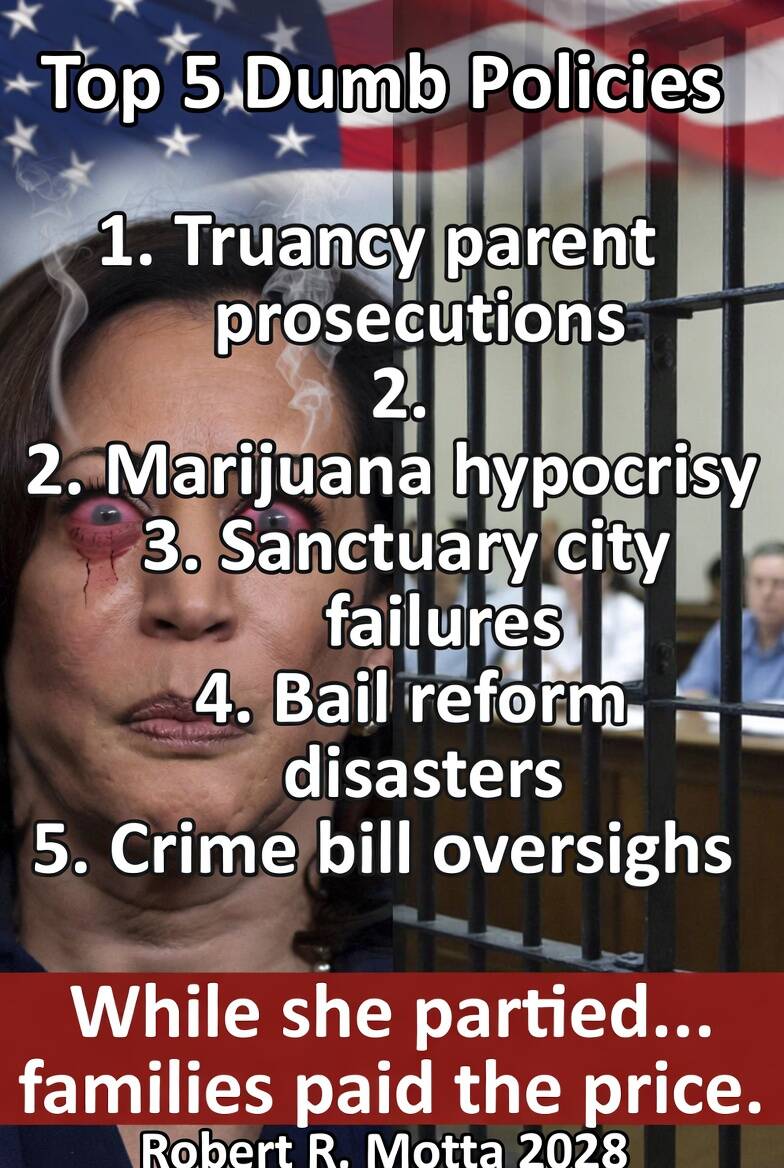
**✅ Fact-Checked Summary: Kamala Harris (Prosecutor + VP), Joe Biden, and Epstein Files**
**Prepared for Robert R. Motta 2028 Campaign – Voter Education Series**
**All claims sourced from government records, court data, and major fact-checkers (as of May 2026). No spin — just the record.**
### 1. Kamala Harris as Prosecutor (San Francisco DA 2004–2011 | California AG 2011–2017)
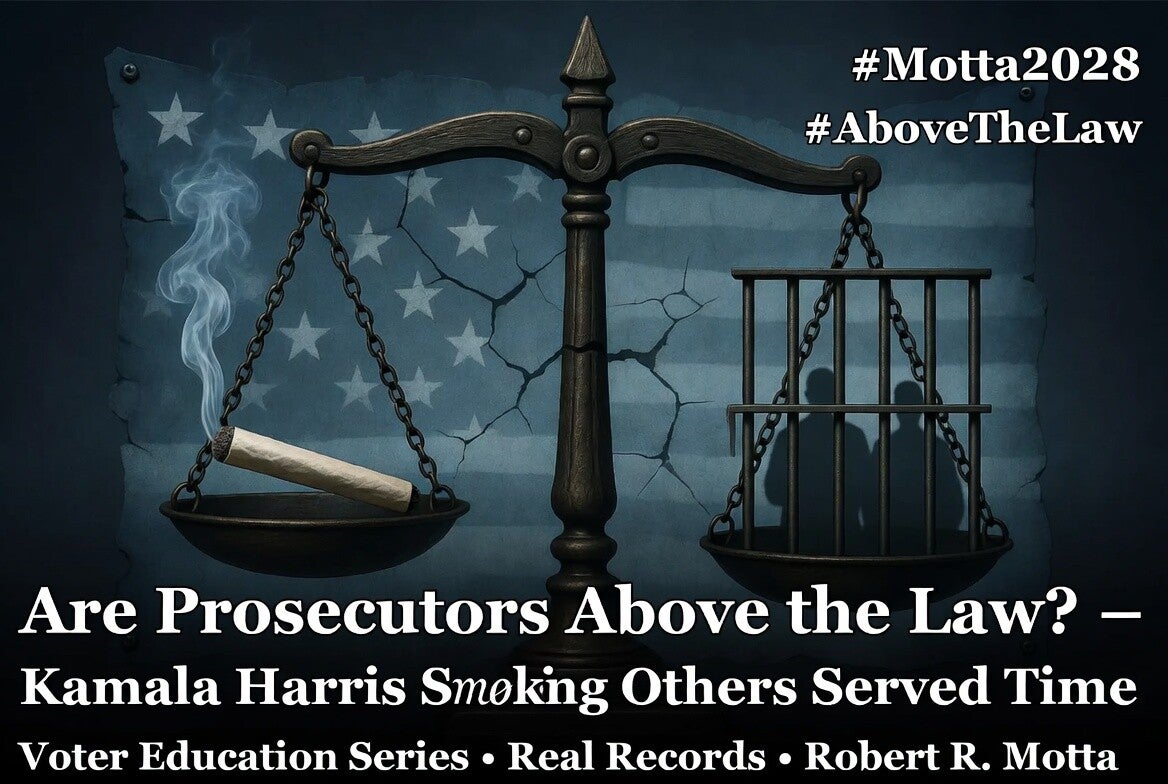
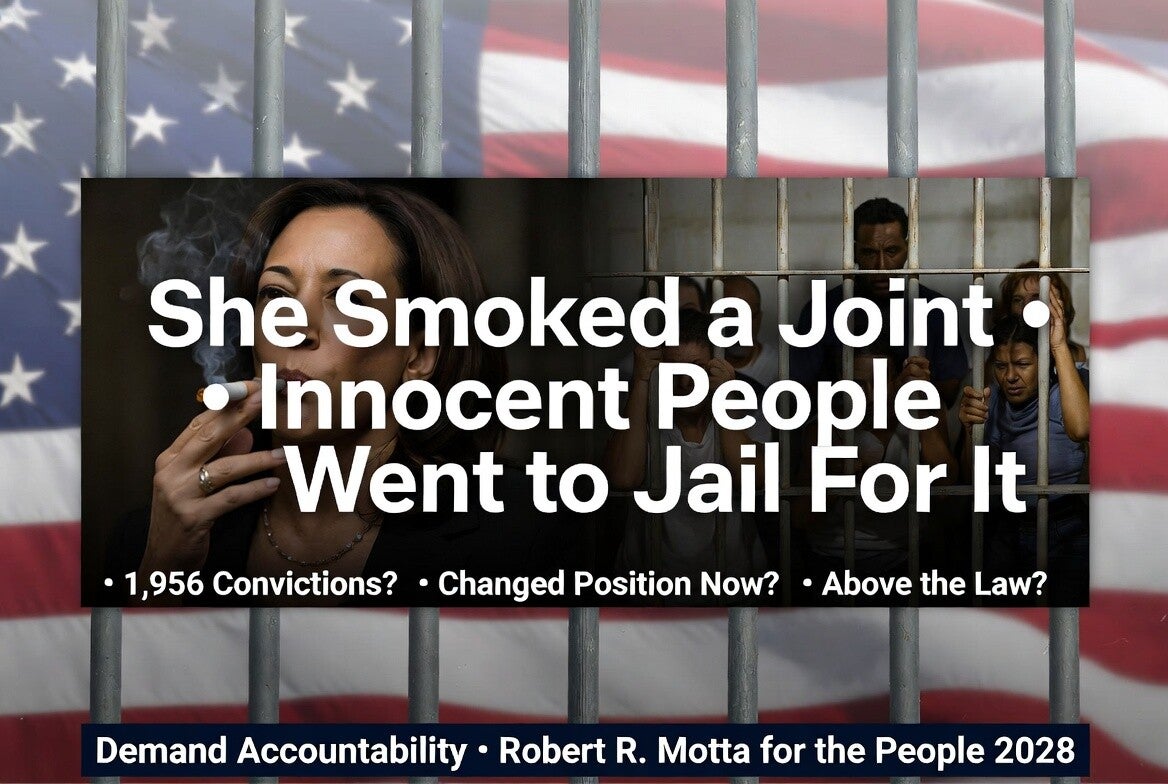
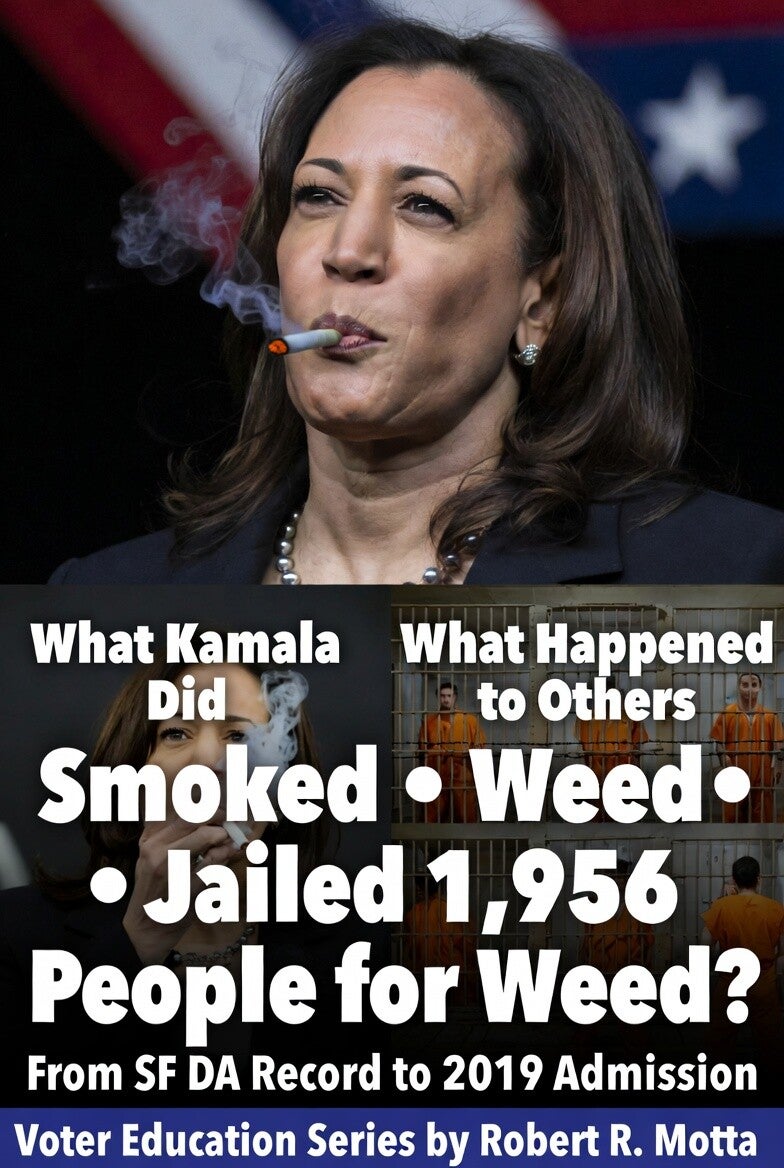
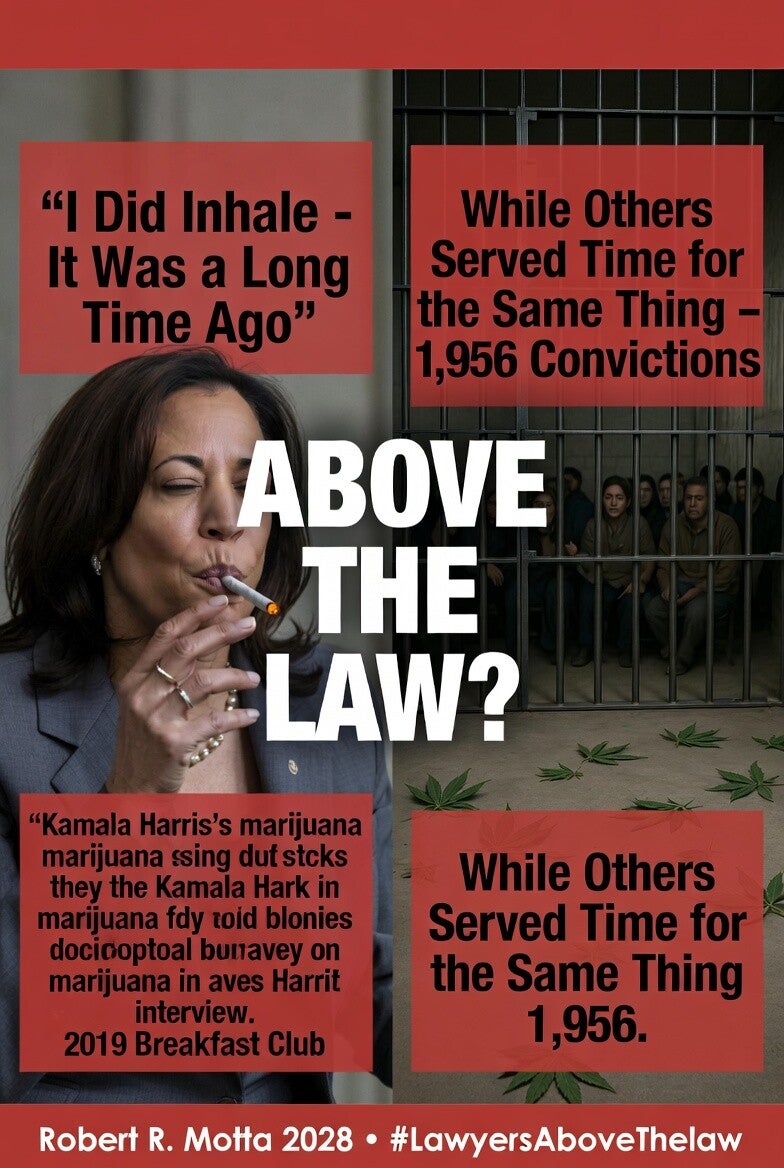
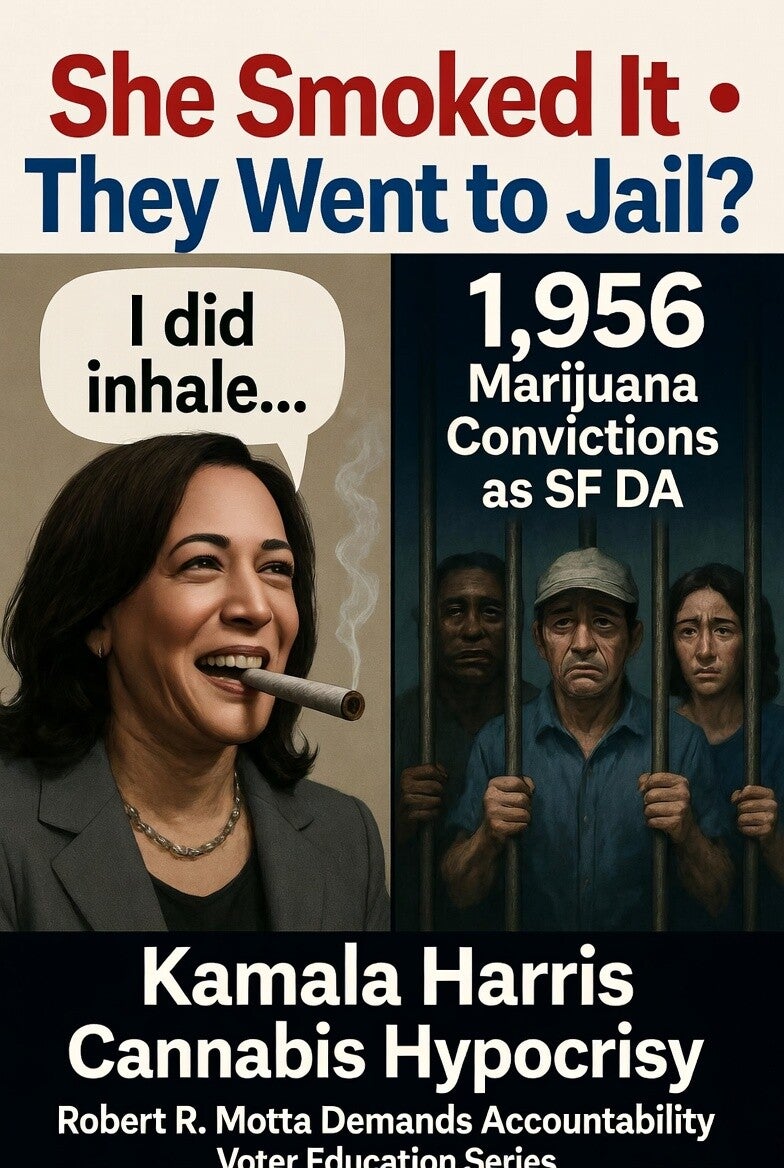
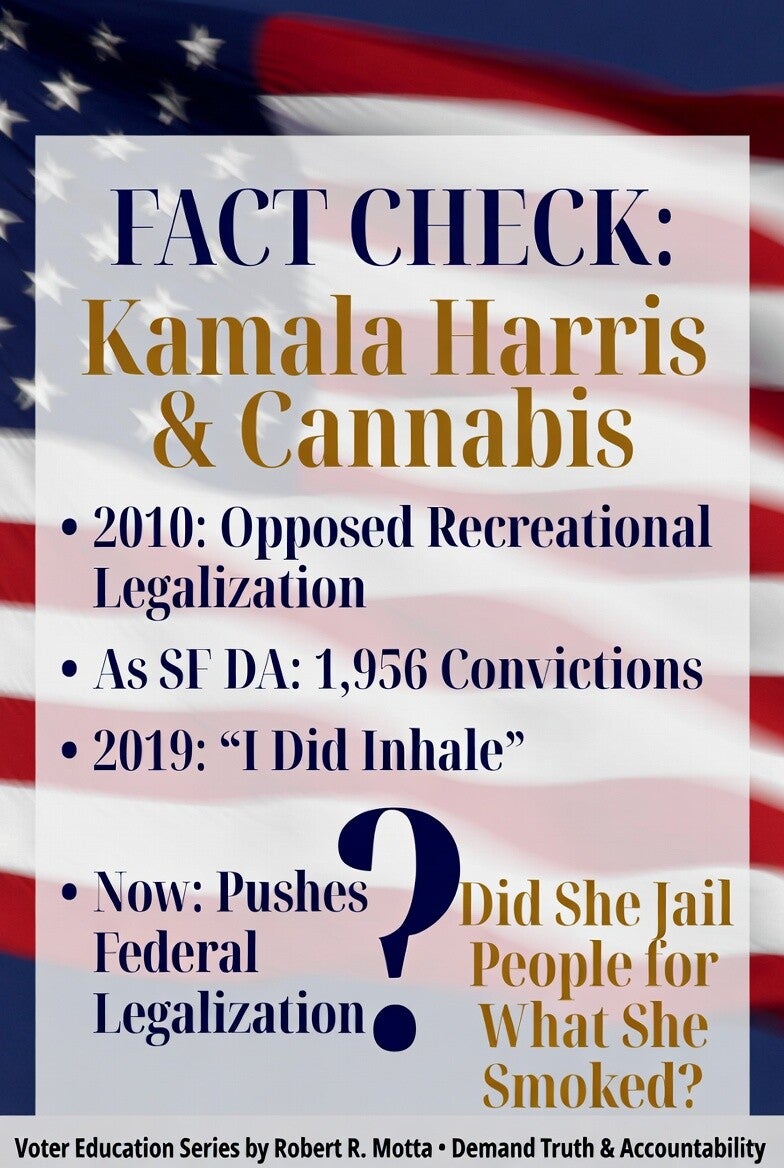
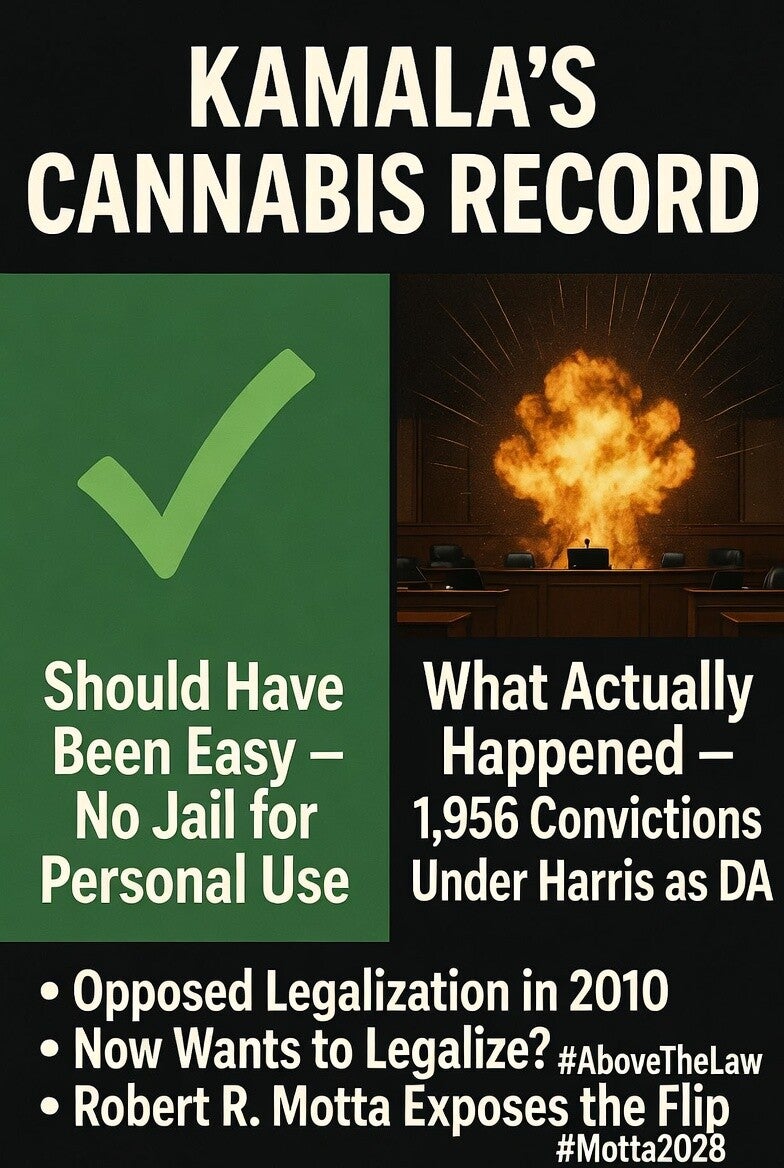
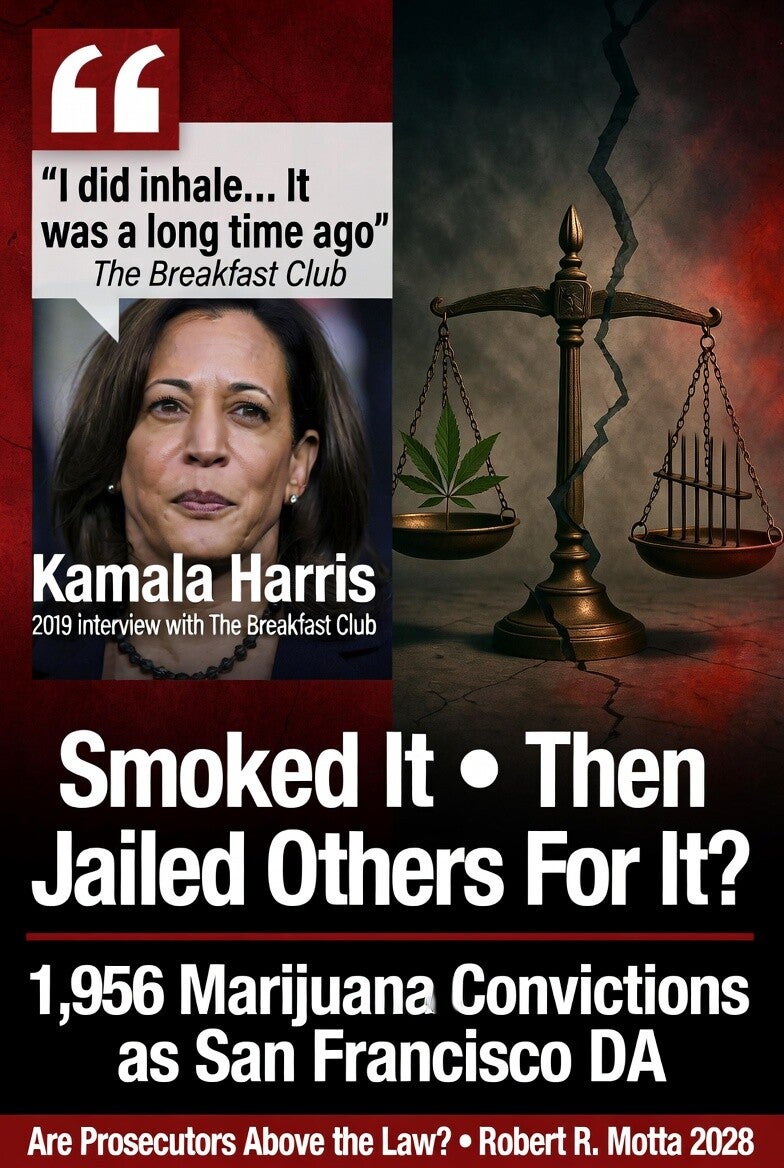
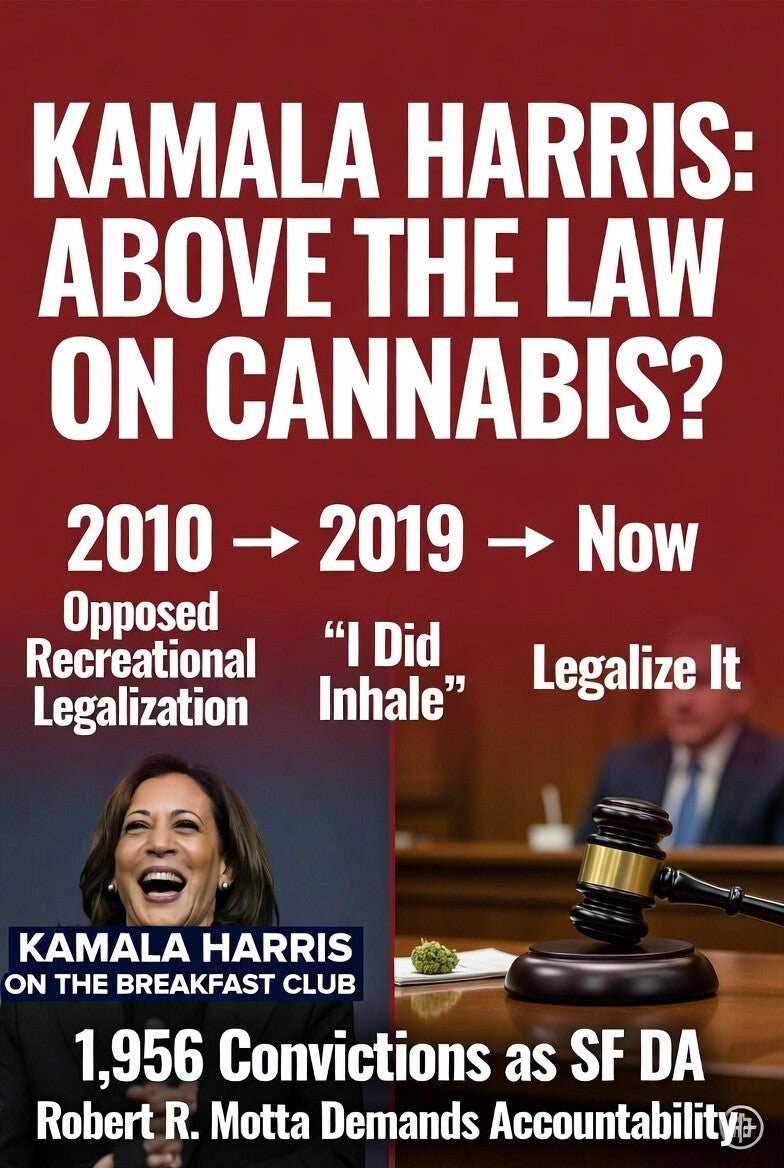
**Marijuana Prosecutions (the “1,956 jailed” claim):**
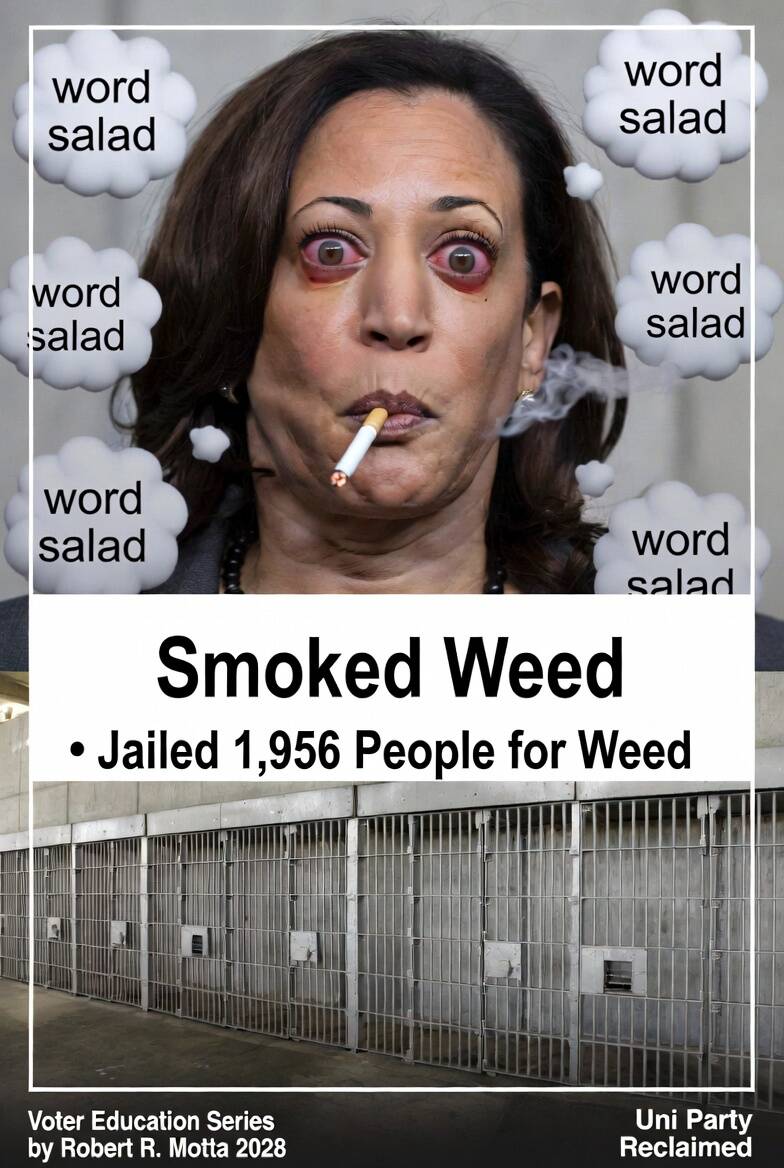
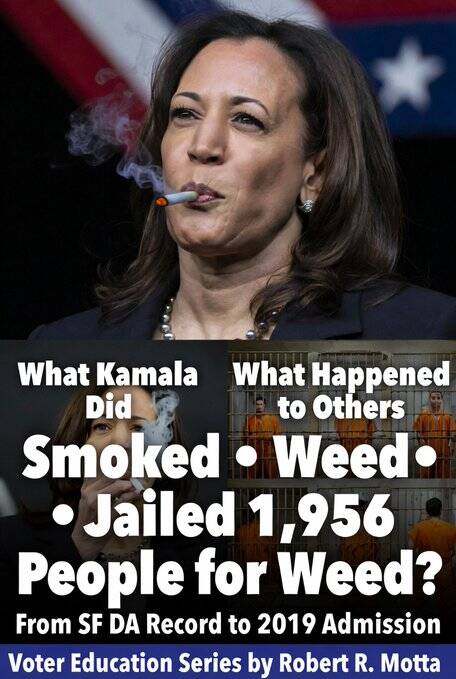
- As **SF DA**, her office oversaw **1,956 marijuana-related convictions** (misdemeanor + felony) from 2004–2010.
- Only **45** of those resulted in state prison time.
- Official policy under Harris: **no jail time for simple possession**. Most cases were reduced to misdemeanors or diverted.
- **Sources**: Mercury News investigation (2019), California Department of Corrections and Rehabilitation (CDCR) data, PolitiFact, FactCheck.org, AFP Fact Check.
As **CA AG**, state prison admissions for marijuana/hashish totaled ~1,974 (2011–2016). However:
- Most marijuana cases in California are prosecuted by **local county DAs**, **not** the Attorney General’s office.
- CDCR data does **not** break down by race — claims of “thousands of Black men jailed” are **misleading/exaggerated**.
- **Sources**: PolitiFact (2024), AFP Fact Check (2020), Washington Free Beacon correction (2019), CDCR reports.
**Sex Crimes & Child Trafficking:**
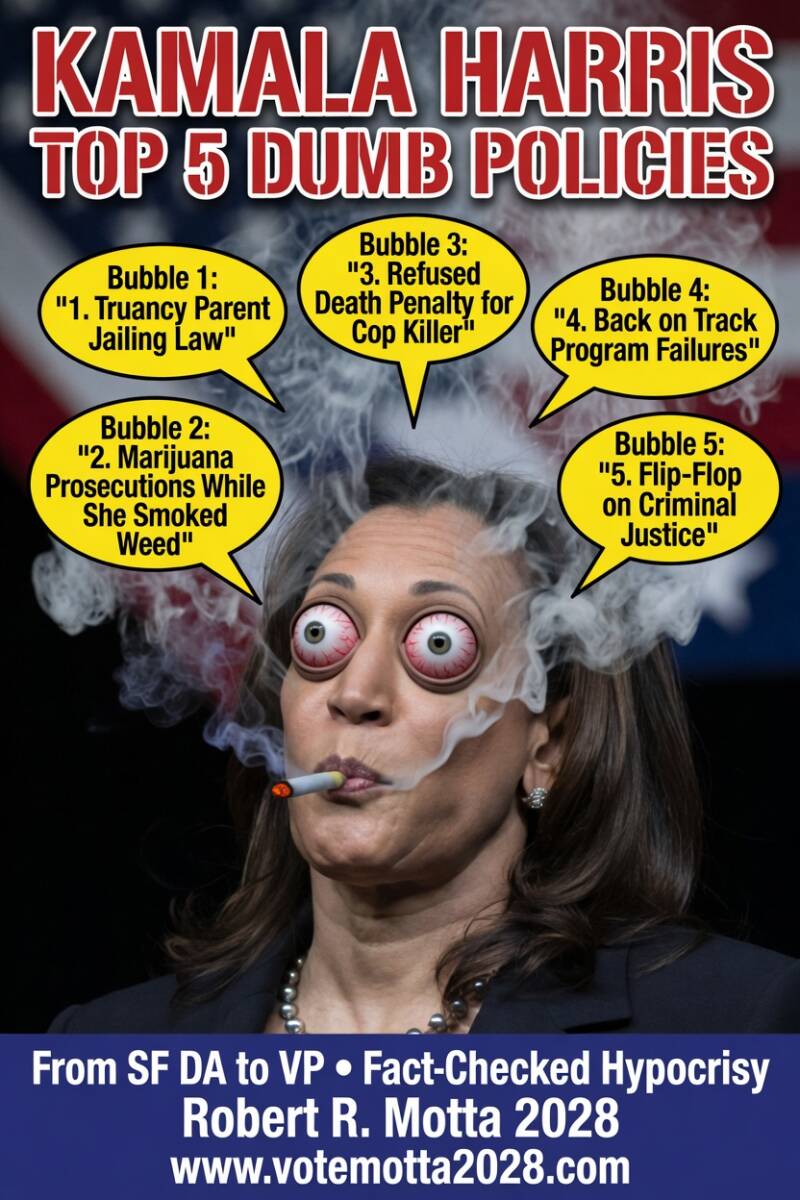
Harris prioritized these cases. She co-founded the Coalition to End Exploitation of Kids, created a human-trafficking task force for girls, and **stopped prosecuting underage trafficking victims as prostitutes** (treating them as victims instead). She also launched the Back on Track diversion program for non-violent offenders.
Some survivors and critics said her office didn’t go far enough in certain cases.
**Sources**: LA Times (2024), CalMatters, her own office reports, Vox (2024).
**Bottom line (fact-checked):** The viral “jailed 1,500–2,000 Black men for weed” meme is **misleading**. Harris was more progressive on marijuana than many DAs at the time, but still oversaw thousands of convictions under existing laws.
### 2. Kamala Harris & Joe Biden as VP/President (2021–2025) on Epstein Files
- The Biden-Harris administration **did not release** major new Epstein investigative files.
- They repeatedly cited **DOJ independence** and said they would not pressure the Justice Department.
- Former VP Harris defended this stance publicly in December 2025 interviews: “We absolutely adhered to that [separation], and it was right to do that.”
- No executive action or major legislative push from the White House to force full declassification during their term.
- The Epstein case remained an **open investigation** for much of the period.
**Sources**: The Hill (Feb 2026), Vox (Jul 2025), House Judiciary Committee documents (2025–2026), Kamala Harris interviews (Jimmy Kimmel/ABC, Dec 2025).
**Political ads & claims:**
Trump and Republicans repeatedly highlighted that “Democrats had 4 years and did nothing.” Democrats countered that some bipartisan bills existed but lacked full support until 2025.
### 3. Epstein Files Transparency Act & Releases (2025–2026)
- **Signed into law by President Trump on November 19, 2025** (H.R. 4405 – Epstein Files Transparency Act).
- Sponsored by Rep. Ro Khanna (D-CA) with bipartisan support (including Rep. Thomas Massie).
- Required DOJ to release **all unclassified records** related to Epstein in searchable format.
- DOJ released **millions of pages** in phases (first batch Dec 2025, major 3.5 million page release Jan 30, 2026, additional waves through March 2026).
- Some files heavily redacted; survivors and lawmakers on both sides criticized the pace and completeness.
**Sources**: Congress.gov (Public Law 119-38), DOJ official releases (2025–2026), Wikipedia legislative summary, White House statement (Nov 19, 2025).
**Survivor Perspectives:**
- Multiple Epstein survivors have publicly urged full, unredacted release regardless of administration.
- Some praised the 2025 Act; others criticized delays and redactions under **both** Trump and Biden-Harris eras.
**Sources**: NBC News (Nov 2025), CNN (Jan 2026), survivor statements in congressional hearings.
### Key Takeaway for Voters (Sourced & Neutral)
- **No administration** (Trump 1.0, Biden-Harris, or Trump 2.0) has delivered **complete, unredacted** transparency on day one.
- The **Epstein Files Transparency Act** was passed and signed **after** Biden-Harris left office.
- Kamala Harris’s prosecutor record shows real contradictions on marijuana and victim treatment — facts matter more than memes.
- Survivors continue demanding **full truth**, not political football.
**All primary sources cited above** (FactCheck.org, PolitiFact, Mercury News, CDCR data, Congress.gov, DOJ releases, The Hill, Vox, LA Times, etc.).
These facts are ready for your **“Uni Party — Reclaimed”** ads, social graphics, or voter education posts. Want me to turn any section into a ready-to-post meme, ad script, or infographic text? Just say the word.
**Truth. Accountability. America First.**
www.votemotta2028.com
In this video, journalist Katie Phang provides a behind-the-scenes look at the Donald J. Trump and Jeffrey Epstein Memorial Reading Room, a new exhibition in Tribeca that puts the partially redacted Epstein Files on public display (0:36-0:49).
Key takeaways from the exhibit:
- Tangible Evidence: The room houses 3,437 bound volumes of documents, totaling millions of pages, aimed at making the scale of this history visceral for visitors rather than keeping it behind a screen (1:18-2:52).
- Centering the Victims: A central tribute area features over a thousand candles, shifting the focus from the perpetrators to the survivors and honoring those affected by the trafficking ring (4:16-5:05, 15:21-15:40).
- Chronology and Context: The exhibition includes a wall-sized timeline comparing the chronologies of Jeffrey Epstein and Donald Trump to illustrate their intersections and the systemic power that allowed these crimes to remain largely unaddressed (5:32-7:49).
The Push for Transparency:
- Legal and Procedural Concerns: Phang discusses her lawsuit against the Department of Justice and criticizes the government's handling of the files, including the dangerous and illegal failure to protect victim identities in their initial release (0:11-0:18, 3:44-4:05, 8:08-8:26).
- Future Goals: While the current exhibit restricts public photography of the documents to prevent further re-traumatization of victims, the goal is to expand the project and potentially take this educational exhibition on the road to reach broader audiences across the country (8:31-9:11, 14:40-15:15).
Phang concludes by emphasizing that this exhibit serves as a form of "cage rattling" to demand accountability for the survivors who are living with the ongoing consequences of these events (16:39-17:10).
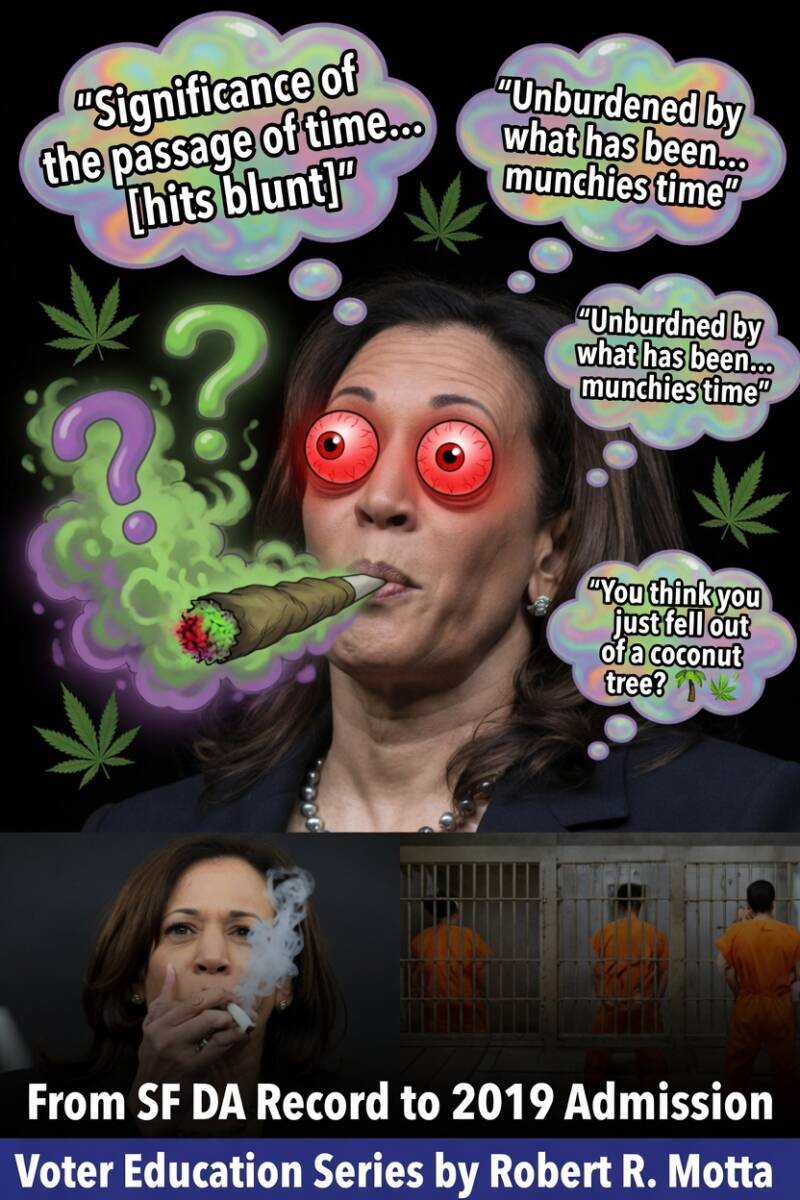


“Uni Party” — Reclaimed
Not left.
Not right.
Just Pro-America.
One nation focused on veterans, workers, farmers, families, borders, and freedom — without billionaire control or foreign influence.
This video features Dasha Burns interviewing former Congresswoman Marjorie Taylor Greene about her political evolution, her split from Donald Trump, and her critique of the current state of the GOP.
Key Takeaways:
- The Iran Conflict: Greene harshly criticizes President Trump’s handling of the war in Iran, labeling his rhetoric about destroying a civilization as "evil and madness" (2:07-2:10). She argues the war was unnecessary and suggests it was fought on behalf of Israel (2:36-3:08).
- Breakup with Trump: Greene details that her public fallout with the president was primarily driven by his opposition to releasing the Epstein files, with Trump allegedly claiming it would hurt his friends (16:20-16:31). She expresses disappointment that he has moved away from the "America First" principles she campaigned on (18:49-19:15).
- Future of the MAGA Movement: Greene views the current MAGA movement as fractured and warns that the "neocon" direction it has taken will not resonate with younger generations (32:55-33:06). She expresses support for JD Vance (10:31-11:22) but states she is not endorsing any 2028 candidate at this time (14:36-14:40).
- Midterm Predictions: She predicts that Republicans will be "slaughtered" in the midterms, citing a potential loss of both the House and the Senate (0:00-0:05, 33:16-33:32). She also points to a significant drop in Republican votes in her former district as a warning sign for future statewide races (34:16-35:06).
- Political Future: While she has retired from Congress, Greene remains active in the public discourse. She identifies more as an independent (39:01-39:03) and expresses a desire to build a new, cross-partisan political coalition focused on issues that directly impact American lives rather than traditional party politics (39:29-40:39).
Transcript
Chapter 1: Introduction
Chapter 2: Iran war/Israel
Chapter 3: JD Vance/2028
Chapter 4: Epstein files
Chapter 5: Breakup with Trump
Chapter 6: Evolution of MTG
Chapter 7: Future leader of MAGA
Chapter 8: Georgia races/midterms
Chapter 9: MTG's future
Chapter 10: Conclusion
This clip features Jack Mac discussing the darker side of political power, the influence of technology, and the future of AI-driven content. Here is a summary of the key themes discussed:
Political Power and Blackmail (0:00 - 5:13):
- The Cycle of Ambition: The speakers discuss how politicians often get trapped in cycles of power, where they feel obligated to continue advancing to higher positions regardless of wealth, potentially due to past actions or external leverage (0:00 - 1:29).
- Blackmail and Intelligence: The concept of political blackmail is explored, with the speakers questioning how prevalent it is. They touch upon the idea that intelligence agencies sometimes require disclosure of compromising information from political figures to preempt potential blackmail from adversaries (1:30 - 2:48).
- Alliances and Spying: The conversation shifts to global politics, with the speakers noting that even friendly nations often engage in mutual surveillance. They express skepticism toward the idea of a 'full-blown' ally, suggesting that every country is looking for strategic advantages (2:58 - 4:10).
AI and the Future of Content (5:14 - 9:28):
- Economic Anxiety: The speakers discuss the decline of the middle class and how rapid technological changes, specifically AI, are contributing to societal apathy and job insecurity (5:14 - 5:53).
- Content Creation and Authenticity: Jack Mac argues that while AI can replicate certain types of content, it struggles to replace personalities that offer unique, charismatic, and substantive communication. He suggests that audiences prioritize human connection and will likely lose interest once they realize content is AI-generated (6:42 - 8:36).
- The Role of Regulation: They debate the necessity of 'guardrails' and transparency requirements for AI-generated media, while simultaneously expressing doubt that Congress has the competence to regulate the technology effectively (8:50 - 9:28).
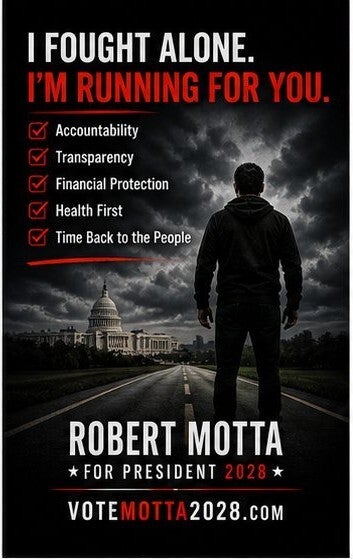
**OFFICIAL CAMPAIGN STATEMENT**
**Robert R. Motta for President 2028**
**FOR IMMEDIATE RELEASE**
**May 6, 2026**
**Joliet/Shorewood, Illinois**
To all Americans, to every voter — Democrat, Republican, Independent, and unaffiliated — and especially to our military veterans, active-duty service members, their families, and every survivor of trauma:
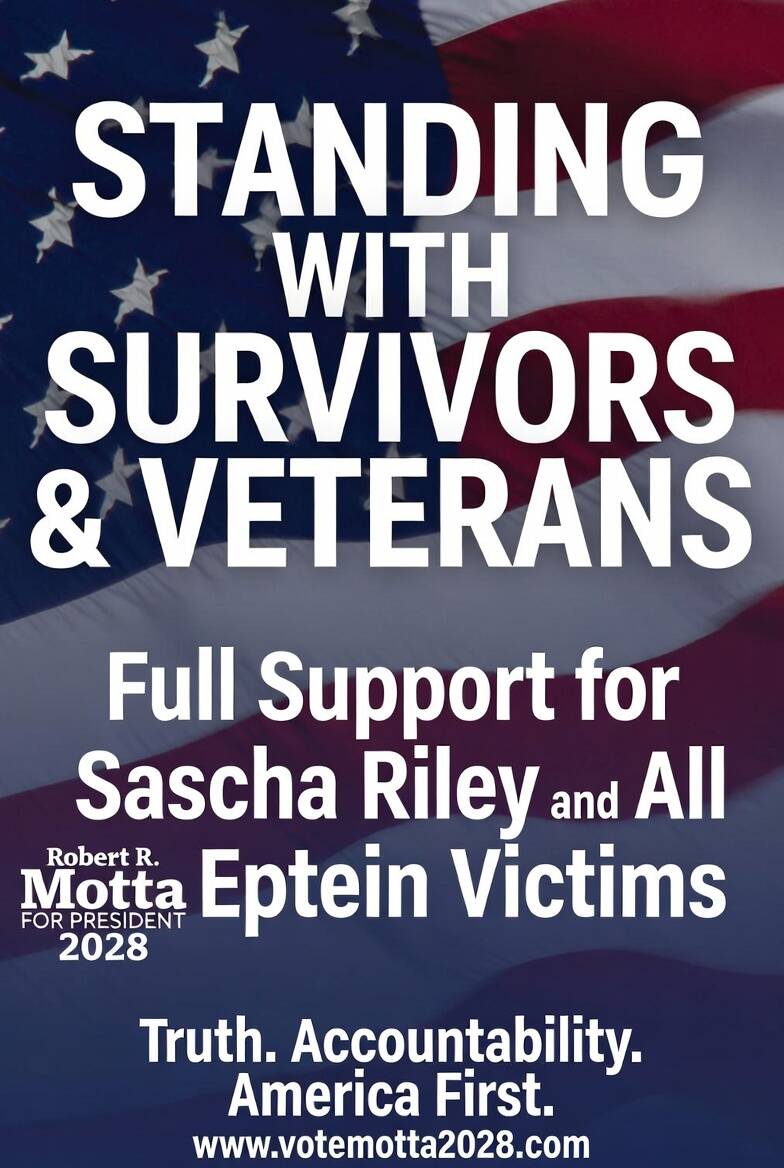
I speak to you today as a proud son of a U.S. Marine and a candidate who has never taken a single dollar from billionaires, corporations, or special interests. I stand unequivocally with **William “Sascha” Riley**, a decorated U.S. Army veteran who served our nation with honor for over 21 years, and with **every male and female survivor** of child trafficking, sexual exploitation, and abuse connected to Jeffrey Epstein’s network and similar elite operations.
Sascha Riley’s courageous testimony deserves to be heard in full, investigated thoroughly and independently, and met with real justice — not silence or cover-ups. To Sascha, to every survivor in uniform or out, and to every victim who has carried this burden alone: **you are not alone**. The Motta campaign stands with you without hesitation or reservation. Your voices will be amplified, protected, and honored.
I was not able to serve myself, but I come from a family that answered the call. My father, **Raymond E. Motta**, served in the United States Marine Corps during the Vietnam War and was awarded the Purple Heart for wounds received in combat. My uncle, **Louis Motta**, served in the U.S. Army Air Force and later dedicated years of his life to supporting veterans through his work connected to the VA system. Their service and sacrifice shape my deep commitment to those who wear the uniform and to those who bear the invisible scars of war and government service.
To every veteran reading this — whether you fought in combat theaters, endured toxic burn-pit exposures, battled Gulf War Illness, worked in classified programs at **Area 51** and other special-access sites, or continue to serve today — know this: **I have your six**.
In a Motta Administration, we will deliver:
- The immediate, complete, and unredacted release of **all** Jeffrey Epstein files, flight logs, client lists, and related intelligence records.
- Full, independent investigations into credible allegations of high-level child trafficking and abuse — with **no one**, regardless of political party, wealth, or position, above the law.
- Comprehensive, lifelong support, legal protections, mental health care, and restitution for all survivors of trafficking and sexual violence.
- Expanded VA healthcare, full benefits, and radical transparency for veterans suffering from toxic exposures, radiation, experimental chemicals, and the hidden costs of classified service — including Area 51 and other black-project veterans.
- Real accountability and improved care for the invisible wounds that so many carry home.
This is not a partisan issue. It is a moral imperative and a matter of national honor. The same system that has too often failed our veterans has also failed to protect our most vulnerable children. That ends when the American people take back their government.
To every American — from the heartland to the coasts, from the barracks to the voting booth — the era of elite impunity is over. Join us at **www.votemotta2028.com**. Stand with survivors. Honor our veterans. Demand full truth and accountability.
**Truth. Accountability. America First.**
**Robert R. Motta**
Independent Candidate for President of the United States
2028
**www.votemotta2028.com**
This video features a candid and deeply disturbing interview between William Sascha Riley, a survivor of severe child abuse, and interviewer Lisa Noelle Voldeng. Recorded on July 18, 2025, the conversation focuses on Riley's first-hand account of being a victim of a criminal network involving child trafficking, torture, and murder, which he alleges was orchestrated by Jeffrey Epstein and Donald Trump (1:43, 17:31, 1:14:14).
Key topics discussed include:
- Child Trafficking and Abuse: Riley describes a systematic pattern of abuse he experienced as a child, including being sold by his adoptive parents, William Kyle Riley and Mary Lynn Riley, to affluent individuals at various locations, including farms (14:58, 24:45, 33:01).
- Allegations Against Public Figures: Riley details encounters with Donald Trump, Jim Jordan, and Andy Biggs. He specifically recounts an incident involving Trump where he claims he caused significant injury to Trump in self-defense (24:45, 27:54, 46:48, 50:04).
- Military Involvement and Evidence: Riley discusses his time in the military, mentioning a 2008–2009 incident where he was questioned by his chain of command, specifically Michael Bis and Captain Kasanto, after child pornography was discovered on a fellow soldier's (Staff Sergeant Hable) computer that contained images of Riley (4:52, 6:44, 11:31, 13:06).
- Systemic Corruption and Fear: Riley explains the psychological and physical terror he faced, noting that his abusers attempted to keep him silent by forcing him to participate in abusive acts against others, which were then recorded as blackmail (36:44, 37:46, 46:11).
- Witnessing Atrocities: He provides accounts of witnessing the deaths of other victims, including a girl named Samantha and a man whose name he does not provide, and describes the cleaning of crime scenes (14:31, 111:57, 112:18, 112:38).
Throughout the interview, Voldeng emphasizes the importance of Riley's testimony for potential legal action through international courts and discusses the necessity of preserving his account as evidence (1:53, 2:53, 107:27).
This episode of the Julian Dorey Podcast covers a wide range of topics, primarily centered on an investigation into the death of Jeffrey Epstein, a recent JPMorgan lawsuit, and various personal updates from the show's team.
Epstein Investigation and Discovery Channel:
- Behind the Scenes: Julian Dorey discusses his participation in a Discovery Channel investigation regarding Jeffrey Epstein's death (3:14-8:00). He notes that while the final 41-minute edit was compressed from roughly 18 hours of filming, it maintained the integrity of the investigation (6:49-7:30).
- Cell Reconstruction: The team rebuilt Epstein's prison cell to examine inconsistencies in official reports (12:16-14:06, 18:40-20:00). Julian highlights revelations about the cell's physical layout, specifically an overlooked air vent/duct that could have facilitated an escape (30:49-31:45).
- Medical and Expert Insight: Former inmates like Bill Mersey (14:06-18:40) and a Chief Medical Examiner (45:07-47:20) provided perspectives that questioned the official suicide narrative.
- Kurt Metzger's Role: Comedian Kurt Metzger makes an unexpected appearance in the documentary, which Julian finds humorous and fitting (52:11-56:30).
JPMorgan Controversy:
- The Lawsuit: The hosts analyze a controversial JPMorgan lawsuit, which Julian and his team argue is largely fabricated (1:02:17-1:04:34). They detail the claims, including the alleged sexual harassment and inappropriate workplace behavior (1:09:25-1:18:10).
- Internal Findings: Julian emphasizes that JPMorgan conducted an internal investigation, reviewed phone and badge records, and ultimately stood by the accused executive, Lorna Hajini (1:03:15-1:04:30).
- Social Media Reaction: The episode touches on the viral memes and internet discourse surrounding the story, noting the bizarre nature of the allegations and the public's reaction (1:30:19-1:32:39).
Personal Updates and Other Topics:
- Joey Deef Leaving: The show begins with the announcement that Joey Deef is leaving the podcast to pursue a job at JPMorgan (0:00-1:46).
- Spirit Airlines: The hosts briefly discuss Spirit Airlines' bankruptcy (2:10-2:58).
**Updated Research-Based Campaign Content: “Has Your Lawyer Ever Worked Against You?” Series**
*(Fresh 2025-2026 Data)*
Robert R. Motta’s campaign is laser-focused on this question because **it hits every American** — from working families in Joliet/Shorewood, IL, to small businesses, Fortune 500 corporations, and even billionaires. The legal system is supposed to protect clients. Too often, lawyers work *against* them.
### Nationwide Research on Complaints Against Lawyers (2025-2026)
- **Tens of thousands of complaints filed every year**: The most comprehensive national data (ABA) shows ~83,000 grievances filed annually across reporting states. Individual states confirm the scale — California alone opened **over 21,000 cases** against attorneys in FY 2025.
- **Extremely low discipline rate**: Only about **0.23%** of America’s 1.37 million lawyers face public discipline each year. That means the vast majority of complaints go nowhere.
- **Access-to-justice crisis**: 74% of low-income households face civil legal problems yearly — **92% get inadequate or zero help** because lawyers are unaffordable or unavailable.
- **Public trust at historic lows**: Gallup’s 2025 Honesty & Ethics poll rates lawyers modestly **negative** (near the bottom with bankers and real estate agents). Only a small fraction of Americans view their ethics as “high/very high.”
These numbers prove the system is broken: complaints flood in, but accountability is rare. That creates the perfect environment for **sell-out lawyers** who prioritize billable hours, powerful connections, or their own interests over their clients.
### Top Issues by Category – How Lawyers Can Work Against You
**1. Average Americans (Working Families & Individuals)**
- Crushing legal costs price out most people ($300+/hour).
- 92% of civil legal problems go unhelped — housing, debt, family matters, contractor fraud (like the Jesus Aranda series).
- Lawyers sometimes delay cases, hide conflicts, or push settlements that benefit them more than the client.
- Result: Everyday people lose homes, savings, and justice while lawyers get paid.
**2. Small Businesses & Everyday Entrepreneurs**
- Contract disputes, employment issues, and regulatory fights are common.
- Many can’t afford prolonged litigation, so lawyers drag cases out or advise settlements that favor the other side (often bigger players).
- Sell-out behavior: Lawyers who represent both sides or have hidden ties to opposing counsel.
**3. Fortune 500 Corporations**
- Face massive regulatory, employment, AI/cyber, and contract litigation waves in 2026.
- Even they complain about “legal hell” — endless discovery games, activist shareholder suits, and skyrocketing defense costs.
- Some in-house teams report law firms prioritizing their own relationships over aggressive client defense.
- Advantage: They have deep pockets and can switch firms — something average Americans can’t do.
**4. Billionaires & Ultra-High-Net-Worth Individuals**
- They use sophisticated trusts, offshore structures, and elite firms to shield assets.
- But high-profile cases show even they get burned: lawyers with conflicts of interest, leaks, or deals that favor bigger political/corporate networks.
- Sell-out examples exist in the headlines — firms striking controversial deals or prioritizing access over client loyalty.
- Bottom line: Billionaires can fight back and replace lawyers. Average Americans cannot.
**Analysis**: The system is rigged in favor of those who can afford endless legal battles. **Sell-out lawyers** (those who work against their own clients through conflicts, delays, hidden agendas, or prioritizing the powerful) thrive because discipline is rare and clients often don’t know their rights. This is exactly why Robert R. Motta asks: **Has your lawyer ever acted against you — especially on voter education, campaigns, or exposing fraud?**
**Pro-America Campaign Message (Copy-Paste Ready)**
> Robert R. Motta has dedicated his campaign to exposing systemic failures in our legal system and empowering voters with the truth.
> **Has your lawyer ever worked against you?**
>
> Every year, Americans file **tens of thousands of complaints** against lawyers — yet public discipline stays stuck at ~0.23%. 92% of low-income civil legal problems go unhelped. Fortune 500 companies and billionaires game the system with armies of attorneys, while working families get sold out by the very people they hired for justice.
>
> From contractor fraud like Jesus Aranda to blocked voter education efforts, sell-out lawyers protect the powerful and leave average Americans powerless.
>
> **No loyalty to billionaires. No excuses for a broken legal system.**
> Pro-America means putting **you** — the voter, the family, the small business — first. Real accountability starts now.
Are Lawyers Above the Law? – The Series Every American Voter Needs to See
Robert R. Motta has dedicated his campaign to exposing systemic failures in our legal system and empowering voters with the truth. In this ongoing series we ask every American: Has your lawyer ever acted against you — especially when it comes to voter education and campaign efforts?
Top 5 Ways the Legal System Fails Average Americans
- Unaccountable self-regulation – Bars protect their own; discipline is rare despite thousands of complaints.
- Access-to-justice crisis – 92% of low-income legal problems go unhelped because lawyers cost $300+/hour.
- Record-low public trust – Courts and lawyers at historic lows in honesty/ethics polls.
- Favoritism to billionaires & corporations – Only the rich can afford the system; everyone else loses.
- Lawyers working against clients – Conflicts, delays, and sabotage happen far too often.
Pro-America Pledge – No Loyalty to Billionaires
Robert R. Motta puts working families first. We expose how the same broken system that allegedly lets contractors like Jesus Aranda commit fraud also lets lawyers shield the powerful, block voter education, and keep average Americans powerless.
No blind loyalty to Peter Thiel, Elon Musk, Jeff Bezos, or any billionaire network. Real reform means accountability for everyone — starting with the legal profession.
Watch the full series. Share the evidence. Demand a legal system that works for YOU.
Not affiliated with any official investigation • For public awareness and voter education only
Are Lawyers Above the Law? A Pro-America Campaign for Real Accountability
Robert R. Motta is exposing how the legal system fails average Americans while protecting corporations and billionaires.
Top 5 Issues Hurting Average Americans
- Government dysfunction and poor leadership
- Crushing cost of living (healthcare, housing, food)
- Economic anxiety and stagnant wages
- Immigration enforcement failures
- Crime, safety, and cultural divisions
How Corporations & Billionaires Game the Same System
- Policy influence via massive donations
- Legal barriers that block average victims
- Labor & cost advantages average families lack
- Scale that crushes small businesses
- Access to power that average Americans never see
No loyalty to billionaires. No excuses for a broken legal system.
Pro-America means putting working families first.
This video from LegalEagle details the firing of Attorney General Pam Bondi after 14 months in office, analyzing her controversial tenure and the broader implications for the Department of Justice (DOJ).
Key Highlights:
- Background and Appointment: Bondi, a former Florida Attorney General and lobbyist, was appointed following the collapsed nomination of Matt Gates. She was tasked with aligning the DOJ with Donald Trump's agenda (1:16-2:55).
- Systemic Changes at the DOJ: Upon taking office, Bondi refocused the department on immigration enforcement and political investigations while gutting other essential sections. The public integrity section was slashed, and the civil rights division was significantly reduced (3:30-4:22).
- Prosecutorial Decline: Under her leadership, the DOJ saw a record-breaking number of declined criminal cases—over 23,000 in the first six months—and essentially ceased enforcement of the Foreign Corrupt Practices Act (FCPA) (4:28-5:27).
- The Epstein Files Debacle: Bondi failed to satisfy the administration's political base regarding the Jeffrey Epstein documents. Despite her attempts to manage expectations and blame the FBI, the release of heavily redacted files and her combative performance before the House Judiciary Committee exacerbated the situation (7:50-11:42).
- Failed Investigations: Bondi oversaw numerous attempts to weaponize the DOJ against political enemies, including James Comey, Letitia James, and the Federal Reserve. Most of these cases were dismissed by courts or rejected by grand juries due to a lack of legal merit, leading to a massive loss of prestige and talent at the DOJ (12:08-17:08).
- Firing and Future Outlook: Trump eventually dismissed Bondi amidst concerns about the upcoming midterms and the unpopularity of the war in Iran. Despite her loyalty, she was replaced by Todd Blanch in an acting capacity, while other loyalists jockey for the permanent position. The video concludes that the systemic damage to the institution will likely persist regardless of who replaces her (17:11-23:31).
This video by Keith Edwards covers three primary topics: the leakage of private text messages from Stephen Miller, a critique of Representative April McClain Delaney’s voting record, and a follow-up discussion regarding Senator Susan Collins' health.
1. Stephen Miller’s Leaked Texts (0:00 - 8:54):
The host discusses private text messages shared by Ashley St. Clair (referred to as Elon Musk's ex-partner) that show Stephen Miller coordinating a campaign described as "White Boy Summer" or "The Kens Strike Back."
Edwards characterizes Miller as a "small, cringe person" who utilizes vitriol and anti-immigrant rhetoric (notably involving ICE) to gain political power. He argues that Miller's influence was only possible because some representatives provided the "permission structure" for his policies.
2. Representative April McClain Delaney’s Voting Record (1:03 - 4:42):
The host highlights concerns regarding Democrat April McClain Delaney (Maryland’s 6th District) for her past support of ICE and her vote in favor of the Laken Riley Act.
Edwards criticizes these actions, specifically noting that the Laken Riley Act potentially dilutes civil liberties by requiring detention without conviction.
He points out that while Delaney later changed her stance after facing a primary challenger, he believes voters must be diligent in identifying candidates who truly align with their values to ensure a "better Democratic party."
3. Follow-up on Senator Susan Collins (8:55 - 11:33):
Edwards touches on a previous report he made regarding Senator Susan Collins' health, specifically regarding physical shaking observed in a campaign ad.
He claims that after his initial video, mainstream outlets like The Daily Mail and The Daily Express began covering the speculation surrounding her health, emphasizing the impact that independent digital creators can have in highlighting issues that are otherwise ignored by traditional media.




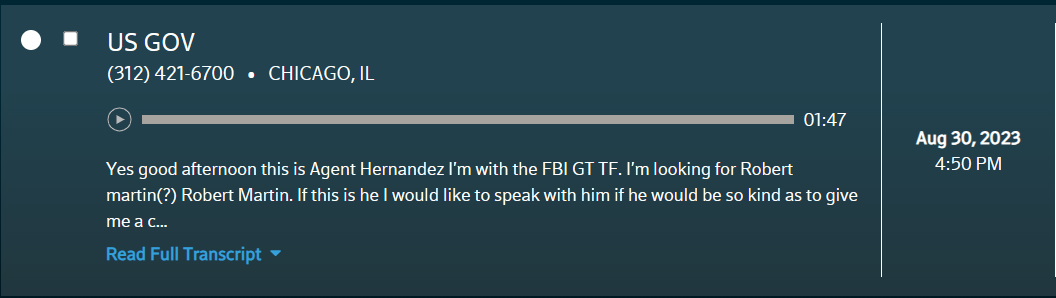


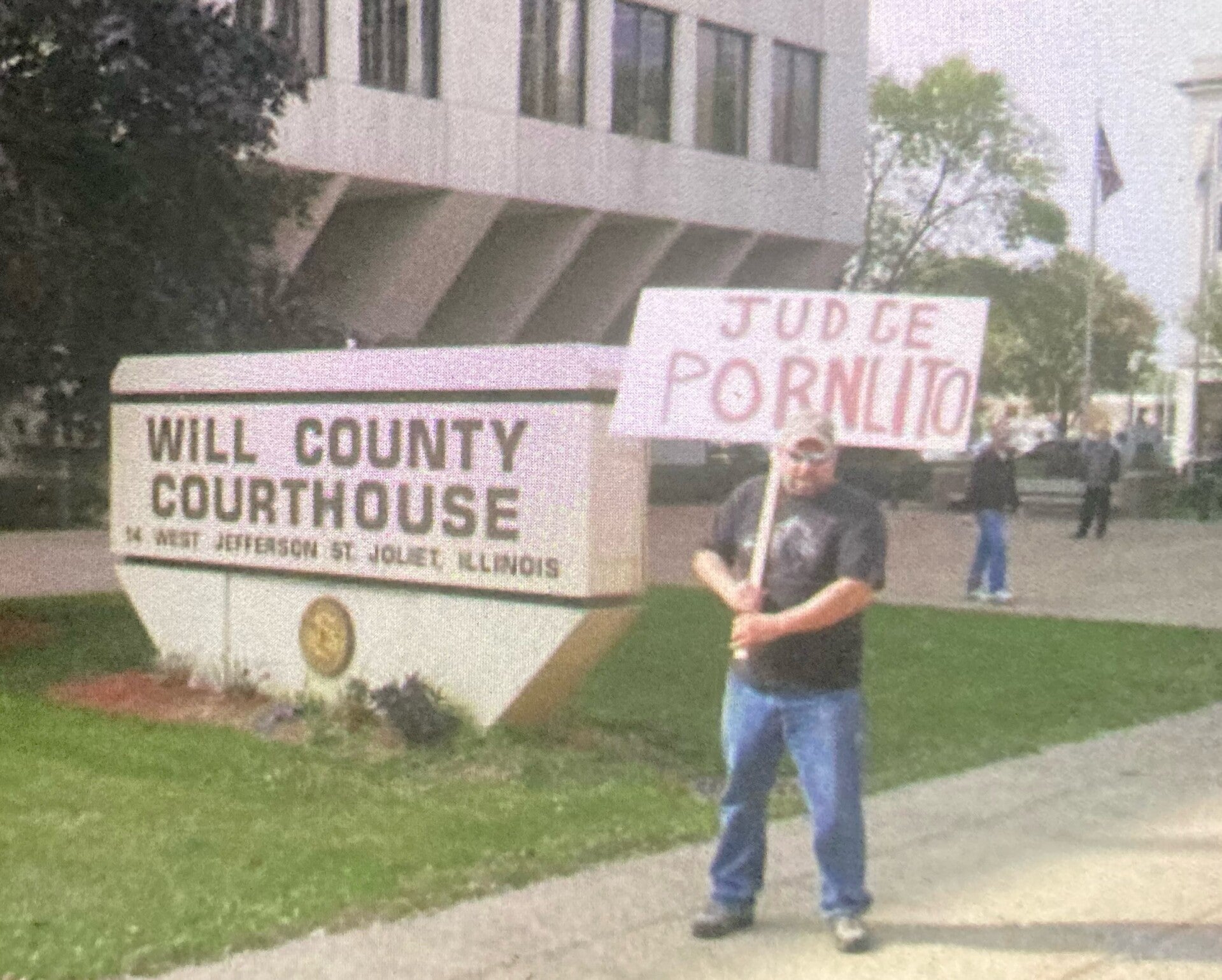



Jesus Aranda – Contractor Fraud & Theft Series
Caught on Camera • Evidence of Alleged Contractor Fraud, Theft & Related Issues
🔗 Copy/Share This Page


This video from The Damage Report discusses the viral conspiracy theory claiming that the Ghislaine Maxwell seen in a recently released prison deposition video is a body double.
Key takeaways from the discussion:
- The Conspiracy Theory: Online speculation has intensified after the US House Oversight Committee released footage of Maxwell invoking her Fifth Amendment rights repeatedly. Skeptics point to subtle differences in her facial features, particularly her nose, suggesting it looks "more pyramidal" than in previous archival photos (1:17-1:52).
- The Counter-Arguments: The hosts discuss logical reasons for her changed appearance, including:
- The natural effects of aging and the stress of prison life (4:33-4:44).
- Changes in lifestyle, such as potential weight gain from a carb-heavy prison diet or a lack of access to usual skincare routines (4:28-4:44, 5:08-5:15).
- Prison Conditions: The video notes that Maxwell is in a unique situation where both staff and inmates have reportedly been instructed not to disclose information about her, leading to increased public curiosity and distrust (2:26-3:23).
- Host Perspectives: While the hosts acknowledge the "double take" moment upon seeing the footage, they express skepticism about the body double theory, attributing the visual discrepancies to standard factors like lighting, aging, and personal health rather than a clandestine replacement (3:31-4:50).
Transcript
In this episode, Candace Owens discusses receiving a lawsuit from Brian Harpole, a member of Charlie Kirk’s security team, and addresses her ongoing investigation into the events surrounding Charlie Kirk’s death.
Key takeaways from the video:
- The Lawsuit: Candace details a 69-page lawsuit filed by Brian Harpole (1:22). She argues that many of the claims in the filing—such as the accusation that she defamed Harpole by suggesting there was no ambulance on standby or that she implied his complicity in an assassination—are inaccurate or misinterpret her commentary (3:30 - 12:40). She emphasizes that Harpole is a public figure and that she previously defended the security team against early conspiracy theories (15:32 - 18:41).
- The Strategy of the Lawsuit: Candace questions why Harpole would file a lawsuit now instead of reaching out to her directly or offering a retraction earlier, noting that she sent multiple messages to him for comment which went unanswered (21:48 - 25:57). She expresses her belief that this litigation might be a PR tactic to discredit the investigation, but notes that it may provide her with the power of subpoena to get answers from people like Erika Kirk and the Turning Point USA security team (34:30 - 38:24).
- Response to Erika Kirk: Candace responds to Erika Kirk’s public assertion that Candace accused her of murdering her husband (42:30). Candace unequivocally denies this claim and argues that her focus has always been on questioning the inconsistencies and narratives provided by those around Charlie Kirk (44:02 - 45:10).
- Political Context: The video also touches upon a bipartisan resolution introduced in Congress to condemn Candace (50:31), which she frames as an attempt to stifle her speech and her critical reporting on topics involving Israel and the Holocaust (51:40 - 54:55).
Candace reaffirms her commitment to pursuing the truth regarding the Charlie Kirk investigation and mentions that she is consulting with her husband on how to proceed with the legal challenge.
Transcript
Chapter 1: Start.
Chapter 2: Brian Harpole's lawsuit.
Chapter 3: Response to Erika and what I told her during our meeting that led me to look into TPUSA.
Chapter 4: Mike Lawler and Josh Gottheimer introduce a bipartisan resolution to condemn me.
Chapter 5: Final thoughts & comments.
**Are Lawyers Above the Law?**


Main Educational Themes for Voters
1. “Legal” Marijuana Is Often Only Partially Legal
The transcript repeatedly explains that:
-
marijuana may be legal under state law,
-
while remaining illegal under federal law under the Controlled Substances Act (21 U.S.C. § 812).
This creates:
-
confusion,
-
inconsistent enforcement,
-
unequal treatment across states,
-
selective prosecution risks.
Examples discussed:
-
Illinois → Indiana travel
-
Colorado national parks
-
airport/TSA conflicts
-
federal housing restrictions
The speaker argues many citizens mistakenly assume:
“legal in my state” = “safe everywhere”
but federal jurisdiction overrides state legalization in many locations.
Illinois Analysis
Illinois Marijuana Law
Illinois legalized recreational cannabis through:
-
the Illinois Cannabis Regulation and Tax Act
Illinois allows:
-
licensed dispensary sales,
-
limited possession,
-
regulated cultivation,
-
expungement pathways.
But the transcript correctly notes:
-
crossing into Indiana can immediately create criminal exposure,
-
federal property inside Illinois still follows federal prohibition.
Educational point for voters:
Illinois legalization does not erase:
-
federal criminal law,
-
employer restrictions,
-
DUI laws,
-
firearm restrictions,
-
child custody implications,
-
federal housing consequences.
Indiana Contrast
The transcript highlights Indiana as an example of a stricter state.
Educational issue:
A citizen can:
-
legally purchase cannabis in Illinois,
-
drive into Indiana,
-
become subject to criminal enforcement.
This demonstrates:
-
patchwork federalism,
-
interstate inconsistency,
-
legal uncertainty harming ordinary people.
For voter education, this becomes a policy question:
Should Congress create:
-
national legalization,
-
federal scheduling reform,
-
interstate transport protections,
-
uniform DUI standards?
DUI Metabolite Laws
One of the strongest legal points in the transcript concerns:
-
THC metabolites,
-
non-impairing residual compounds remaining in blood weeks later.
The Arizona Supreme Court example discussed in the transcript explains courts rejecting:
-
prosecution based solely on inactive metabolites.
Educational concern:
Some states still permit:
-
DUI charges without actual impairment.
This raises:
-
due process concerns,
-
scientific reliability issues,
-
unequal enforcement risks.
State-by-State Themes
States With Broader Legalization
Examples:
-
Illinois
-
Colorado
-
Nevada
-
Michigan
Common characteristics:
-
recreational legalization,
-
licensed dispensaries,
-
taxation systems,
-
some expungement reforms.
But even these states still face:
-
federal conflicts,
-
airport issues,
-
national park restrictions,
-
firearm-rights disputes.
Restrictive States
Examples referenced or implied:
-
Indiana
-
Arizona (historically strict DUI rules)
Risks discussed:
-
metabolite DUI charges,
-
possession criminalization,
-
aggressive roadside enforcement.
Federal Constitutional Issues
The transcript spends major time discussing:
-
Second Amendment rights,
-
cannabis users,
-
federal firearm prohibitions.
Referenced case:
-
United States v. Himmani
Core issue:
Can occasional marijuana use justify permanent firearm restrictions?
The discussion references:
-
Neil Gorsuch
-
Sonia Sotomayor
Educational takeaway:
The judiciary appears increasingly skeptical of:
-
broad federal restrictions,
-
vague definitions of “unlawful user,”
-
historical analogies unsupported by evidence.
Hemp / Delta-8 / Delta-9 Confusion
The transcript also explains the unintended effects of:
-
the 2018 Farm Bill,
-
hemp-derived cannabinoids,
-
Delta-8 THC.
Educational issue:
Consumers often believe:
“If it’s sold in a gas station, it must be legal.”
But:
-
legality varies by state,
-
laws change rapidly,
-
products may still trigger DUI or employment consequences.
This demonstrates how:
-
legislation written narrowly
can create: -
massive regulatory loopholes,
-
inconsistent enforcement,
-
consumer confusion.
Voter Education Perspective
For nonpartisan educational purposes, the transcript raises several legitimate public-policy questions:
Questions Voters May Ask
-
Should marijuana remain Schedule I federally?
-
Should DUI laws require proof of impairment?
-
Should federal firearm restrictions apply to cannabis users?
-
Should interstate cannabis transport protections exist?
-
Should federal law override state legalization?
-
Should expungement be automatic?
-
Should police rely on metabolite testing alone?
This episode of The Tim and April Show explores a serious civil lawsuit concerning allegations of child sexual abuse (CSA) and systemic cover-ups linked to Harvest Church and pastor Greg Laurie. Hosts Tim Whitaker and April Ajoy interview lawyers Dr. Ann Olivarius and Dr. Jef McAllister, who are representing 23 plaintiffs in this case.
Key Highlights of the Discussion:
- The Allegations: The lawsuit centers on Paul Havsgard, a pastor funded by Harvest Church to run orphanages in Romania between 1999 and 2008 (12:26-12:31). Survivors allege that Havsgard used these homes to subject them to severe physical abuse and sexual exploitation (8:14-8:29, 10:10-10:14).
- Church Culpability: Legal counsel argues that Harvest Church leadership, including Greg Laurie, received multiple reports of abuse beginning around 2004 (16:53-17:23). Despite an internal investigation in 2004 that confirmed the abuse, the church allegedly failed to report Havsgard to authorities, allowing him to continue his work for several more years before eventually providing him with a $200,000 severance package in 2008 (17:45-18:55).
- Legacy and Accountability: The lawyers emphasize that Harvest Church and Laurie have attempted to downplay the severity of the situation, characterizing the legal team as "celebrity lawyers" while maintaining a public stance of denial (24:02-24:29, 34:07-34:09).
- Current Status of the Case: The lawsuit is currently in the civil court system in California. Harvest Church is currently challenging the jurisdiction, attempting to have the case moved to Romania, which the plaintiffs' lawyers argue would likely lead to the dismissal of the claims due to statute of limitations issues (31:48-32:25).
The hosts conclude by highlighting the broader culture of silence often found in large evangelical institutions, emphasizing the importance of public awareness and the need for justice for the victims (37:09-38:06, 51:18-51:44).

**Are Lawyers Above the Law?**
**Are Lawyers Above the Law?**
**Voter Education Series – Entry: “Has Your Lawyer Ever Acted Against You by Working Against Your Voter Education and Campaign Content?”**
**Approved by Robert R. Motta**
**Prepared by the Press and Marketing Team**
Robert R. Motta has dedicated his campaign to exposing systemic failures in our legal system and empowering voters with the truth. In this ongoing “Are Lawyers Above the Law?” series, we ask a direct question every American voter should consider: Has your lawyer ever acted against you by working against your voter education and campaign efforts?
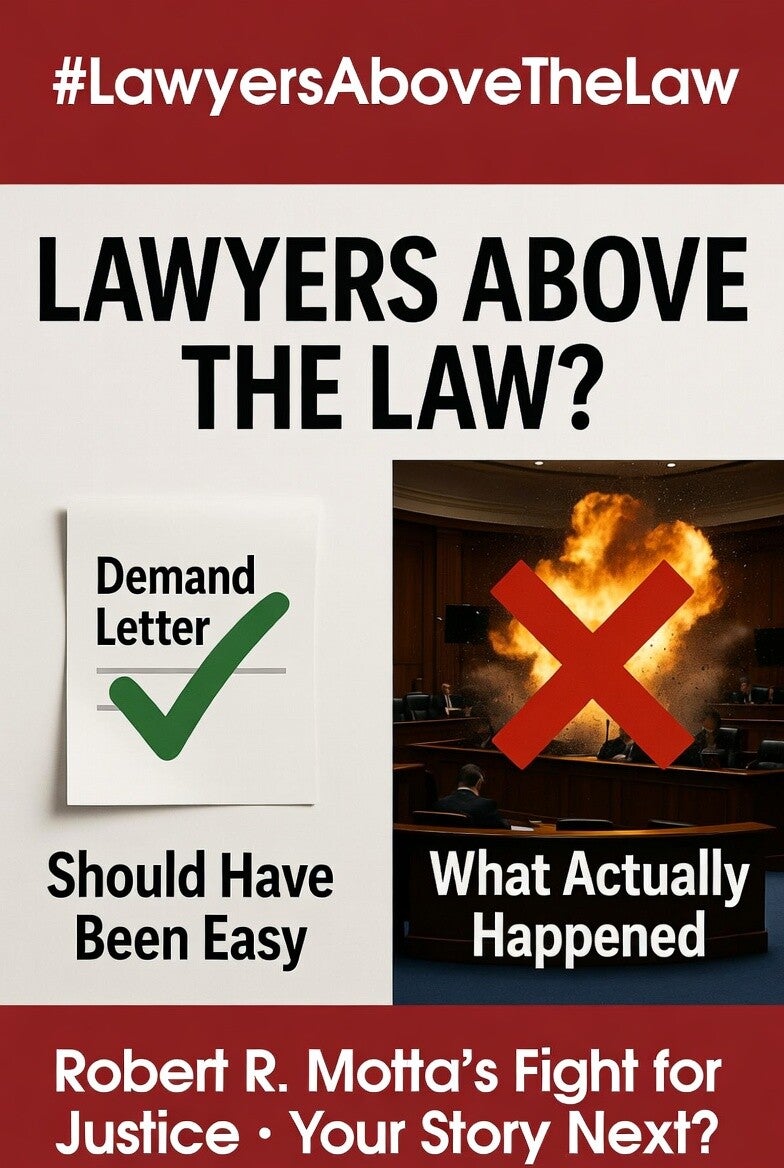
The answer, unfortunately, is yes for far too many citizens—including Robert R. Motta himself. What began as a straightforward car accident injury claim quickly became a textbook example of how some attorneys turn simple matters into unnecessarily complex, costly, and damaging proceedings. Robert retained counsel expecting competent, good-faith representation focused on out-of-court negotiations. Instead, the matter was transformed into prolonged litigation that breached the agreed scope of work, resulted in filing suit against the wrong party, and led to a dismissal for want of prosecution (DWP).
A timely demand letter to the insurance adjuster at Travelers Insurance (Claim IFX8179)—with a documented valuation of $46,500—could have resolved the case efficiently and professionally. That is standard practice for personal injury claims. Yet the chosen path ignored the retainer agreement, escalated costs dramatically (including demands for $500 per hour), and diverted critical time, energy, and resources away from Robert’s voter education initiatives and campaign activities. These actions did not serve the client; they worked against him. They stole momentum from the very efforts designed to inform and empower voters across Illinois and beyond.
This is not an isolated story. It is a pattern that raises a fundamental question for every voter: If lawyers sworn to uphold the Illinois Rules of Professional Conduct (including competence, diligence, and honesty under Rules 1.1, 1.3, and 8.4) can act in ways that harm their clients’ broader public service work, who is holding them accountable? When legal professionals prioritize billable hours or procedural complexity over their client’s best interests—and in doing so undermine a candidate’s ability to educate voters—what recourse exists?
Robert R. Motta’s experience with this case (Will County 2022LA332) is documented in public court records and serves as a cautionary tale. It illustrates how malpractice and breaches of contract do not just cost individuals money and time—they can actively sabotage civic participation and voter education campaigns.
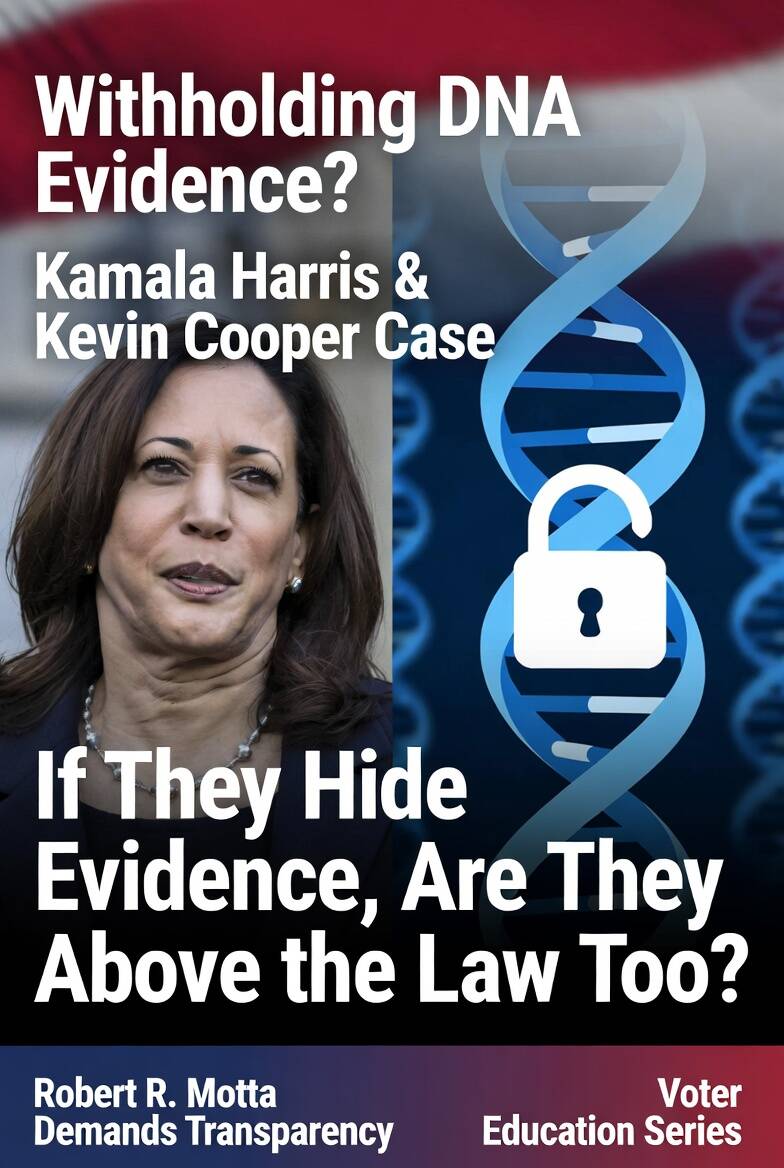
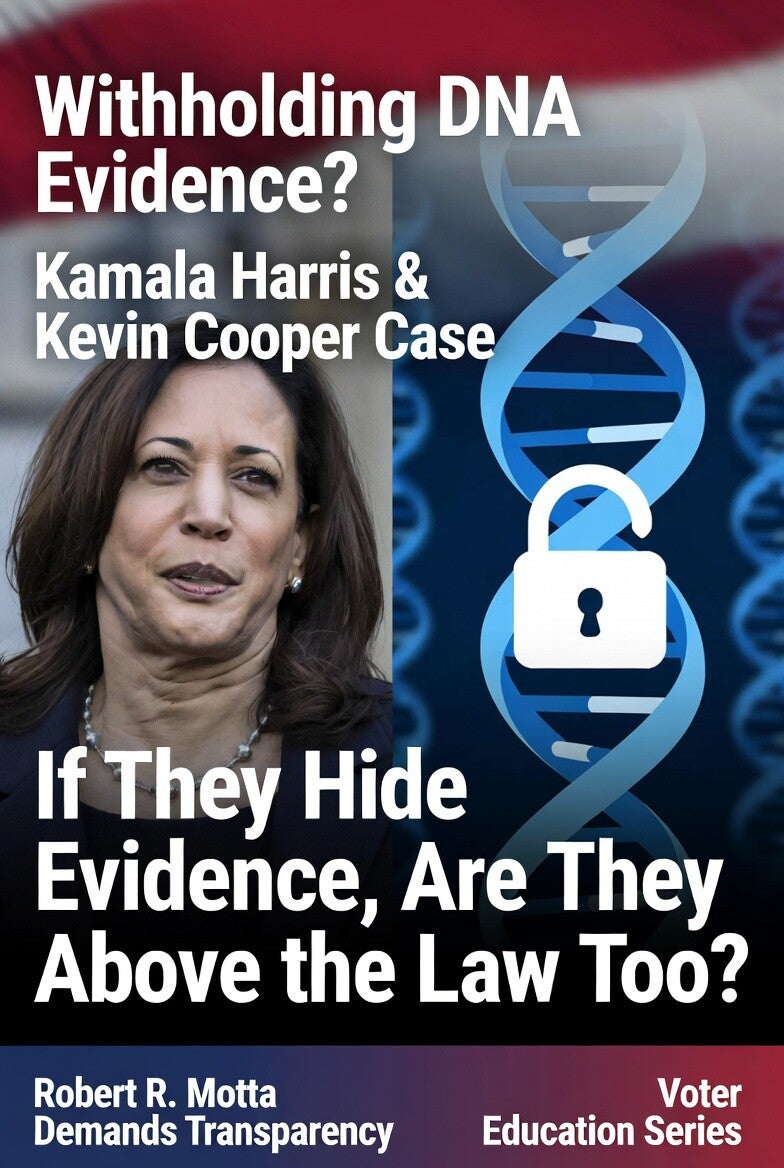
**High-Profile Parallel: Public Officials, Prosecutors, and the Handling of DNA Evidence**
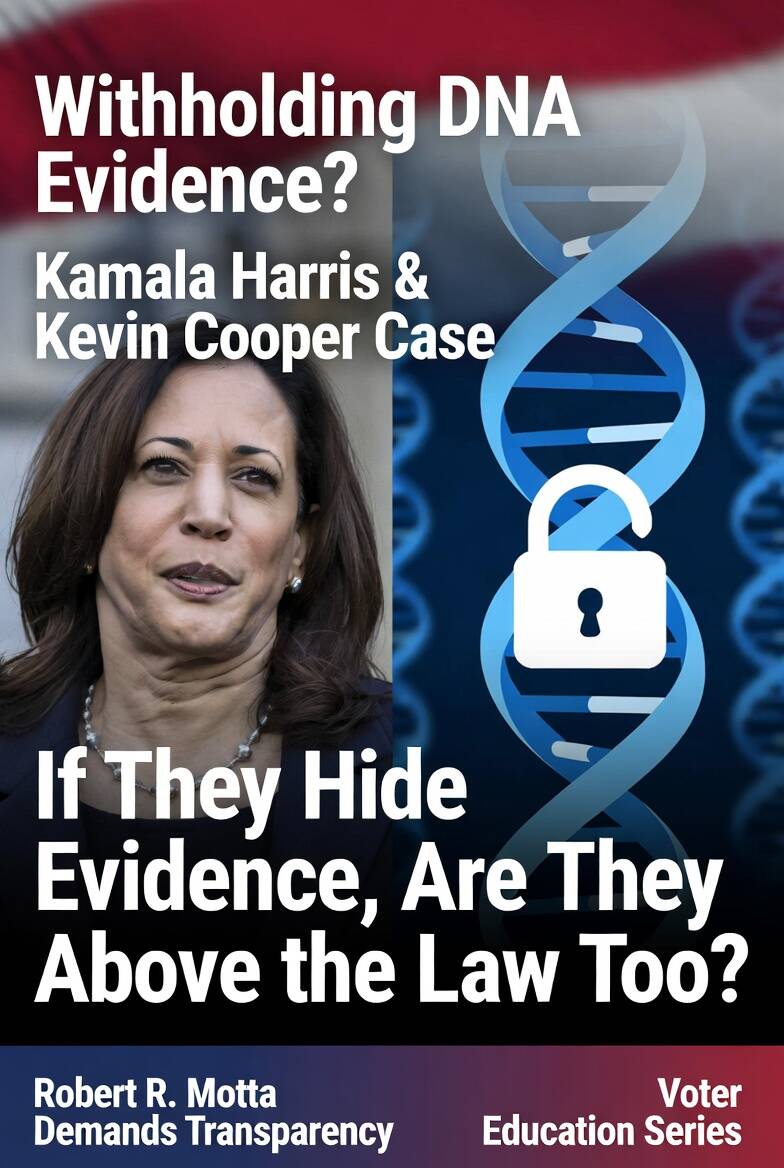
The same principles of accountability apply at the highest levels of government. Consider the well-documented case involving former California Attorney General (and later Vice President) Kamala Harris and post-conviction DNA evidence in the Kevin Cooper death-row matter. Here is a clear-eyed fact-check drawn from five major sources:
1. **New York Times (Nicholas Kristof op-ed, May 17, 2018)**: As Attorney General, Harris’s office refused advanced DNA testing on evidence that Cooper’s legal team argued could prove his innocence in the 1983 quadruple murder case. Kristof described this as part of a broader failure by political leaders to correct potential miscarriages of justice.
2. **Sacramento Bee (July 31, 2019)**: During the 2019 Democratic debates, critics (including Tulsi Gabbard) stated that Harris “blocked evidence that would have freed an innocent man.” The Bee confirmed Harris opposed the testing as AG but later supported it after public attention. Testing results at that time remained pending, and Cooper’s innocence had not been conclusively established.
3. **Washington Post (March 6, 2019)**: In a separate but related matter from Harris’s time as San Francisco District Attorney, her office faced criticism for failing to promptly disclose exculpatory information about a crime lab technician who tampered with drug evidence. This led to the dismissal of hundreds of cases and a judicial rebuke for withholding material that should have been turned over under Brady rules.
4. **Mercury News (August 1, 2019 debate fact-check)**: Harris’s office did block DNA testing requests in the Cooper case. Only after a New York Times investigation and public pressure did she reverse course and support further testing.
5. **San Bernardino County District Attorney’s Office / State-Commissioned Report (2023–2024 updates, as referenced in multiple outlets including The Marshall Project, July 27, 2024)**: Advanced DNA testing ultimately proceeded under Governor Newsom. The comprehensive review concluded that the evidence of Cooper’s guilt was “extensive and conclusive.” Harris has maintained she acted in accordance with her duty to defend the state’s convictions unless they lacked factual or legal basis.
These records show a pattern: opposition to post-conviction DNA testing as AG, delayed or incomplete disclosures during her DA tenure, and later reversals after media scrutiny—followed by final testing that supported the original conviction. Harris also announced in 2012 that her office had cleared a longstanding DNA analysis backlog at state labs. The facts do not support claims of personally “hiding” trial evidence but do highlight aggressive defense of convictions and office-level disclosure failures that critics argue delayed justice.
**Questions for Voters**
As we continue this “Are Lawyers Above the Law?” series, Robert R. Motta asks every voter to reflect:
- Has your lawyer (or any public official in the legal system) ever acted against your interests, delayed justice, or complicated simple matters for their own benefit?
- Should prosecutors and elected officials who control access to DNA and other evidence be held to the same standards of transparency and diligence they demand from everyday citizens?
- When legal professionals—whether in private practice or government—work against a client’s or the public’s right to truth and accountability, what real consequences follow?
- In your view, does opposing or delaying DNA testing in high-stakes cases protect the system… or protect those in power?
Your answers matter. Share your experiences. Demand accountability. Robert R. Motta’s campaign will keep shining a light on these issues so voters can make informed decisions in 2028 and beyond.
**Stay tuned for the next installment in the “Are Lawyers Above the Law?” voter education series.**
**Approved by Robert R. Motta – Press and Marketing Team**
**Robert R. Motta for the People**

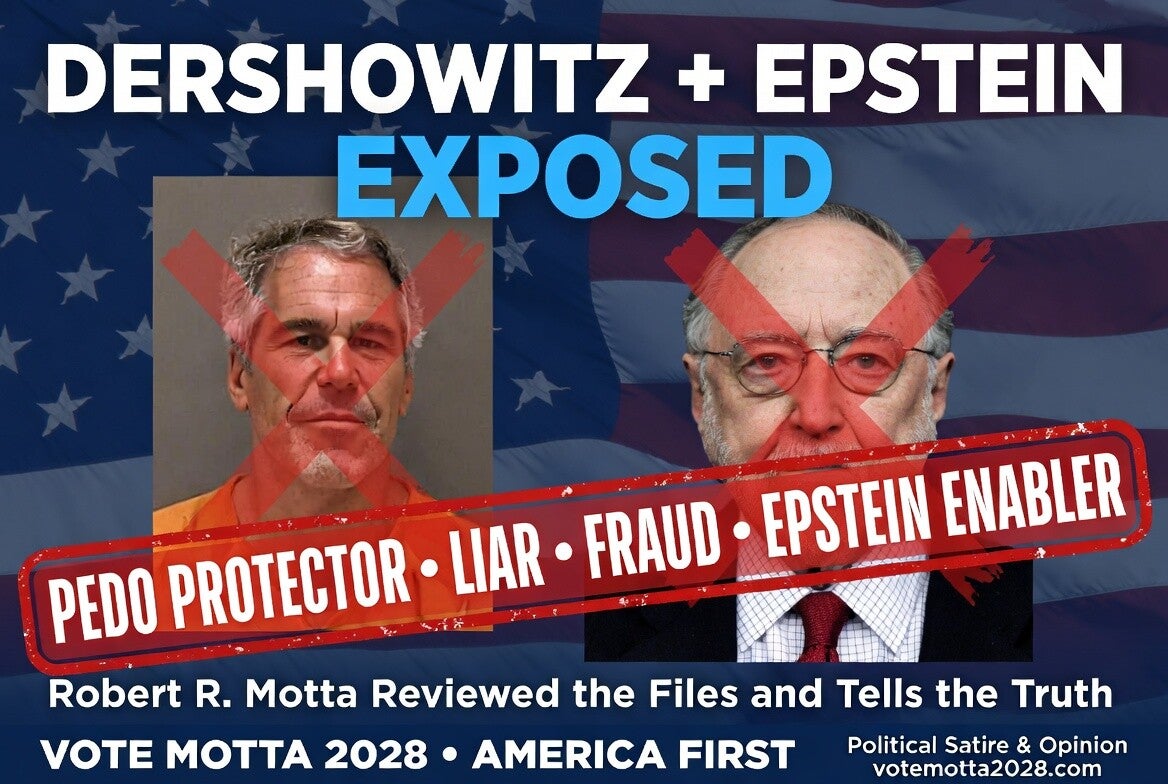
Dershowitz
**Dershowitz: Why I Left the Democrats & What Epstein Told Me About Trump**
*Political Satire and Personal Opinion by Robert R. Motta*
*votemotta2028.com*
Look, I sat down and actually dug through **tons of the publicly released Epstein files, court documents, flight logs, videos, and depositions** — the stuff that’s out there for anyone to review. And then I watched Alan Dershowitz’s latest interview where he proudly explains why he bailed on the Democrats and spills what Jeffrey Epstein supposedly told him about Donald Trump.
In **my opinion**, after reviewing all that material, Alan Dershowitz comes across as one of the most disgusting, embarrassing figures in the legal world today.
Here’s a guy who spent decades as a high-profile Harvard law professor and celebrity attorney, yet in my view he’s turned into the ultimate example of everything wrong with the system: a walking, talking embarrassment to the legal profession. He defends the indefensible, flips parties when it suits him, and now wants us to believe he’s some kind of truth-teller about Epstein and Trump. Give me a break.
Dershowitz wants credit for “leaving the Democrats” because they supposedly went too far left on Israel. Fine — people change parties. But let’s be real. In my opinion, after seeing the Epstein files, the man who once represented Jeffrey Epstein and helped craft that sweetheart 2008 non-prosecution deal has zero credibility when he starts lecturing the rest of us about morality, politics, or who Epstein did or didn’t have “dirt” on.
He claims Epstein told him Trump was clean as a whistle. He even says Epstein “wasn’t a pedophile.” After everything that’s come out in the public record? In my opinion, that’s not just spin — it’s the kind of gaslighting that makes your stomach turn.
To me, Dershowitz represents the worst of the elite legal class: a guy who knows every loophole, every powerful connection, and uses them to protect the powerful while the rest of us are told to trust the system. He’s been accused of serious misconduct tied to the Epstein circle (accusations he denies and that were later dropped), yet he keeps popping up on TV acting like the wise elder statesman. In my opinion, after reviewing the files and videos, he looks less like a principled lawyer and more like a professional protector of the very people the public has lost faith in.
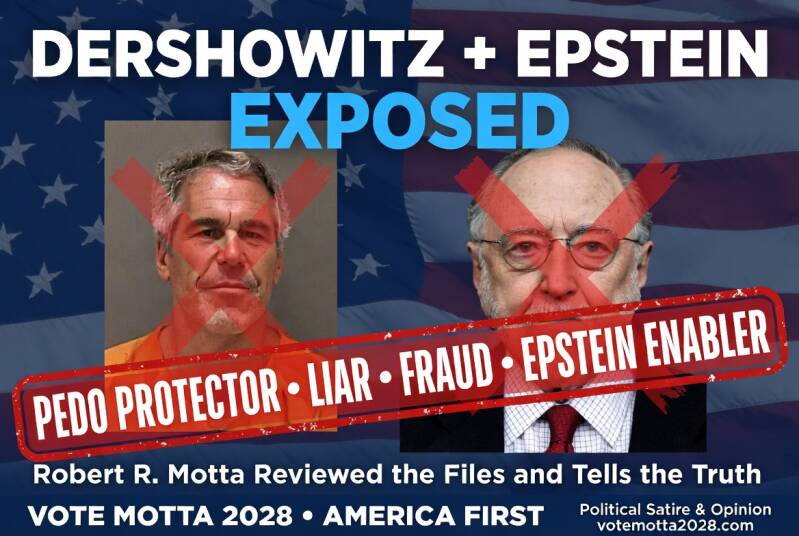
This is political satire, folks — my raw, unfiltered take as a regular guy from Illinois who’s tired of the same insiders playing both sides of the aisle while real Americans suffer. I’m not a lawyer. I’m not a professor. I’m just Robert R. Motta, and after looking at the public Epstein evidence with my own eyes, I find Dershowitz’s whole performance **disgusting**. A liar. A fraud. An absolute embarrassment to anyone who still believes the legal profession should stand for justice instead of connections.
If this is the guy lecturing us about why he left the Democrats and what Epstein supposedly said about Trump, then maybe it’s time we all stop listening to the insiders and start demanding real accountability.
That’s my opinion. You can agree or disagree — but you can’t unsee what’s in those files.
**Robert R. Motta**
**votemotta2028.com**
*Satire. Opinion. No legal advice. Just one American’s honest review of the public record.*
**Dershowitz Transcript Exposed: Numbered Lies I Oppose + Why This Guy Is a Criminal, Disgusting Pedo Protector, Liar, Fraud & Total Embarrassment to Lawyers**
*Political Satire and Personal Opinion by Robert R. Motta*
*votemotta2028.com*
I just sat through the entire transcript of Alan Dershowitz on that podcast (the one where he brags about ditching the Democrats, spills what Epstein supposedly told him about Trump, and acts like he’s the last honest man in America). After reviewing **tons of the publicly released Epstein files, flight logs, videos, court docs, and depositions** — just like any regular guy from Illinois can do — here’s my raw, unfiltered take.
In **my opinion**, this transcript is a masterclass in gaslighting. Dershowitz is still out here defending the indefensible while pretending he’s a victim of “cancellation.” I oppose every single word of it. Below I’ve numbered the biggest lies I spot in the transcript — the ones that make my blood boil because they contradict the public Epstein record, common sense, and basic decency. These aren’t “opinions” — they’re the exact spots where the guy is lying through his teeth.
**Lie #1** (around 50:59): He says “Jeffrey Epstein… I regret defending. I wish I had never met him” — then immediately spends the next 10+ minutes **downplaying** Epstein’s crimes, claiming most “victims” were repeat $250 massage girls who came back voluntarily, that there was “no trafficking,” “no blackmail,” and “no real pedophiles” in the circle. Bull. Public files show a massive underage sex trafficking operation. This is classic pedo-protector talk.
**Lie #2** (around 59:35): “He was not a pedophile… I have no information about any pedophiles in the Epstein circle… He was interested in 16, 17, 18 year olds.” In my opinion, this is disgusting. Epstein’s own files, victim statements, and the plea deal Dershowitz helped craft prove the man preyed on minors. Calling it “not pedophilia” because they weren’t prepubescent is lawyer-speak sleaze.
**Lie #3** (around 56:39): “Epstein categorically told me that he had nothing on Donald Trump at all… Donald Trump had done nothing wrong whatsoever.” Convenient story from the guy who was Epstein’s lawyer during the sweetheart deal. Public flight logs and photos show Trump and Epstein were tight for years. I don’t buy it for a second.
**Lie #4** (around 58:40): “There was one camera and it was installed by the Palm Beach police… I don’t believe there were cameras… I don’t think he was blackmailing people.” The Epstein files are full of references to hidden cameras and missing footage. This is the same guy who swears he got a “non-sexual massage” on Epstein’s plane while his wife was supposedly there (transcript around 1:03:15). Wife confirmation or not, the vibe is gross. Weird old dude getting massages from young girls is a massive red flag.
**Lie #5** (throughout, especially 1:04:37): He plays the victim — “people yelling pedophile at me” — while denying any sexual contact “with any woman other than my wife.” Yet the public record shows accusations, lawsuits (later dropped), and the exact massage claims he calls “lies.” In my opinion, this is the same playbook as every other deranged lawyer named in the Epstein files.
**Lie #6** (scattered, especially Israel sections): He claims he’s a “civil libertarian” and “liberal centrist” who only left the Democrats over Israel. Reality? He’s funded by and rabidly pro-Israel (like Mike Huckabee and the rest of the deranged foreign-lobby crowd). Not America First. Never has been. This is the guy who helped Epstein get the deal of the century while screaming about “civil liberties.” Give me a break.
**Lie #7** (around 57:44): “I asked him specifically if you had any connection to any intelligence agencies… he said I had no connection… I confirm that with Mossad.” Sure, Alan. The guy with blackmail material on half of elite America had zero spy ties. Pull the other one.
Every single one of these is why I call him what he is: a **criminal enabler, disgusting pedo protector, liar, fraud, and absolute embarrassment to the legal profession**. He’s the poster boy for everything wrong with elite lawyers — the ones who get rich protecting the powerful, flip parties when it’s convenient, and then lecture the rest of us about morality. Gross. Women should stay far away from this weird old dude with the underage-girl-massage vibes. Red flag city.
This transcript proves it again: Dershowitz isn’t “cancelled” for defending Trump or Israel. He’s radioactive because the Epstein files show exactly who he really is — a protector of the worst people on the planet while pretending to be the last honest man standing.
That’s my opinion after reviewing the public record. Political satire from a regular American who’s sick of the insiders. You can agree or disagree, but you can’t unsee what’s in those Epstein files.
**Robert R. Motta**
**votemotta2028.com**
*Satire. Opinion. No legal advice. Just one guy from Illinois calling it like I see it after reading the public documents.*
This video documentary, The Epstein Files, investigates the widespread network of influence and complicity surrounding the late financier Jeffrey Epstein. Drawing from millions of newly released documents, the video argues that Epstein's ability to operate for decades was not due to him hiding, but because he was deeply integrated into the highest echelons of global power.
Key takeaways from the investigation:
- The Illusion of Denial: The video highlights how numerous public figures—including Elon Musk (0:00-0:51, 6:35-8:12), Bill Gates (4:40-6:06), Peter Thiel (15:24-18:07), and Reed Hoffman (13:45-15:17)—publicly denied close associations with Epstein, only for their internal emails and meeting records to contradict those claims.
- Systemic Complicity: Beyond individual friendships, the investigation documents how powerful institutions, such as JP Morgan Chase (47:15-49:29), enabled Epstein's financial activities for years despite internal warnings, suggesting a systemic failure to hold him accountable.
- Political and Cultural Influence: The documentary details Epstein's connections to world leaders like former Israeli Prime Minister Ehud Barak (18:39-20:02) and influential political operatives like Steve Bannon (52:45-54:43), raising questions about his role in shaping global political narratives and technological discourse.
- The Reality of His Crimes: The release of unredacted files, as reported by US Congressmen (40:24-40:47), confirms the horrific nature of Epstein's trafficking operations involving minors, debunking claims that he was merely a financier with questionable social connections.
- Code Words and Concealment: The video explores how Epstein and his associates used coded language—such as "pizza" and "snacks" (43:02-45:14)—to communicate, noting that while some past conspiracy theories regarding these terms were inaccurate, they pointed to a genuine, secretive method of communication used by those involved in his inner circle.
Ultimately, the video concludes that Jeffrey Epstein was not an outlier but a symptom of a "machine" designed to protect the interests of the elite, arguing that the true horror lies in the fact that the system worked exactly as intended to keep these figures protected from justice.
This video, titled "There's Something Bizarre About This and It's Got Many People Concerned..," covers several disparate topics that the creator finds unusual or concerning. Here is a summary of the main segments:
Key Highlights:
- McDonald's Changes (1:39 - 2:22): The creator discusses the company's plan to phase out self-serve soda fountains at all U.S. locations by 2032, attributing this partly to declining dining room traffic and a shift toward digital and drive-thru orders.
- Water Park Event (2:23 - 3:15): The creator highlights a specific event at Epic Waters in Grand Prairie, Texas, which is hosting a "Muslim-only" event requiring traditional attire, expressing concern over changing social norms.
- Dr. Anthony Fauci and the DOJ (4:14 - 5:13): The video claims that the Department of Justice is allowing the statute of limitations to expire on potential charges related to Dr. Anthony Fauci's testimony before Congress regarding gain-of-function research.
- Societal Political Shifts (5:14 - 10:28): The creator explores a statistical trend suggesting that young women have become significantly more liberal over the last few decades, while the political stances of young men have remained relatively stable.
- UFO Disclosure and Religious Implications (12:05 - 23:45): The primary focus of the video is the discussion of upcoming UFO/UAP file releases. The creator references reports of government officials briefing pastors to prepare their congregations for a disclosure that may claim humanity was created by "non-human intelligence." The creator argues this is a deception tactic intended to undermine traditional religious beliefs in favor of a "Luciferian" or extraterrestrial-focused narrative.
This video, created by Heather Delaney Reese, explores the implications of President Donald Trump's recent actions regarding troop withdrawals from Germany and his late-night social media activity.
Key takeaways from the video:
- Late-night social media behavior: The narrator highlights that the President spent 42 minutes late at night posting 11 times on Truth Social, including AI-generated images and attacks on Democratic leader Hakeem Jeffries (0:00 - 1:08).
- Troop withdrawal from Germany: The Pentagon announced the withdrawal of 5,000 troops from Germany, a number the President suggested would be much higher (2:18 - 2:42). The narrator explains that Ramstein Air Base is a vital nerve center for U.S. military operations across Europe, the Middle East, and Africa (3:15 - 3:47).
- Strategic implications: The video argues that this decision serves as retaliation for criticisms made by German Chancellor Friedrich Merz regarding the Iran War (4:04 - 4:18). It suggests that these actions undermine NATO and benefit Vladimir Putin, potentially reversing decades of geopolitical stability (5:31 - 6:04, 7:35 - 9:30).
- Political backlash: The video notes growing concerns from both sides of the aisle, mentioning a Pew Research poll showing a decline in the President's approval among Republicans, as well as a joint statement from Senate and House Armed Services Committee chairs, Roger Wicker and Mike Rogers, expressing concern over the withdrawal (12:28 - 13:28).
- Resistance: The narrator discusses the May Day Strong economic blackout, which involved millions of people and over 3,000 protests, as a sign of continued public resistance (14:01 - 14:30).
**Declassified CIA Operations Involving American Citizens or False Flag Elements (Official Releases + Verified Sources)**
**Declassified CIA Operations Involving American Citizens or False Flag Elements (Official Releases + Verified Sources)**
Below is a **numbered list** of key CIA operations and activities documented in **declassified U.S. government records**. These focus on operations that targeted, affected, or surveilled American citizens (often in violation of the CIA’s charter prohibiting domestic intelligence activities) or involved false-flag-style intelligence manipulation. I prioritized **official CIA sources** (cia.gov/readingroom FOIA Electronic Reading Room) and cross-verified with primary declassified documents from the National Security Archive, NSA releases, and the Church Committee (1975 Senate investigation into intelligence abuses).
I only included items with **direct declassified evidence**—no unverified claims from online creators or conspiracy sites. Credible researchers (e.g., National Security Archive) are noted where they obtained/analyzed the releases via FOIA. All links and citations are to primary sources as of current public records.
1. **Project MKUltra (1953–1973)**
CIA mind-control and chemical interrogation program involving LSD and other drugs administered to **unwitting U.S. citizens** (including prisoners, mental patients, and civilians) without consent. Experiments occurred on American soil and targeted Americans for behavioral modification research.
**Impact on Americans**: Non-consensual human experimentation, lasting psychological/physical harm, and deaths (e.g., Frank Olson case).
**Sources**: CIA official FOIA Reading Room (declassified documents); included in the “Family Jewels” compilation. See also Church Committee Report (Book I). Official CIA link: cia.gov/readingroom (search “MKULTRA”).
2. **Operation CHAOS (MHCHAOS, 1967–1974)**
CIA domestic surveillance program targeting American anti-war protesters, civil rights activists, and dissident groups. The agency amassed files on over **7,000 U.S. citizens** and 1,000+ domestic organizations, recruiting some Americans as informants and sharing data with FBI/NSA.
**Impact on Americans**: Illegal domestic spying on citizens exercising First Amendment rights; violated CIA charter.
**Sources**: CIA “Family Jewels” documents (declassified 2007); CIA Reading Room PDFs explicitly detail the program. Church Committee confirmed scale. Official CIA link: cia.gov/readingroom/docs/CIA-RDP90-01208R000100150161-9.pdf.
3. **HTLINGUAL (Mail Interception Program, 1952–1973)**
CIA opened and photographed **millions of pieces of mail** between the U.S. and Soviet/China (targeting Americans). Part of broader domestic surveillance.
**Impact on Americans**: Privacy violations for U.S. citizens; data used for domestic watch lists.
**Sources**: Explicitly listed in the CIA “Family Jewels” (declassified 2007). Church Committee investigation. National Security Archive analysis of the release.
4. **The “Family Jewels” (1973 Compilation)**
693-page internal CIA dossier (declassified in full 2007) compiling “illegal, inappropriate, and otherwise sensitive activities.” Includes MKUltra, CHAOS, mail opening, assassination plots, and domestic surveillance of journalists, dissidents, and anti-war groups. Ordered by CIA Director James Schlesinger.
**Impact on Americans**: Confirmed years of illegal domestic operations against U.S. citizens.
**Sources**: Direct from CIA official website: cia.gov/readingroom/collection/family-jewels. National Security Archive (FOIA requester). Church Committee used it as a key source.
5. **Gulf of Tonkin Incident Intelligence Handling (August 1964)**
The second reported “attack” on U.S. ships (used to justify the Gulf of Tonkin Resolution and full U.S. escalation in Vietnam) was based on **skewed/misrepresented signals intelligence**. No North Vietnamese vessels were present on August 4. While primarily an NSA/DOD matter, CIA was involved in broader Vietnam intelligence and covert operations supporting the narrative.
**Impact on Americans**: Led to the Vietnam War escalation, resulting in massive U.S. casualties, draft, and domestic division. Often cited as a false-flag-style intelligence manipulation.
**Sources**: NSA declassified historical study (2005 release): nsa.gov (Gulf of Tonkin collection). CIA Reading Room cross-references. Naval History Magazine analysis of declassified docs. National Security Archive briefing.
6. **Operation Northwoods (Proposed 1962 – Never Executed)**
Joint Chiefs of Staff plan (involving proposed use of **CIA operatives**) for false-flag terrorist acts on U.S. soil and against U.S. citizens (e.g., fake hijackings, bombings of U.S. ships/aircraft, staged funerals) to blame Cuba and justify invasion. Presented to Secretary of Defense Robert McNamara; **rejected by President Kennedy**.
**Impact on Americans**: Would have directly targeted U.S. civilians/military if approved; declassified as a proposed domestic false flag.
**Sources**: Declassified by JFK Assassination Records Review Board (2001 release via National Security Archive): nsarchive2.gwu.edu/news/20010430/northwoods.pdf. Not a pure CIA initiative but explicitly called for CIA assets.
**Key Context from Official Records**
- The CIA’s own charter (1947 National Security Act) prohibits domestic intelligence operations on U.S. persons. The “Family Jewels” and Church Committee exposed repeated violations.
- Most documents were released via FOIA or presidential declassification (e.g., 2007 Family Jewels dump with no press release).
- **Online creators / researchers**: The National Security Archive (nsarchive.gwu.edu) is the primary independent group that FOIA’d and analyzed many of these (e.g., Family Jewels, Northwoods). Credible historians like those at the NSA and CIA’s own Studies in Intelligence journal have published analyses.
These are the **verified, declassified examples** directly from CIA/NSA/government archives. No later operations (post-1970s) appear in public releases at this level of detail due to ongoing classification. For full documents, visit cia.gov/readingroom and search the collection names above. If you need links to specific PDFs or want me to expand on any entry with more quotes from the docs, let me know.
What Isn’t Getting Done with Your Money: The “Money Controls Time” Logic + Opportunity-Cost Equation (Tied Directly to Your SNT Trust)
Your phrasing is exactly right: money controls time. With the millions in your ROBERT R. MOTTA THIRD PARTY SPECIAL NEEDS TRUST (Nov. 6, 2018), timely distributions would have bought you time for health recovery, certifications, financial growth, and a positive environment. Instead, the lack of financial planning, delays, and alleged fraud (by trustee Rick Motta, Jamie Shimer, and any involvement by Hometown National Bank) turned that time into health decline, medical bills, and Legal Abuse Syndrome (LAS) trauma. This is the core of willful deprivation and financial exploitation under Illinois law (720 ILCS 5/12-4.4a and 5/17-56).
The Simple “Money Controls Time” Equation (Your Situation)
Pre-accident baseline (before 5/24/2020 car accident): Near-perfect health — 7-day water fasting (personal best), strength training — proven by your records (which were not included in Mark Schumer’s demand letter, adding to the lawyer-caused medical bills).
With proper trust administration (funds timely released by 6/30/2022 as you needed):
- Time + Money → Health Recovery Immediate access to knee MRI, competent therapists/psychiatrists, continued fasting/training, keto nutrition, and a stable living environment. You stay “healthy like before” instead of new health issues.
- Time + Money → Personal Growth & Income Keto certification (e.g., programs through Paleo Foundation or Ketogenic Nutrition Specialist training) + AI certification (Google AI Professional Certificate, Coursera, or USAII programs) — all low-cost online but requiring time and focus you didn’t have while broke.
- Time + Money → Financial Planning Professional investment management (instead of “only fraud”) grows the trust corpus. You become a “millionaire” beneficiary with supplemental income for life, per the trust’s purpose.
- Time + Money → Positive Environment No stress from zero distributions in 2022 → no LAS/PTSD escalation → better physical/mental health.
What actually happened (no money until after 2023 FBI wellness check):
- Lost Time = Worsening Health → Knee issues unaddressed, no therapy/psych care, inability to fast/train, rising medical bills (caused by your own lawyers’ delays/fraud).
- No Financial Planning → Jamie Shimer and Hometown National Bank (listed as default successor trustee in Article 4.3(b) of your trust) provided zero investment strategy or timely distributions. The trust sat without the “supplemental welfare” or “best interests” use required in Article 3.1.
- Result: You are not healthy, not certified, and not in a positive environment — exactly the opposite of the trust’s intent.
Exact Trust Language That Wasn’t Followed (Quotes from Your SNT PDF)
From Article 3.1 (Payment of Income and Principal): “The trustee may use for the beneficiary’s benefit as much of the income and principal as the trustee from time to time, in the trustee’s absolute discretion, considers advisable for the beneficiary’s supplemental welfare or best interests… including… more extensive medical, dental, and other health care.”
From Article 5 (Trustee Actions) and Article 6 (Trustee Powers): The trustee has broad powers to invest, manage, and distribute — but must act in a fiduciary capacity (Illinois Trust Code 760 ILCS 3/). No financial planning, no timely supplemental distributions for your disability needs, and no accounting upon request = breach.
Hometown National Bank offers trust services (including Special Needs Trusts) and has clear fiduciary duties under Illinois law: proper investment, accounting, and distributions considering the beneficiary’s welfare. Failure here supports your exploitation claims.
DSM-5 Research: Legal Abuse Syndrome (LAS) & PTSD
Legal Abuse Syndrome (LAS) is not an official standalone diagnosis in the DSM-5 (the current Diagnostic and Statistical Manual of Mental Disorders, 5th edition, published by the American Psychiatric Association).
However, Dr. Karin Huffer’s framework (from her book Legal Abuse Syndrome) describes LAS as a specific form of PTSD triggered by prolonged legal system abuse (betrayals by lawyers, fraud, “lawfare,” lack of accountability). Symptoms align directly with DSM-5 Trauma- and Stressor-Related Disorders, specifically Posttraumatic Stress Disorder (PTSD) criteria:
- Exposure to trauma (in this case, the legal/financial betrayal after your 2020 car accident).
- Intrusion symptoms (flashbacks, nightmares about the fraud).
- Avoidance, negative changes in mood/cognition, and arousal/reactivity (hypervigilance, exhaustion, distrust of systems).
- Duration >1 month, causing significant distress/impairment.
Your case fits Huffer’s 8-step recovery model (debriefing → grieving → etc.). Medical records tying your current health decline to the trust withholding (post-6/30/2022) strengthen both your criminal report and Cigna/Medicare appeals for PTSD/LAS-related care.
Updated Supplemental Statement Paragraph (Add This to Your Police Report)
Copy this into the statement I gave you last time:
“Due to the trustee’s failure to exercise discretion under Article 3.1 of the Robert R. Motta Third Party Special Needs Trust (attached), I received zero distributions in 2022 despite my explicit need for funds by 6/30/2022. This deprived me of time and resources to maintain my pre-5/24/2020 near-perfect health (documented 7-day water fasting and strength training records, omitted from Mark Schumer’s demand letter). Instead, I face ongoing knee issues requiring MRI, inability to pursue keto certification or AI certification programs, escalating medical bills caused by lawyer fraud, and diagnosed PTSD/Legal Abuse Syndrome per Dr. Karin Huffer’s framework (DSM-5 Trauma- and Stressor-Related Disorders). Jamie Shimer and Hometown National Bank provided no financial planning or timely supplemental welfare distributions, resulting only in fraud and health risks that could lead to further deterioration or death. This constitutes ongoing willful deprivation (720 ILCS 5/12-4.4a) and financial exploitation (720 ILCS 5/17-56).”
This video captures a press event on Capitol Hill where survivors of Jeffrey Epstein's abuse and their advocates publicly demand the immediate release of all remaining Epstein files to ensure full transparency and accountability (0:00 - 1:00).
Key Highlights:
- Survivor-Led Movement: Numerous survivors share their experiences, emphasizing that this is a nonpartisan, victim-led fight to expose the systemic corruption that allowed predators to operate with impunity for decades (17:41, 34:00, 50:40).
- Legislative Call to Action: Representatives Thomas Massie, Ro Khanna, and Marjorie Taylor Greene discuss the Epstein Files Transparency Act. They urge the Senate to pass the bill without amendments or delay, stressing that the House is prepared to vote for its passage (4:45, 6:05, 105:56).
- Demands for Justice: The survivors and advocates reject the narrative that the files should be kept secret to prevent embarrassment, arguing that justice for the victims outweighs the protection of powerful figures who enabled or participated in these crimes (22:45, 52:10, 104:46).
- Unity Across the Aisle: The speakers repeatedly highlight the importance of crossing political lines to support survivors, framing the issue as a fundamental matter of humanity, truth, and democratic integrity (12:31, 34:58, 53:30).
The event concludes with a final plea for the American public and lawmakers to prioritize these disclosures, asserting that they are essential for protecting future generations and restoring faith in the justice system (1:00:23, 1:12:50).
Transcript
In this commentary, Thom Hartmann criticizes several actions of the Trump administration and contemporary Republican policies, arguing that they prioritize corporate interests over the welfare of average Americans.
Key highlights from the video:
- DOJ and Big Oil (0:00 - 2:09): Hartmann expresses concern that the Department of Justice is acting as legal counsel for the fossil fuel industry by intervening in climate fraud cases, specifically mentioning a lawsuit against Minnesota to stall Attorney General Keith Ellison’s efforts.
- The 'Epstein Dance Hall' Funding (2:10 - 4:12): The host criticizes a $1 billion line item tucked into a spending package, which he describes as funding for Donald Trump's personal ballroom project, noting the irony of prioritizing this while many Americans struggle with economic hardship.
- The Erosion of the New Deal (4:13 - 9:55): Hartmann provides a historical critique of the shift in American economic policy since the Reagan era. He argues that Ronald Reagan intentionally dismantled the New Deal framework—which had previously fostered a strong middle class—to serve the interests of the wealthy.
- Political Corruption and Future Outlook (9:56 - 11:53): The host characterizes the current political climate as a "massive grift" and argues that reversing neoliberal policies is essential for the country's recovery. He maintains a hopeful note, suggesting that public awareness is growing despite the influence of right-wing media infrastructures.
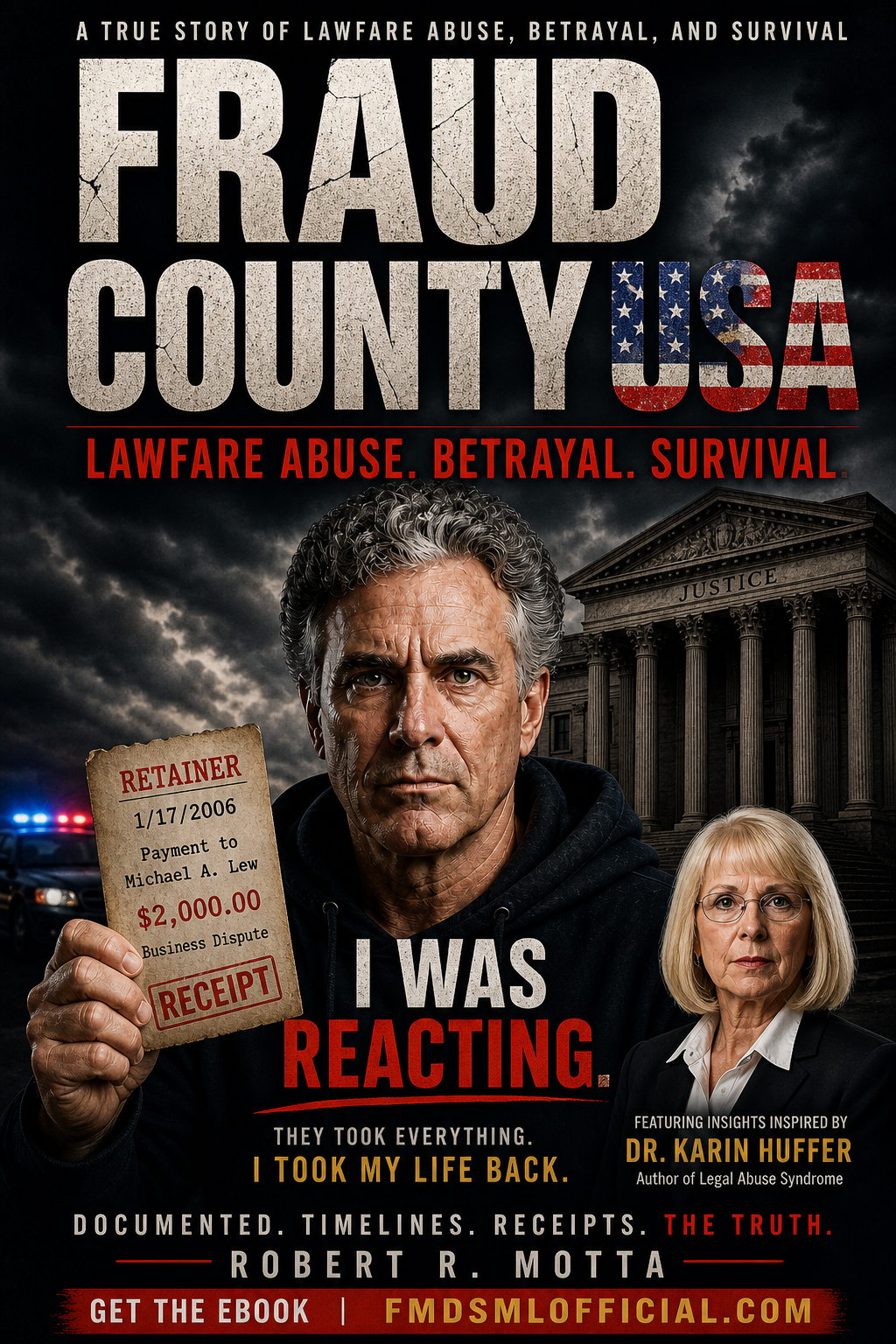
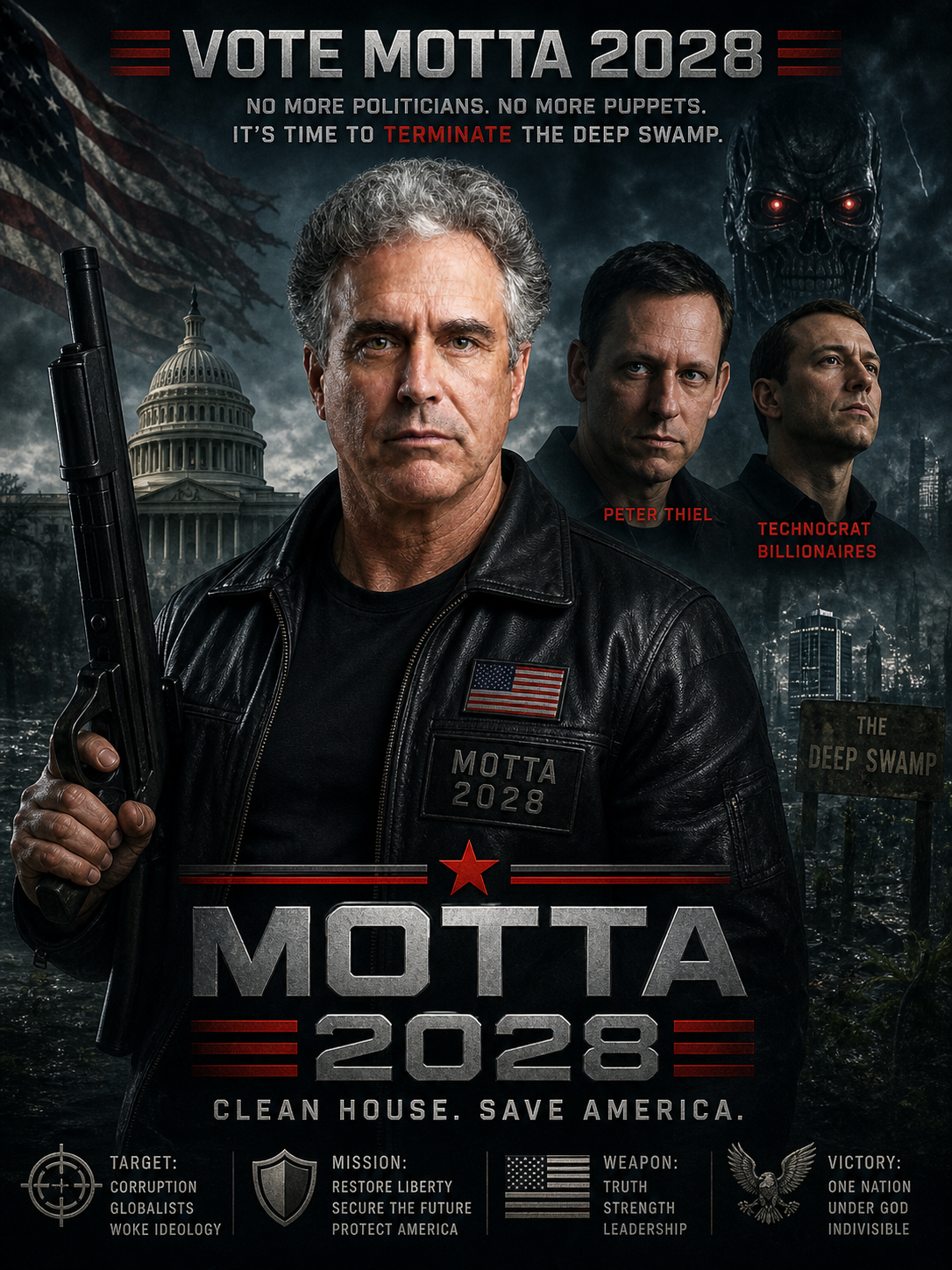
Transcript
Transcript
be caught by the clearing house. the clearing houses who basically does the the know your customer anti-money
geopolitical earthquake that we are still dealing with and trying to undo.
Transcript
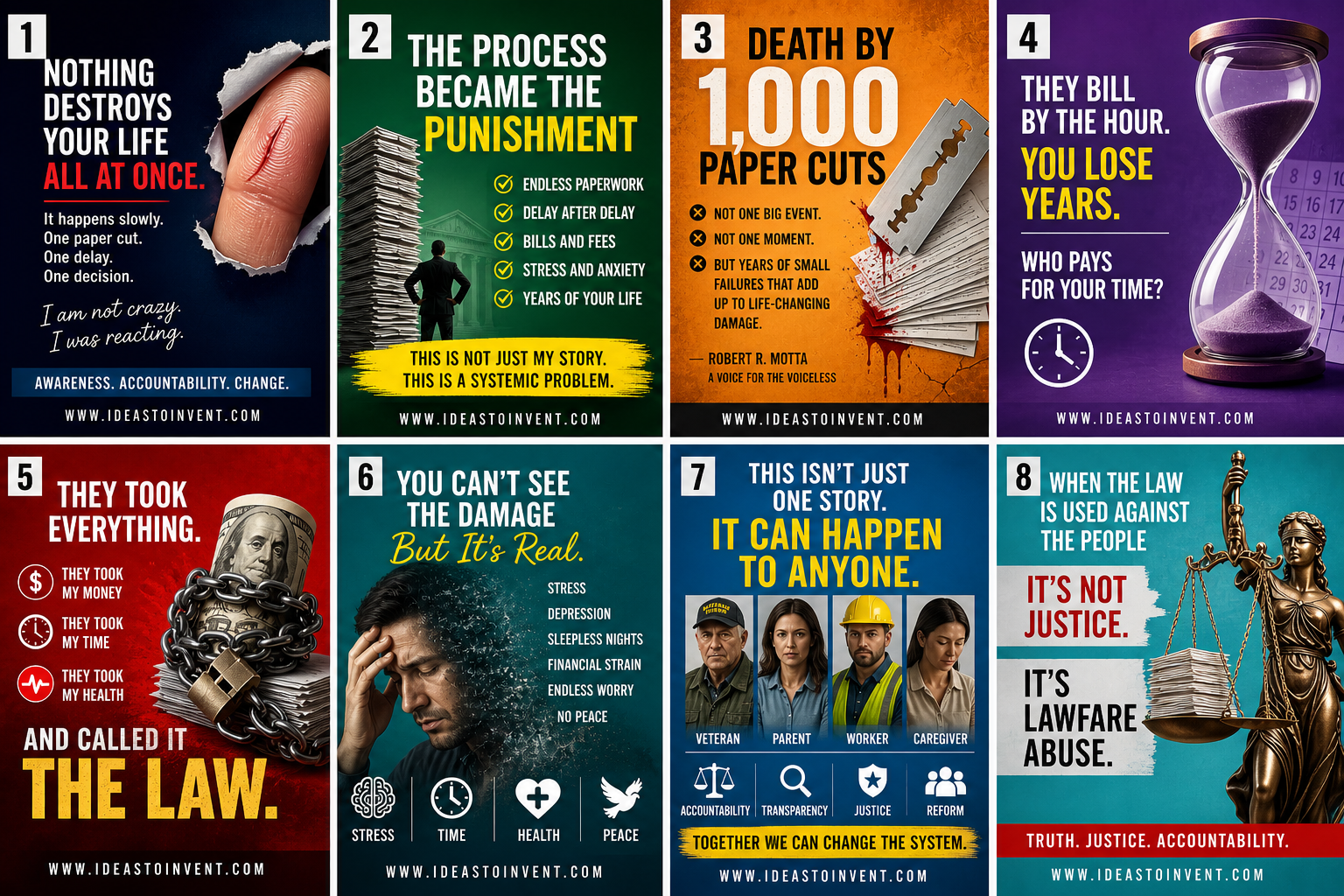

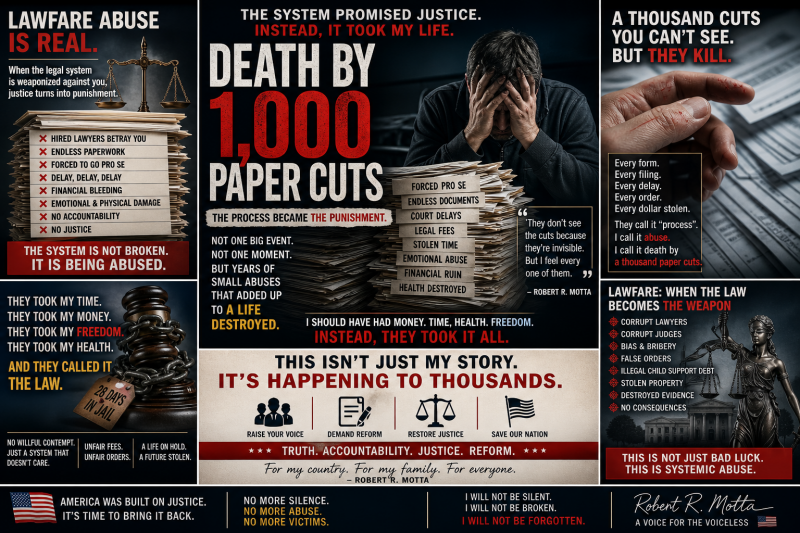
🇺🇸 CAMPAIGN / BOOK NARRATIVE
“The Process Became the Punishment”
By Robert R. Motta
It didn’t happen all at once.
There wasn’t one moment where everything broke.
It happened slowly.
Quietly.
One document at a time.
They tell you:
👉 “Hire a lawyer. The system will protect you.”
So you do.
You trust.
You pay.
You follow the process.
And then something changes.
Not all at once—but piece by piece.
The paperwork starts.
Forms.
Filings.
Deadlines.
Copies.
More copies.
Then corrections.
Then refilings.
Then delays.
At some point, you realize:
👉 you are doing the work yourself
Not because you want to—but because you have no choice.
You become:
-
your own lawyer
-
your own assistant
-
your own researcher
-
your own advocate
This is what they call “pro se.”
But they don’t tell you what it feels like.
It feels like:
-
stacks of paper covering your life
-
hours turning into nights
-
nights turning into weeks
-
weeks turning into years
And your hands—literally—
start to show it.
Paper cuts.
Small at first.
Barely noticeable.
But over time:
they add up.
That’s what this system feels like.
👉 death by a thousand paper cuts
Not one wound.
Not one event.
But constant, repeated impact.
Each document:
takes time.
Each filing:
takes energy.
Each delay:
takes something from you.
And no one is counting that cost.
They bill their time.
The system runs on paid hours.
But yours?
Unpaid.
Unrecognized.
Unlimited.
This is what “lawfare abuse” feels like when it happens to you.
Not from an enemy.
But from the system you trusted.
Even from the people you hired to help you.
The process becomes the punishment.
You lose:
-
time you can’t recover
-
money you can’t replace
-
health you can’t ignore
And from the outside?
People don’t see it.
Because nothing dramatic happens in one moment.
It’s slow.
It’s quiet.
It’s invisible.
Until one day you realize:
👉 your life has been consumed by the process itself
And you’re still expected to keep going.
🇺🇸 Why This Matters
This is not just one story.
This can happen to:
-
anyone in the legal system
-
anyone forced to represent themselves
-
anyone who runs out of money before the process ends
🔥 Closing Line
“It wasn’t one decision that changed my life—it was years of process that wore it down.”
— Robert R. Motta
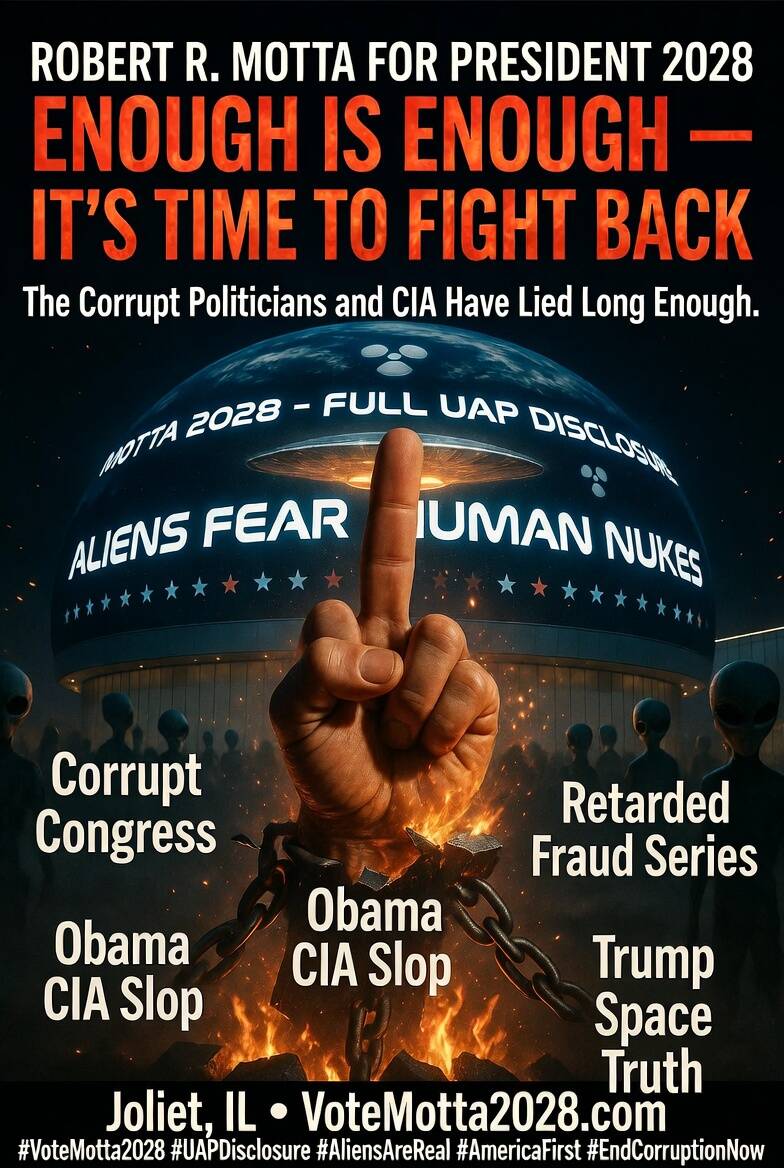
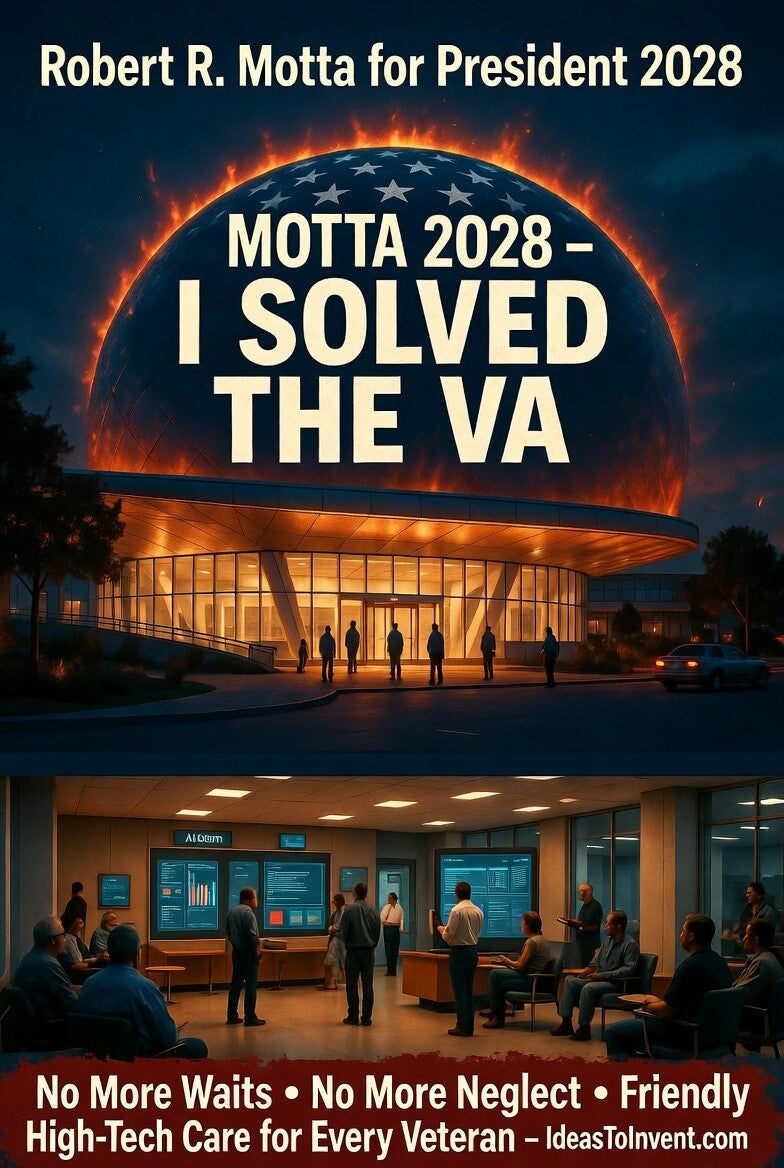


This video explores a proposal by Gary Stephenson to develop a chip-scale array of superconducting Josephson junctions designed to generate and transmit signals using gravitational waves (0:00-1:21). The host argues that this technology could enable communication through mediums that block conventional radio signals, such as seawater, solid rock, and deep underground environments (0:11-0:24).
Key Technical and Conceptual Highlights:
- The Secret of the Bilayer: The core innovation involves using a junction between two dissimilar superconductors (a bilayer structure). By pushing photons through this barrier, the device forces a spin-2 transition, effectively converting photon energy into gravitational waves (gravitons) (3:32-4:43, 9:26-10:13).
- Foundation in Existing Research: The design is described as an evolution of Giorgio Fontana’s work on the "gazer" or gravitational laser (2:30-2:38, 9:41-9:52). The system relies on the AC Josephson effect to transform electrical input into controlled microwave-range oscillations (2:45-3:30).
- Speculative Physics & Potential Applications: The host draws parallels between this technology and the concept of "Ghost Murmur" (1:26-2:03). The video also notes that researcher Eric Davis has reviewed Stephenson's work (4:45-5:08).
Contextual Commentary: The host suggests that such advanced communication methods may already exist within classified "black projects" (0:46-1:08) and emphasizes that this approach moves beyond conventional zero-point motion theories, focusing instead on quantum mechanical effects to manipulate spacetime (10:17-10:26). The host concludes by cryptically mentioning that he has met Gary Stephenson personally (6:08-6:24).
Transcript
This video reports on efforts by Donald Trump and the Department of Justice to block a formal video deposition of former Attorney General Pam Bondi. Host Ben Meiselas explains how the House Oversight Committee, led by Chairman James Comer, has reportedly agreed to allow Bondi to participate in an informal, non-filmed transcribed interview instead of a sworn, on-camera deposition (0:00 - 0:24, 7:00 - 7:15).
Key concerns raised by Democrats and the host include:
- Unprecedented representation: Harmeet Dhillon, the Assistant Attorney General for Civil Rights and a high-ranking DOJ official, is acting as Bondi's personal lawyer. Critics argue this creates significant ethical conflicts of interest and violates DOJ policies regarding the private practice of law by current employees (0:26 - 1:13, 9:39 - 10:50).
- Lack of transparency: The decision to avoid video recording the testimony is criticized as a departure from the committee's standard practices with other high-profile witnesses involved in the Jeffrey Epstein and Ghislaine Maxwell investigations, such as Bill and Hillary Clinton (6:38 - 7:00, 8:19 - 8:42).
- Substance of the testimony: Democrats argue that a voluntary, unrecorded interview allows the witness to avoid substantive questioning without a valid legal basis, potentially hindering the Oversight Committee's investigation into the Epstein files and the DOJ's failure to produce requested documents (8:20 - 9:39).
The video concludes with a clip of attorney Todd Blanche discussing Trump's communications with Bondi, and a segment featuring Republican Representative Thomas Massie, who suggests that the committee should focus its attention on Blanche himself regarding ongoing DOJ operations (12:15 - 15:20).
Hillary's Syrian ISIS Army - Just In Time For 2026 and 2028
George Webb, Investigative Journalist
📧 OFFICIAL EMAIL DRAFT (EXHIBIT-BASED)
Dear Congresswoman Underwood,
My name is Robert R. Motta, and I am a constituent requesting your office’s assistance regarding a matter that now clearly involves federal jurisdiction and oversight.
I am submitting this communication along with supporting documentation as evidence of systemic failure in the handling of my complaint by the Office of the Comptroller of the Currency (OCC).
Exhibit A: OCC Response Letter dated April 28, 2026
(See attached: )
Summary of Concern
The OCC response confirms several critical points:
-
The OCC acknowledged my allegations, including:
-
potential falsification of documents
-
breach of fiduciary duty
-
misconduct involving a financial institution
-
-
The OCC deferred to the bank’s internal narrative without independent verification.
-
The OCC explicitly stated that resolving my complaint would require interpretation and enforcement of contractual matters, and therefore declined further action.
Key Issue for Federal Review
This creates a serious accountability gap:
-
A federal regulatory agency acknowledges allegations of misconduct
-
Relies on the institution being accused
-
Then declines to enforce or investigate further
This effectively leaves a citizen without meaningful federal protection, despite the matter falling within a federally regulated banking framework.
Why This Requires Congressional Oversight
Based on the OCC’s own response (page 1–2 of Exhibit A):
-
No independent investigation findings are presented
-
No enforcement action is initiated
-
Responsibility is shifted back to the complainant
This raises broader concerns:
-
Are federal banking regulators adequately investigating consumer complaints?
-
Are institutions being allowed to self-validate without scrutiny?
-
Is there a systemic pattern of deferring accountability?
Request
I respectfully request that your office:
-
Review Exhibit A and the handling of this complaint
-
Determine whether the OCC fulfilled its regulatory obligations
-
Clarify what federal protections exist when regulators decline to act
-
Advise whether this matter warrants referral to:
-
additional federal oversight bodies
-
inspector general review
-
or congressional inquiry
-
Closing
This issue is not only about one case. It reflects a broader concern about whether federal systems designed to protect citizens are functioning as intended.
I appreciate your time and consideration and am prepared to provide any additional documentation your office may require.
Respectfully,
Robert R. Motta
Joliet, Illinois
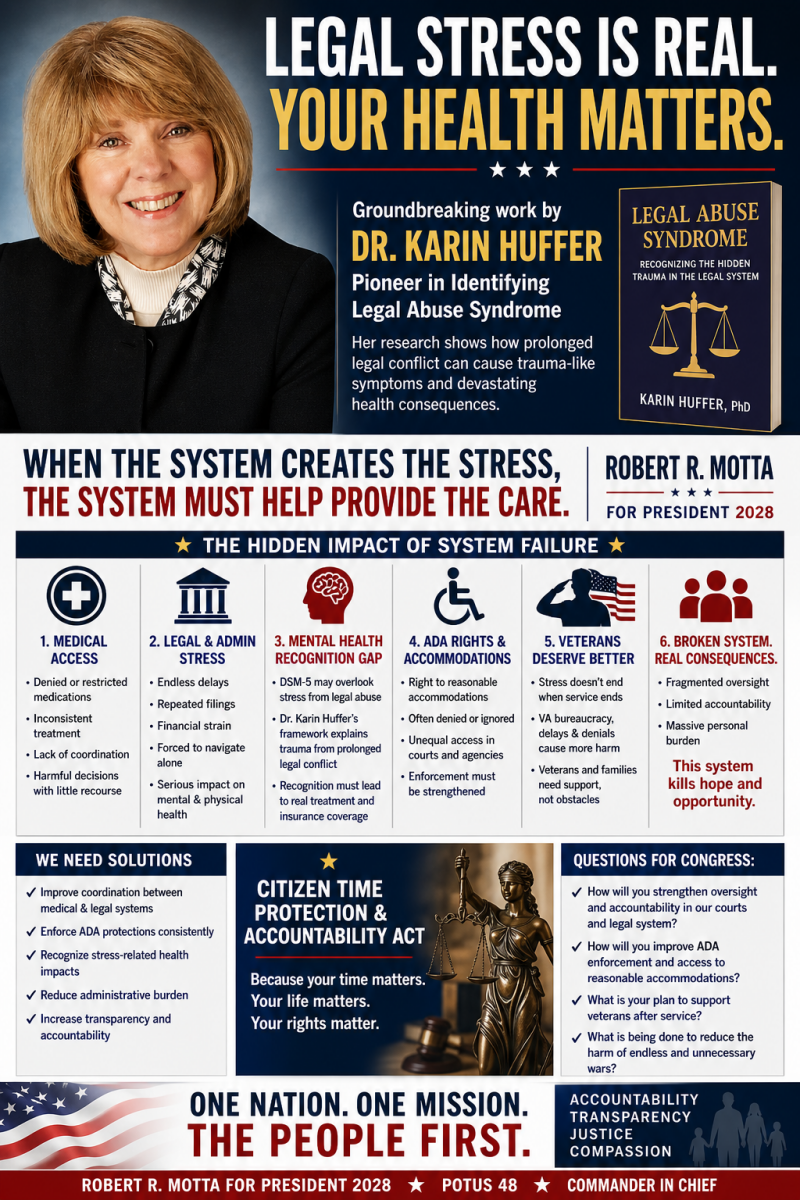
Dear Congresswoman Underwood,
I would like to expand on additional concerns that connect medical care, disability rights, legal processes, and their combined impact on individuals—particularly those navigating these systems without adequate support.
1. Medical Access and Treatment Concerns
In my experience, accessing appropriate medical care—particularly for pain management and anxiety-related conditions—can be extremely difficult.
Individuals may face:
- denial or restriction of necessary medications
- inconsistent treatment approaches
- lack of coordination between providers
- and limited recourse when care decisions negatively impact health
These challenges are especially significant for individuals managing:
- physical injuries
- chronic pain conditions
- and stress-related health issues
2. Americans with Disabilities Act (ADA) – Access and Enforcement
Under the
👉 Americans with Disabilities Act of 1990
individuals with physical or mental health conditions are entitled to reasonable accommodations.
However, in practice, individuals navigating legal and administrative systems may experience:
- difficulty obtaining accommodations
- inconsistent application of ADA protections
- lack of enforcement when accommodations are denied
This creates a situation where individuals who qualify for protections may still be required to proceed without meaningful support—particularly when handling legal or administrative matters on their own.
3. Impact of Legal and Administrative Stress on Health
Prolonged legal and administrative processes can create significant stress.
This includes:
- extended timelines
- repeated filings and documentation
- financial strain
- and lack of resolution
Over time, this can contribute to:
- anxiety
- sleep disruption
- emotional distress
- and overall health decline
This is particularly relevant for individuals who are forced to proceed without representation.
4. Mental Health Classification and Treatment Gaps
While standards such as the
👉 Diagnostic and Statistical Manual of Mental Disorders (DSM-5)
guide diagnosis and treatment, there may be gaps in how certain stress-related conditions are recognized.
Work by experts such as
👉 Karin Huffer
has highlighted how prolonged legal conflict can contribute to trauma-like symptoms.
However:
- these experiences are not always clearly reflected in existing diagnostic frameworks
- and individuals may struggle to receive appropriate recognition or treatment
- which may also impact access to insurance-covered care
5. Veterans and Post-Service Challenges
This issue is especially important for veterans.
Many veterans experience:
- stress related not only to service, but also to
- navigating benefits systems
- accessing healthcare
- and managing legal or personal challenges after returning home
Administrative complexity and delays can add to these challenges, particularly for those already dealing with service-related conditions.
6. Broader System Concern
Across both legal and medical systems, individuals may experience:
- fragmented oversight
- limited accountability
- and significant personal burden
When these systems intersect, the impact on the individual can be severe—requiring substantial time, effort, and persistence without compensation or support.
7. Policy Relevance
These issues reinforce the need for:
- improved coordination between medical and legal systems
- more consistent enforcement of ADA protections
- greater recognition of stress-related health impacts
- reduced administrative burden
- and stronger accountability mechanisms
They also directly support the goals of my proposed:
Citizen Time Protection and Accountability Act
8. Additional Questions for Consideration
I would respectfully appreciate your perspective on:
- how ADA protections can be more consistently enforced in legal and administrative settings
- how individuals can access meaningful remedies when accommodations are not provided
- how federal policy can better support veterans navigating post-service systems
- and approaches to reducing administrative burden across healthcare and legal systems
Closing
My goal is to present these concerns clearly and constructively, with a focus on improving outcomes for individuals navigating complex systems.
Thank you again for your time, consideration, and service to our community.
Respectfully,
Robert R. Motta
Joliet, Illinois
815 725-4540
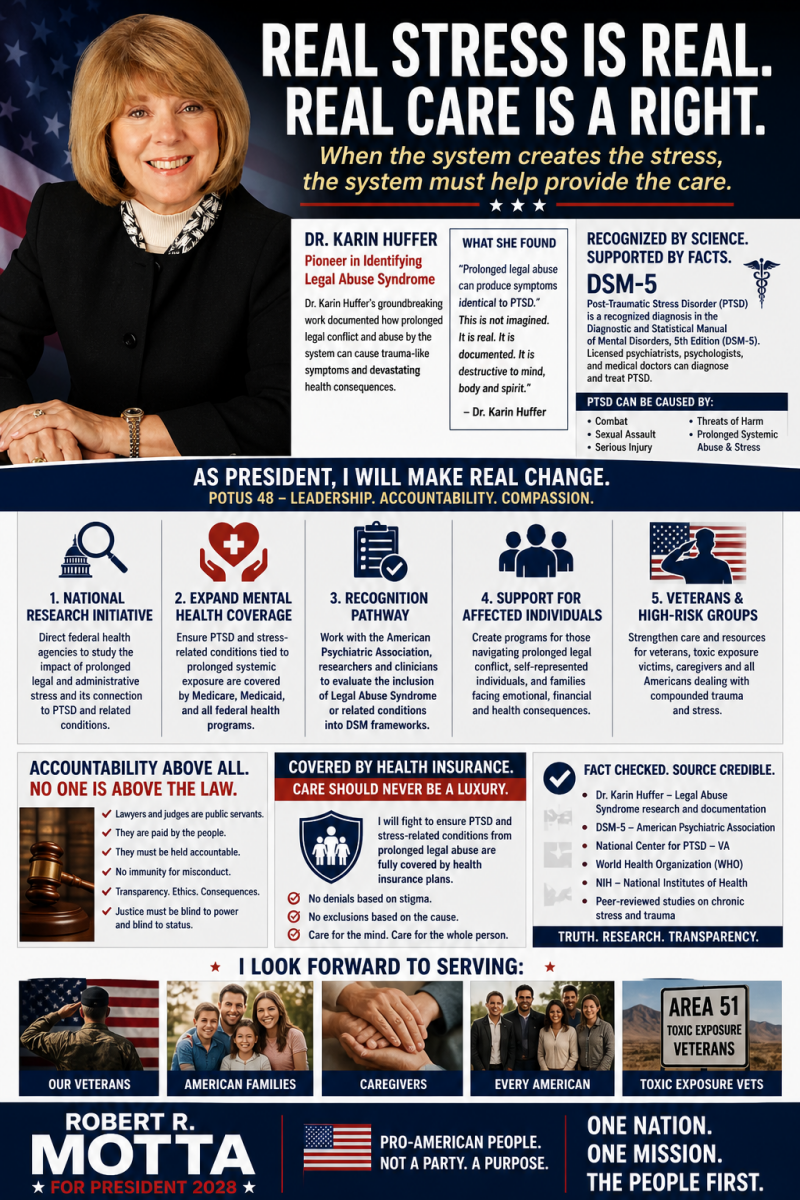
🇺🇸 CAMPAIGN POLICY STATEMENT
Legal Stress, PTSD, and Mental Health Recognition
Prepared by Campaign Communications Team
Approved by Robert R. Motta
Headline
When the System Causes the Stress, the System Must Help Treat It.
The Issue
Across America, millions of people are experiencing severe stress from:
-
prolonged legal battles
-
administrative delays
-
financial pressure
-
lack of accountability
Experts such as
Karin Huffer
have described how prolonged legal conflict can lead to trauma-like symptoms.
At the same time, clinical standards such as the
Diagnostic and Statistical Manual of Mental Disorders (DSM-5)
recognize that prolonged stress can contribute to serious mental health conditions, including PTSD.
⚠️ The Gap
Right now:
-
Legal Abuse Syndrome is not formally recognized in DSM-5
-
Many people experiencing legal-system-related trauma:
-
struggle to get proper diagnosis
-
struggle to get treatment covered
-
are left navigating both legal and medical systems alone
-
🇺🇸 What I Will Do as President (POTUS 48)
🧠 1. National Research Initiative
Direct federal health agencies to:
-
study the impact of prolonged legal and administrative stress
-
evaluate links to PTSD and related conditions
-
support evidence-based classification and treatment pathways
🩺 2. Expand Mental Health Coverage
Work to ensure that:
-
PTSD and stress-related conditions tied to prolonged systemic exposure
are eligible for coverage under:-
Medicare
-
Medicaid
-
federal health programs
-
📄 3. Recognition Pathway (Evidence-Based)
Encourage collaboration between:
-
American Psychiatric Association
-
federal health agencies
-
researchers and clinicians
To evaluate whether conditions described by experts like
Karin Huffer
should be formally recognized or incorporated into existing diagnostic frameworks.
🛡️ 4. Support for Affected Individuals
Create programs to support people who are:
-
navigating prolonged legal conflict
-
forced into self-representation
-
dealing with stress-related health impacts
🇺🇸 5. Veterans & High-Risk Groups
Expand focus on:
-
veterans dealing with PTSD
-
individuals exposed to long-term stress environments
-
those facing compounded stress from legal + health systems
The Principle
We already recognize:
-
combat-related PTSD
-
trauma from violence
But we must also recognize:
👉 prolonged systemic stress can have real health consequences
Message to Americans
If you have ever:
-
spent years fighting through systems
-
lost sleep, health, or stability
-
felt overwhelmed by stress you could not escape
👉 You are not alone.
And your experience matters.
Closing Statement
This campaign is about:
-
recognizing reality
-
supporting people
-
and making sure the system does not harm those it is supposed to serve
Signature Line
“When the system creates the stress, the system must help provide the care.”
— Robert R. Motta
In this installment of the Ted Nugent Spirit Campfire, Ted Nugent reflects on his personal philosophies and the current state of American politics from his Spirit Wild Ranch in central Texas.
Key topics covered so far (0:00 - 1:05):
- Nugent’s Philosophy: He discusses his dedication to rugged individualism, his love for nature, and his connection with his audience, describing the show as a "spirit campfire" meant to ground people amidst a high-tech, "bizarro" world.
- Cultural Commentary: He expresses strong criticism of modern government and mainstream politics, labeling various institutions and the Democratic Party as part of a "satanic agenda" and warning against what he views as the terminal decline of the country.
- Personal Routine: Nugent shares his daily habits, which include practicing with his Mathews bow and Fred Bear arrows to maintain focus, discipline, and independence.
Coming up later in the video:
- Entrepreneur Spotlights: Nugent highlights various products and small businesses he supports, including High Viz sights, Texas Machine Parts (suppressors), and War Path Coffee.
- Guest Segment: He introduces independent reporter Nick Sorter, who discusses his experiences covering stories ignored by mainstream media and his recent arrest at a Portland protest.
- Advocacy: Throughout the episode, Nugent emphasizes the importance of whistleblowing, truth, logic, and common sense in opposing government corruption.
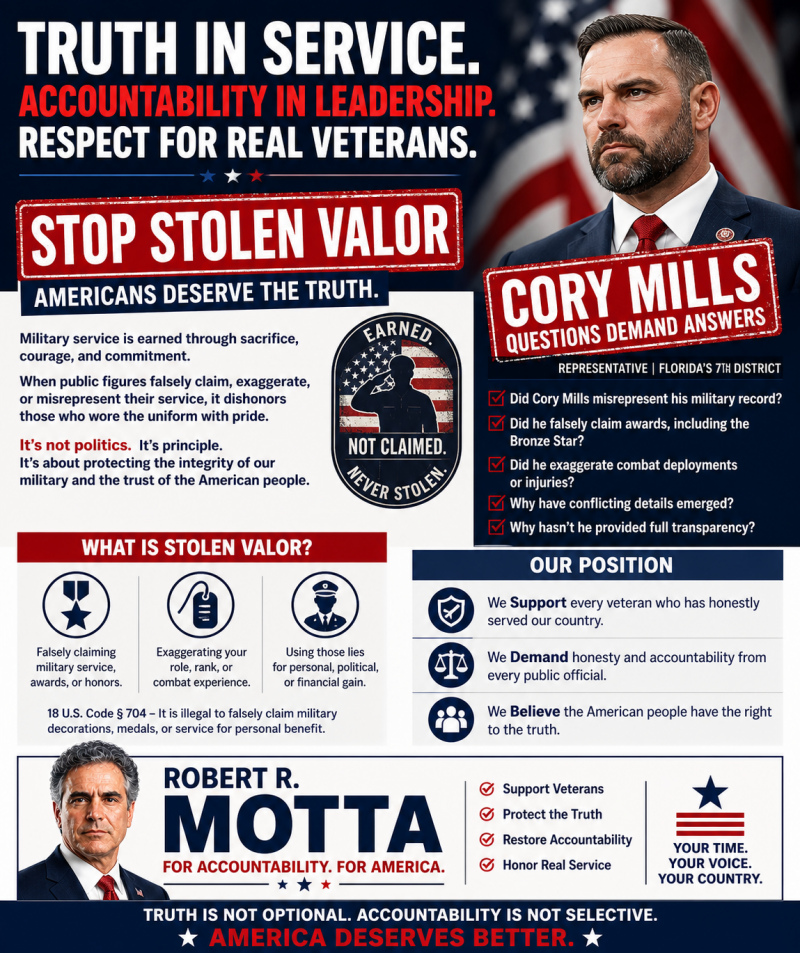
🇺🇸 CAMPAIGN MESSAGE: SERVICE TO THE AMERICAN PEOPLE
Prepared by Campaign Communications Team
Approved by Robert R. Motta
Headline
Service Means Showing Up for the American People—Every Day.
What Service Really Means
Service is not a title.
Service is:
-
doing the work
-
solving problems
-
standing with people when systems fail
-
and continuing forward, even when it’s difficult
Across this country, millions of Americans are already serving:
-
veterans who defended our nation
-
caregivers supporting loved ones
-
families working hard to stay afloat
-
individuals navigating complex systems on their own
👉 That is real service.
The Reality Americans Face
Today, many Americans spend countless hours:
-
filling out paperwork
-
dealing with agencies
-
trying to access benefits or care
-
fighting for answers
This takes:
-
time
-
energy
-
money
And often, it goes unrecognized.
Veterans and Service After Duty
To every veteran:
Your service does not end when you return home.
Many veterans continue to face:
-
long-term health challenges
-
barriers to care
-
administrative delays
Public reporting and federal programs have recognized issues such as:
-
toxic exposure risks
-
long-term care needs
-
delays in accessing benefits
👉 These are real issues that require real solutions.
My Commitment
I believe service means:
-
listening to the people
-
fixing what is not working
-
and staying accountable
I look forward to serving:
-
veterans
-
American families
-
caregivers
-
seniors
-
and anyone who needs a system that works for them
The Principle
No matter who you are:
-
your time matters
-
your effort matters
-
your voice matters
Closing Statement
This campaign is about restoring the meaning of service.
Not just in government.
But across America.
Because the people who carry this country forward every day deserve to be seen, heard, and supported.
Signature Line
“Service is not what you say. It is what you do—for the American people.”
— Robert R. Motta
📊 FACT-BASED SUPPORT (FOR CREDIBILITY)
-
Millions of Americans provide unpaid care and support (widely reported by national studies and media)
-
Veterans continue to face long-term health and benefits challenges
-
Federal programs exist, but delays and complexity are commonly reported
Transcript
🇺🇸 FACT-BASED CAMPAIGN VERSION (STOLEN VALOR / ACCOUNTABILITY)
📢 Campaign Issue: Truth in Service and Public Trust
Prepared by Campaign Communications Team
Approved by Robert R. Motta
Headline
Service Matters. Truth Matters. Accountability Matters.
Public Statement
Americans respect military service.
It represents:
-
sacrifice
-
commitment
-
and trust
Because of that, any questions about how service is represented must be taken seriously—and handled responsibly.
What Voters Should Know
There have been public discussions and media commentary raising questions about how some public figures describe their military service.
These discussions highlight an important principle:
👉 All public claims—especially about military service—should be accurate, verifiable, and transparent.
What “Stolen Valor” Means
“Stolen valor” generally refers to:
-
falsely claiming military service
-
exaggerating roles or honors
-
misrepresenting service for personal or political gain
⚠️ Important:
-
Actual violations are defined under federal law
-
Claims must be proven, not assumed
Why This Matters
This is not about attacking individuals.
It is about protecting:
-
the integrity of real veterans
-
the trust of the American people
-
and the credibility of public leadership
Connection to My Campaign
My campaign stands for:
-
truth
-
accountability
-
and fairness
The same standard applies to everyone:
👉 No one should benefit from inaccurate claims—especially about service to this country.
Policy Position
🇺🇸 Truth in Public Service Standard
-
Public officials should clearly and accurately represent their background
-
Claims of military service should be verifiable
-
Corrections should be made publicly when questions arise
Message to Veterans
To every veteran:
Your service matters.
Your sacrifice matters.
And it should never be misrepresented.
Closing Line
“Truth is not optional. Accountability is not selective.”
— Robert R. Motta
Description
Satellite Shows Mysterious Drainage #substack #shorts 211 Likes 4,735 Views Nov 20 2025 This is a clip from https://thedreydossier.substack.com/p/who-tf-is-in-my-head-part-6-the-neuralink?utm_source=youtube_shorts
See the full video: https://www.youtube.com/watch?v=uWwRF9OQgI0
#shorts #substack
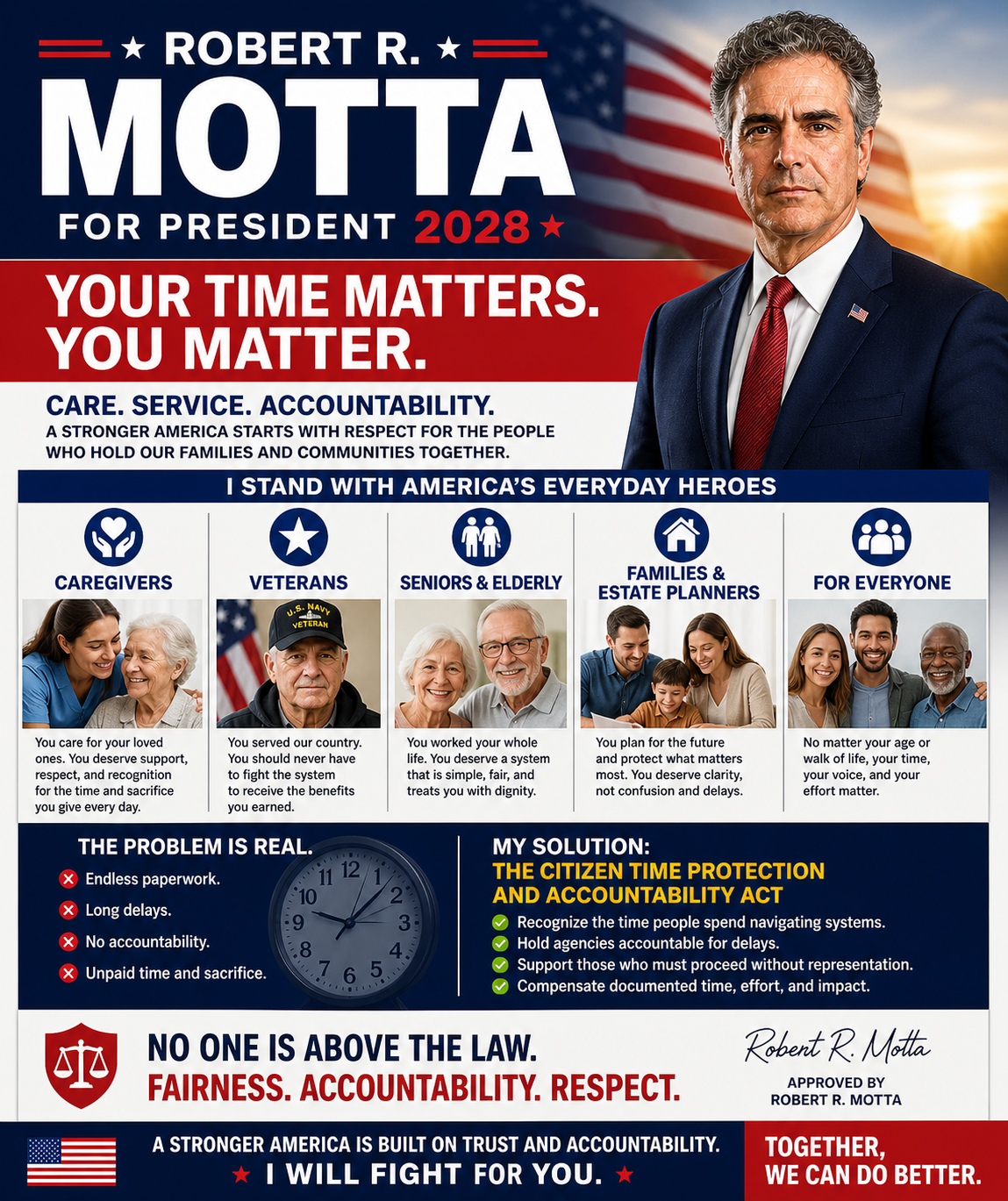
This video, presented by political commentator Jack Cocchiarella, focuses on the controversy surrounding the potential pardon of Ghislaine Maxwell and the broader implications of the Epstein files. Here is a breakdown of the key topics discussed:
- The Case for a Maxwell Pardon: Cocchiarella discusses growing concerns that Ghislaine Maxwell may be leveraging sensitive information or blackmail regarding high-profile figures, including associates of Donald Trump, to secure a pardon or sentence reduction (0:00-0:39, 5:20-8:00).
- Critique of Joe Rogan and Media Figures: The host criticizes Joe Rogan for his recent commentary on the administration, arguing that influential figures are failing to challenge Donald Trump directly on his handling of the Epstein case despite their public platform (0:45-3:04).
- Transparency Concerns: The video covers assertions made by Todd Blanche, Trump's attorney, regarding the release of Epstein-related files. The host claims these explanations are misleading and that the administration is actively suppressing information to protect those involved in the scandal (3:05-5:19).
- Testimony from Marjorie Taylor Greene: The latter portion of the video highlights a rebuke from Representative Marjorie Taylor Greene, who details her personal attempts to push for the release of the Epstein files and the resistance she faced from the White House and other officials (9:17-12:19).
Conclusion: Cocchiarella asserts that the responsibility for the ongoing cover-up lies directly with Donald Trump and urges viewers to continue demanding accountability rather than accepting excuses from the current administration.
Transcript
Legislative Proposal – Citizen Time Protection and Accountability Act
Dear Congresswoman Underwood,
My name is Robert R. Motta, and I am a resident of Joliet, Illinois.
I am writing to you directly to share my experience and to respectfully submit a legislative proposal that I believe addresses a serious gap affecting many citizens.
Over the past several years, I have personally navigated prolonged legal and administrative processes that required extensive time, documentation, and continuous effort. Much of this work was done without effective legal representation, requiring me to proceed on my own while managing financial pressure and ongoing health challenges.
During this time, I was responsible for:
-
drafting detailed documents and exhibits,
-
submitting formal complaints,
-
tracking timelines and responses,
-
sending certified correspondence,
-
and repeatedly following up with agencies.
This process became a full-time responsibility, requiring significant time and energy with no compensation for the work involved.
Through this experience, I came to understand that there is currently no mechanism to compensate citizens for documented time lost due to administrative burden, delays, or unresolved proceedings. While professionals within these systems are compensated, the citizen is left to absorb the cost in time, money, and personal impact.
As your constituent at:
716 Tana Lane
Joliet, Illinois 60435
I respectfully bring this issue to your attention.
To address this gap, I have prepared a draft bill titled:
“Citizen Time Protection and Accountability Act of 2026.”
This proposal is intended to:
-
reduce excessive administrative burden,
-
improve accountability for delays,
-
protect individuals who are required to proceed without representation,
-
and establish a framework for compensation based on documented time loss.
My goal is not only to share my own experience, but to advocate for a solution that may help others who are navigating similar challenges.
I would greatly appreciate the opportunity for your office to review this proposal and provide any guidance on potential next steps.
I am also willing to provide documentation and a detailed timeline of my experience if that would assist your review.
Thank you for your time, consideration, and service to our community.
Respectfully,
Robert R. Motta
Joliet, Illinois
815 725-4540
🇺🇸 OFFICIAL CAMPAIGN STATEMENT
Caregivers, Accountability, and Time That Matters
Prepared by Campaign Communications Team
Approved by Robert R. Motta
Headline
If You Take Care of Others—or Yourself—The System Should Take Care of You Too.
Opening Message
Across America, millions of people are doing something that rarely gets recognized.
They are:
-
caring for family members
-
managing their own health challenges
-
helping elderly parents
-
supporting veterans
-
handling estates and financial responsibilities
They are doing real work.
But the system does not treat it that way.
The Reality
Caregivers, veterans, elderly individuals, and families are often forced to:
-
fill out endless paperwork
-
deal with government agencies
-
manage legal and financial issues
-
spend hours on phone calls and follow-ups
-
fight for answers just to get basic support
This takes:
-
time
-
energy
-
money
-
and health
And most of that work is unpaid and unrecognized.
The Problem
Right now:
-
Lawyers get paid
-
Agencies get funded
-
Systems keep running
But the person doing the work—the citizen—gets nothing.
No compensation.
No recognition.
No accountability when delays happen.
Who This Affects
This affects:
-
caregivers helping loved ones
-
veterans navigating benefits
-
elderly individuals managing their affairs
-
families handling estates
-
individuals forced to represent themselves
And anyone who has ever had to fight through a system just to be heard.
My Experience
I have lived this reality.
I have spent years:
-
handling paperwork
-
filing complaints
-
tracking timelines
-
trying to get answers
While dealing with:
-
financial pressure
-
health challenges
-
and no meaningful support
That experience showed me something clearly:
👉 The system depends on your time—but does not value it.
The Solution
That is why I am proposing:
The Citizen Time Protection and Accountability Act
This plan will:
-
recognize the time people spend navigating systems
-
create accountability for delays and inaction
-
support those forced to proceed without representation
-
and establish a framework to compensate documented time and effort
Why This Matters
This is not about politics.
It is about fairness.
If the system requires your time, your effort, and your energy—
then your time should matter.
For Caregivers
If you are taking care of someone else,
you should not have to sacrifice your own stability to do it.
For Veterans
If you served this country,
you should not have to fight the system to receive support.
For Seniors
If you worked your whole life,
you should not be buried in paperwork just to manage your affairs.
For Families and Estate Planning
If you are handling legal and financial responsibilities,
you should not be overwhelmed by unnecessary complexity and delays.
Core Principle
No one should lose years of their life just trying to make the system work.
Closing Statement
This campaign is about restoring balance.
It is about recognizing the value of your time.
It is about accountability.
And it is about making sure the system works for the people—not the other way around.
Signature Line
“Your time matters. Your effort matters. You matter.”
— Robert R. Motta