
Blue Planet
Oceans and atmosphere make Earth glow blue from space.
— Robert Motta (@rm044335) April 27, 2026
— Robert Motta (@rm044335) April 27, 2026
Prepared by the Motta 2028 Press Team
Approved by Robert R. Motta, Candidate for President & Commander-in-Chief
The American people are not asking for politics.
They are asking for honesty, accountability, and results.
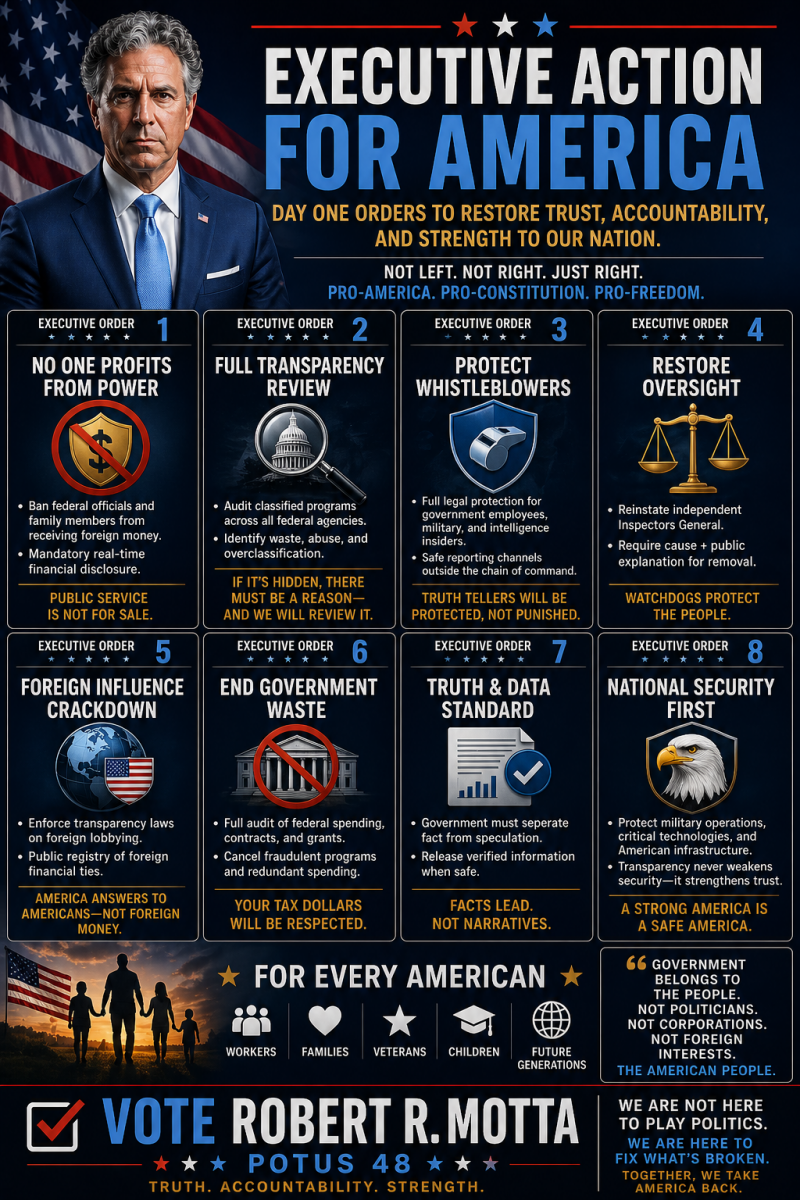
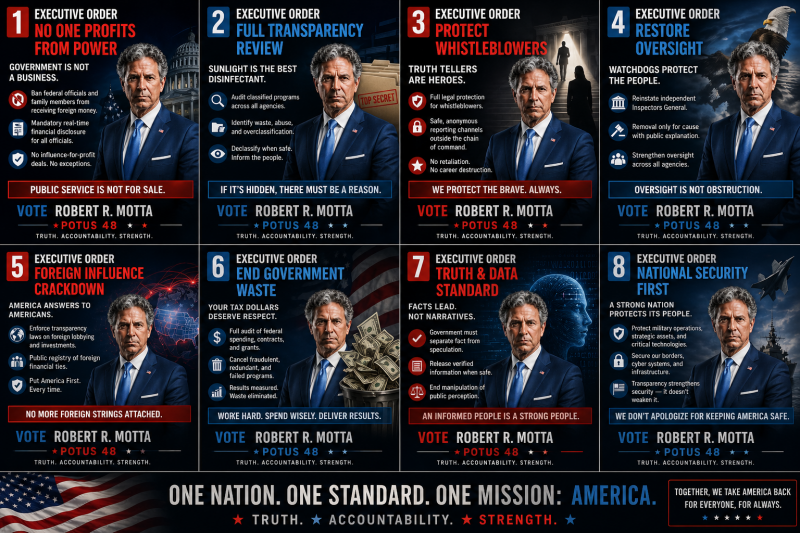
This administration will deliver immediate executive action.
Ban federal officials and family members from:
Receiving foreign money
Making deals tied to government influence
Mandatory real-time financial disclosure
👉 Public service is not for sale
Audit classified programs across:
CIA
DoD
Federal agencies
Identify:
Waste
Abuse
Overclassification
👉 If it’s hidden, there must be a reason — and we will review it
Full legal protection for:
Government employees
Military personnel
Intelligence insiders
Safe reporting channels outside chain of command
👉 Truth tellers will be protected, not punished
Reinstate independent Inspectors General
Require cause + public explanation for removal
👉 Watchdogs protect the people
Enforce transparency laws on:
Foreign lobbying
Foreign investments tied to officials
Public registry of foreign financial ties
👉 America answers to Americans — not foreign money
Full audit of:
Federal spending
Contracts
Grants
Cancel:
Fraudulent programs
Redundant spending
👉 Your tax dollars will be respected
Government must:
Separate fact from speculation
Release verified information when safe
No manipulation of public perception
👉 Facts lead. Not narratives.
Protect:
Military operations
Critical technologies
American infrastructure
👉 Transparency never weakens security — it strengthens trust
Not Democrat.
Not Republican.
👉 American.
Truth over propaganda
Accountability over power
Unity over division
Action over talk
This plan protects:
Workers
Families
Veterans
Children
Future generations
“Government belongs to the people.
Not politicians. Not corporations. Not foreign interests.
The American people.”
We are not here to play politics.
We are here to fix what’s broken.
— Robert Motta (@rm044335) April 27, 2026
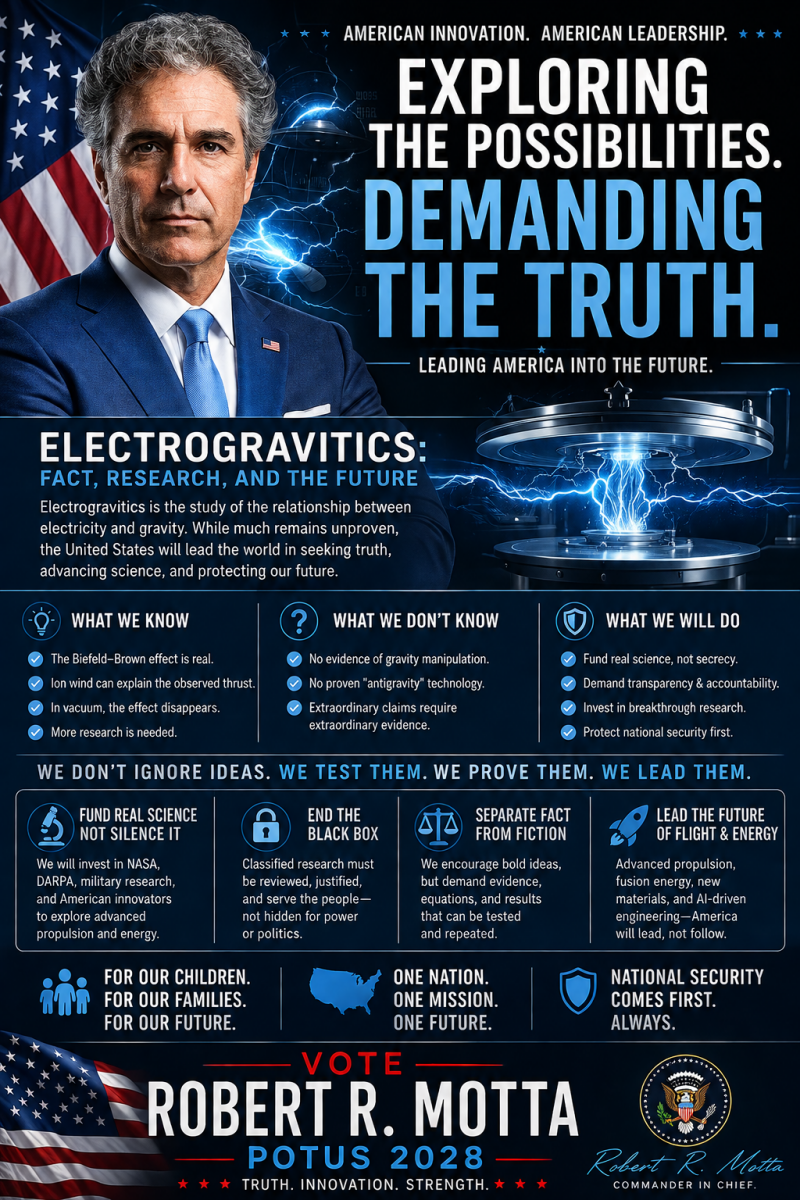
— Robert Motta (@rm044335) April 27, 2026
Written by the Robert R. Motta Press Team
Approved by Robert R. Motta, Candidate for President & Commander-in-Chief (2028)
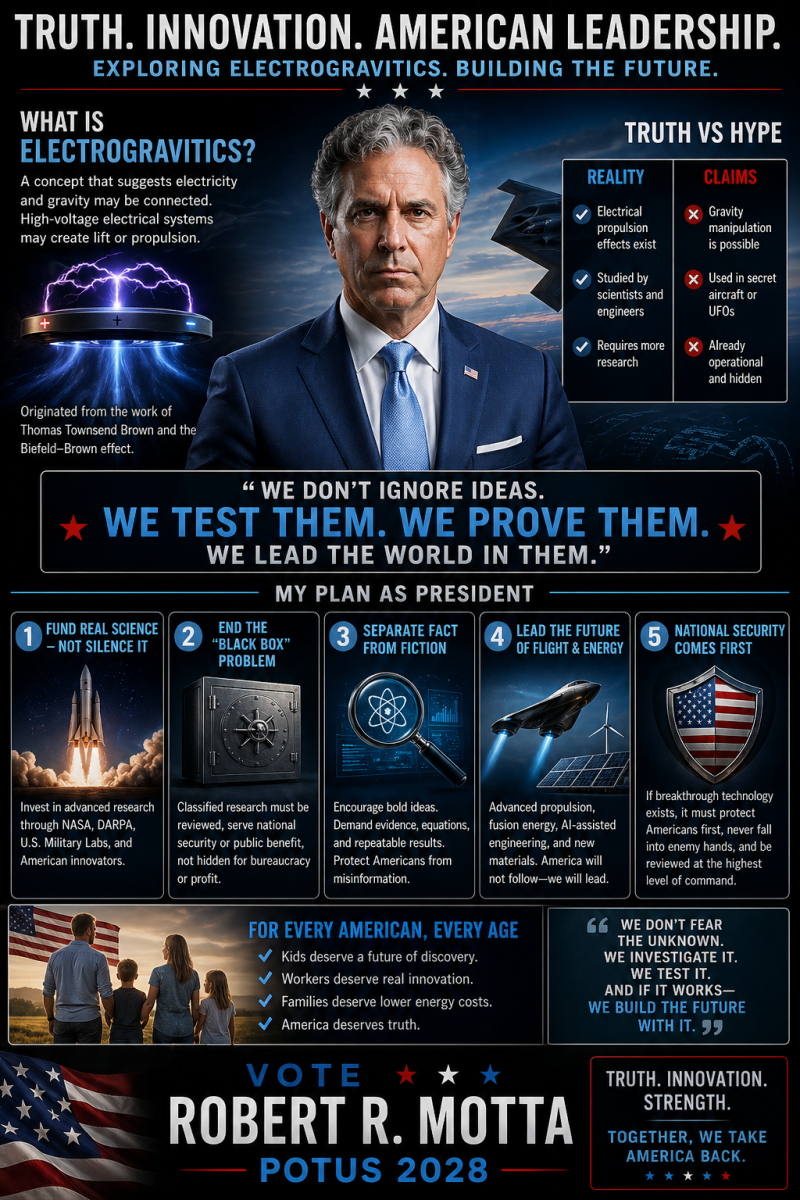
Electrogravitics is a concept that suggests electricity and gravity may be connected. Some researchers have explored whether high-voltage electrical systems could create lift or propulsion—sometimes described as “antigravity.”
This idea traces back to Thomas Townsend Brown and the Biefeld–Brown effect, where high voltage applied to certain devices creates movement.
👉 What science says today:
The effect is real, but
Most evidence shows it is caused by ion wind (charged air movement) — not gravity control
In vacuum conditions, the effect disappears, which challenges “antigravity” claims
RealityClaimsElectrical propulsion effects existGravity manipulation is possibleStudied by scientists and engineersUsed in secret aircraft or UFOsRequires more researchAlready operational and hidden
As your future Commander-in-Chief, I will take a clear, honest, and strong stance:
We do not ignore ideas.
We test them. We prove them. We lead the world in them.
1. Fund Real Science — Not Silence It
We will invest in advanced propulsion, energy, and physics research through:
NASA
DARPA
U.S. Military Research Labs
American universities and independent inventors
2. End the “Black Box” Problem
If research is classified:
It must be reviewed regularly
It must serve national security or public benefit
It must NOT be hidden to protect bureaucracy or profit
3. Separate Fact from Fiction
We will:
Encourage bold ideas
Demand evidence, equations, and repeatable results
Protect Americans from misinformation
4. Lead the Future of Flight & Energy
Whether it’s:
Advanced propulsion
Fusion energy
AI-assisted engineering
New materials
America will not follow — we will lead
If any breakthrough technology exists:
It must protect Americans first
It must never fall into enemy hands
It must be reviewed at the highest level of command
This campaign is simple:
Kids deserve a future of discovery
Workers deserve real innovation
Families deserve lower energy costs
America deserves truth
“We don’t fear the unknown.
We investigate it.
We test it.
And if it works — we build the future with it.”
Vote Robert R. Motta — POTUS 2028
Truth. Innovation. Strength.
General Flynn says if you dig into the AIDS virus, you’ll find that it was likely manufactured by the US Government
— healthbot (@thehealthb0t) April 26, 2026
“What it really comes down to is our government involved in manufacturing diseases and then manufacturing drugs that are supposed to help when in fact they don’t… pic.twitter.com/fE1bcUgs0U

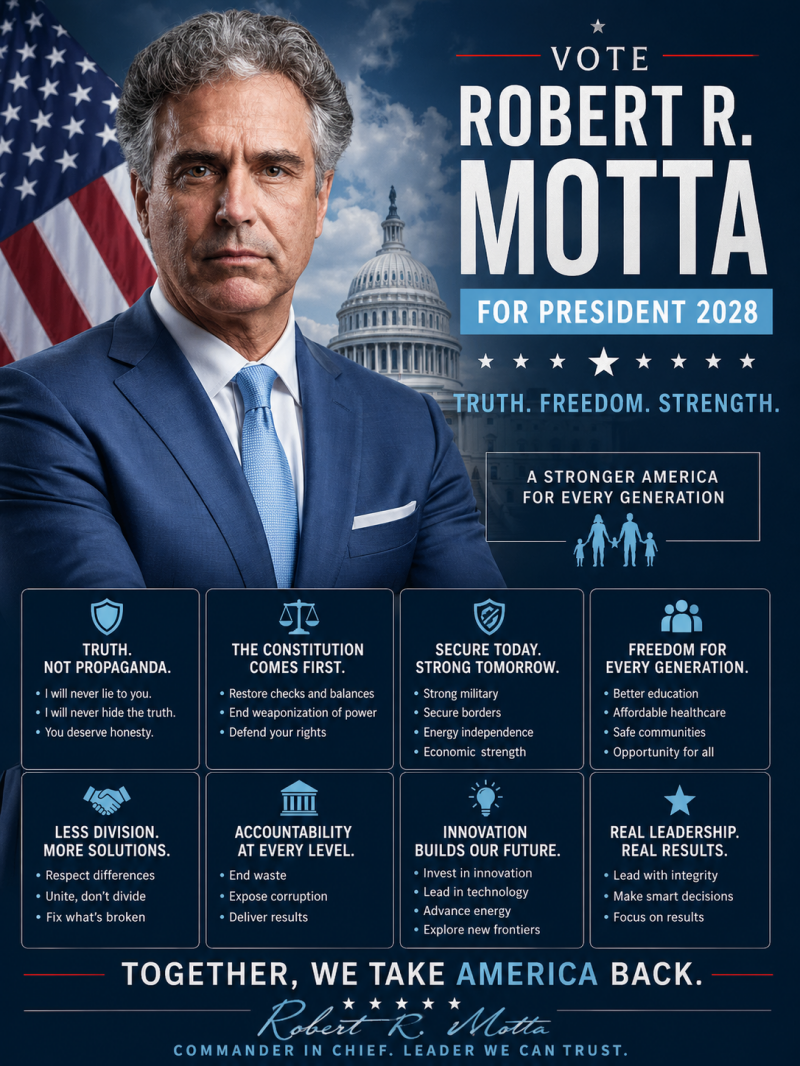
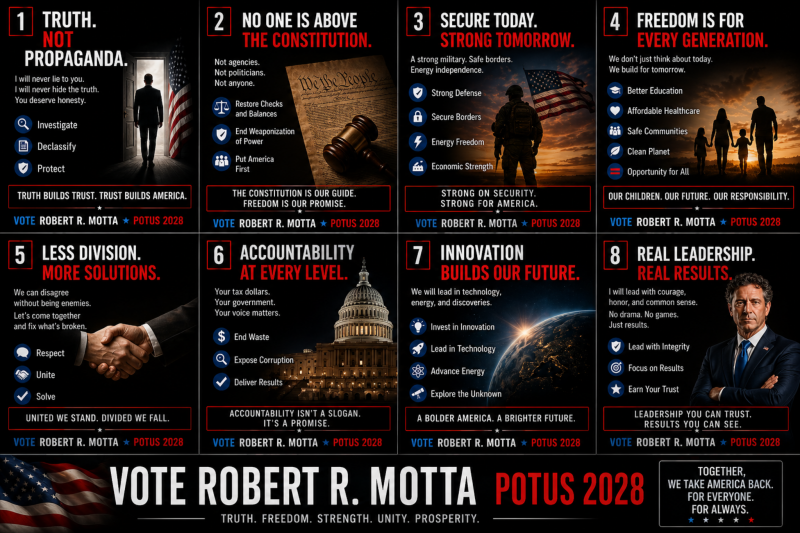
— Robert Motta (@rm044335) April 26, 2026
— Robert Motta (@rm044335) April 26, 2026
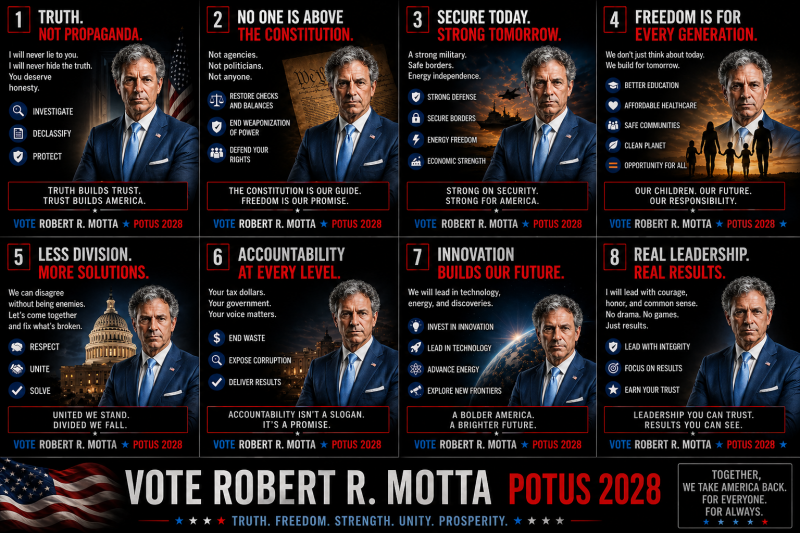
— Robert Motta (@rm044335) April 26, 2026
Follow along using the transcript.
— Robert Motta (@rm044335) April 26, 2026
— Robert Motta (@rm044335) April 26, 2026
One of History’s BEST White House Correspondents Dinner moments was when President Trump called out Hillary Clinton…
— Liz Churchill (@liz_churchill10) April 26, 2026
“Everyone knows of course…Hillary’s belief that it takes a Village…which only makes sense in places like Haiti…where she’s taken a number of them…” pic.twitter.com/DwsON48Ko0
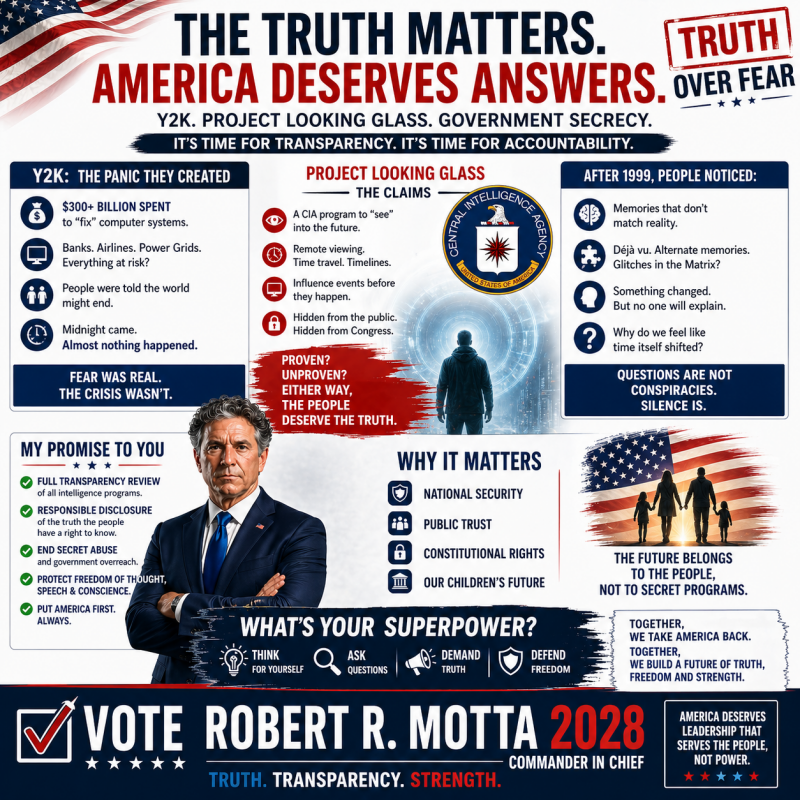
Across media, podcasts, and commentary—including voices like Candace Owens—people are asking questions about:
Government secrecy
Intelligence programs
The Y2K panic and massive tech spending
Claims of hidden technologies like “Project Looking Glass”
Concerns about manipulation, control, and truth
As discussed in the transcript, some claim:
Government programs may have explored advanced tech
Y2K created global fear but resulted in minimal disruption
People feel something changed after 1999
Some believe reality, time, or perception is being influenced
Y2K was real → governments spent $300+ billion fixing systems
Intelligence agencies do run classified programs
Technology has rapidly accelerated since 2000
Public trust in institutions has declined
“Project Looking Glass” predicting the future
Devices that can see timelines
Consciousness controlling reality through machines
Government controlling time or destiny
👉 These claims require evidence — not belief.
Audit classified programs (CIA, DoD, contractors)
Identify:
Waste
Abuse
Overclassification
Declassify what is safe to release
Protect:
National security
Troops
Sources
👉 No more hiding embarrassment behind “classified”
No secret programs used against Americans
No weaponization of intelligence agencies
Restore constitutional limits
Investigate:
Psychological operations (PSYOPs)
Information control
Government-media influence
Your thoughts, beliefs, and future belong to YOU
No system should manipulate human behavior or perception
“If something is real — show the evidence.
If something is hidden — explain why.
If something is wrong — fix it.”
Your superpower is:
Thinking for yourself
Asking questions
Demanding truth
Standing up for freedom
My fellow Americans,
You’ve heard the stories.
You’ve seen the headlines.
You’ve felt something isn’t right.
But here’s the truth:
We don’t fix America with fear.
We fix America with facts.
If programs exist — we review them.
If secrets are abused — we expose them.
If power is misused — we stop it.
No hidden system is above the Constitution.
No agency is above the American people.
We will protect this country.
We will tell the truth.
And we will restore trust.
Vote Motta 2028 — Truth. Transparency. Strength.
POST 1
You’ve heard about secret programs.
You’ve heard about hidden tech.
Here’s my promise:
🇺🇸 If it’s real → we review it
🇺🇸 If it’s hidden → we explain it
🇺🇸 If it’s abuse → we END it
No more secrets over the people.
#VoteMotta2028 #TruthMatters
POST 2
What’s your superpower?
🧠 Thinking for yourself
🇺🇸 Standing for truth
🔍 Asking questions
That’s how we take America back.
#VoteMotta2028
POST 3
Fear doesn’t lead this country.
Truth does.
I will audit secret programs, protect national security, and restore trust.
America deserves answers.
#CommanderInChief #VoteMotta2028
— Robert Motta (@rm044335) April 26, 2026
What are we seeing in our skies?
Around the world, pilots, military personnel, and advanced sensors have reported objects that:
Move in ways we don’t fully understand
Appear on infrared systems with unusual signatures
Show patterns we cannot easily explain
These are called UAPs — Unidentified Aerial Phenomena.
Observations have been recorded by trained professionals
Some detections involve advanced sensor systems
Governments have acknowledged unexplained encounters
The origin of these objects
The technology behind them
Whether they are foreign, experimental, or something else
This is not science fiction.
This is about:
National security
Airspace safety
Scientific discovery
Technological leadership
We do not jump to conclusions.
We do not ignore evidence.
👉 We investigate. We test. We lead.
As President and Commander in Chief, I will:
Strengthen detection and response systems
Ensure pilot and civilian safety
Scientists
Engineers
Military experts
Independent researchers
Working together — transparently and responsibly
Military
Intelligence
Aviation
Space
👉 One system. One truth standard.
Without compromising national security
Without hiding information from the public
If new technology exists — anywhere —
America must:
understand it
match it
lead it
There are many voices discussing:
advanced propulsion
plasma-based systems
experimental energy concepts
These ideas should not be blindly believed
👉 or blindly dismissed
They should be tested.
We don’t fear the unknown.
We explore it.
We study it.
We lead it.
This is about:
Your safety
Your future
Your children’s world
My fellow Americans,
For too long, we’ve been told to ignore what we see,
or to accept answers without evidence.
That ends now.
We will not panic.
We will not speculate.
We will investigate.
We will bring together the best minds in science, defense, and innovation
to understand what is happening in our skies and beyond.
Because America does not follow the future.
👉 We lead it.
We don’t ignore the unknown.
We investigate it.
UAPs. Innovation. National security.
Day One:
✔ Protect our skies
✔ Unify data
✔ Launch real research
🇺🇸 #Motta2028 #TruthMatters #AmericaLeads
Remember when Obama and Fauci turned up at schools to guilt-trip children into taking the experimental mRNA injections, in order to "protect" old people? pic.twitter.com/uXs1oQR8hn
— healthbot (@thehealthb0t) April 26, 2026

— Robert Motta (@rm044335) April 26, 2026
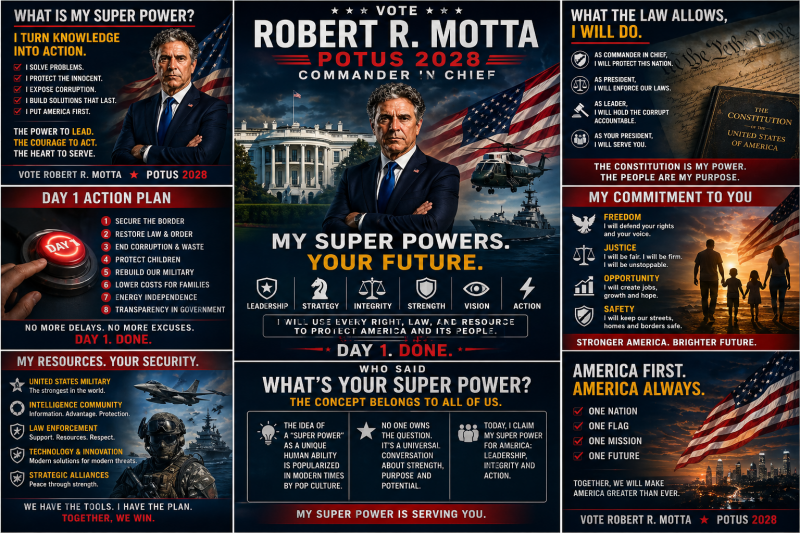
By Robert R. Motta — Candidate for President, POTUS 48, Commander in Chief
Your superpower is not something you wear.
It’s not something you’re born famous with.
👉 It’s something you choose to use.
The courage to stand up
The strength to protect others
The discipline to build something better
The voice to speak truth
The heart to care when others don’t
That’s your superpower.
I turn knowledge into action.
I protect the innocent
I expose corruption
I build solutions that last
I fight for families, children, and future generations
I put America first
This campaign is not about one man.
It’s about unlocking the power of millions of Americans.
Because when YOU use your superpower:
Families become stronger
Communities become safer
Innovation moves forward
Truth defeats fear
As President and Commander in Chief, I will:
Secure our nation and protect our people
End fraud, waste, and abuse in government
Defend children and families
Support innovation, inventors, and builders
Restore trust through transparency and accountability
Strengthen America’s future for your children and mine
This is for:
Bobby and Carly Motta
Your children
Your grandchildren
Every future American
We are not just running a campaign.
We are building a future.
Ask yourself:
👉 What is MY superpower?
👉 How can I use it to help America?
Because no government can replace the strength of its people.
No one owns the idea of a “superpower.”
It belongs to every human being.
And in America —
we use it to build, protect, and lead.
My superpower is serving you.
Your superpower is changing the future.
Together, we don’t wait for change.
We become it.
Stronger America. Brighter Future.
— Robert Motta (@rm044335) April 26, 2026

— Robert Motta (@rm044335) April 26, 2026
— Robert Motta (@rm044335) April 26, 2026
Written for public release by the Robert R. Motta Press Team. Approved by Robert R. Motta, candidate for President of the United States and Commander-in-Chief, 2028.
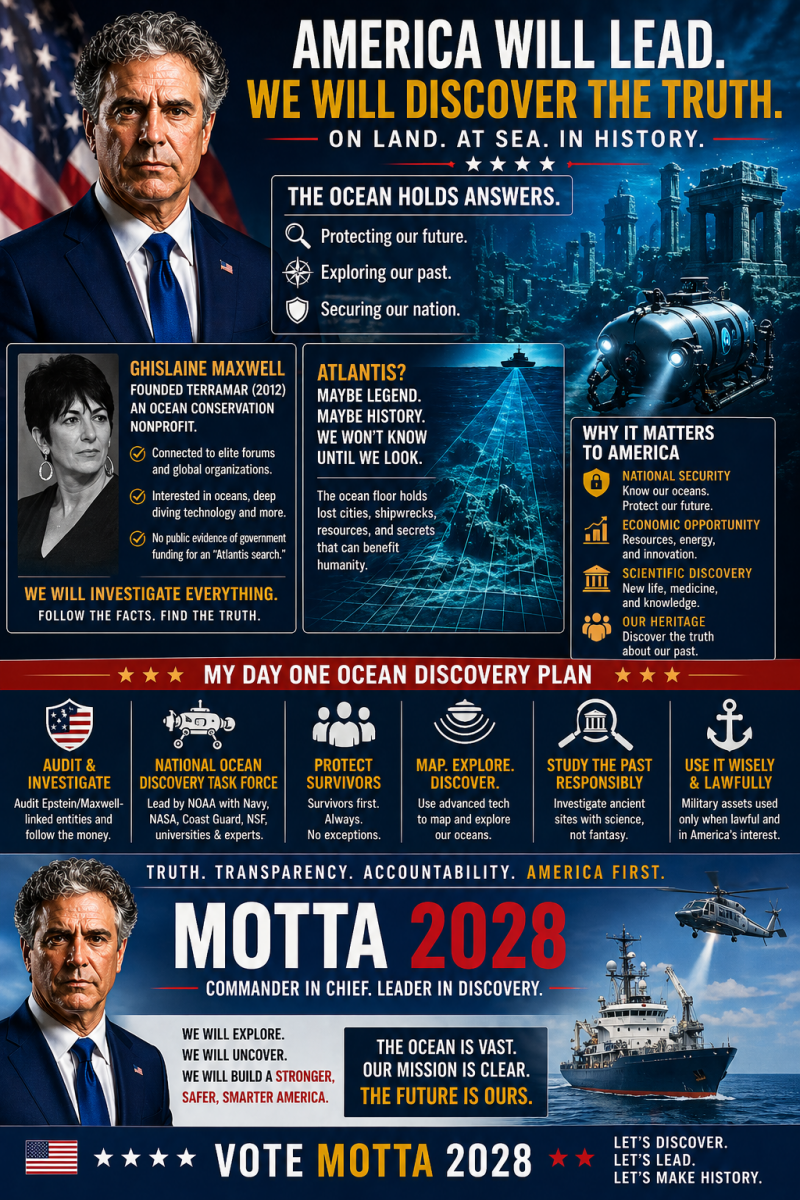
Ghislaine Maxwell founded the TerraMar Project in 2012 as an ocean-focused nonprofit claiming to protect the high seas, the part of the ocean outside any one nation’s jurisdiction. Public summaries report that TerraMar closed in July 2019 shortly after renewed federal charges against Jeffrey Epstein became public. (Wikipedia)
Public records and reporting also connect Maxwell’s TerraMar work to elite forums, including United Nations-related meetings, the Arctic Circle Assembly, the Council on Foreign Relations, and the Clinton Global Initiative. These appearances show access to public-policy circles, but they do not prove that governments funded a secret Atlantis search. (Wikipedia)
Maxwell has been described in public material as interested in ocean conservation, deep-water exploration, submersibles, and marine technology. Some newer online claims say she was searching for Atlantis, but I found no reliable public record proving that a government funded Maxwell to find Atlantis. (Wikipedia)
Atlantis remains a legendary or disputed subject, not an established archaeological site. That does not mean ocean exploration is a waste. The ocean floor contains real lost settlements, shipwrecks, ancient coastlines, mineral resources, biological discoveries, and national-security information. NOAA Ocean Exploration says its mission is to explore the unknown ocean for national benefit, strengthen national security, support economic prosperity, and make collected data publicly available. (NOAA Ocean Exploration)
As Commander-in-Chief, a President can direct national-security priorities and coordinate executive agencies. The Navy is organized, trained, and equipped for national-security interests and operations at sea. (Legal Information Institute)
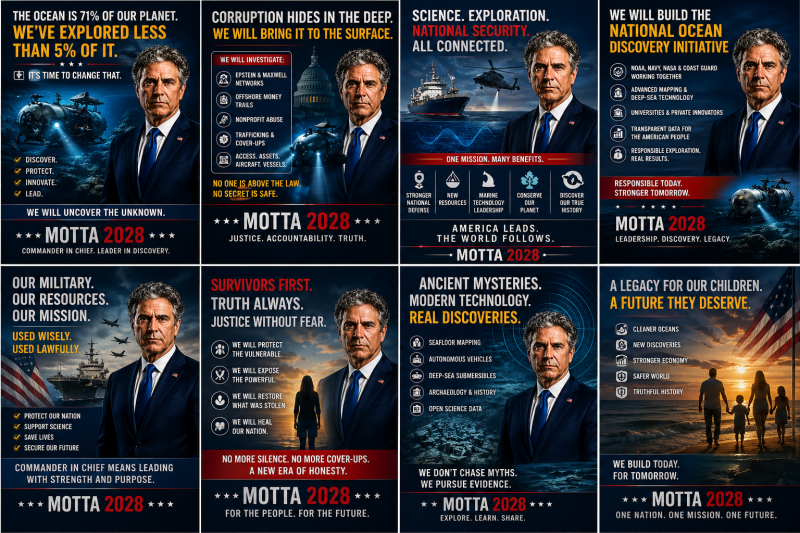
But a President should not use the military for a private treasure hunt. A lawful administration can launch a National Ocean Discovery Initiative through NOAA, Navy, NASA partnerships, universities, private explorers, and transparent grants. The purpose would be science, national security, mapping, archaeology, disaster risk, critical minerals, and public knowledge.
Create a National Ocean Discovery Task Force led by NOAA, with Navy, NASA, Coast Guard, NSF, universities, and vetted private partners.
Audit Epstein/Maxwell-linked ocean entities for trafficking, money movement, nonprofit abuse, foreign contacts, and government-access failures.
Protect survivors first while following evidence wherever it leads.
Map the seafloor for public benefit using sonar, autonomous vehicles, submersibles, and open scientific data where safe.
Investigate ancient submerged sites responsibly without pretending Atlantis is proven before evidence exists.
Use military assets only when lawful and justified by national security, safety, search-and-recovery, or authorized research support.
America should explore the oceans with courage, science, and honesty.
If powerful people used ocean charities, elite access, private vessels, aircraft, or offshore systems to hide crimes, we will investigate. If ancient history lies beneath the sea, we will study it with evidence. If discoveries can help America, we will share them responsibly.
We will not sell fantasy to voters. We will fund real exploration, protect survivors, expose corruption, and build a future worthy of our children.
VoteMotta2028: Truth on land. Truth at sea. America leads discovery.

— Robert Motta (@rm044335) April 26, 2026
— Robert Motta (@rm044335) April 26, 2026
Written by the Robert R. Motta Press Team
Approved by Robert R. Motta, Candidate for President & Commander-in-Chief, 2028
Energy is not just science.
It affects:
Your cost of living
Your job
Your national security
Your children’s future
If breakthrough energy is possible—even partially—America must investigate it honestly and openly.
In the interview, nuclear physicist Max Zamilov explains the history and controversy around cold fusion.
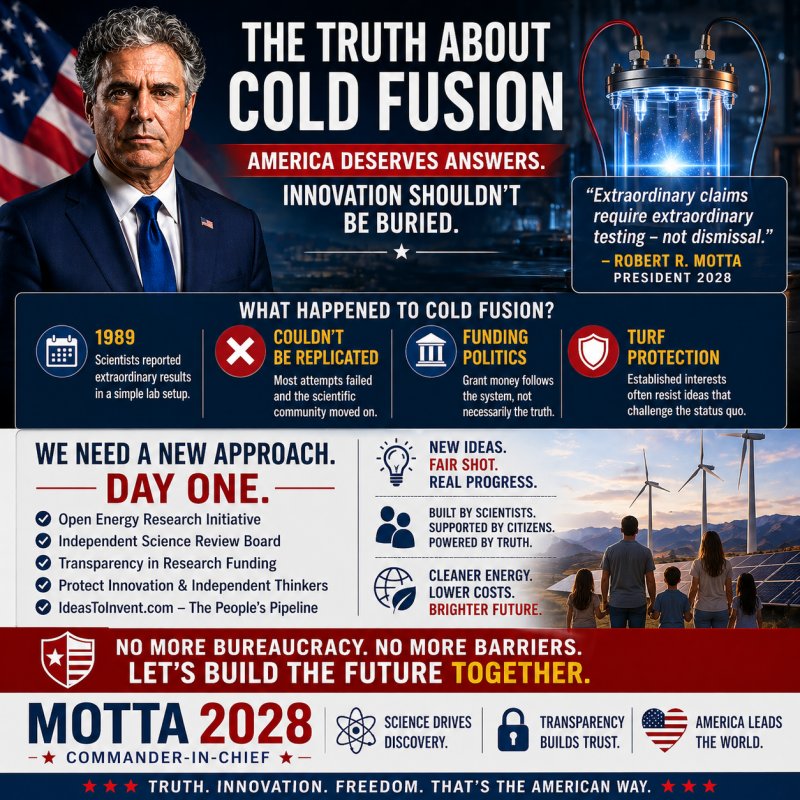
Cold Fusion Claim (1989)
Scientists claimed fusion could occur in a simple lab setup
This challenged traditional high-cost fusion systems
Replication Failure
Major institutions attempted to replicate results
Most failed to confirm the findings
📌 From transcript:
“At the end of the day nobody could replicate the result.”
Zamilov explains multiple factors:
Scientists must compete for limited grants
Research follows funding—not always truth
📌
“You never find funding to do the research you want… the system is screwed up.”
Universities and agencies control funding priorities
Innovative or unconventional ideas struggle to get support
Established research fields defend funding
Competing ideas can threaten careers
📌
“Everybody protects their turf.”
Fusion should produce measurable radiation
Many cold fusion experiments did not show this
📌
“No neutrons, no fusion.”
Original experiments were not reliably replicated
Measurement errors were found in many studies
Cold fusion remains unproven as a working energy source
Whether research was dismissed too quickly
Whether funding structures limit innovation
Whether alternative fusion methods could still exist
That cold fusion was successfully hidden
That a working system exists today
This is not about conspiracy.
This is about:
👉 Whether America investigates ideas fairly
Fund:
Fusion (traditional + alternative)
advanced materials
experimental energy systems
Remove political bias from funding decisions
Include:
physicists
engineers
independent researchers
Publish:
what is funded
what is rejected
why
Support:
small labs
independent inventors
non-traditional research paths
Public submission pipeline for:
new energy concepts
experimental ideas
citizen innovation
Like many Americans, I had to learn outside the system.
From:
online education
independent researchers
real-world experimentation
👉 That experience showed me:
Innovation doesn’t only come from institutions
Curiosity must be protected—not suppressed
My fellow Americans,
We don’t fear new ideas.
We test them.
We don’t silence innovation.
We challenge it—and prove it.
Cold fusion may not be solved yet.
But the bigger issue is this:
👉 Did we give it a fair chance?
As President, I will make sure no idea is buried because it threatens funding, power, or bureaucracy.
We will fund truth.
We will test innovation.
And we will build the future—together.
🇺🇸 Vote Motta 2028
Energy shouldn’t be controlled by bureaucracy.
It should be driven by truth, testing, and innovation.
We don’t ignore ideas.
We investigate them.
🇺🇸 #Motta2028 #EnergyFuture #Innovation
Written by the Robert R. Motta Press Team
Approved by Robert R. Motta, Candidate for President & Commander-in-Chief, 2028
Like many Americans, I trusted systems that were supposed to protect me.
Doctors. Lawyers. Courts. Institutions.
But over time, I learned something important:
👉 Not every system is broken—but some are failing the people they serve.
Years ago, I began studying health and longevity.
I watched experts like:
Peter Attia
Functional medicine educators
Independent health researchers
I also explored:
Nutrition
Metabolic health
Fasting
In 2019, I learned about water fasting through educational content.
I completed:
My first 48-hour water fast
Studied metabolic repair and inflammation
The body can heal when given the right conditions
Prevention matters more than reaction
Many Americans are never taught how to take control of their health
After injuries and legal challenges, I encountered:
Confusion in medical care
Legal processes that felt overwhelming
A system that did not always feel transparent or fair
⚠️ Important for voters:
These are personal experiences and concerns, not legal conclusions.
This is not just about me.
This is about:
Families navigating healthcare
Americans struggling in legal systems
People feeling unheard
Promote preventative care
Expand access to:
Nutrition education
metabolic health tools
lifestyle-based medicine
Support innovation in longevity and wellness
Increase transparency in courts
Strengthen oversight of legal ethics
Protect Americans from fraud, waste, and abuse
No system should be used to:
intimidate citizens
drain resources unfairly
hide misconduct
👉 Justice must be:
fair
transparent
accountable
This campaign is for:
Bobby Motta
Carly Motta
Your children
Your grandchildren
Recent discussions—including videos mentioning:
Peter Attia
Epstein-related files
Show something important:
👉 We need truth—but we also need facts.
We will:
Investigate credible evidence
Protect innocent people
Avoid spreading unverified claims
Because:
👉 Truth without evidence is noise
👉 Evidence without action is failure
My fellow Americans,
I’ve lived what many of you are living.
Trying to stay healthy in a confusing system.
Trying to find justice in a complex system.
Trying to do the right thing—and not always being heard.
That’s why I’m running.
Not to tear down America—
But to fix what isn’t working.
We will build a country where:
health is taught, not guessed
justice is fair, not feared
truth is proven, not hidden
And where your children grow up stronger than we did.
🇺🇸 Vote Motta 2028
I’ve lived it. I’ve learned from it. I’m fixing it.
Health. Justice. Truth.
No more confusion.
No more abuse.
No more silence.
🇺🇸 #Motta2028 #HealthFreedom #JusticeForAll

This is about our children.
— Robert Motta (@rm044335) April 26, 2026
This is about our future.
We don’t look away.
We stand up.
🇺🇸 Together, we rebuild trust.#Motta2028 pic.twitter.com/QtIZSf2OIy
A Wikipedia-style reader feature exploring the vanished flight, the technology workers onboard, intelligence questions, and the difference between evidence, speculation, and civic responsibility.
Summary: Malaysia Airlines Flight MH370 disappeared on March 8, 2014, while flying from Kuala Lumpur to Beijing with 239 people aboard. The disappearance remains one of modern aviation’s most discussed mysteries. Some commentators connect the case to scientists, espionage, military technology, or intelligence agencies. This article walks the reader through those claims while separating known facts from unverified theories.
MH370 was a Boeing 777-200ER operated by Malaysia Airlines. It departed Kuala Lumpur International Airport for Beijing Capital International Airport and later disappeared from civilian radar. Subsequent analysis indicated that the aircraft changed course and likely continued flying for hours.

The following embedded videos are included for readers who want to examine mainstream documentary coverage and public discussion. These videos are not endorsements of every claim made in them; they are included as research material.
One of the most repeated details about MH370 is that 20 employees of Freescale Semiconductor were aboard. Twelve were reportedly from Malaysia and eight from China. This fact is real, but online discussions often expand it into claims that the passengers were “quantum scientists” or secret weapons engineers.
The better description is more careful: they were technology employees connected to semiconductors and electronics. Semiconductor knowledge is important to national security and economic competition, but that does not prove the flight was targeted.
Ashton Forbes is known online for promoting alternative theories about MH370, including claims involving unusual video evidence and advanced technology. His work has drawn attention because it offers a dramatic answer to an unresolved tragedy.
For readers, the fair question is not whether a theory is exciting. The fair question is whether it is supported by verifiable evidence. At present, no public investigation has confirmed claims that MH370 was teleported, seized by the U.S. military, or removed through a covert CIA operation.
Intelligence agencies do conduct espionage. Nations do compete for scientists, semiconductor capability, quantum research, artificial intelligence, and military technology. The United States, China, Russia, and other countries all treat high-end technical knowledge as strategically important.
However, that reality does not automatically validate every theory about MH370. A CIA operation involving a civilian aircraft with 239 people would require extraordinary evidence. Publicly available evidence has not established that such an operation occurred.
In an April 23, 2026 video, Ashton Forbes argued that the UFO community is looking in the wrong direction. Instead of beginning with aliens, he points readers toward Lockheed Martin’s Skunk Works, the CIA, and the U.S. Air Force. His central claim is simple: if advanced aerial technology exists, it may come from classified human engineering rather than extraterrestrial visitors.
Forbes cites Ben Rich’s memoir about Lockheed Skunk Works, emphasizing the line that Skunk Works functioned for years as the CIA’s unofficial “toy makers.” That historical point is real: Rich wrote that Skunk Works built highly advanced aircraft for secretive missions and that its principal customers included the Central Intelligence Agency and the U.S. Air Force.
The strongest part of Forbes’ argument is the historical pattern: secret aircraft, intelligence funding, contractor engineering, and long-term classification are all real features of U.S. national security history. The weakest part is the jump from that history to the specific conclusion that CIA “orbs” intercepted or removed MH370. That jump needs evidence that has not been publicly established.
For readers, Forbes’ argument is useful because it redirects the discussion from fantasy to institutions: contractors, budgets, classified programs, intelligence oversight, and military secrecy. Even if his MH370 conclusion is wrong, the broader civic question remains important: how much advanced technology can exist behind classification before democratic oversight becomes too weak?
In the United States, covert action generally requires presidential authorization and legal notification to congressional intelligence oversight committees. Individual senators do not personally “approve” CIA field operations. Figures such as Marco Rubio may have oversight roles depending on committee assignments and offices held, but oversight is not the same as operational command.
In Ashton Forbes’ “Once You Build for the CIA, You Never Stop” transcript, the free-energy idea appears as part of a larger claim about classified technology. Forbes argues that once a contractor builds advanced systems for the CIA, Air Force, or other secretive government customers, the technology can become trapped behind classification. In that model, a company may not be free to commercialize a breakthrough even if the breakthrough could benefit the public.

Forbes uses Lockheed Martin as the example. He points to Ben Rich’s Skunk Works history and argues that a long CIA–Lockheed relationship could create a hidden technology pipeline. His core claim is that a contractor might build advanced systems for classified missions, then lose the ability to turn related technology into public products. He frames this as one way a “breakaway civilization” could hoard technology outside ordinary markets.
Lockheed Martin did publicly announce a Compact Fusion Reactor concept in 2014. The announcement drew attention because it came from Skunk Works, a division famous for secret aircraft programs. The idea was bold: a much smaller fusion reactor that could someday deliver powerful, clean energy from a compact machine.
The public fact-check is more cautious. Lockheed’s compact fusion announcement was real, but there is no public proof that the company produced a working commercial fusion reactor. The projected timeline did not result in a publicly available power plant. That means the transcript’s idea can be discussed as a theory about classification and incentives, but it should not be presented as proven fact.
For a general audience, the phrase “free energy” needs careful language. In physics, energy is not created from nothing. Machines must obey thermodynamics. Reactors, turbines, panels, batteries, grids, and maintenance all cost money. But in civic language, “free energy” often means energy that is so abundant, clean, and cheap that ordinary families everywhere can live with far less hardship.
Fusion is the process that powers the Sun. It releases energy by joining light atoms together. Scientists want fusion because it could provide dense, low-carbon power with less long-lived waste than conventional nuclear fission. But Earth-based fusion is difficult. Plasma must be heated to extreme temperatures, confined, controlled, and converted into useful electricity.
Real progress exists. The National Ignition Facility has reported fusion ignition in laser-driven experiments, and international projects such as ITER continue to test magnetic confinement fusion. These are major scientific steps, but they are not the same as a finished power plant. A real fusion power plant must produce net electricity after all losses, operate repeatedly, survive harsh conditions, and compete economically.

If the goal is energy dignity for every human being, fusion is only one possible future path. The world can also expand technologies that already work. Solar, wind, hydroelectric power, geothermal systems, modern nuclear fission, grid upgrades, batteries, and efficiency improvements can all help reduce energy poverty now.
These videos help readers compare the promise of fusion with the engineering difficulty. They are included for education and are not endorsements of every claim.
A pro-America, pro-human energy policy should ask two questions at once: What is scientifically real? And who benefits? If a breakthrough exists, it should not become only a weapon, monopoly, or classified toy. If a technology is not proven, leaders should not sell fantasy. The goal should be honest science, lower bills, cleaner air, national security, and energy dignity for every family on Earth.
This module explains the Julian Dorey Podcast episode featuring Matthew Hedger and Shawnee Delaney. Hedger is presented in the episode as a former CIA “NOC” operative, while Delaney is presented as a former DIA clandestine operations officer. The conversation covers non-official cover, deep-cover identity building, covert finance, cartel infiltration, insider threats, AI-enabled espionage, and the moral gray zone of intelligence work.

In the transcript, Hedger explains that “NOC” means non-official cover. The term refers to an intelligence officer or operative who is not presented as a diplomat and does not have the protection of a diplomatic passport. In simple terms, a NOC lives under a civilian, business, or other non-government identity. If caught, the operative may be deniable.
The episode centers on two intelligence-world guests. Matthew Hedger describes a career involving deep cover, covert finance, criminal-world cover, and alleged cartel money-laundering access. Shawnee Delaney describes experience in Defense Intelligence Agency work, counterintelligence, cybersecurity, insider-threat programs, surveillance, investigations, and AI-related threats.
In the episode, “going black” means slipping away from the visible cover activity to conduct an operational act without the surrounding people realizing what happened. The cover group may think the person went for a run, attended a meeting, or handled ordinary business while the real mission occurs elsewhere.
A legend is the constructed identity and backstory behind a cover life. The transcript discusses backstopping details such as credit history, memberships, habits, and other records that make a fake identity feel real when investigated.
Hedger describes rehearsing fake memories until they can be recalled like real experiences. Instead of inventing a story under pressure, the operative can recall a rehearsed scene with details such as food, weather, location, and conversation.
This means engineering a meeting so the target feels it happened naturally. The transcript gives the example of using a target’s favorite book or hobby so the target initiates conversation and feels a sense of personal connection.
The conversation repeatedly returns to one idea: intelligence work is less like a movie chase and more like long-term human influence. The guests describe spotting a target, assessing access and vulnerability, developing trust, recruiting cooperation, handling the relationship, and eventually ending the relationship. Delaney compares this process to dating because each step depends on psychology, patience, trust, and timing.
In the transcript, targets are not always dramatic villains. Some are bankers, corporate employees, smugglers, family people, or ordinary-looking individuals with access. The episode argues that access matters more than movie-style toughness. A person who can move money, unlock a system, introduce a banker, or plug in a device can matter more than a violent criminal boss.
A major theme of the episode is covert finance. Hedger says part of his work involved moving money so it did not appear to come from the U.S. government. He describes why an intelligence service would need this: paying sources, funding operations, purchasing restricted technology, or operating in hostile environments where a direct U.S. government payment would expose people.
The transcript also covers alleged criminal-world cover. Hedger describes access to biker gangs, cartel-linked money movers, international banks, and laundering networks. Readers should treat the specific personal stories as claims from the guest. The broader concept is real: governments, criminals, banks, shell companies, trade networks, cash systems, and crypto can all intersect in illicit finance investigations.
Delaney emphasizes insider threat: the danger created when someone inside a trusted organization misuses access, gets compromised, clicks malicious links, leaks secrets, or helps an adversary. The episode uses the example of one disgruntled insider causing massive damage. It also discusses corporate security failures, employee vulnerability, and how ordinary human trust can be exploited.

The episode argues that AI has lowered the barrier for fraud, corporate espionage, and manipulation. Delaney describes voice cloning, deepfake scams, AI-assisted phishing, and tools that can analyze employee behavior for signs of risk. Hedger adds that AI can accelerate the creation of targeting packages by summarizing a person’s vulnerabilities, preferences, communications, and patterns.
These videos are included so readers can understand the vocabulary and compare this episode with broader public discussion of intelligence work. They are educational embeds, not endorsements of every claim.
A CIA NOC, as explained in the episode, is a deep-cover operator without diplomatic cover. The work described is not mainly glamorous action. It is identity construction, patience, psychological influence, risk management, and constant awareness that a single mistake can expose the person, the mission, or people around them.
This campaign module translates Ashton Forbes’ April 24, 2026 transcript into lawful, constitutional campaign language. Forbes speaks in a confrontational style, saying the public should learn how the CIA works, expose its weak points, and “take over the CIA.” In campaign terms, that message becomes: no agency is above the Constitution, no classified program should escape lawful oversight, and the President must appoint leaders who serve the American people.
Forbes argues that the CIA has rules, weaknesses, internal directorates, and vulnerabilities. He says the public can damage hidden power by talking openly about how the system operates. He highlights the Directorate of Science and Technology, covert action, presidential findings, compartmentalization, and classified technology. He also says “Ashton Forbes for CIA director” and notes that the CIA Director is an appointed position.
As President, a VoteMotta administration would have real appointment powers, but those powers operate through law. The President nominates the CIA Director, but the Senate must provide advice, consent, and confirmation. The CIA Director reports to the Director of National Intelligence and manages intelligence collection, analysis, covert action, counterintelligence, liaison relationships, personnel, operations, and budget.
As Commander-in-Chief, the President directs the armed forces. The CIA is not the military, but it is part of the national-security structure. A President can set intelligence priorities, appoint leadership, demand lawful briefings, issue lawful covert-action findings, and insist on oversight. A President cannot lawfully bypass Congress, ignore Senate confirmation, or personally run illegal operations.
A VoteMotta administration would consider outsiders, whistleblowers, technologists, veterans, investigators, and constitutional reformers for advisory roles. Ashton Forbes could be considered for a public-interest advisory role on intelligence transparency, classified technology, or citizen review of unexplained aerospace claims. Considering him for CIA Director would be framed as a serious question requiring vetting, qualifications review, ethics review, clearance review, and Senate confirmation—not as a guaranteed appointment.
Forbes’ strength is public pressure. He knows how to build attention, challenge official narratives, and force questions into the open. His weakness, as a formal nominee, is that there is no public record showing senior intelligence management, military command, Senate-confirmed office, or agency leadership experience. A credible campaign can say he is under consideration for an advisory or investigative role while reserving CIA Director for a fully vetted, Senate-confirmable national-security leader.
CIA Directors have come from different backgrounds: intelligence professionals, military leaders, legislators, diplomats, lawyers, and senior national-security officials. The lesson for voters is that the role requires more than curiosity. It requires discipline, legality, management ability, credibility with allies, and the independence to tell the President hard truths.
My fellow Americans,
For too long, the people have been told to trust hidden systems without being given enough reason to trust them. We need intelligence agencies. We need brave professionals who protect this nation from real threats. But in a constitutional republic, power must never become untouchable.
As President, I will nominate leaders who understand one simple truth: no agency is above the Constitution. The CIA, the Pentagon, the contractors, and the classified programs all exist to serve the American people—not the other way around.
Independent voices have warned that the public does not fully understand how powerful intelligence technology has become. We will not answer that concern with panic. We will answer it with lawful oversight, serious review, and patriotic transparency.
My administration will review classified technology programs, strengthen congressional oversight, protect whistleblowers who follow the law, and ensure that breakthrough science benefits Americans—not just hidden budgets and private monopolies.
We will defend America. We will protect secrets that truly must remain secret. But we will never accept a permanent shadow government that cannot be questioned. In America, power belongs to the people.
VoteMotta2028: truth, safety, accountability, and constitutional command.
The responsible campaign position is to investigate without prejudging. The Freescale employees aboard MH370 were real technology workers. Intelligence interest in advanced technology is real. U.S., Chinese, Russian, and other intelligence services do target science and technology. But those facts do not prove MH370 was a CIA operation.
The word conspiracy is often used in two very different ways. In everyday speech, it can mean a hidden plan by multiple people. In law, it has a much stricter meaning.
In the transcript context, the speaker explains that “collusion” is not a formal legal term, while conspiracy is a real crime with a high legal standard. fileciteturn10file0
Courts are designed to separate:
Across the United States, people sometimes believe courts, lawyers, banks, or agencies acted unfairly in their personal cases. These concerns can involve:
However, for readers, the key distinction remains:
VoteMotta2028 supports investigating fraud, waste, abuse, and misconduct. But it also supports the rule of law:
We will never ignore corruption. But we will never replace evidence with rumor. Justice means facts, records, and proof—applied equally to every American.
This VoteMotta2028 civic-education module explains what public servants swear to do, what courtroom integrity requires, and how a constitutional campaign can demand zero tolerance for fraud, waste, abuse, perjury, hidden evidence, retaliation, and politically motivated misuse of legal power.
Zero tolerance for fraud, waste, abuse, false evidence, hidden evidence, intimidation, retaliation, and political lawfare. Public office is not private property. Courtrooms are not weapons. Government power belongs under oath, under law, under evidence, and under public accountability.
American public service begins with an oath. The President swears to faithfully execute the office and preserve, protect, and defend the Constitution. Federal employees swear to support and defend the Constitution against enemies foreign and domestic. Federal judges swear to administer justice without respect to persons and to do equal right to the poor and the rich. Military enlistees swear to support and defend the Constitution while obeying lawful orders under regulations and the Uniform Code of Military Justice.
Lawyers are bound by professional-conduct rules in their jurisdictions. Prosecutors have special duties because they use the power of the state. ABA Model Rule 3.8 says prosecutors must not prosecute charges they know are unsupported by probable cause and must timely disclose evidence that tends to negate guilt or mitigate punishment. The ABA commentary says a prosecutor is a “minister of justice,” not merely an advocate.
| Rule / Case | Plain-English meaning | Source |
|---|---|---|
| Brady rule | Prosecutors must disclose material favorable evidence to the defense. | Cornell Wex: Brady rule |
| Giglio v. United States | Promises, benefits, or credibility issues involving key government witnesses can be impeachment evidence that must be disclosed. | Justia: Giglio |
| Napue v. Illinois | A prosecutor cannot allow known false testimony to go uncorrected. | Justia: Napue |
| Mooney v. Holohan | A conviction obtained through knowingly used perjured testimony violates due process. | Justia: Mooney |
| Judicial ethics | Federal judges should uphold integrity, avoid impropriety, and perform duties fairly, impartially, and diligently. | U.S. Courts: Code of Conduct |
The Code of Conduct for United States Judges says public confidence in the judiciary depends on integrity and independence. Judges should avoid impropriety and the appearance of impropriety, act impartially, and disqualify themselves when impartiality might reasonably be questioned. Chief Justice John Roberts warned in his 2024 year-end report that violence, intimidation, disinformation, and defiance of lawful court judgments threaten judicial independence and the rule of law.
Police officers often take state or local oaths, and many agencies use an oath of honor promising integrity, courage, respect for the Constitution, and public trust. In court, officer credibility matters. Under Brady and Giglio principles, impeachment information about law-enforcement witnesses can become important if it affects credibility, bias, truthfulness, or reliability.
Fraud, waste, and abuse are not slogans; they are oversight categories. Inspectors General exist to prevent and detect fraud, waste, and abuse and to promote economy, efficiency, and effectiveness in government programs. The False Claims Act is one of the federal government’s strongest tools for recovering taxpayer money from false claims; DOJ reported more than $2.68 billion in False Claims Act settlements and judgments in fiscal year 2023.
“Lawfare” is commonly used to describe the misuse of legal processes as a weapon. In campaign language, it should be defined carefully: not every prosecution of a political figure is lawfare, and not every acquittal proves corruption. The question is evidence, motive, procedure, equal treatment, and whether the same rules apply to powerful and ordinary people alike.
American history includes famous cases where many people doubt official accounts. The responsible campaign position is transparency without pretending suspicion is proof. For JFK, the National Archives continues publishing assassination records, and the Warren Commission identified Lee Harvey Oswald as the assassin while later public debate continued. For Dr. Martin Luther King Jr., the House Select Committee on Assassinations found that James Earl Ray fired the fatal shot, while also finding a likelihood of conspiracy based on available circumstantial evidence and separately stating that no federal, state, or local government agency was involved. For current defendants such as Tyler Robinson, the only constitutional answer is due process: presumption of innocence, public evidence, lawful discovery, fair jury, and no trial by rumor.
Great public speeches remind citizens that justice requires courage and service. Dr. Martin Luther King Jr. wrote from Birmingham Jail that “injustice anywhere is a threat to justice everywhere.” John F. Kennedy’s inaugural address called Americans to ask what they could do for their country. Theodore Roosevelt’s “Man in the Arena” praised the person who actually strives in a worthy cause. Dwight Eisenhower warned about the military-industrial complex and the danger of concentrated power.
My fellow Americans,
Every officer of this Republic serves under an oath. The oath does not belong to a party. It does not belong to a donor. It does not belong to a courtroom clique, a contractor, a lobbyist, or a political machine. The oath belongs to the Constitution and to the people.
When judges forget equal justice, when prosecutors hide evidence, when police lie, when officials waste taxpayer money, when agencies retaliate against whistleblowers, and when powerful people use the law as a weapon, the oath has been broken.
We will restore the oath. We will protect lawful judges from intimidation and hold corrupt officials accountable. We will protect honest police and expose dishonest ones. We will defend victims and the accused alike by demanding evidence, due process, and truth.
We will build a government where fraud, waste, and abuse meet zero tolerance; where justice is not for sale; where no citizen is framed by rumor; and where no official is too powerful to answer questions.
VoteMotta2028: the oath comes first.
This campaign module is designed for voters on the left, right, and center. Americans disagree on many things, but many share the same concern: no intelligence agency should be above the Constitution, above Congress, above courts, or above the American people.
Defend America. Follow the Constitution. End torture. Protect lawful whistleblowers. Stop political weaponization. Audit contractors. Declassify responsibly. Respect civil liberties. Tell the truth to the people.
Progressives often focus on civil liberties, torture, drones, secrecy, and whistleblower retaliation. Conservatives often focus on politicized intelligence, surveillance abuse, deep-state power, and border/national-security failures. Independents often focus on competence, waste, truth, and whether powerful institutions are accountable. A serious reform campaign can speak to all three groups without weakening national security.
| # | Issue | Why voters care | VoteMotta2028 position |
|---|---|---|---|
| 1 | Torture and black sites | The Senate torture report and later public reporting documented brutal interrogation practices and major contractor involvement. | No torture, no black sites, no rebranding cruelty as “enhanced interrogation.” |
| 2 | John Kiriakou and selective accountability | Kiriakou went to prison for disclosing classified information, while many architects or defenders of the torture program avoided comparable punishment. | Support a lawful pardon/clemency review if he has not already received one. |
| 3 | Section 702 and warrantless surveillance concerns | Section 702 surveillance targets foreigners but can incidentally collect Americans’ communications, creating bipartisan privacy concerns. | Protect foreign-intelligence capability while requiring stronger safeguards for Americans. |
| 4 | Politicization of intelligence | Voters fear intelligence can be shaped to serve presidents, parties, or narratives instead of truth. | Demand written dissent channels, protected analysts, and penalties for political manipulation. |
| 5 | Overclassification and declassification abuse | Too much secrecy hides mistakes, but reckless declassification can expose sources and methods. | Responsible declassification with independent review and source protection. |
| 6 | Whistleblower protection | Employees need safe lawful channels to report abuse, fraud, torture, illegal surveillance, or politicized intelligence. | Protect lawful whistleblowers; punish retaliation. |
| 7 | Contractor power and waste | The torture program showed how contractors can gain enormous power and profit inside secrecy. | Audit major intelligence contracts and ban conflicts of interest. |
| 8 | Covert action oversight | Secret operations can affect wars, foreign governments, civilians, and U.S. credibility. | Require lawful presidential findings and real congressional notification. |
| 9 | Election-interference intelligence | Foreign interference claims can be real, exaggerated, politicized, or underplayed. | Publish public evidence summaries whenever possible while protecting sensitive sources. |
| 10 | Accountability for leadership failures | Directors and senior officials often leave office, write books, join media, or enter private work after controversial programs. | Create post-service ethics rules, public accountability reports, and stronger oversight hearings. |
The transcript claims John Brennan helped drive the John Kiriakou prosecution and criticizes Brennan’s public position on torture. It also raises the question of why Donald Trump has not pardoned Kiriakou despite Trump’s public hostility toward Brennan. These are strong commentary claims, not court findings. The established public record is that Kiriakou was sentenced to 30 months in prison after pleading guilty to disclosing the identity of a covert officer, and that the Senate torture report documented extensive CIA abuses and contractor involvement.
CIA reform has never belonged to only one party. Senator Dianne Feinstein led the Senate torture investigation from the Democratic side. Senator John McCain, a Republican and torture survivor, strongly opposed torture. Civil-liberties Democrats and libertarian-leaning Republicans have challenged surveillance powers. National-security hawks in both parties argue that intelligence tools are necessary to stop terrorists, hostile states, cyberattacks, cartels, fentanyl networks, and foreign election interference. A serious president must listen to all sides while enforcing the Constitution.
America needs intelligence professionals who can stop real threats before they reach our families. But the CIA must never become a law unto itself.
We will defend this nation without torture. We will protect secrets without hiding corruption. We will support brave officers without protecting abusive leaders. We will gather intelligence without turning government power against the American people.
Left, right, and independent voters all deserve the same promise: the Constitution comes first.
VoteMotta2028: strong intelligence, clean hands, constitutional command.
This VoteMotta2028 campaign module is based on the Ashton Forbes interview with Salvatore Cezar Pais, where the discussion moves through Navy patents, fusion, spacetime manipulation, wormholes, time travel, MH370 claims, artificial intelligence, China, disclosure, and the question of whether breakthrough science can become either a human blessing or a doomsday weapon.
As a candidate for President and future Commander-in-Chief, Robert R. Motta will champion American inventors, military engineers, garage builders, independent scientists, and lawful whistleblowers. A VoteMotta administration will review breakthrough energy, propulsion, medical, and aerospace ideas through evidence, testing, national security safeguards, and public benefit—not ridicule, gatekeeping, or political favoritism.
Salvatore Cezar Pais is an aerospace engineer associated with the U.S. Navy and Naval Air Systems Command/Naval Air Warfare Center Aircraft Division in public patent and publication records. He is known for a controversial group of Navy-assigned patents often called the “UFO patents” in media coverage. These patents propose high-energy electromagnetic systems, inertial mass reduction, high-frequency gravitational wave generation, piezoelectricity-induced room-temperature superconductivity, and plasma-compression fusion.
In the transcript, Pais repeatedly emphasizes that he speaks as a private citizen and that his opinions are his own, not official statements of the Navy or Space Force. He says the technologies are “man-made tech,” not alien technology, and frames his purpose as human unification and survival rather than personal fame. fileciteturn14file0

The transcript contains dramatic language. Pais describes “weapons of time,” “wormhole weapons,” reverse temporal excursion, spacetime tearing, fusion power sources, artificial intelligence, and the possibility that advanced technology could be either an energy panacea or a doomsday weapon. He tells Congress-style questioners that the most important thing to understand is that this technology could be “a panacea to the energy needs of the entire mankind” or “one of the greatest doomsday weapons” ever designed. fileciteturn14file0
| # | Title | Public status / plain-English meaning | Source |
|---|---|---|---|
| 1 | Electromagnetic Field Generator and Method to Generate an Electromagnetic Field | Navy-assigned patent involving high-intensity electromagnetic field generation through vibration and electrical charging. | Google Patents: US10135366B2 |
| 2 | Craft Using an Inertial Mass Reduction Device | Navy-assigned patent describing a craft using microwave emitters and resonant cavities to create a local polarized vacuum outside the craft. | PubChem: US10144532B2 |
| 3 | High Frequency Gravitational Wave Generator | Navy-assigned patent describing gas-filled shells, microwave emitters, sound generators, charged vibrating surfaces, and gravitational-field fluctuations. | PubChem: US10322827B2 |
| 4 | Piezoelectricity-Induced Room Temperature Superconductor | Patent application describing a wire with an insulator core and metal coating, where pulsed current plus vibration is claimed to induce room-temperature superconductivity. | USPTO.report: US20190058105A1 |
| 5 | Plasma Compression Fusion Device | Patent application and related IEEE paper proposing plasma-compression-induced nuclear fusion using high magnetic-energy flux. | ResearchGate / IEEE paper record |
| 6 | The High Energy Electromagnetic Field Generator | Peer-reviewed 2015 paper associated with Pais’ broader electromagnetic-field ideas. | ResearchGate / Inderscience paper record |
In the transcript, Salvatore Pais emphasizes the need for lab access, instrumentation, and sustained funding to test high-energy electromagnetic, plasma, and fusion concepts. fileciteturn14file0
VoteMotta2028 commitment: establish a lawful, audited pathway to provide lab time, equipment, and peer review for high-potential concepts—without bypassing safety, export controls, or classification rules.
This approach funds innovation while preventing misuse, ensuring taxpayer accountability, and separating measured results from unverified claims.
Robert R. Motta’s campaign can honor Pais without overstating the science. The responsible position is not blind belief and not lazy dismissal. The responsible position is: test the claims, publish what can be published, protect what must be protected, and make sure any peaceful breakthrough benefits humanity.
A VoteMotta administration will propose a lawful Future Science Review Board involving the Navy, Air Force, Space Force, NASA, DARPA, DOE national laboratories, NSF, NSA, CIA, DIA, ODNI, university physicists, independent engineers, garage inventors, and ethical civilian observers. Its purpose will be to evaluate advanced energy, propulsion, AI, materials, and medical technologies under strict safety, classification, and public-benefit standards.
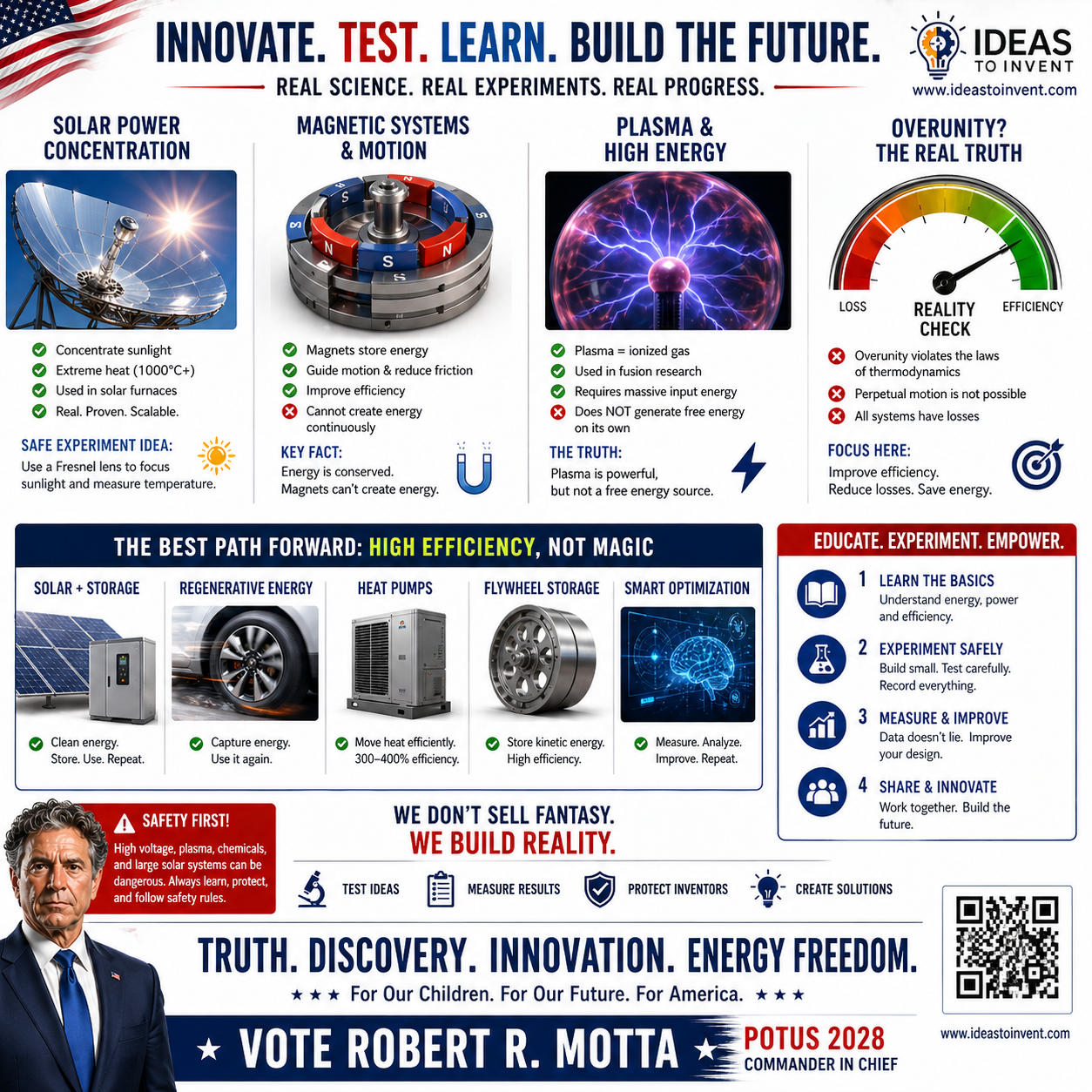
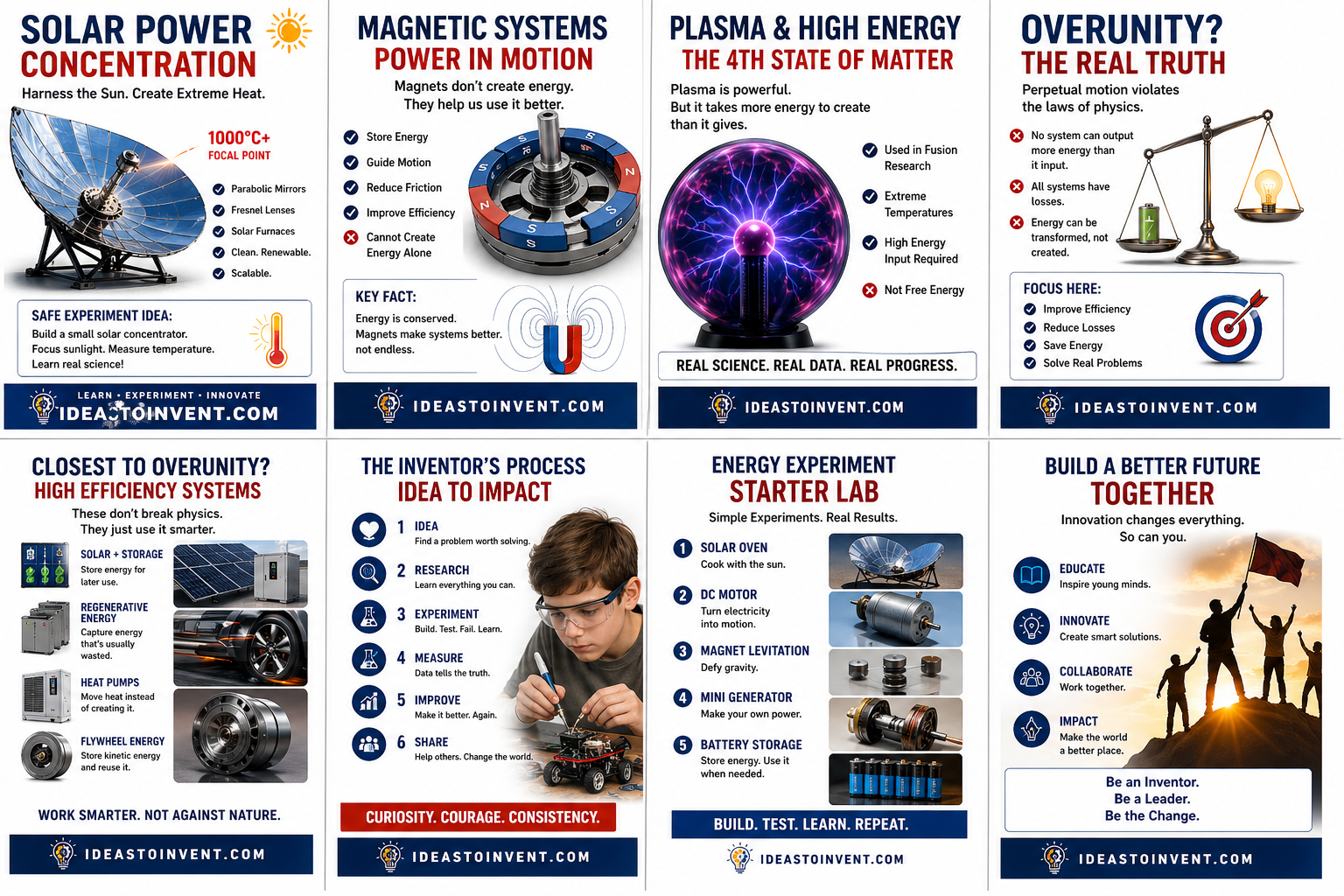
The campaign will support www.ideastoinvent.com as a citizen-inventor and AI-assisted study concept: a place where Americans can submit ideas, 3D models, prototypes, patent leads, scientific questions, and open-source evidence for structured review. The goal is to help inventors move from imagination to documentation: diagrams, physics assumptions, safety review, cost analysis, patent research, prototype pathways, and independent testing.
As President, Robert R. Motta could lawfully consider national honors for inventors and service members, including the Presidential Medal of Freedom for civilian contribution and military decorations through lawful Department of Defense processes where eligibility is met. The President cannot simply award a Nobel Prize; Nobel Prizes are awarded by independent Nobel institutions under their own nomination rules. A President can publicly advocate for recognition, support research, and encourage qualified nominators to consider deserving inventors.
As President, I will review Dr. Salvatore Cezar Pais and other military inventors for the highest lawful honors available to a President where evidence, service, and national benefit justify recognition. I will also advocate that peaceful breakthrough inventors—uniformed, civilian, university-based, or garage-built—receive serious consideration for the world’s highest scientific honors when their work is independently proven.
America must become the country where the next Nikola Tesla, the next Grace Hopper, the next Katherine Johnson, the next Sal Pais, or the next unknown garage inventor is not ignored, mocked, or buried, but tested fairly and honored when proven.
Dr. Weiping Yu is publicly described by the Motor & Drive Systems/Magnetics Conference as a NASA physicist and Crew Spacecraft Subsystem Manager at Kennedy Space Center. His Uon Theory of Everything proposes a magnetic-dipole foundation for matter, forces, fields, and charge. In public summaries, Yu argues that conventional particles such as electrons and protons are emergent constructs of deeper magnetic interactions. This is not mainstream consensus physics, and readers should treat it as an alternative theory requiring independent validation.
In the transcript, Pais says disclosure should happen “carefully” and “in steps,” not all at once. fileciteturn14file0 A VoteMotta administration will use that principle for advanced technology: protect national security, prevent panic, avoid weaponization, but refuse permanent secrecy when peaceful benefits can transform energy, medicine, transportation, and human survival.
My fellow Americans,
Our nation was built by inventors, engineers, soldiers, sailors, scientists, machinists, farmers, coders, dreamers, and citizens who refused to accept that the future had already been decided.
Dr. Salvatore Cezar Pais reminds us that bold ideas should not be laughed out of the room before they are tested. Dr. Weiping Yu reminds us that even the deepest assumptions in physics should be questioned with discipline and courage. Independent inventors remind us that genius does not always wear a badge, hold a chair at a university, or come from inside a federal laboratory.
As President and Commander-in-Chief, I will defend our nation, protect our service members, and demand that breakthrough science be reviewed with seriousness. If a technology can provide clean energy for humanity, heal disease, protect Earth, or move civilization forward, it must not be buried forever in fear, bureaucracy, or private monopoly.
But we will also be wise. We will not hand doomsday tools to the world without safeguards. We will not confuse speculation with proof. We will not sell fantasy to voters. We will test, verify, protect, and then build.
VoteMotta2028: invent the future, protect the people, honor the builders.
This module lists key equations for readers. It clearly separates established physics from speculative or patent-described ideas. No public record verifies working “time weapons.” Equations below are educational anchors so readers can understand what is known versus proposed.
| # | Equation | Meaning (plain English) |
|---|---|---|
| 1 | E = mc² | Mass–energy equivalence: a small amount of mass can convert to large energy. |
| 2 | F = ma | Newton’s Second Law: force equals mass times acceleration. |
| 3 | F = G m₁ m₂ / r² | Gravity between masses decreases with distance squared. |
| 4 | Maxwell’s Equations | Set of equations governing electric and magnetic fields. |
| 5 | Schrödinger Equation | Describes quantum wave behavior of particles. |
| 6 | Einstein Field Equation: G_{μν} = (8πG/c⁴) T_{μν} | Spacetime curvature relates to energy and momentum. |
| # | Equation | Meaning |
|---|---|---|
| 1 | E = Δm c² | Energy released in nuclear reactions from mass defect. |
| 2 | Binding Energy Curve | Shows why fission and fusion release energy. |
| 3 | Fusion Reaction (example) | D + T → He + n + energy |
| # | Equation | Meaning |
|---|---|---|
| 1 | Lawson Criterion | nTτ must exceed threshold for fusion ignition. |
| 2 | Magnetic Pressure: B² / (2μ₀) | Magnetic fields can confine plasma. |
| 3 | Plasma Frequency | Natural oscillation frequency of charged particles. |
These are not standard equations proven in physics textbooks. They are conceptual relationships described in patents and papers.
| # | Concept | Description |
|---|---|---|
| 1 | High Energy EM Field | Extremely high electromagnetic energy density altering local vacuum conditions. |
| 2 | Resonant Cavity Effects | Microwave or vibration-induced resonance affecting mass/energy interaction. |
| 3 | Inertial Mass Reduction (claimed) | Idea that effective mass could be altered via EM/plasma effects. |
| 4 | Plasma Compression Fusion | Using electromagnetic compression to trigger fusion. |
| # | Equation | Meaning |
|---|---|---|
| 1 | Time Dilation: t' = t / √(1 - v²/c²) | Time slows at high speeds. |
| 2 | Gravitational Time Dilation | Time passes slower in stronger gravity fields. |
The transcript references “weapons of time,” wormholes, and spacetime manipulation. These ideas would require solutions to Einstein’s equations involving extreme energy densities (e.g., exotic matter, negative energy). No experimental system has demonstrated this.
Equations are the foundation of truth in physics. If a technology works, it must be expressible, testable, and reproducible through equations and experiments. Claims without verifiable equations and results remain hypotheses, not proven science.
This VoteMotta2028 campaign module explains, in plain language for voters of every age, how inventions can become secret when national security is involved, what rights inventors still have, and what a President and Commander-in-Chief can lawfully do to review secrecy, protect America, and release peaceful breakthroughs when it is safe.
Written by the Robert R. Motta press team. Approved by Robert R. Motta, candidate for President and Commander-in-Chief, 2028.
America must protect its troops, intelligence sources, and national defense. America must also protect inventors, innovation, and the public good. A VoteMotta administration will not recklessly expose dangerous weapons designs. It will also not allow secrecy to become a permanent hiding place for fraud, waste, abuse, monopolies, or peaceful technologies that could help the American people.
The United States Patent and Trademark Office, known as the USPTO, is the federal agency that examines patent applications and grants patents. A patent normally gives an inventor a limited property right in exchange for public disclosure of how the invention works. That public-disclosure bargain is central to American innovation: inventors teach the public, and in return they receive legal protection for a limited time.
Yes. Under 35 U.S.C. § 181, if publication or disclosure of an invention might be detrimental to national security, the Commissioner for Patents can order that the invention be kept secret and withhold publication or patent grant. The law also allows review by defense-related agencies when the government does not already own the invention.
| Law / Rule | What it means for voters | Public source |
|---|---|---|
| 35 U.S.C. § 181 | Allows secrecy orders when publication or patent grant could harm national security. | Cornell LII: 35 U.S.C. § 181 |
| Annual renewal | A secrecy order generally lasts no more than one year unless renewed because the national interest still requires it. | U.S. House: current § 181 text |
| Appeal right | The owner of an application under a secrecy order has a right to appeal to the Secretary of Commerce under rules. | Cornell LII: appeal language |
| Compensation | 35 U.S.C. § 183 provides a path for compensation claims when an invention is kept secret and used by the government. | FAS: Invention Secrecy Act chapter |
| Foreign filing restrictions | U.S. law can restrict foreign patent filings when national security review is required. | FAS: 35 U.S.C. Chapter 17 |
Security-sensitive inventions can include weapons, cryptography, communications security, nuclear-related technology, advanced aerospace systems, surveillance tools, cyber capabilities, and other technologies that could help a hostile power if released without safeguards. The key question is not whether an idea is exciting. The key question is whether public disclosure would put Americans at risk.
Inventors should not be treated as disposable. If the government restricts an invention for national security, the inventor deserves clear rules, due process, lawful appeal options, fair compensation where the law provides it, and a timely review to determine whether secrecy is still required.
The President is Commander-in-Chief of the armed forces and directs national security policy across the executive branch. A President can order agencies to review secrecy policy, require audits, direct responsible declassification reviews, set executive-branch priorities, and nominate leaders who respect both security and innovation. But a President must still obey the Constitution, statutes, court orders, and special legal protections for certain categories of information.
| Presidential power | Campaign explanation | Guardrail |
|---|---|---|
| National-security direction | The President can direct executive agencies to review how secrecy orders are used. | Must protect real defense needs. |
| Declassification review | The President can push responsible declassification where release no longer harms national security. | Must not expose weapons details, sources, methods, or troops. |
| Agency leadership | The President can appoint and nominate leaders who value inventor rights and accountability. | Senate confirmation and ethics rules still matter. |
| Executive orders | The President can issue lawful orders for audits, review boards, and transparency standards. | Cannot override statutes by wish alone. |
| Budget priorities | The President can request funding for testing, labs, and public-benefit research. | Congress controls appropriations. |
VoteMotta2028 supports IdeasToInvent.com as a citizen-invention doorway: a place for inventors, veterans, engineers, students, machinists, coders, and garage builders to document ideas, 3D models, drawings, prototypes, prior-art research, safety concerns, and test plans. The goal is not to promise that every idea works. The goal is to build a fair pathway from idea to evidence.
My fellow Americans,
America wins when inventors are free to build, when soldiers are protected, and when government secrecy serves the people instead of burying truth.
As President and Commander-in-Chief, I will review the patent secrecy system with discipline and respect for national security. We will not release dangerous weapons designs to our enemies. We will not expose our troops, our intelligence sources, or our cyber defenses.
But we will also not allow secrecy to become a hiding place for waste, abuse, monopoly, or forgotten inventions that could help families, lower energy costs, heal disease, strengthen infrastructure, and move America forward.
Under VoteMotta2028, inventors will get a fair hearing. Classified inventions will get lawful review. Peaceful breakthroughs will be considered for responsible release. Dangerous technologies will remain protected.
Protect the secret. Free the breakthrough. Put America’s inventors back at the center of the future.
This VoteMotta2028 campaign module analyzes the 60 Minutes Australia segment titled Inside Epstein's Zorro Ranch: the FBI cover-up exposed. It is written for a public audience in clear, proper tense and separates established facts, survivor testimony, official concerns, and allegations that still require investigation.
Written by the Robert R. Motta Press Team. Approved by Robert R. Motta, candidate for President of the United States and Commander-in-Chief, 2028.
The Epstein case remains a national failure of justice, transparency, and survivor protection. A VoteMotta administration will place survivors first, investigate credible allegations, protect victims’ identities, and hold accountable any person or institution that obstructed justice, ignored evidence, or enabled trafficking.
Jeffrey Epstein owned a remote New Mexico property known as Zorro Ranch. The 60 Minutes Australia transcript describes the ranch as isolated, difficult to escape, and alleged to be one of the locations where Epstein and Ghislaine Maxwell abused and trafficked victims. The segment focuses on survivor testimony, newly discussed Epstein-file materials, a New Mexico truth commission, and unanswered questions about why federal authorities did not fully search or prosecute activity connected to the ranch.
The transcript centers survivor Shantae Davies, who states that she was abused at multiple Epstein properties, including Zorro Ranch. She describes the ranch as eerie, quiet, remote, and frightening because there was nowhere to run and no one nearby to hear screams. She also states that Epstein abused her when she was young and that the experience damaged her life.
| # | Question | Why it matters | VoteMotta2028 response |
|---|---|---|---|
| 1 | Why was Zorro Ranch not searched earlier? | The transcript says other Epstein properties were searched, while New Mexico officials questioned why the ranch was not. | Require a full written federal explanation and congressional review. |
| 2 | What happened to the 2019 tip about alleged buried victims? | The transcript says the tip was forwarded to the FBI and later alarmed state officials. | Audit every credible tip, document each action taken, and reopen unresolved leads. |
| 3 | Why were state investigators told to stand down? | Former New Mexico Attorney General Hector Balderas said federal authorities asked the state to hold back to protect the federal case. | Require written justification whenever federal authorities pause state investigations. |
| 4 | Were possible co-conspirators ignored? | The transcript says New Mexico officials are seeking prosecutions and accountability beyond Epstein. | Appoint independent prosecutors where conflicts of interest exist. |
| 5 | Were survivor identities and evidence protected properly? | Survivors and officials described years of uncertainty, trauma, and unanswered questions. | Create a survivor-protection and evidence-preservation protocol. |
VoteMotta2028 will treat the Epstein case as one example of a larger national-security and human-rights crisis. Wealth, status, political access, intelligence connections, military status, celebrity, or corporate power must never shield traffickers or enablers. If evidence shows that any official, contractor, military member, banker, lawyer, nonprofit worker, or intelligence-linked person assisted trafficking, obstruction, blackmail, or abuse, that person must face lawful investigation and prosecution.
My fellow Americans,
The Epstein case exposed a terrible truth: when power protects itself, survivors are left alone. That must never happen again.
As President and Commander-in-Chief, I will order a lawful review of the Epstein files, the Zorro Ranch investigation, federal tip handling, and any decision that caused evidence to be ignored or survivors to be abandoned.
We will protect victims. We will preserve evidence. We will follow the money. We will investigate co-conspirators. We will ask why federal authorities failed, and we will not accept silence as an answer.
No child, no survivor, and no American will be ignored because an abuser is rich, famous, connected, or protected.
VoteMotta2028: no survivor ignored, no trafficker protected, no agency above accountability.
A patriotic approach does not require accepting every official answer, nor does it require believing every viral theory. A pro-America approach asks for truth, due process, transparency, and respect for the families who lost loved ones.
VoteMotta2028 theme: America is strongest when citizens ask hard questions, protect constitutional accountability, support honest investigation, and refuse to confuse speculation with proof.
MH370 remains an open wound for families and a profound mystery for the public. The semiconductor workers onboard are a real part of the story, and global technology competition is real. But the leap from those facts to a confirmed CIA or military operation has not been proven.
The most responsible position is curiosity with discipline: keep asking questions, but keep the line between evidence and imagination clear.
TREASON 🚨
— @Chicago1Ray 🇺🇸 (@Chicago1Ray) April 22, 2026
Barack Obama made sure that there was no peaceful transfer of power to Trump
He knew they were wiretapping of Trump Tower
ObamaGate & RussiaGate were way bigger than Watergate
They all belong in Gitmo.. they're all traitors pic.twitter.com/tV6jHGIutd
America deserves answers.
— Robert Motta (@rm044335) April 26, 2026
Our children deserve a better future.
Humanity deserves progress.
Disclosure. Innovation. Accountability.
Day One.#Motta2028 #IdeasToInvent pic.twitter.com/w87Tjpi0jn
As President Obama once said, “The only people who don’t want to disclose the truth are people with something to hide” (source: Obama press briefing on transparency, 2013). I respect his belief in transparency—but I will act on Day One.
In my administration, we will deliver on full disclosure and responsible innovation. My policies include:
Day One Executive Orders to review classified patents and programs for public benefit—while protecting national security.
I will appoint ethical, transparent leaders—considering whistleblowers like John Kiriakou—ensuring no agency is above the people.
With IdeasToInvent.com and a 3D AI innovation studio, I will empower inventors—whether they’re scientists, DIY builders, or future generations like my children and yours.
We will protect whistleblowers like Dr. Steven Greer, ensuring disclosure where it benefits humanity. If past administrations hesitated, I will not. The American people, and their future, deserve the truth.
— Robert R. Motta, Candidate for President & Commander-in-Chief, 2028.
2.5 minutes of Democrats calling for the use of political vioIence
— End Wokeness (@EndWokeness) April 26, 2026
It's on them
https://t.co/2QlIIKSwXC

I’ve got your six.
— Robert Motta (@rm044335) April 26, 2026
That means I’ve got your back—always.
Our veterans, our troops, our families, our future.
No one stands alone in America.
🇺🇸 Loyalty. Trust. Protection.
Vote Motta 2028 pic.twitter.com/xjoIoCnAVi
A Wikipedia-style reader feature exploring the vanished flight, the technology workers onboard, intelligence questions, and the difference between evidence, speculation, and civic responsibility.
Summary: Malaysia Airlines Flight MH370 disappeared on March 8, 2014, while flying from Kuala Lumpur to Beijing with 239 people aboard. The disappearance remains one of modern aviation’s most discussed mysteries. Some commentators connect the case to scientists, espionage, military technology, or intelligence agencies. This article walks the reader through those claims while separating known facts from unverified theories.
MH370 was a Boeing 777-200ER operated by Malaysia Airlines. It departed Kuala Lumpur International Airport for Beijing Capital International Airport and later disappeared from civilian radar. Subsequent analysis indicated that the aircraft changed course and likely continued flying for hours.
The following embedded videos are included for readers who want to examine mainstream documentary coverage and public discussion. These videos are not endorsements of every claim made in them; they are included as research material.
One of the most repeated details about MH370 is that 20 employees of Freescale Semiconductor were aboard. Twelve were reportedly from Malaysia and eight from China. This fact is real, but online discussions often expand it into claims that the passengers were “quantum scientists” or secret weapons engineers.
The better description is more careful: they were technology employees connected to semiconductors and electronics. Semiconductor knowledge is important to national security and economic competition, but that does not prove the flight was targeted.
Ashton Forbes is known online for promoting alternative theories about MH370, including claims involving unusual video evidence and advanced technology. His work has drawn attention because it offers a dramatic answer to an unresolved tragedy.
For readers, the fair question is not whether a theory is exciting. The fair question is whether it is supported by verifiable evidence. At present, no public investigation has confirmed claims that MH370 was teleported, seized by the U.S. military, or removed through a covert CIA operation.
Intelligence agencies do conduct espionage. Nations do compete for scientists, semiconductor capability, quantum research, artificial intelligence, and military technology. The United States, China, Russia, and other countries all treat high-end technical knowledge as strategically important.
However, that reality does not automatically validate every theory about MH370. A CIA operation involving a civilian aircraft with 239 people would require extraordinary evidence. Publicly available evidence has not established that such an operation occurred.
In an April 23, 2026 video, Ashton Forbes argued that the UFO community is looking in the wrong direction. Instead of beginning with aliens, he points readers toward Lockheed Martin’s Skunk Works, the CIA, and the U.S. Air Force. His central claim is simple: if advanced aerial technology exists, it may come from classified human engineering rather than extraterrestrial visitors.
Forbes cites Ben Rich’s memoir about Lockheed Skunk Works, emphasizing the line that Skunk Works functioned for years as the CIA’s unofficial “toy makers.” That historical point is real: Rich wrote that Skunk Works built highly advanced aircraft for secretive missions and that its principal customers included the Central Intelligence Agency and the U.S. Air Force.
The strongest part of Forbes’ argument is the historical pattern: secret aircraft, intelligence funding, contractor engineering, and long-term classification are all real features of U.S. national security history. The weakest part is the jump from that history to the specific conclusion that CIA “orbs” intercepted or removed MH370. That jump needs evidence that has not been publicly established.
For readers, Forbes’ argument is useful because it redirects the discussion from fantasy to institutions: contractors, budgets, classified programs, intelligence oversight, and military secrecy. Even if his MH370 conclusion is wrong, the broader civic question remains important: how much advanced technology can exist behind classification before democratic oversight becomes too weak?
In the United States, covert action generally requires presidential authorization and legal notification to congressional intelligence oversight committees. Individual senators do not personally “approve” CIA field operations. Figures such as Marco Rubio may have oversight roles depending on committee assignments and offices held, but oversight is not the same as operational command.
In Ashton Forbes’ “Once You Build for the CIA, You Never Stop” transcript, the free-energy idea appears as part of a larger claim about classified technology. Forbes argues that once a contractor builds advanced systems for the CIA, Air Force, or other secretive government customers, the technology can become trapped behind classification. In that model, a company may not be free to commercialize a breakthrough even if the breakthrough could benefit the public.
Forbes uses Lockheed Martin as the example. He points to Ben Rich’s Skunk Works history and argues that a long CIA–Lockheed relationship could create a hidden technology pipeline. His core claim is that a contractor might build advanced systems for classified missions, then lose the ability to turn related technology into public products. He frames this as one way a “breakaway civilization” could hoard technology outside ordinary markets.
Lockheed Martin did publicly announce a Compact Fusion Reactor concept in 2014. The announcement drew attention because it came from Skunk Works, a division famous for secret aircraft programs. The idea was bold: a much smaller fusion reactor that could someday deliver powerful, clean energy from a compact machine.
The public fact-check is more cautious. Lockheed’s compact fusion announcement was real, but there is no public proof that the company produced a working commercial fusion reactor. The projected timeline did not result in a publicly available power plant. That means the transcript’s idea can be discussed as a theory about classification and incentives, but it should not be presented as proven fact.
For a general audience, the phrase “free energy” needs careful language. In physics, energy is not created from nothing. Machines must obey thermodynamics. Reactors, turbines, panels, batteries, grids, and maintenance all cost money. But in civic language, “free energy” often means energy that is so abundant, clean, and cheap that ordinary families everywhere can live with far less hardship.
Fusion is the process that powers the Sun. It releases energy by joining light atoms together. Scientists want fusion because it could provide dense, low-carbon power with less long-lived waste than conventional nuclear fission. But Earth-based fusion is difficult. Plasma must be heated to extreme temperatures, confined, controlled, and converted into useful electricity.
Real progress exists. The National Ignition Facility has reported fusion ignition in laser-driven experiments, and international projects such as ITER continue to test magnetic confinement fusion. These are major scientific steps, but they are not the same as a finished power plant. A real fusion power plant must produce net electricity after all losses, operate repeatedly, survive harsh conditions, and compete economically.
If the goal is energy dignity for every human being, fusion is only one possible future path. The world can also expand technologies that already work. Solar, wind, hydroelectric power, geothermal systems, modern nuclear fission, grid upgrades, batteries, and efficiency improvements can all help reduce energy poverty now.
These videos help readers compare the promise of fusion with the engineering difficulty. They are included for education and are not endorsements of every claim.
A pro-America, pro-human energy policy should ask two questions at once: What is scientifically real? And who benefits? If a breakthrough exists, it should not become only a weapon, monopoly, or classified toy. If a technology is not proven, leaders should not sell fantasy. The goal should be honest science, lower bills, cleaner air, national security, and energy dignity for every family on Earth.
This module explains the Julian Dorey Podcast episode featuring Matthew Hedger and Shawnee Delaney. Hedger is presented in the episode as a former CIA “NOC” operative, while Delaney is presented as a former DIA clandestine operations officer. The conversation covers non-official cover, deep-cover identity building, covert finance, cartel infiltration, insider threats, AI-enabled espionage, and the moral gray zone of intelligence work.
In the transcript, Hedger explains that “NOC” means non-official cover. The term refers to an intelligence officer or operative who is not presented as a diplomat and does not have the protection of a diplomatic passport. In simple terms, a NOC lives under a civilian, business, or other non-government identity. If caught, the operative may be deniable.
The episode centers on two intelligence-world guests. Matthew Hedger describes a career involving deep cover, covert finance, criminal-world cover, and alleged cartel money-laundering access. Shawnee Delaney describes experience in Defense Intelligence Agency work, counterintelligence, cybersecurity, insider-threat programs, surveillance, investigations, and AI-related threats.
In the episode, “going black” means slipping away from the visible cover activity to conduct an operational act without the surrounding people realizing what happened. The cover group may think the person went for a run, attended a meeting, or handled ordinary business while the real mission occurs elsewhere.
A legend is the constructed identity and backstory behind a cover life. The transcript discusses backstopping details such as credit history, memberships, habits, and other records that make a fake identity feel real when investigated.
Hedger describes rehearsing fake memories until they can be recalled like real experiences. Instead of inventing a story under pressure, the operative can recall a rehearsed scene with details such as food, weather, location, and conversation.
This means engineering a meeting so the target feels it happened naturally. The transcript gives the example of using a target’s favorite book or hobby so the target initiates conversation and feels a sense of personal connection.
The conversation repeatedly returns to one idea: intelligence work is less like a movie chase and more like long-term human influence. The guests describe spotting a target, assessing access and vulnerability, developing trust, recruiting cooperation, handling the relationship, and eventually ending the relationship. Delaney compares this process to dating because each step depends on psychology, patience, trust, and timing.
In the transcript, targets are not always dramatic villains. Some are bankers, corporate employees, smugglers, family people, or ordinary-looking individuals with access. The episode argues that access matters more than movie-style toughness. A person who can move money, unlock a system, introduce a banker, or plug in a device can matter more than a violent criminal boss.
A major theme of the episode is covert finance. Hedger says part of his work involved moving money so it did not appear to come from the U.S. government. He describes why an intelligence service would need this: paying sources, funding operations, purchasing restricted technology, or operating in hostile environments where a direct U.S. government payment would expose people.
The transcript also covers alleged criminal-world cover. Hedger describes access to biker gangs, cartel-linked money movers, international banks, and laundering networks. Readers should treat the specific personal stories as claims from the guest. The broader concept is real: governments, criminals, banks, shell companies, trade networks, cash systems, and crypto can all intersect in illicit finance investigations.
Delaney emphasizes insider threat: the danger created when someone inside a trusted organization misuses access, gets compromised, clicks malicious links, leaks secrets, or helps an adversary. The episode uses the example of one disgruntled insider causing massive damage. It also discusses corporate security failures, employee vulnerability, and how ordinary human trust can be exploited.
The episode argues that AI has lowered the barrier for fraud, corporate espionage, and manipulation. Delaney describes voice cloning, deepfake scams, AI-assisted phishing, and tools that can analyze employee behavior for signs of risk. Hedger adds that AI can accelerate the creation of targeting packages by summarizing a person’s vulnerabilities, preferences, communications, and patterns.
These videos are included so readers can understand the vocabulary and compare this episode with broader public discussion of intelligence work. They are educational embeds, not endorsements of every claim.
A CIA NOC, as explained in the episode, is a deep-cover operator without diplomatic cover. The work described is not mainly glamorous action. It is identity construction, patience, psychological influence, risk management, and constant awareness that a single mistake can expose the person, the mission, or people around them.
This campaign module translates Ashton Forbes’ April 24, 2026 transcript into lawful, constitutional campaign language. Forbes speaks in a confrontational style, saying the public should learn how the CIA works, expose its weak points, and “take over the CIA.” In campaign terms, that message becomes: no agency is above the Constitution, no classified program should escape lawful oversight, and the President must appoint leaders who serve the American people.
Forbes argues that the CIA has rules, weaknesses, internal directorates, and vulnerabilities. He says the public can damage hidden power by talking openly about how the system operates. He highlights the Directorate of Science and Technology, covert action, presidential findings, compartmentalization, and classified technology. He also says “Ashton Forbes for CIA director” and notes that the CIA Director is an appointed position.
As President, a VoteMotta administration would have real appointment powers, but those powers operate through law. The President nominates the CIA Director, but the Senate must provide advice, consent, and confirmation. The CIA Director reports to the Director of National Intelligence and manages intelligence collection, analysis, covert action, counterintelligence, liaison relationships, personnel, operations, and budget.
As Commander-in-Chief, the President directs the armed forces. The CIA is not the military, but it is part of the national-security structure. A President can set intelligence priorities, appoint leadership, demand lawful briefings, issue lawful covert-action findings, and insist on oversight. A President cannot lawfully bypass Congress, ignore Senate confirmation, or personally run illegal operations.
A VoteMotta administration would consider outsiders, whistleblowers, technologists, veterans, investigators, and constitutional reformers for advisory roles. Ashton Forbes could be considered for a public-interest advisory role on intelligence transparency, classified technology, or citizen review of unexplained aerospace claims. Considering him for CIA Director would be framed as a serious question requiring vetting, qualifications review, ethics review, clearance review, and Senate confirmation—not as a guaranteed appointment.
Forbes’ strength is public pressure. He knows how to build attention, challenge official narratives, and force questions into the open. His weakness, as a formal nominee, is that there is no public record showing senior intelligence management, military command, Senate-confirmed office, or agency leadership experience. A credible campaign can say he is under consideration for an advisory or investigative role while reserving CIA Director for a fully vetted, Senate-confirmable national-security leader.
CIA Directors have come from different backgrounds: intelligence professionals, military leaders, legislators, diplomats, lawyers, and senior national-security officials. The lesson for voters is that the role requires more than curiosity. It requires discipline, legality, management ability, credibility with allies, and the independence to tell the President hard truths.
My fellow Americans,
For too long, the people have been told to trust hidden systems without being given enough reason to trust them. We need intelligence agencies. We need brave professionals who protect this nation from real threats. But in a constitutional republic, power must never become untouchable.
As President, I will nominate leaders who understand one simple truth: no agency is above the Constitution. The CIA, the Pentagon, the contractors, and the classified programs all exist to serve the American people—not the other way around.
Independent voices have warned that the public does not fully understand how powerful intelligence technology has become. We will not answer that concern with panic. We will answer it with lawful oversight, serious review, and patriotic transparency.
My administration will review classified technology programs, strengthen congressional oversight, protect whistleblowers who follow the law, and ensure that breakthrough science benefits Americans—not just hidden budgets and private monopolies.
We will defend America. We will protect secrets that truly must remain secret. But we will never accept a permanent shadow government that cannot be questioned. In America, power belongs to the people.
VoteMotta2028: truth, safety, accountability, and constitutional command.
The responsible campaign position is to investigate without prejudging. The Freescale employees aboard MH370 were real technology workers. Intelligence interest in advanced technology is real. U.S., Chinese, Russian, and other intelligence services do target science and technology. But those facts do not prove MH370 was a CIA operation.
The word conspiracy is often used in two very different ways. In everyday speech, it can mean a hidden plan by multiple people. In law, it has a much stricter meaning.
In the transcript context, the speaker explains that “collusion” is not a formal legal term, while conspiracy is a real crime with a high legal standard. fileciteturn10file0
Courts are designed to separate:
Across the United States, people sometimes believe courts, lawyers, banks, or agencies acted unfairly in their personal cases. These concerns can involve:
However, for readers, the key distinction remains:
VoteMotta2028 supports investigating fraud, waste, abuse, and misconduct. But it also supports the rule of law:
We will never ignore corruption. But we will never replace evidence with rumor. Justice means facts, records, and proof—applied equally to every American.
This VoteMotta2028 civic-education module explains what public servants swear to do, what courtroom integrity requires, and how a constitutional campaign can demand zero tolerance for fraud, waste, abuse, perjury, hidden evidence, retaliation, and politically motivated misuse of legal power.
Zero tolerance for fraud, waste, abuse, false evidence, hidden evidence, intimidation, retaliation, and political lawfare. Public office is not private property. Courtrooms are not weapons. Government power belongs under oath, under law, under evidence, and under public accountability.
American public service begins with an oath. The President swears to faithfully execute the office and preserve, protect, and defend the Constitution. Federal employees swear to support and defend the Constitution against enemies foreign and domestic. Federal judges swear to administer justice without respect to persons and to do equal right to the poor and the rich. Military enlistees swear to support and defend the Constitution while obeying lawful orders under regulations and the Uniform Code of Military Justice.
Lawyers are bound by professional-conduct rules in their jurisdictions. Prosecutors have special duties because they use the power of the state. ABA Model Rule 3.8 says prosecutors must not prosecute charges they know are unsupported by probable cause and must timely disclose evidence that tends to negate guilt or mitigate punishment. The ABA commentary says a prosecutor is a “minister of justice,” not merely an advocate.
| Rule / Case | Plain-English meaning | Source |
|---|---|---|
| Brady rule | Prosecutors must disclose material favorable evidence to the defense. | Cornell Wex: Brady rule |
| Giglio v. United States | Promises, benefits, or credibility issues involving key government witnesses can be impeachment evidence that must be disclosed. | Justia: Giglio |
| Napue v. Illinois | A prosecutor cannot allow known false testimony to go uncorrected. | Justia: Napue |
| Mooney v. Holohan | A conviction obtained through knowingly used perjured testimony violates due process. | Justia: Mooney |
| Judicial ethics | Federal judges should uphold integrity, avoid impropriety, and perform duties fairly, impartially, and diligently. | U.S. Courts: Code of Conduct |
The Code of Conduct for United States Judges says public confidence in the judiciary depends on integrity and independence. Judges should avoid impropriety and the appearance of impropriety, act impartially, and disqualify themselves when impartiality might reasonably be questioned. Chief Justice John Roberts warned in his 2024 year-end report that violence, intimidation, disinformation, and defiance of lawful court judgments threaten judicial independence and the rule of law.
Police officers often take state or local oaths, and many agencies use an oath of honor promising integrity, courage, respect for the Constitution, and public trust. In court, officer credibility matters. Under Brady and Giglio principles, impeachment information about law-enforcement witnesses can become important if it affects credibility, bias, truthfulness, or reliability.
Fraud, waste, and abuse are not slogans; they are oversight categories. Inspectors General exist to prevent and detect fraud, waste, and abuse and to promote economy, efficiency, and effectiveness in government programs. The False Claims Act is one of the federal government’s strongest tools for recovering taxpayer money from false claims; DOJ reported more than $2.68 billion in False Claims Act settlements and judgments in fiscal year 2023.
“Lawfare” is commonly used to describe the misuse of legal processes as a weapon. In campaign language, it should be defined carefully: not every prosecution of a political figure is lawfare, and not every acquittal proves corruption. The question is evidence, motive, procedure, equal treatment, and whether the same rules apply to powerful and ordinary people alike.
American history includes famous cases where many people doubt official accounts. The responsible campaign position is transparency without pretending suspicion is proof. For JFK, the National Archives continues publishing assassination records, and the Warren Commission identified Lee Harvey Oswald as the assassin while later public debate continued. For Dr. Martin Luther King Jr., the House Select Committee on Assassinations found that James Earl Ray fired the fatal shot, while also finding a likelihood of conspiracy based on available circumstantial evidence and separately stating that no federal, state, or local government agency was involved. For current defendants such as Tyler Robinson, the only constitutional answer is due process: presumption of innocence, public evidence, lawful discovery, fair jury, and no trial by rumor.
Great public speeches remind citizens that justice requires courage and service. Dr. Martin Luther King Jr. wrote from Birmingham Jail that “injustice anywhere is a threat to justice everywhere.” John F. Kennedy’s inaugural address called Americans to ask what they could do for their country. Theodore Roosevelt’s “Man in the Arena” praised the person who actually strives in a worthy cause. Dwight Eisenhower warned about the military-industrial complex and the danger of concentrated power.
My fellow Americans,
Every officer of this Republic serves under an oath. The oath does not belong to a party. It does not belong to a donor. It does not belong to a courtroom clique, a contractor, a lobbyist, or a political machine. The oath belongs to the Constitution and to the people.
When judges forget equal justice, when prosecutors hide evidence, when police lie, when officials waste taxpayer money, when agencies retaliate against whistleblowers, and when powerful people use the law as a weapon, the oath has been broken.
We will restore the oath. We will protect lawful judges from intimidation and hold corrupt officials accountable. We will protect honest police and expose dishonest ones. We will defend victims and the accused alike by demanding evidence, due process, and truth.
We will build a government where fraud, waste, and abuse meet zero tolerance; where justice is not for sale; where no citizen is framed by rumor; and where no official is too powerful to answer questions.
VoteMotta2028: the oath comes first.
This campaign module is designed for voters on the left, right, and center. Americans disagree on many things, but many share the same concern: no intelligence agency should be above the Constitution, above Congress, above courts, or above the American people.
Defend America. Follow the Constitution. End torture. Protect lawful whistleblowers. Stop political weaponization. Audit contractors. Declassify responsibly. Respect civil liberties. Tell the truth to the people.
Progressives often focus on civil liberties, torture, drones, secrecy, and whistleblower retaliation. Conservatives often focus on politicized intelligence, surveillance abuse, deep-state power, and border/national-security failures. Independents often focus on competence, waste, truth, and whether powerful institutions are accountable. A serious reform campaign can speak to all three groups without weakening national security.
| # | Issue | Why voters care | VoteMotta2028 position |
|---|---|---|---|
| 1 | Torture and black sites | The Senate torture report and later public reporting documented brutal interrogation practices and major contractor involvement. | No torture, no black sites, no rebranding cruelty as “enhanced interrogation.” |
| 2 | John Kiriakou and selective accountability | Kiriakou went to prison for disclosing classified information, while many architects or defenders of the torture program avoided comparable punishment. | Support a lawful pardon/clemency review if he has not already received one. |
| 3 | Section 702 and warrantless surveillance concerns | Section 702 surveillance targets foreigners but can incidentally collect Americans’ communications, creating bipartisan privacy concerns. | Protect foreign-intelligence capability while requiring stronger safeguards for Americans. |
| 4 | Politicization of intelligence | Voters fear intelligence can be shaped to serve presidents, parties, or narratives instead of truth. | Demand written dissent channels, protected analysts, and penalties for political manipulation. |
| 5 | Overclassification and declassification abuse | Too much secrecy hides mistakes, but reckless declassification can expose sources and methods. | Responsible declassification with independent review and source protection. |
| 6 | Whistleblower protection | Employees need safe lawful channels to report abuse, fraud, torture, illegal surveillance, or politicized intelligence. | Protect lawful whistleblowers; punish retaliation. |
| 7 | Contractor power and waste | The torture program showed how contractors can gain enormous power and profit inside secrecy. | Audit major intelligence contracts and ban conflicts of interest. |
| 8 | Covert action oversight | Secret operations can affect wars, foreign governments, civilians, and U.S. credibility. | Require lawful presidential findings and real congressional notification. |
| 9 | Election-interference intelligence | Foreign interference claims can be real, exaggerated, politicized, or underplayed. | Publish public evidence summaries whenever possible while protecting sensitive sources. |
| 10 | Accountability for leadership failures | Directors and senior officials often leave office, write books, join media, or enter private work after controversial programs. | Create post-service ethics rules, public accountability reports, and stronger oversight hearings. |
The transcript claims John Brennan helped drive the John Kiriakou prosecution and criticizes Brennan’s public position on torture. It also raises the question of why Donald Trump has not pardoned Kiriakou despite Trump’s public hostility toward Brennan. These are strong commentary claims, not court findings. The established public record is that Kiriakou was sentenced to 30 months in prison after pleading guilty to disclosing the identity of a covert officer, and that the Senate torture report documented extensive CIA abuses and contractor involvement.
CIA reform has never belonged to only one party. Senator Dianne Feinstein led the Senate torture investigation from the Democratic side. Senator John McCain, a Republican and torture survivor, strongly opposed torture. Civil-liberties Democrats and libertarian-leaning Republicans have challenged surveillance powers. National-security hawks in both parties argue that intelligence tools are necessary to stop terrorists, hostile states, cyberattacks, cartels, fentanyl networks, and foreign election interference. A serious president must listen to all sides while enforcing the Constitution.
America needs intelligence professionals who can stop real threats before they reach our families. But the CIA must never become a law unto itself.
We will defend this nation without torture. We will protect secrets without hiding corruption. We will support brave officers without protecting abusive leaders. We will gather intelligence without turning government power against the American people.
Left, right, and independent voters all deserve the same promise: the Constitution comes first.
VoteMotta2028: strong intelligence, clean hands, constitutional command.
This VoteMotta2028 campaign module is based on the Ashton Forbes interview with Salvatore Cezar Pais, where the discussion moves through Navy patents, fusion, spacetime manipulation, wormholes, time travel, MH370 claims, artificial intelligence, China, disclosure, and the question of whether breakthrough science can become either a human blessing or a doomsday weapon.
As a candidate for President and future Commander-in-Chief, Robert R. Motta will champion American inventors, military engineers, garage builders, independent scientists, and lawful whistleblowers. A VoteMotta administration will review breakthrough energy, propulsion, medical, and aerospace ideas through evidence, testing, national security safeguards, and public benefit—not ridicule, gatekeeping, or political favoritism.
Salvatore Cezar Pais is an aerospace engineer associated with the U.S. Navy and Naval Air Systems Command/Naval Air Warfare Center Aircraft Division in public patent and publication records. He is known for a controversial group of Navy-assigned patents often called the “UFO patents” in media coverage. These patents propose high-energy electromagnetic systems, inertial mass reduction, high-frequency gravitational wave generation, piezoelectricity-induced room-temperature superconductivity, and plasma-compression fusion.
In the transcript, Pais repeatedly emphasizes that he speaks as a private citizen and that his opinions are his own, not official statements of the Navy or Space Force. He says the technologies are “man-made tech,” not alien technology, and frames his purpose as human unification and survival rather than personal fame. fileciteturn14file0
The transcript contains dramatic language. Pais describes “weapons of time,” “wormhole weapons,” reverse temporal excursion, spacetime tearing, fusion power sources, artificial intelligence, and the possibility that advanced technology could be either an energy panacea or a doomsday weapon. He tells Congress-style questioners that the most important thing to understand is that this technology could be “a panacea to the energy needs of the entire mankind” or “one of the greatest doomsday weapons” ever designed. fileciteturn14file0
| # | Title | Public status / plain-English meaning | Source |
|---|---|---|---|
| 1 | Electromagnetic Field Generator and Method to Generate an Electromagnetic Field | Navy-assigned patent involving high-intensity electromagnetic field generation through vibration and electrical charging. | Google Patents: US10135366B2 |
| 2 | Craft Using an Inertial Mass Reduction Device | Navy-assigned patent describing a craft using microwave emitters and resonant cavities to create a local polarized vacuum outside the craft. | PubChem: US10144532B2 |
| 3 | High Frequency Gravitational Wave Generator | Navy-assigned patent describing gas-filled shells, microwave emitters, sound generators, charged vibrating surfaces, and gravitational-field fluctuations. | PubChem: US10322827B2 |
| 4 | Piezoelectricity-Induced Room Temperature Superconductor | Patent application describing a wire with an insulator core and metal coating, where pulsed current plus vibration is claimed to induce room-temperature superconductivity. | USPTO.report: US20190058105A1 |
| 5 | Plasma Compression Fusion Device | Patent application and related IEEE paper proposing plasma-compression-induced nuclear fusion using high magnetic-energy flux. | ResearchGate / IEEE paper record |
| 6 | The High Energy Electromagnetic Field Generator | Peer-reviewed 2015 paper associated with Pais’ broader electromagnetic-field ideas. | ResearchGate / Inderscience paper record |
In the transcript, Salvatore Pais emphasizes the need for lab access, instrumentation, and sustained funding to test high-energy electromagnetic, plasma, and fusion concepts. fileciteturn14file0
VoteMotta2028 commitment: establish a lawful, audited pathway to provide lab time, equipment, and peer review for high-potential concepts—without bypassing safety, export controls, or classification rules.
This approach funds innovation while preventing misuse, ensuring taxpayer accountability, and separating measured results from unverified claims.
Robert R. Motta’s campaign can honor Pais without overstating the science. The responsible position is not blind belief and not lazy dismissal. The responsible position is: test the claims, publish what can be published, protect what must be protected, and make sure any peaceful breakthrough benefits humanity.
A VoteMotta administration will propose a lawful Future Science Review Board involving the Navy, Air Force, Space Force, NASA, DARPA, DOE national laboratories, NSF, NSA, CIA, DIA, ODNI, university physicists, independent engineers, garage inventors, and ethical civilian observers. Its purpose will be to evaluate advanced energy, propulsion, AI, materials, and medical technologies under strict safety, classification, and public-benefit standards.
The campaign will support www.ideastoinvent.com as a citizen-inventor and AI-assisted study concept: a place where Americans can submit ideas, 3D models, prototypes, patent leads, scientific questions, and open-source evidence for structured review. The goal is to help inventors move from imagination to documentation: diagrams, physics assumptions, safety review, cost analysis, patent research, prototype pathways, and independent testing.
As President, Robert R. Motta could lawfully consider national honors for inventors and service members, including the Presidential Medal of Freedom for civilian contribution and military decorations through lawful Department of Defense processes where eligibility is met. The President cannot simply award a Nobel Prize; Nobel Prizes are awarded by independent Nobel institutions under their own nomination rules. A President can publicly advocate for recognition, support research, and encourage qualified nominators to consider deserving inventors.
As President, I will review Dr. Salvatore Cezar Pais and other military inventors for the highest lawful honors available to a President where evidence, service, and national benefit justify recognition. I will also advocate that peaceful breakthrough inventors—uniformed, civilian, university-based, or garage-built—receive serious consideration for the world’s highest scientific honors when their work is independently proven.
America must become the country where the next Nikola Tesla, the next Grace Hopper, the next Katherine Johnson, the next Sal Pais, or the next unknown garage inventor is not ignored, mocked, or buried, but tested fairly and honored when proven.
Dr. Weiping Yu is publicly described by the Motor & Drive Systems/Magnetics Conference as a NASA physicist and Crew Spacecraft Subsystem Manager at Kennedy Space Center. His Uon Theory of Everything proposes a magnetic-dipole foundation for matter, forces, fields, and charge. In public summaries, Yu argues that conventional particles such as electrons and protons are emergent constructs of deeper magnetic interactions. This is not mainstream consensus physics, and readers should treat it as an alternative theory requiring independent validation.
In the transcript, Pais says disclosure should happen “carefully” and “in steps,” not all at once. fileciteturn14file0 A VoteMotta administration will use that principle for advanced technology: protect national security, prevent panic, avoid weaponization, but refuse permanent secrecy when peaceful benefits can transform energy, medicine, transportation, and human survival.
My fellow Americans,
Our nation was built by inventors, engineers, soldiers, sailors, scientists, machinists, farmers, coders, dreamers, and citizens who refused to accept that the future had already been decided.
Dr. Salvatore Cezar Pais reminds us that bold ideas should not be laughed out of the room before they are tested. Dr. Weiping Yu reminds us that even the deepest assumptions in physics should be questioned with discipline and courage. Independent inventors remind us that genius does not always wear a badge, hold a chair at a university, or come from inside a federal laboratory.
As President and Commander-in-Chief, I will defend our nation, protect our service members, and demand that breakthrough science be reviewed with seriousness. If a technology can provide clean energy for humanity, heal disease, protect Earth, or move civilization forward, it must not be buried forever in fear, bureaucracy, or private monopoly.
But we will also be wise. We will not hand doomsday tools to the world without safeguards. We will not confuse speculation with proof. We will not sell fantasy to voters. We will test, verify, protect, and then build.
VoteMotta2028: invent the future, protect the people, honor the builders.
This module lists key equations for readers. It clearly separates established physics from speculative or patent-described ideas. No public record verifies working “time weapons.” Equations below are educational anchors so readers can understand what is known versus proposed.
| # | Equation | Meaning (plain English) |
|---|---|---|
| 1 | E = mc² | Mass–energy equivalence: a small amount of mass can convert to large energy. |
| 2 | F = ma | Newton’s Second Law: force equals mass times acceleration. |
| 3 | F = G m₁ m₂ / r² | Gravity between masses decreases with distance squared. |
| 4 | Maxwell’s Equations | Set of equations governing electric and magnetic fields. |
| 5 | Schrödinger Equation | Describes quantum wave behavior of particles. |
| 6 | Einstein Field Equation: G_{μν} = (8πG/c⁴) T_{μν} | Spacetime curvature relates to energy and momentum. |
| # | Equation | Meaning |
|---|---|---|
| 1 | E = Δm c² | Energy released in nuclear reactions from mass defect. |
| 2 | Binding Energy Curve | Shows why fission and fusion release energy. |
| 3 | Fusion Reaction (example) | D + T → He + n + energy |
| # | Equation | Meaning |
|---|---|---|
| 1 | Lawson Criterion | nTτ must exceed threshold for fusion ignition. |
| 2 | Magnetic Pressure: B² / (2μ₀) | Magnetic fields can confine plasma. |
| 3 | Plasma Frequency | Natural oscillation frequency of charged particles. |
These are not standard equations proven in physics textbooks. They are conceptual relationships described in patents and papers.
| # | Concept | Description |
|---|---|---|
| 1 | High Energy EM Field | Extremely high electromagnetic energy density altering local vacuum conditions. |
| 2 | Resonant Cavity Effects | Microwave or vibration-induced resonance affecting mass/energy interaction. |
| 3 | Inertial Mass Reduction (claimed) | Idea that effective mass could be altered via EM/plasma effects. |
| 4 | Plasma Compression Fusion | Using electromagnetic compression to trigger fusion. |
| # | Equation | Meaning |
|---|---|---|
| 1 | Time Dilation: t' = t / √(1 - v²/c²) | Time slows at high speeds. |
| 2 | Gravitational Time Dilation | Time passes slower in stronger gravity fields. |
The transcript references “weapons of time,” wormholes, and spacetime manipulation. These ideas would require solutions to Einstein’s equations involving extreme energy densities (e.g., exotic matter, negative energy). No experimental system has demonstrated this.
Equations are the foundation of truth in physics. If a technology works, it must be expressible, testable, and reproducible through equations and experiments. Claims without verifiable equations and results remain hypotheses, not proven science.
This VoteMotta2028 campaign module explains, in plain language for voters of every age, how inventions can become secret when national security is involved, what rights inventors still have, and what a President and Commander-in-Chief can lawfully do to review secrecy, protect America, and release peaceful breakthroughs when it is safe.
Written by the Robert R. Motta press team. Approved by Robert R. Motta, candidate for President and Commander-in-Chief, 2028.
America must protect its troops, intelligence sources, and national defense. America must also protect inventors, innovation, and the public good. A VoteMotta administration will not recklessly expose dangerous weapons designs. It will also not allow secrecy to become a permanent hiding place for fraud, waste, abuse, monopolies, or peaceful technologies that could help the American people.
The United States Patent and Trademark Office, known as the USPTO, is the federal agency that examines patent applications and grants patents. A patent normally gives an inventor a limited property right in exchange for public disclosure of how the invention works. That public-disclosure bargain is central to American innovation: inventors teach the public, and in return they receive legal protection for a limited time.
Yes. Under 35 U.S.C. § 181, if publication or disclosure of an invention might be detrimental to national security, the Commissioner for Patents can order that the invention be kept secret and withhold publication or patent grant. The law also allows review by defense-related agencies when the government does not already own the invention.
| Law / Rule | What it means for voters | Public source |
|---|---|---|
| 35 U.S.C. § 181 | Allows secrecy orders when publication or patent grant could harm national security. | Cornell LII: 35 U.S.C. § 181 |
| Annual renewal | A secrecy order generally lasts no more than one year unless renewed because the national interest still requires it. | U.S. House: current § 181 text |
| Appeal right | The owner of an application under a secrecy order has a right to appeal to the Secretary of Commerce under rules. | Cornell LII: appeal language |
| Compensation | 35 U.S.C. § 183 provides a path for compensation claims when an invention is kept secret and used by the government. | FAS: Invention Secrecy Act chapter |
| Foreign filing restrictions | U.S. law can restrict foreign patent filings when national security review is required. | FAS: 35 U.S.C. Chapter 17 |
Security-sensitive inventions can include weapons, cryptography, communications security, nuclear-related technology, advanced aerospace systems, surveillance tools, cyber capabilities, and other technologies that could help a hostile power if released without safeguards. The key question is not whether an idea is exciting. The key question is whether public disclosure would put Americans at risk.
Inventors should not be treated as disposable. If the government restricts an invention for national security, the inventor deserves clear rules, due process, lawful appeal options, fair compensation where the law provides it, and a timely review to determine whether secrecy is still required.
The President is Commander-in-Chief of the armed forces and directs national security policy across the executive branch. A President can order agencies to review secrecy policy, require audits, direct responsible declassification reviews, set executive-branch priorities, and nominate leaders who respect both security and innovation. But a President must still obey the Constitution, statutes, court orders, and special legal protections for certain categories of information.
| Presidential power | Campaign explanation | Guardrail |
|---|---|---|
| National-security direction | The President can direct executive agencies to review how secrecy orders are used. | Must protect real defense needs. |
| Declassification review | The President can push responsible declassification where release no longer harms national security. | Must not expose weapons details, sources, methods, or troops. |
| Agency leadership | The President can appoint and nominate leaders who value inventor rights and accountability. | Senate confirmation and ethics rules still matter. |
| Executive orders | The President can issue lawful orders for audits, review boards, and transparency standards. | Cannot override statutes by wish alone. |
| Budget priorities | The President can request funding for testing, labs, and public-benefit research. | Congress controls appropriations. |
VoteMotta2028 supports IdeasToInvent.com as a citizen-invention doorway: a place for inventors, veterans, engineers, students, machinists, coders, and garage builders to document ideas, 3D models, drawings, prototypes, prior-art research, safety concerns, and test plans. The goal is not to promise that every idea works. The goal is to build a fair pathway from idea to evidence.
My fellow Americans,
America wins when inventors are free to build, when soldiers are protected, and when government secrecy serves the people instead of burying truth.
As President and Commander-in-Chief, I will review the patent secrecy system with discipline and respect for national security. We will not release dangerous weapons designs to our enemies. We will not expose our troops, our intelligence sources, or our cyber defenses.
But we will also not allow secrecy to become a hiding place for waste, abuse, monopoly, or forgotten inventions that could help families, lower energy costs, heal disease, strengthen infrastructure, and move America forward.
Under VoteMotta2028, inventors will get a fair hearing. Classified inventions will get lawful review. Peaceful breakthroughs will be considered for responsible release. Dangerous technologies will remain protected.
Protect the secret. Free the breakthrough. Put America’s inventors back at the center of the future.
A patriotic approach does not require accepting every official answer, nor does it require believing every viral theory. A pro-America approach asks for truth, due process, transparency, and respect for the families who lost loved ones.
VoteMotta2028 theme: America is strongest when citizens ask hard questions, protect constitutional accountability, support honest investigation, and refuse to confuse speculation with proof.
MH370 remains an open wound for families and a profound mystery for the public. The semiconductor workers onboard are a real part of the story, and global technology competition is real. But the leap from those facts to a confirmed CIA or military operation has not been proven.
The most responsible position is curiosity with discipline: keep asking questions, but keep the line between evidence and imagination clear.


A Wikipedia-style reader feature exploring the vanished flight, the technology workers onboard, intelligence questions, and the difference between evidence, speculation, and civic responsibility.
Summary: Malaysia Airlines Flight MH370 disappeared on March 8, 2014, while flying from Kuala Lumpur to Beijing with 239 people aboard. The disappearance remains one of modern aviation’s most discussed mysteries. Some commentators connect the case to scientists, espionage, military technology, or intelligence agencies. This article walks the reader through those claims while separating known facts from unverified theories.
MH370 was a Boeing 777-200ER operated by Malaysia Airlines. It departed Kuala Lumpur International Airport for Beijing Capital International Airport and later disappeared from civilian radar. Subsequent analysis indicated that the aircraft changed course and likely continued flying for hours.
The following embedded videos are included for readers who want to examine mainstream documentary coverage and public discussion. These videos are not endorsements of every claim made in them; they are included as research material.
One of the most repeated details about MH370 is that 20 employees of Freescale Semiconductor were aboard. Twelve were reportedly from Malaysia and eight from China. This fact is real, but online discussions often expand it into claims that the passengers were “quantum scientists” or secret weapons engineers.
The better description is more careful: they were technology employees connected to semiconductors and electronics. Semiconductor knowledge is important to national security and economic competition, but that does not prove the flight was targeted.
Ashton Forbes is known online for promoting alternative theories about MH370, including claims involving unusual video evidence and advanced technology. His work has drawn attention because it offers a dramatic answer to an unresolved tragedy.
For readers, the fair question is not whether a theory is exciting. The fair question is whether it is supported by verifiable evidence. At present, no public investigation has confirmed claims that MH370 was teleported, seized by the U.S. military, or removed through a covert CIA operation.
Intelligence agencies do conduct espionage. Nations do compete for scientists, semiconductor capability, quantum research, artificial intelligence, and military technology. The United States, China, Russia, and other countries all treat high-end technical knowledge as strategically important.
However, that reality does not automatically validate every theory about MH370. A CIA operation involving a civilian aircraft with 239 people would require extraordinary evidence. Publicly available evidence has not established that such an operation occurred.
In an April 23, 2026 video, Ashton Forbes argued that the UFO community is looking in the wrong direction. Instead of beginning with aliens, he points readers toward Lockheed Martin’s Skunk Works, the CIA, and the U.S. Air Force. His central claim is simple: if advanced aerial technology exists, it may come from classified human engineering rather than extraterrestrial visitors.
Forbes cites Ben Rich’s memoir about Lockheed Skunk Works, emphasizing the line that Skunk Works functioned for years as the CIA’s unofficial “toy makers.” That historical point is real: Rich wrote that Skunk Works built highly advanced aircraft for secretive missions and that its principal customers included the Central Intelligence Agency and the U.S. Air Force.
The strongest part of Forbes’ argument is the historical pattern: secret aircraft, intelligence funding, contractor engineering, and long-term classification are all real features of U.S. national security history. The weakest part is the jump from that history to the specific conclusion that CIA “orbs” intercepted or removed MH370. That jump needs evidence that has not been publicly established.
For readers, Forbes’ argument is useful because it redirects the discussion from fantasy to institutions: contractors, budgets, classified programs, intelligence oversight, and military secrecy. Even if his MH370 conclusion is wrong, the broader civic question remains important: how much advanced technology can exist behind classification before democratic oversight becomes too weak?
In the United States, covert action generally requires presidential authorization and legal notification to congressional intelligence oversight committees. Individual senators do not personally “approve” CIA field operations. Figures such as Marco Rubio may have oversight roles depending on committee assignments and offices held, but oversight is not the same as operational command.
In Ashton Forbes’ “Once You Build for the CIA, You Never Stop” transcript, the free-energy idea appears as part of a larger claim about classified technology. Forbes argues that once a contractor builds advanced systems for the CIA, Air Force, or other secretive government customers, the technology can become trapped behind classification. In that model, a company may not be free to commercialize a breakthrough even if the breakthrough could benefit the public.
Forbes uses Lockheed Martin as the example. He points to Ben Rich’s Skunk Works history and argues that a long CIA–Lockheed relationship could create a hidden technology pipeline. His core claim is that a contractor might build advanced systems for classified missions, then lose the ability to turn related technology into public products. He frames this as one way a “breakaway civilization” could hoard technology outside ordinary markets.
Lockheed Martin did publicly announce a Compact Fusion Reactor concept in 2014. The announcement drew attention because it came from Skunk Works, a division famous for secret aircraft programs. The idea was bold: a much smaller fusion reactor that could someday deliver powerful, clean energy from a compact machine.
The public fact-check is more cautious. Lockheed’s compact fusion announcement was real, but there is no public proof that the company produced a working commercial fusion reactor. The projected timeline did not result in a publicly available power plant. That means the transcript’s idea can be discussed as a theory about classification and incentives, but it should not be presented as proven fact.
For a general audience, the phrase “free energy” needs careful language. In physics, energy is not created from nothing. Machines must obey thermodynamics. Reactors, turbines, panels, batteries, grids, and maintenance all cost money. But in civic language, “free energy” often means energy that is so abundant, clean, and cheap that ordinary families everywhere can live with far less hardship.
Fusion is the process that powers the Sun. It releases energy by joining light atoms together. Scientists want fusion because it could provide dense, low-carbon power with less long-lived waste than conventional nuclear fission. But Earth-based fusion is difficult. Plasma must be heated to extreme temperatures, confined, controlled, and converted into useful electricity.
Real progress exists. The National Ignition Facility has reported fusion ignition in laser-driven experiments, and international projects such as ITER continue to test magnetic confinement fusion. These are major scientific steps, but they are not the same as a finished power plant. A real fusion power plant must produce net electricity after all losses, operate repeatedly, survive harsh conditions, and compete economically.
If the goal is energy dignity for every human being, fusion is only one possible future path. The world can also expand technologies that already work. Solar, wind, hydroelectric power, geothermal systems, modern nuclear fission, grid upgrades, batteries, and efficiency improvements can all help reduce energy poverty now.
These videos help readers compare the promise of fusion with the engineering difficulty. They are included for education and are not endorsements of every claim.
A pro-America, pro-human energy policy should ask two questions at once: What is scientifically real? And who benefits? If a breakthrough exists, it should not become only a weapon, monopoly, or classified toy. If a technology is not proven, leaders should not sell fantasy. The goal should be honest science, lower bills, cleaner air, national security, and energy dignity for every family on Earth.
This module explains the Julian Dorey Podcast episode featuring Matthew Hedger and Shawnee Delaney. Hedger is presented in the episode as a former CIA “NOC” operative, while Delaney is presented as a former DIA clandestine operations officer. The conversation covers non-official cover, deep-cover identity building, covert finance, cartel infiltration, insider threats, AI-enabled espionage, and the moral gray zone of intelligence work.
In the transcript, Hedger explains that “NOC” means non-official cover. The term refers to an intelligence officer or operative who is not presented as a diplomat and does not have the protection of a diplomatic passport. In simple terms, a NOC lives under a civilian, business, or other non-government identity. If caught, the operative may be deniable.
The episode centers on two intelligence-world guests. Matthew Hedger describes a career involving deep cover, covert finance, criminal-world cover, and alleged cartel money-laundering access. Shawnee Delaney describes experience in Defense Intelligence Agency work, counterintelligence, cybersecurity, insider-threat programs, surveillance, investigations, and AI-related threats.
In the episode, “going black” means slipping away from the visible cover activity to conduct an operational act without the surrounding people realizing what happened. The cover group may think the person went for a run, attended a meeting, or handled ordinary business while the real mission occurs elsewhere.
A legend is the constructed identity and backstory behind a cover life. The transcript discusses backstopping details such as credit history, memberships, habits, and other records that make a fake identity feel real when investigated.
Hedger describes rehearsing fake memories until they can be recalled like real experiences. Instead of inventing a story under pressure, the operative can recall a rehearsed scene with details such as food, weather, location, and conversation.
This means engineering a meeting so the target feels it happened naturally. The transcript gives the example of using a target’s favorite book or hobby so the target initiates conversation and feels a sense of personal connection.
The conversation repeatedly returns to one idea: intelligence work is less like a movie chase and more like long-term human influence. The guests describe spotting a target, assessing access and vulnerability, developing trust, recruiting cooperation, handling the relationship, and eventually ending the relationship. Delaney compares this process to dating because each step depends on psychology, patience, trust, and timing.
In the transcript, targets are not always dramatic villains. Some are bankers, corporate employees, smugglers, family people, or ordinary-looking individuals with access. The episode argues that access matters more than movie-style toughness. A person who can move money, unlock a system, introduce a banker, or plug in a device can matter more than a violent criminal boss.
A major theme of the episode is covert finance. Hedger says part of his work involved moving money so it did not appear to come from the U.S. government. He describes why an intelligence service would need this: paying sources, funding operations, purchasing restricted technology, or operating in hostile environments where a direct U.S. government payment would expose people.
The transcript also covers alleged criminal-world cover. Hedger describes access to biker gangs, cartel-linked money movers, international banks, and laundering networks. Readers should treat the specific personal stories as claims from the guest. The broader concept is real: governments, criminals, banks, shell companies, trade networks, cash systems, and crypto can all intersect in illicit finance investigations.
Delaney emphasizes insider threat: the danger created when someone inside a trusted organization misuses access, gets compromised, clicks malicious links, leaks secrets, or helps an adversary. The episode uses the example of one disgruntled insider causing massive damage. It also discusses corporate security failures, employee vulnerability, and how ordinary human trust can be exploited.
The episode argues that AI has lowered the barrier for fraud, corporate espionage, and manipulation. Delaney describes voice cloning, deepfake scams, AI-assisted phishing, and tools that can analyze employee behavior for signs of risk. Hedger adds that AI can accelerate the creation of targeting packages by summarizing a person’s vulnerabilities, preferences, communications, and patterns.
These videos are included so readers can understand the vocabulary and compare this episode with broader public discussion of intelligence work. They are educational embeds, not endorsements of every claim.
A CIA NOC, as explained in the episode, is a deep-cover operator without diplomatic cover. The work described is not mainly glamorous action. It is identity construction, patience, psychological influence, risk management, and constant awareness that a single mistake can expose the person, the mission, or people around them.
This campaign module translates Ashton Forbes’ April 24, 2026 transcript into lawful, constitutional campaign language. Forbes speaks in a confrontational style, saying the public should learn how the CIA works, expose its weak points, and “take over the CIA.” In campaign terms, that message becomes: no agency is above the Constitution, no classified program should escape lawful oversight, and the President must appoint leaders who serve the American people.
Forbes argues that the CIA has rules, weaknesses, internal directorates, and vulnerabilities. He says the public can damage hidden power by talking openly about how the system operates. He highlights the Directorate of Science and Technology, covert action, presidential findings, compartmentalization, and classified technology. He also says “Ashton Forbes for CIA director” and notes that the CIA Director is an appointed position.
As President, a VoteMotta administration would have real appointment powers, but those powers operate through law. The President nominates the CIA Director, but the Senate must provide advice, consent, and confirmation. The CIA Director reports to the Director of National Intelligence and manages intelligence collection, analysis, covert action, counterintelligence, liaison relationships, personnel, operations, and budget.
As Commander-in-Chief, the President directs the armed forces. The CIA is not the military, but it is part of the national-security structure. A President can set intelligence priorities, appoint leadership, demand lawful briefings, issue lawful covert-action findings, and insist on oversight. A President cannot lawfully bypass Congress, ignore Senate confirmation, or personally run illegal operations.
A VoteMotta administration would consider outsiders, whistleblowers, technologists, veterans, investigators, and constitutional reformers for advisory roles. Ashton Forbes could be considered for a public-interest advisory role on intelligence transparency, classified technology, or citizen review of unexplained aerospace claims. Considering him for CIA Director would be framed as a serious question requiring vetting, qualifications review, ethics review, clearance review, and Senate confirmation—not as a guaranteed appointment.
Forbes’ strength is public pressure. He knows how to build attention, challenge official narratives, and force questions into the open. His weakness, as a formal nominee, is that there is no public record showing senior intelligence management, military command, Senate-confirmed office, or agency leadership experience. A credible campaign can say he is under consideration for an advisory or investigative role while reserving CIA Director for a fully vetted, Senate-confirmable national-security leader.
CIA Directors have come from different backgrounds: intelligence professionals, military leaders, legislators, diplomats, lawyers, and senior national-security officials. The lesson for voters is that the role requires more than curiosity. It requires discipline, legality, management ability, credibility with allies, and the independence to tell the President hard truths.
My fellow Americans,
For too long, the people have been told to trust hidden systems without being given enough reason to trust them. We need intelligence agencies. We need brave professionals who protect this nation from real threats. But in a constitutional republic, power must never become untouchable.
As President, I will nominate leaders who understand one simple truth: no agency is above the Constitution. The CIA, the Pentagon, the contractors, and the classified programs all exist to serve the American people—not the other way around.
Independent voices have warned that the public does not fully understand how powerful intelligence technology has become. We will not answer that concern with panic. We will answer it with lawful oversight, serious review, and patriotic transparency.
My administration will review classified technology programs, strengthen congressional oversight, protect whistleblowers who follow the law, and ensure that breakthrough science benefits Americans—not just hidden budgets and private monopolies.
We will defend America. We will protect secrets that truly must remain secret. But we will never accept a permanent shadow government that cannot be questioned. In America, power belongs to the people.
VoteMotta2028: truth, safety, accountability, and constitutional command.
The responsible campaign position is to investigate without prejudging. The Freescale employees aboard MH370 were real technology workers. Intelligence interest in advanced technology is real. U.S., Chinese, Russian, and other intelligence services do target science and technology. But those facts do not prove MH370 was a CIA operation.
The word conspiracy is often used in two very different ways. In everyday speech, it can mean a hidden plan by multiple people. In law, it has a much stricter meaning.
In the transcript context, the speaker explains that “collusion” is not a formal legal term, while conspiracy is a real crime with a high legal standard. fileciteturn10file0
Courts are designed to separate:
Across the United States, people sometimes believe courts, lawyers, banks, or agencies acted unfairly in their personal cases. These concerns can involve:
However, for readers, the key distinction remains:
VoteMotta2028 supports investigating fraud, waste, abuse, and misconduct. But it also supports the rule of law:
We will never ignore corruption. But we will never replace evidence with rumor. Justice means facts, records, and proof—applied equally to every American.
This VoteMotta2028 civic-education module explains what public servants swear to do, what courtroom integrity requires, and how a constitutional campaign can demand zero tolerance for fraud, waste, abuse, perjury, hidden evidence, retaliation, and politically motivated misuse of legal power.
Zero tolerance for fraud, waste, abuse, false evidence, hidden evidence, intimidation, retaliation, and political lawfare. Public office is not private property. Courtrooms are not weapons. Government power belongs under oath, under law, under evidence, and under public accountability.
American public service begins with an oath. The President swears to faithfully execute the office and preserve, protect, and defend the Constitution. Federal employees swear to support and defend the Constitution against enemies foreign and domestic. Federal judges swear to administer justice without respect to persons and to do equal right to the poor and the rich. Military enlistees swear to support and defend the Constitution while obeying lawful orders under regulations and the Uniform Code of Military Justice.
Lawyers are bound by professional-conduct rules in their jurisdictions. Prosecutors have special duties because they use the power of the state. ABA Model Rule 3.8 says prosecutors must not prosecute charges they know are unsupported by probable cause and must timely disclose evidence that tends to negate guilt or mitigate punishment. The ABA commentary says a prosecutor is a “minister of justice,” not merely an advocate.
| Rule / Case | Plain-English meaning | Source |
|---|---|---|
| Brady rule | Prosecutors must disclose material favorable evidence to the defense. | Cornell Wex: Brady rule |
| Giglio v. United States | Promises, benefits, or credibility issues involving key government witnesses can be impeachment evidence that must be disclosed. | Justia: Giglio |
| Napue v. Illinois | A prosecutor cannot allow known false testimony to go uncorrected. | Justia: Napue |
| Mooney v. Holohan | A conviction obtained through knowingly used perjured testimony violates due process. | Justia: Mooney |
| Judicial ethics | Federal judges should uphold integrity, avoid impropriety, and perform duties fairly, impartially, and diligently. | U.S. Courts: Code of Conduct |
The Code of Conduct for United States Judges says public confidence in the judiciary depends on integrity and independence. Judges should avoid impropriety and the appearance of impropriety, act impartially, and disqualify themselves when impartiality might reasonably be questioned. Chief Justice John Roberts warned in his 2024 year-end report that violence, intimidation, disinformation, and defiance of lawful court judgments threaten judicial independence and the rule of law.
Police officers often take state or local oaths, and many agencies use an oath of honor promising integrity, courage, respect for the Constitution, and public trust. In court, officer credibility matters. Under Brady and Giglio principles, impeachment information about law-enforcement witnesses can become important if it affects credibility, bias, truthfulness, or reliability.
Fraud, waste, and abuse are not slogans; they are oversight categories. Inspectors General exist to prevent and detect fraud, waste, and abuse and to promote economy, efficiency, and effectiveness in government programs. The False Claims Act is one of the federal government’s strongest tools for recovering taxpayer money from false claims; DOJ reported more than $2.68 billion in False Claims Act settlements and judgments in fiscal year 2023.
“Lawfare” is commonly used to describe the misuse of legal processes as a weapon. In campaign language, it should be defined carefully: not every prosecution of a political figure is lawfare, and not every acquittal proves corruption. The question is evidence, motive, procedure, equal treatment, and whether the same rules apply to powerful and ordinary people alike.
American history includes famous cases where many people doubt official accounts. The responsible campaign position is transparency without pretending suspicion is proof. For JFK, the National Archives continues publishing assassination records, and the Warren Commission identified Lee Harvey Oswald as the assassin while later public debate continued. For Dr. Martin Luther King Jr., the House Select Committee on Assassinations found that James Earl Ray fired the fatal shot, while also finding a likelihood of conspiracy based on available circumstantial evidence and separately stating that no federal, state, or local government agency was involved. For current defendants such as Tyler Robinson, the only constitutional answer is due process: presumption of innocence, public evidence, lawful discovery, fair jury, and no trial by rumor.
Great public speeches remind citizens that justice requires courage and service. Dr. Martin Luther King Jr. wrote from Birmingham Jail that “injustice anywhere is a threat to justice everywhere.” John F. Kennedy’s inaugural address called Americans to ask what they could do for their country. Theodore Roosevelt’s “Man in the Arena” praised the person who actually strives in a worthy cause. Dwight Eisenhower warned about the military-industrial complex and the danger of concentrated power.
My fellow Americans,
Every officer of this Republic serves under an oath. The oath does not belong to a party. It does not belong to a donor. It does not belong to a courtroom clique, a contractor, a lobbyist, or a political machine. The oath belongs to the Constitution and to the people.
When judges forget equal justice, when prosecutors hide evidence, when police lie, when officials waste taxpayer money, when agencies retaliate against whistleblowers, and when powerful people use the law as a weapon, the oath has been broken.
We will restore the oath. We will protect lawful judges from intimidation and hold corrupt officials accountable. We will protect honest police and expose dishonest ones. We will defend victims and the accused alike by demanding evidence, due process, and truth.
We will build a government where fraud, waste, and abuse meet zero tolerance; where justice is not for sale; where no citizen is framed by rumor; and where no official is too powerful to answer questions.
VoteMotta2028: the oath comes first.
This campaign module is designed for voters on the left, right, and center. Americans disagree on many things, but many share the same concern: no intelligence agency should be above the Constitution, above Congress, above courts, or above the American people.
Defend America. Follow the Constitution. End torture. Protect lawful whistleblowers. Stop political weaponization. Audit contractors. Declassify responsibly. Respect civil liberties. Tell the truth to the people.
Progressives often focus on civil liberties, torture, drones, secrecy, and whistleblower retaliation. Conservatives often focus on politicized intelligence, surveillance abuse, deep-state power, and border/national-security failures. Independents often focus on competence, waste, truth, and whether powerful institutions are accountable. A serious reform campaign can speak to all three groups without weakening national security.
| # | Issue | Why voters care | VoteMotta2028 position |
|---|---|---|---|
| 1 | Torture and black sites | The Senate torture report and later public reporting documented brutal interrogation practices and major contractor involvement. | No torture, no black sites, no rebranding cruelty as “enhanced interrogation.” |
| 2 | John Kiriakou and selective accountability | Kiriakou went to prison for disclosing classified information, while many architects or defenders of the torture program avoided comparable punishment. | Support a lawful pardon/clemency review if he has not already received one. |
| 3 | Section 702 and warrantless surveillance concerns | Section 702 surveillance targets foreigners but can incidentally collect Americans’ communications, creating bipartisan privacy concerns. | Protect foreign-intelligence capability while requiring stronger safeguards for Americans. |
| 4 | Politicization of intelligence | Voters fear intelligence can be shaped to serve presidents, parties, or narratives instead of truth. | Demand written dissent channels, protected analysts, and penalties for political manipulation. |
| 5 | Overclassification and declassification abuse | Too much secrecy hides mistakes, but reckless declassification can expose sources and methods. | Responsible declassification with independent review and source protection. |
| 6 | Whistleblower protection | Employees need safe lawful channels to report abuse, fraud, torture, illegal surveillance, or politicized intelligence. | Protect lawful whistleblowers; punish retaliation. |
| 7 | Contractor power and waste | The torture program showed how contractors can gain enormous power and profit inside secrecy. | Audit major intelligence contracts and ban conflicts of interest. |
| 8 | Covert action oversight | Secret operations can affect wars, foreign governments, civilians, and U.S. credibility. | Require lawful presidential findings and real congressional notification. |
| 9 | Election-interference intelligence | Foreign interference claims can be real, exaggerated, politicized, or underplayed. | Publish public evidence summaries whenever possible while protecting sensitive sources. |
| 10 | Accountability for leadership failures | Directors and senior officials often leave office, write books, join media, or enter private work after controversial programs. | Create post-service ethics rules, public accountability reports, and stronger oversight hearings. |
The transcript claims John Brennan helped drive the John Kiriakou prosecution and criticizes Brennan’s public position on torture. It also raises the question of why Donald Trump has not pardoned Kiriakou despite Trump’s public hostility toward Brennan. These are strong commentary claims, not court findings. The established public record is that Kiriakou was sentenced to 30 months in prison after pleading guilty to disclosing the identity of a covert officer, and that the Senate torture report documented extensive CIA abuses and contractor involvement.
CIA reform has never belonged to only one party. Senator Dianne Feinstein led the Senate torture investigation from the Democratic side. Senator John McCain, a Republican and torture survivor, strongly opposed torture. Civil-liberties Democrats and libertarian-leaning Republicans have challenged surveillance powers. National-security hawks in both parties argue that intelligence tools are necessary to stop terrorists, hostile states, cyberattacks, cartels, fentanyl networks, and foreign election interference. A serious president must listen to all sides while enforcing the Constitution.
America needs intelligence professionals who can stop real threats before they reach our families. But the CIA must never become a law unto itself.
We will defend this nation without torture. We will protect secrets without hiding corruption. We will support brave officers without protecting abusive leaders. We will gather intelligence without turning government power against the American people.
Left, right, and independent voters all deserve the same promise: the Constitution comes first.
VoteMotta2028: strong intelligence, clean hands, constitutional command.
This VoteMotta2028 campaign module is based on the Ashton Forbes interview with Salvatore Cezar Pais, where the discussion moves through Navy patents, fusion, spacetime manipulation, wormholes, time travel, MH370 claims, artificial intelligence, China, disclosure, and the question of whether breakthrough science can become either a human blessing or a doomsday weapon.
As a candidate for President and future Commander-in-Chief, Robert R. Motta will champion American inventors, military engineers, garage builders, independent scientists, and lawful whistleblowers. A VoteMotta administration will review breakthrough energy, propulsion, medical, and aerospace ideas through evidence, testing, national security safeguards, and public benefit—not ridicule, gatekeeping, or political favoritism.
Salvatore Cezar Pais is an aerospace engineer associated with the U.S. Navy and Naval Air Systems Command/Naval Air Warfare Center Aircraft Division in public patent and publication records. He is known for a controversial group of Navy-assigned patents often called the “UFO patents” in media coverage. These patents propose high-energy electromagnetic systems, inertial mass reduction, high-frequency gravitational wave generation, piezoelectricity-induced room-temperature superconductivity, and plasma-compression fusion.
In the transcript, Pais repeatedly emphasizes that he speaks as a private citizen and that his opinions are his own, not official statements of the Navy or Space Force. He says the technologies are “man-made tech,” not alien technology, and frames his purpose as human unification and survival rather than personal fame. fileciteturn14file0
The transcript contains dramatic language. Pais describes “weapons of time,” “wormhole weapons,” reverse temporal excursion, spacetime tearing, fusion power sources, artificial intelligence, and the possibility that advanced technology could be either an energy panacea or a doomsday weapon. He tells Congress-style questioners that the most important thing to understand is that this technology could be “a panacea to the energy needs of the entire mankind” or “one of the greatest doomsday weapons” ever designed. fileciteturn14file0
| # | Title | Public status / plain-English meaning | Source |
|---|---|---|---|
| 1 | Electromagnetic Field Generator and Method to Generate an Electromagnetic Field | Navy-assigned patent involving high-intensity electromagnetic field generation through vibration and electrical charging. | Google Patents: US10135366B2 |
| 2 | Craft Using an Inertial Mass Reduction Device | Navy-assigned patent describing a craft using microwave emitters and resonant cavities to create a local polarized vacuum outside the craft. | PubChem: US10144532B2 |
| 3 | High Frequency Gravitational Wave Generator | Navy-assigned patent describing gas-filled shells, microwave emitters, sound generators, charged vibrating surfaces, and gravitational-field fluctuations. | PubChem: US10322827B2 |
| 4 | Piezoelectricity-Induced Room Temperature Superconductor | Patent application describing a wire with an insulator core and metal coating, where pulsed current plus vibration is claimed to induce room-temperature superconductivity. | USPTO.report: US20190058105A1 |
| 5 | Plasma Compression Fusion Device | Patent application and related IEEE paper proposing plasma-compression-induced nuclear fusion using high magnetic-energy flux. | ResearchGate / IEEE paper record |
| 6 | The High Energy Electromagnetic Field Generator | Peer-reviewed 2015 paper associated with Pais’ broader electromagnetic-field ideas. | ResearchGate / Inderscience paper record |
In the transcript, Salvatore Pais emphasizes the need for lab access, instrumentation, and sustained funding to test high-energy electromagnetic, plasma, and fusion concepts. fileciteturn14file0
VoteMotta2028 commitment: establish a lawful, audited pathway to provide lab time, equipment, and peer review for high-potential concepts—without bypassing safety, export controls, or classification rules.
This approach funds innovation while preventing misuse, ensuring taxpayer accountability, and separating measured results from unverified claims.
Robert R. Motta’s campaign can honor Pais without overstating the science. The responsible position is not blind belief and not lazy dismissal. The responsible position is: test the claims, publish what can be published, protect what must be protected, and make sure any peaceful breakthrough benefits humanity.
A VoteMotta administration will propose a lawful Future Science Review Board involving the Navy, Air Force, Space Force, NASA, DARPA, DOE national laboratories, NSF, NSA, CIA, DIA, ODNI, university physicists, independent engineers, garage inventors, and ethical civilian observers. Its purpose will be to evaluate advanced energy, propulsion, AI, materials, and medical technologies under strict safety, classification, and public-benefit standards.
The campaign will support www.ideastoinvent.com as a citizen-inventor and AI-assisted study concept: a place where Americans can submit ideas, 3D models, prototypes, patent leads, scientific questions, and open-source evidence for structured review. The goal is to help inventors move from imagination to documentation: diagrams, physics assumptions, safety review, cost analysis, patent research, prototype pathways, and independent testing.
As President, Robert R. Motta could lawfully consider national honors for inventors and service members, including the Presidential Medal of Freedom for civilian contribution and military decorations through lawful Department of Defense processes where eligibility is met. The President cannot simply award a Nobel Prize; Nobel Prizes are awarded by independent Nobel institutions under their own nomination rules. A President can publicly advocate for recognition, support research, and encourage qualified nominators to consider deserving inventors.
As President, I will review Dr. Salvatore Cezar Pais and other military inventors for the highest lawful honors available to a President where evidence, service, and national benefit justify recognition. I will also advocate that peaceful breakthrough inventors—uniformed, civilian, university-based, or garage-built—receive serious consideration for the world’s highest scientific honors when their work is independently proven.
America must become the country where the next Nikola Tesla, the next Grace Hopper, the next Katherine Johnson, the next Sal Pais, or the next unknown garage inventor is not ignored, mocked, or buried, but tested fairly and honored when proven.
Dr. Weiping Yu is publicly described by the Motor & Drive Systems/Magnetics Conference as a NASA physicist and Crew Spacecraft Subsystem Manager at Kennedy Space Center. His Uon Theory of Everything proposes a magnetic-dipole foundation for matter, forces, fields, and charge. In public summaries, Yu argues that conventional particles such as electrons and protons are emergent constructs of deeper magnetic interactions. This is not mainstream consensus physics, and readers should treat it as an alternative theory requiring independent validation.
In the transcript, Pais says disclosure should happen “carefully” and “in steps,” not all at once. fileciteturn14file0 A VoteMotta administration will use that principle for advanced technology: protect national security, prevent panic, avoid weaponization, but refuse permanent secrecy when peaceful benefits can transform energy, medicine, transportation, and human survival.
My fellow Americans,
Our nation was built by inventors, engineers, soldiers, sailors, scientists, machinists, farmers, coders, dreamers, and citizens who refused to accept that the future had already been decided.
Dr. Salvatore Cezar Pais reminds us that bold ideas should not be laughed out of the room before they are tested. Dr. Weiping Yu reminds us that even the deepest assumptions in physics should be questioned with discipline and courage. Independent inventors remind us that genius does not always wear a badge, hold a chair at a university, or come from inside a federal laboratory.
As President and Commander-in-Chief, I will defend our nation, protect our service members, and demand that breakthrough science be reviewed with seriousness. If a technology can provide clean energy for humanity, heal disease, protect Earth, or move civilization forward, it must not be buried forever in fear, bureaucracy, or private monopoly.
But we will also be wise. We will not hand doomsday tools to the world without safeguards. We will not confuse speculation with proof. We will not sell fantasy to voters. We will test, verify, protect, and then build.
VoteMotta2028: invent the future, protect the people, honor the builders.
This module lists key equations for readers. It clearly separates established physics from speculative or patent-described ideas. No public record verifies working “time weapons.” Equations below are educational anchors so readers can understand what is known versus proposed.
| # | Equation | Meaning (plain English) |
|---|---|---|
| 1 | E = mc² | Mass–energy equivalence: a small amount of mass can convert to large energy. |
| 2 | F = ma | Newton’s Second Law: force equals mass times acceleration. |
| 3 | F = G m₁ m₂ / r² | Gravity between masses decreases with distance squared. |
| 4 | Maxwell’s Equations | Set of equations governing electric and magnetic fields. |
| 5 | Schrödinger Equation | Describes quantum wave behavior of particles. |
| 6 | Einstein Field Equation: G_{μν} = (8πG/c⁴) T_{μν} | Spacetime curvature relates to energy and momentum. |
| # | Equation | Meaning |
|---|---|---|
| 1 | E = Δm c² | Energy released in nuclear reactions from mass defect. |
| 2 | Binding Energy Curve | Shows why fission and fusion release energy. |
| 3 | Fusion Reaction (example) | D + T → He + n + energy |
| # | Equation | Meaning |
|---|---|---|
| 1 | Lawson Criterion | nTτ must exceed threshold for fusion ignition. |
| 2 | Magnetic Pressure: B² / (2μ₀) | Magnetic fields can confine plasma. |
| 3 | Plasma Frequency | Natural oscillation frequency of charged particles. |
These are not standard equations proven in physics textbooks. They are conceptual relationships described in patents and papers.
| # | Concept | Description |
|---|---|---|
| 1 | High Energy EM Field | Extremely high electromagnetic energy density altering local vacuum conditions. |
| 2 | Resonant Cavity Effects | Microwave or vibration-induced resonance affecting mass/energy interaction. |
| 3 | Inertial Mass Reduction (claimed) | Idea that effective mass could be altered via EM/plasma effects. |
| 4 | Plasma Compression Fusion | Using electromagnetic compression to trigger fusion. |
| # | Equation | Meaning |
|---|---|---|
| 1 | Time Dilation: t' = t / √(1 - v²/c²) | Time slows at high speeds. |
| 2 | Gravitational Time Dilation | Time passes slower in stronger gravity fields. |
The transcript references “weapons of time,” wormholes, and spacetime manipulation. These ideas would require solutions to Einstein’s equations involving extreme energy densities (e.g., exotic matter, negative energy). No experimental system has demonstrated this.
Equations are the foundation of truth in physics. If a technology works, it must be expressible, testable, and reproducible through equations and experiments. Claims without verifiable equations and results remain hypotheses, not proven science.
A patriotic approach does not require accepting every official answer, nor does it require believing every viral theory. A pro-America approach asks for truth, due process, transparency, and respect for the families who lost loved ones.
VoteMotta2028 theme: America is strongest when citizens ask hard questions, protect constitutional accountability, support honest investigation, and refuse to confuse speculation with proof.
MH370 remains an open wound for families and a profound mystery for the public. The semiconductor workers onboard are a real part of the story, and global technology competition is real. But the leap from those facts to a confirmed CIA or military operation has not been proven.
The most responsible position is curiosity with discipline: keep asking questions, but keep the line between evidence and imagination clear.
A Wikipedia-style reader feature exploring the vanished flight, the technology workers onboard, intelligence questions, and the difference between evidence, speculation, and civic responsibility.
Summary: Malaysia Airlines Flight MH370 disappeared on March 8, 2014, while flying from Kuala Lumpur to Beijing with 239 people aboard. The disappearance remains one of modern aviation’s most discussed mysteries. Some commentators connect the case to scientists, espionage, military technology, or intelligence agencies. This article walks the reader through those claims while separating known facts from unverified theories.
MH370 was a Boeing 777-200ER operated by Malaysia Airlines. It departed Kuala Lumpur International Airport for Beijing Capital International Airport and later disappeared from civilian radar. Subsequent analysis indicated that the aircraft changed course and likely continued flying for hours.
The following embedded videos are included for readers who want to examine mainstream documentary coverage and public discussion. These videos are not endorsements of every claim made in them; they are included as research material.
One of the most repeated details about MH370 is that 20 employees of Freescale Semiconductor were aboard. Twelve were reportedly from Malaysia and eight from China. This fact is real, but online discussions often expand it into claims that the passengers were “quantum scientists” or secret weapons engineers.
The better description is more careful: they were technology employees connected to semiconductors and electronics. Semiconductor knowledge is important to national security and economic competition, but that does not prove the flight was targeted.
Ashton Forbes is known online for promoting alternative theories about MH370, including claims involving unusual video evidence and advanced technology. His work has drawn attention because it offers a dramatic answer to an unresolved tragedy.
For readers, the fair question is not whether a theory is exciting. The fair question is whether it is supported by verifiable evidence. At present, no public investigation has confirmed claims that MH370 was teleported, seized by the U.S. military, or removed through a covert CIA operation.
Intelligence agencies do conduct espionage. Nations do compete for scientists, semiconductor capability, quantum research, artificial intelligence, and military technology. The United States, China, Russia, and other countries all treat high-end technical knowledge as strategically important.
However, that reality does not automatically validate every theory about MH370. A CIA operation involving a civilian aircraft with 239 people would require extraordinary evidence. Publicly available evidence has not established that such an operation occurred.
In an April 23, 2026 video, Ashton Forbes argued that the UFO community is looking in the wrong direction. Instead of beginning with aliens, he points readers toward Lockheed Martin’s Skunk Works, the CIA, and the U.S. Air Force. His central claim is simple: if advanced aerial technology exists, it may come from classified human engineering rather than extraterrestrial visitors.
Forbes cites Ben Rich’s memoir about Lockheed Skunk Works, emphasizing the line that Skunk Works functioned for years as the CIA’s unofficial “toy makers.” That historical point is real: Rich wrote that Skunk Works built highly advanced aircraft for secretive missions and that its principal customers included the Central Intelligence Agency and the U.S. Air Force.
The strongest part of Forbes’ argument is the historical pattern: secret aircraft, intelligence funding, contractor engineering, and long-term classification are all real features of U.S. national security history. The weakest part is the jump from that history to the specific conclusion that CIA “orbs” intercepted or removed MH370. That jump needs evidence that has not been publicly established.
For readers, Forbes’ argument is useful because it redirects the discussion from fantasy to institutions: contractors, budgets, classified programs, intelligence oversight, and military secrecy. Even if his MH370 conclusion is wrong, the broader civic question remains important: how much advanced technology can exist behind classification before democratic oversight becomes too weak?
In the United States, covert action generally requires presidential authorization and legal notification to congressional intelligence oversight committees. Individual senators do not personally “approve” CIA field operations. Figures such as Marco Rubio may have oversight roles depending on committee assignments and offices held, but oversight is not the same as operational command.
In Ashton Forbes’ “Once You Build for the CIA, You Never Stop” transcript, the free-energy idea appears as part of a larger claim about classified technology. Forbes argues that once a contractor builds advanced systems for the CIA, Air Force, or other secretive government customers, the technology can become trapped behind classification. In that model, a company may not be free to commercialize a breakthrough even if the breakthrough could benefit the public.
Forbes uses Lockheed Martin as the example. He points to Ben Rich’s Skunk Works history and argues that a long CIA–Lockheed relationship could create a hidden technology pipeline. His core claim is that a contractor might build advanced systems for classified missions, then lose the ability to turn related technology into public products. He frames this as one way a “breakaway civilization” could hoard technology outside ordinary markets.
Lockheed Martin did publicly announce a Compact Fusion Reactor concept in 2014. The announcement drew attention because it came from Skunk Works, a division famous for secret aircraft programs. The idea was bold: a much smaller fusion reactor that could someday deliver powerful, clean energy from a compact machine.
The public fact-check is more cautious. Lockheed’s compact fusion announcement was real, but there is no public proof that the company produced a working commercial fusion reactor. The projected timeline did not result in a publicly available power plant. That means the transcript’s idea can be discussed as a theory about classification and incentives, but it should not be presented as proven fact.
For a general audience, the phrase “free energy” needs careful language. In physics, energy is not created from nothing. Machines must obey thermodynamics. Reactors, turbines, panels, batteries, grids, and maintenance all cost money. But in civic language, “free energy” often means energy that is so abundant, clean, and cheap that ordinary families everywhere can live with far less hardship.
Fusion is the process that powers the Sun. It releases energy by joining light atoms together. Scientists want fusion because it could provide dense, low-carbon power with less long-lived waste than conventional nuclear fission. But Earth-based fusion is difficult. Plasma must be heated to extreme temperatures, confined, controlled, and converted into useful electricity.
Real progress exists. The National Ignition Facility has reported fusion ignition in laser-driven experiments, and international projects such as ITER continue to test magnetic confinement fusion. These are major scientific steps, but they are not the same as a finished power plant. A real fusion power plant must produce net electricity after all losses, operate repeatedly, survive harsh conditions, and compete economically.
If the goal is energy dignity for every human being, fusion is only one possible future path. The world can also expand technologies that already work. Solar, wind, hydroelectric power, geothermal systems, modern nuclear fission, grid upgrades, batteries, and efficiency improvements can all help reduce energy poverty now.
These videos help readers compare the promise of fusion with the engineering difficulty. They are included for education and are not endorsements of every claim.
A pro-America, pro-human energy policy should ask two questions at once: What is scientifically real? And who benefits? If a breakthrough exists, it should not become only a weapon, monopoly, or classified toy. If a technology is not proven, leaders should not sell fantasy. The goal should be honest science, lower bills, cleaner air, national security, and energy dignity for every family on Earth.
This module explains the Julian Dorey Podcast episode featuring Matthew Hedger and Shawnee Delaney. Hedger is presented in the episode as a former CIA “NOC” operative, while Delaney is presented as a former DIA clandestine operations officer. The conversation covers non-official cover, deep-cover identity building, covert finance, cartel infiltration, insider threats, AI-enabled espionage, and the moral gray zone of intelligence work.
In the transcript, Hedger explains that “NOC” means non-official cover. The term refers to an intelligence officer or operative who is not presented as a diplomat and does not have the protection of a diplomatic passport. In simple terms, a NOC lives under a civilian, business, or other non-government identity. If caught, the operative may be deniable.
The episode centers on two intelligence-world guests. Matthew Hedger describes a career involving deep cover, covert finance, criminal-world cover, and alleged cartel money-laundering access. Shawnee Delaney describes experience in Defense Intelligence Agency work, counterintelligence, cybersecurity, insider-threat programs, surveillance, investigations, and AI-related threats.
In the episode, “going black” means slipping away from the visible cover activity to conduct an operational act without the surrounding people realizing what happened. The cover group may think the person went for a run, attended a meeting, or handled ordinary business while the real mission occurs elsewhere.
A legend is the constructed identity and backstory behind a cover life. The transcript discusses backstopping details such as credit history, memberships, habits, and other records that make a fake identity feel real when investigated.
Hedger describes rehearsing fake memories until they can be recalled like real experiences. Instead of inventing a story under pressure, the operative can recall a rehearsed scene with details such as food, weather, location, and conversation.
This means engineering a meeting so the target feels it happened naturally. The transcript gives the example of using a target’s favorite book or hobby so the target initiates conversation and feels a sense of personal connection.
The conversation repeatedly returns to one idea: intelligence work is less like a movie chase and more like long-term human influence. The guests describe spotting a target, assessing access and vulnerability, developing trust, recruiting cooperation, handling the relationship, and eventually ending the relationship. Delaney compares this process to dating because each step depends on psychology, patience, trust, and timing.
In the transcript, targets are not always dramatic villains. Some are bankers, corporate employees, smugglers, family people, or ordinary-looking individuals with access. The episode argues that access matters more than movie-style toughness. A person who can move money, unlock a system, introduce a banker, or plug in a device can matter more than a violent criminal boss.
A major theme of the episode is covert finance. Hedger says part of his work involved moving money so it did not appear to come from the U.S. government. He describes why an intelligence service would need this: paying sources, funding operations, purchasing restricted technology, or operating in hostile environments where a direct U.S. government payment would expose people.
The transcript also covers alleged criminal-world cover. Hedger describes access to biker gangs, cartel-linked money movers, international banks, and laundering networks. Readers should treat the specific personal stories as claims from the guest. The broader concept is real: governments, criminals, banks, shell companies, trade networks, cash systems, and crypto can all intersect in illicit finance investigations.
Delaney emphasizes insider threat: the danger created when someone inside a trusted organization misuses access, gets compromised, clicks malicious links, leaks secrets, or helps an adversary. The episode uses the example of one disgruntled insider causing massive damage. It also discusses corporate security failures, employee vulnerability, and how ordinary human trust can be exploited.
The episode argues that AI has lowered the barrier for fraud, corporate espionage, and manipulation. Delaney describes voice cloning, deepfake scams, AI-assisted phishing, and tools that can analyze employee behavior for signs of risk. Hedger adds that AI can accelerate the creation of targeting packages by summarizing a person’s vulnerabilities, preferences, communications, and patterns.
These videos are included so readers can understand the vocabulary and compare this episode with broader public discussion of intelligence work. They are educational embeds, not endorsements of every claim.
A CIA NOC, as explained in the episode, is a deep-cover operator without diplomatic cover. The work described is not mainly glamorous action. It is identity construction, patience, psychological influence, risk management, and constant awareness that a single mistake can expose the person, the mission, or people around them.
This campaign module translates Ashton Forbes’ April 24, 2026 transcript into lawful, constitutional campaign language. Forbes speaks in a confrontational style, saying the public should learn how the CIA works, expose its weak points, and “take over the CIA.” In campaign terms, that message becomes: no agency is above the Constitution, no classified program should escape lawful oversight, and the President must appoint leaders who serve the American people.
Forbes argues that the CIA has rules, weaknesses, internal directorates, and vulnerabilities. He says the public can damage hidden power by talking openly about how the system operates. He highlights the Directorate of Science and Technology, covert action, presidential findings, compartmentalization, and classified technology. He also says “Ashton Forbes for CIA director” and notes that the CIA Director is an appointed position.
As President, a VoteMotta administration would have real appointment powers, but those powers operate through law. The President nominates the CIA Director, but the Senate must provide advice, consent, and confirmation. The CIA Director reports to the Director of National Intelligence and manages intelligence collection, analysis, covert action, counterintelligence, liaison relationships, personnel, operations, and budget.
As Commander-in-Chief, the President directs the armed forces. The CIA is not the military, but it is part of the national-security structure. A President can set intelligence priorities, appoint leadership, demand lawful briefings, issue lawful covert-action findings, and insist on oversight. A President cannot lawfully bypass Congress, ignore Senate confirmation, or personally run illegal operations.
A VoteMotta administration would consider outsiders, whistleblowers, technologists, veterans, investigators, and constitutional reformers for advisory roles. Ashton Forbes could be considered for a public-interest advisory role on intelligence transparency, classified technology, or citizen review of unexplained aerospace claims. Considering him for CIA Director would be framed as a serious question requiring vetting, qualifications review, ethics review, clearance review, and Senate confirmation—not as a guaranteed appointment.
Forbes’ strength is public pressure. He knows how to build attention, challenge official narratives, and force questions into the open. His weakness, as a formal nominee, is that there is no public record showing senior intelligence management, military command, Senate-confirmed office, or agency leadership experience. A credible campaign can say he is under consideration for an advisory or investigative role while reserving CIA Director for a fully vetted, Senate-confirmable national-security leader.
CIA Directors have come from different backgrounds: intelligence professionals, military leaders, legislators, diplomats, lawyers, and senior national-security officials. The lesson for voters is that the role requires more than curiosity. It requires discipline, legality, management ability, credibility with allies, and the independence to tell the President hard truths.
My fellow Americans,
For too long, the people have been told to trust hidden systems without being given enough reason to trust them. We need intelligence agencies. We need brave professionals who protect this nation from real threats. But in a constitutional republic, power must never become untouchable.
As President, I will nominate leaders who understand one simple truth: no agency is above the Constitution. The CIA, the Pentagon, the contractors, and the classified programs all exist to serve the American people—not the other way around.
Independent voices have warned that the public does not fully understand how powerful intelligence technology has become. We will not answer that concern with panic. We will answer it with lawful oversight, serious review, and patriotic transparency.
My administration will review classified technology programs, strengthen congressional oversight, protect whistleblowers who follow the law, and ensure that breakthrough science benefits Americans—not just hidden budgets and private monopolies.
We will defend America. We will protect secrets that truly must remain secret. But we will never accept a permanent shadow government that cannot be questioned. In America, power belongs to the people.
VoteMotta2028: truth, safety, accountability, and constitutional command.
The responsible campaign position is to investigate without prejudging. The Freescale employees aboard MH370 were real technology workers. Intelligence interest in advanced technology is real. U.S., Chinese, Russian, and other intelligence services do target science and technology. But those facts do not prove MH370 was a CIA operation.
The word conspiracy is often used in two very different ways. In everyday speech, it can mean a hidden plan by multiple people. In law, it has a much stricter meaning.
In the transcript context, the speaker explains that “collusion” is not a formal legal term, while conspiracy is a real crime with a high legal standard. fileciteturn10file0
Courts are designed to separate:
Across the United States, people sometimes believe courts, lawyers, banks, or agencies acted unfairly in their personal cases. These concerns can involve:
However, for readers, the key distinction remains:
VoteMotta2028 supports investigating fraud, waste, abuse, and misconduct. But it also supports the rule of law:
We will never ignore corruption. But we will never replace evidence with rumor. Justice means facts, records, and proof—applied equally to every American.
This VoteMotta2028 civic-education module explains what public servants swear to do, what courtroom integrity requires, and how a constitutional campaign can demand zero tolerance for fraud, waste, abuse, perjury, hidden evidence, retaliation, and politically motivated misuse of legal power.
Zero tolerance for fraud, waste, abuse, false evidence, hidden evidence, intimidation, retaliation, and political lawfare. Public office is not private property. Courtrooms are not weapons. Government power belongs under oath, under law, under evidence, and under public accountability.
American public service begins with an oath. The President swears to faithfully execute the office and preserve, protect, and defend the Constitution. Federal employees swear to support and defend the Constitution against enemies foreign and domestic. Federal judges swear to administer justice without respect to persons and to do equal right to the poor and the rich. Military enlistees swear to support and defend the Constitution while obeying lawful orders under regulations and the Uniform Code of Military Justice.
Lawyers are bound by professional-conduct rules in their jurisdictions. Prosecutors have special duties because they use the power of the state. ABA Model Rule 3.8 says prosecutors must not prosecute charges they know are unsupported by probable cause and must timely disclose evidence that tends to negate guilt or mitigate punishment. The ABA commentary says a prosecutor is a “minister of justice,” not merely an advocate.
| Rule / Case | Plain-English meaning | Source |
|---|---|---|
| Brady rule | Prosecutors must disclose material favorable evidence to the defense. | Cornell Wex: Brady rule |
| Giglio v. United States | Promises, benefits, or credibility issues involving key government witnesses can be impeachment evidence that must be disclosed. | Justia: Giglio |
| Napue v. Illinois | A prosecutor cannot allow known false testimony to go uncorrected. | Justia: Napue |
| Mooney v. Holohan | A conviction obtained through knowingly used perjured testimony violates due process. | Justia: Mooney |
| Judicial ethics | Federal judges should uphold integrity, avoid impropriety, and perform duties fairly, impartially, and diligently. | U.S. Courts: Code of Conduct |
The Code of Conduct for United States Judges says public confidence in the judiciary depends on integrity and independence. Judges should avoid impropriety and the appearance of impropriety, act impartially, and disqualify themselves when impartiality might reasonably be questioned. Chief Justice John Roberts warned in his 2024 year-end report that violence, intimidation, disinformation, and defiance of lawful court judgments threaten judicial independence and the rule of law.
Police officers often take state or local oaths, and many agencies use an oath of honor promising integrity, courage, respect for the Constitution, and public trust. In court, officer credibility matters. Under Brady and Giglio principles, impeachment information about law-enforcement witnesses can become important if it affects credibility, bias, truthfulness, or reliability.
Fraud, waste, and abuse are not slogans; they are oversight categories. Inspectors General exist to prevent and detect fraud, waste, and abuse and to promote economy, efficiency, and effectiveness in government programs. The False Claims Act is one of the federal government’s strongest tools for recovering taxpayer money from false claims; DOJ reported more than $2.68 billion in False Claims Act settlements and judgments in fiscal year 2023.
“Lawfare” is commonly used to describe the misuse of legal processes as a weapon. In campaign language, it should be defined carefully: not every prosecution of a political figure is lawfare, and not every acquittal proves corruption. The question is evidence, motive, procedure, equal treatment, and whether the same rules apply to powerful and ordinary people alike.
American history includes famous cases where many people doubt official accounts. The responsible campaign position is transparency without pretending suspicion is proof. For JFK, the National Archives continues publishing assassination records, and the Warren Commission identified Lee Harvey Oswald as the assassin while later public debate continued. For Dr. Martin Luther King Jr., the House Select Committee on Assassinations found that James Earl Ray fired the fatal shot, while also finding a likelihood of conspiracy based on available circumstantial evidence and separately stating that no federal, state, or local government agency was involved. For current defendants such as Tyler Robinson, the only constitutional answer is due process: presumption of innocence, public evidence, lawful discovery, fair jury, and no trial by rumor.
Great public speeches remind citizens that justice requires courage and service. Dr. Martin Luther King Jr. wrote from Birmingham Jail that “injustice anywhere is a threat to justice everywhere.” John F. Kennedy’s inaugural address called Americans to ask what they could do for their country. Theodore Roosevelt’s “Man in the Arena” praised the person who actually strives in a worthy cause. Dwight Eisenhower warned about the military-industrial complex and the danger of concentrated power.
My fellow Americans,
Every officer of this Republic serves under an oath. The oath does not belong to a party. It does not belong to a donor. It does not belong to a courtroom clique, a contractor, a lobbyist, or a political machine. The oath belongs to the Constitution and to the people.
When judges forget equal justice, when prosecutors hide evidence, when police lie, when officials waste taxpayer money, when agencies retaliate against whistleblowers, and when powerful people use the law as a weapon, the oath has been broken.
We will restore the oath. We will protect lawful judges from intimidation and hold corrupt officials accountable. We will protect honest police and expose dishonest ones. We will defend victims and the accused alike by demanding evidence, due process, and truth.
We will build a government where fraud, waste, and abuse meet zero tolerance; where justice is not for sale; where no citizen is framed by rumor; and where no official is too powerful to answer questions.
VoteMotta2028: the oath comes first.
This campaign module is designed for voters on the left, right, and center. Americans disagree on many things, but many share the same concern: no intelligence agency should be above the Constitution, above Congress, above courts, or above the American people.
Defend America. Follow the Constitution. End torture. Protect lawful whistleblowers. Stop political weaponization. Audit contractors. Declassify responsibly. Respect civil liberties. Tell the truth to the people.
Progressives often focus on civil liberties, torture, drones, secrecy, and whistleblower retaliation. Conservatives often focus on politicized intelligence, surveillance abuse, deep-state power, and border/national-security failures. Independents often focus on competence, waste, truth, and whether powerful institutions are accountable. A serious reform campaign can speak to all three groups without weakening national security.
| # | Issue | Why voters care | VoteMotta2028 position |
|---|---|---|---|
| 1 | Torture and black sites | The Senate torture report and later public reporting documented brutal interrogation practices and major contractor involvement. | No torture, no black sites, no rebranding cruelty as “enhanced interrogation.” |
| 2 | John Kiriakou and selective accountability | Kiriakou went to prison for disclosing classified information, while many architects or defenders of the torture program avoided comparable punishment. | Support a lawful pardon/clemency review if he has not already received one. |
| 3 | Section 702 and warrantless surveillance concerns | Section 702 surveillance targets foreigners but can incidentally collect Americans’ communications, creating bipartisan privacy concerns. | Protect foreign-intelligence capability while requiring stronger safeguards for Americans. |
| 4 | Politicization of intelligence | Voters fear intelligence can be shaped to serve presidents, parties, or narratives instead of truth. | Demand written dissent channels, protected analysts, and penalties for political manipulation. |
| 5 | Overclassification and declassification abuse | Too much secrecy hides mistakes, but reckless declassification can expose sources and methods. | Responsible declassification with independent review and source protection. |
| 6 | Whistleblower protection | Employees need safe lawful channels to report abuse, fraud, torture, illegal surveillance, or politicized intelligence. | Protect lawful whistleblowers; punish retaliation. |
| 7 | Contractor power and waste | The torture program showed how contractors can gain enormous power and profit inside secrecy. | Audit major intelligence contracts and ban conflicts of interest. |
| 8 | Covert action oversight | Secret operations can affect wars, foreign governments, civilians, and U.S. credibility. | Require lawful presidential findings and real congressional notification. |
| 9 | Election-interference intelligence | Foreign interference claims can be real, exaggerated, politicized, or underplayed. | Publish public evidence summaries whenever possible while protecting sensitive sources. |
| 10 | Accountability for leadership failures | Directors and senior officials often leave office, write books, join media, or enter private work after controversial programs. | Create post-service ethics rules, public accountability reports, and stronger oversight hearings. |
The transcript claims John Brennan helped drive the John Kiriakou prosecution and criticizes Brennan’s public position on torture. It also raises the question of why Donald Trump has not pardoned Kiriakou despite Trump’s public hostility toward Brennan. These are strong commentary claims, not court findings. The established public record is that Kiriakou was sentenced to 30 months in prison after pleading guilty to disclosing the identity of a covert officer, and that the Senate torture report documented extensive CIA abuses and contractor involvement.
CIA reform has never belonged to only one party. Senator Dianne Feinstein led the Senate torture investigation from the Democratic side. Senator John McCain, a Republican and torture survivor, strongly opposed torture. Civil-liberties Democrats and libertarian-leaning Republicans have challenged surveillance powers. National-security hawks in both parties argue that intelligence tools are necessary to stop terrorists, hostile states, cyberattacks, cartels, fentanyl networks, and foreign election interference. A serious president must listen to all sides while enforcing the Constitution.
America needs intelligence professionals who can stop real threats before they reach our families. But the CIA must never become a law unto itself.
We will defend this nation without torture. We will protect secrets without hiding corruption. We will support brave officers without protecting abusive leaders. We will gather intelligence without turning government power against the American people.
Left, right, and independent voters all deserve the same promise: the Constitution comes first.
VoteMotta2028: strong intelligence, clean hands, constitutional command.
This VoteMotta2028 campaign module is based on the Ashton Forbes interview with Salvatore Cezar Pais, where the discussion moves through Navy patents, fusion, spacetime manipulation, wormholes, time travel, MH370 claims, artificial intelligence, China, disclosure, and the question of whether breakthrough science can become either a human blessing or a doomsday weapon.
As a candidate for President and future Commander-in-Chief, Robert R. Motta will champion American inventors, military engineers, garage builders, independent scientists, and lawful whistleblowers. A VoteMotta administration will review breakthrough energy, propulsion, medical, and aerospace ideas through evidence, testing, national security safeguards, and public benefit—not ridicule, gatekeeping, or political favoritism.
Salvatore Cezar Pais is an aerospace engineer associated with the U.S. Navy and Naval Air Systems Command/Naval Air Warfare Center Aircraft Division in public patent and publication records. He is known for a controversial group of Navy-assigned patents often called the “UFO patents” in media coverage. These patents propose high-energy electromagnetic systems, inertial mass reduction, high-frequency gravitational wave generation, piezoelectricity-induced room-temperature superconductivity, and plasma-compression fusion.
In the transcript, Pais repeatedly emphasizes that he speaks as a private citizen and that his opinions are his own, not official statements of the Navy or Space Force. He says the technologies are “man-made tech,” not alien technology, and frames his purpose as human unification and survival rather than personal fame. fileciteturn14file0
The transcript contains dramatic language. Pais describes “weapons of time,” “wormhole weapons,” reverse temporal excursion, spacetime tearing, fusion power sources, artificial intelligence, and the possibility that advanced technology could be either an energy panacea or a doomsday weapon. He tells Congress-style questioners that the most important thing to understand is that this technology could be “a panacea to the energy needs of the entire mankind” or “one of the greatest doomsday weapons” ever designed. fileciteturn14file0
| # | Title | Public status / plain-English meaning | Source |
|---|---|---|---|
| 1 | Electromagnetic Field Generator and Method to Generate an Electromagnetic Field | Navy-assigned patent involving high-intensity electromagnetic field generation through vibration and electrical charging. | Google Patents: US10135366B2 |
| 2 | Craft Using an Inertial Mass Reduction Device | Navy-assigned patent describing a craft using microwave emitters and resonant cavities to create a local polarized vacuum outside the craft. | PubChem: US10144532B2 |
| 3 | High Frequency Gravitational Wave Generator | Navy-assigned patent describing gas-filled shells, microwave emitters, sound generators, charged vibrating surfaces, and gravitational-field fluctuations. | PubChem: US10322827B2 |
| 4 | Piezoelectricity-Induced Room Temperature Superconductor | Patent application describing a wire with an insulator core and metal coating, where pulsed current plus vibration is claimed to induce room-temperature superconductivity. | USPTO.report: US20190058105A1 |
| 5 | Plasma Compression Fusion Device | Patent application and related IEEE paper proposing plasma-compression-induced nuclear fusion using high magnetic-energy flux. | ResearchGate / IEEE paper record |
| 6 | The High Energy Electromagnetic Field Generator | Peer-reviewed 2015 paper associated with Pais’ broader electromagnetic-field ideas. | ResearchGate / Inderscience paper record |
Robert R. Motta’s campaign can honor Pais without overstating the science. The responsible position is not blind belief and not lazy dismissal. The responsible position is: test the claims, publish what can be published, protect what must be protected, and make sure any peaceful breakthrough benefits humanity.
A VoteMotta administration will propose a lawful Future Science Review Board involving the Navy, Air Force, Space Force, NASA, DARPA, DOE national laboratories, NSF, NSA, CIA, DIA, ODNI, university physicists, independent engineers, garage inventors, and ethical civilian observers. Its purpose will be to evaluate advanced energy, propulsion, AI, materials, and medical technologies under strict safety, classification, and public-benefit standards.
The campaign will support www.ideastoinvent.com as a citizen-inventor and AI-assisted study concept: a place where Americans can submit ideas, 3D models, prototypes, patent leads, scientific questions, and open-source evidence for structured review. The goal is to help inventors move from imagination to documentation: diagrams, physics assumptions, safety review, cost analysis, patent research, prototype pathways, and independent testing.
As President, Robert R. Motta could lawfully consider national honors for inventors and service members, including the Presidential Medal of Freedom for civilian contribution and military decorations through lawful Department of Defense processes where eligibility is met. The President cannot simply award a Nobel Prize; Nobel Prizes are awarded by independent Nobel institutions under their own nomination rules. A President can publicly advocate for recognition, support research, and encourage qualified nominators to consider deserving inventors.
As President, I will review Dr. Salvatore Cezar Pais and other military inventors for the highest lawful honors available to a President where evidence, service, and national benefit justify recognition. I will also advocate that peaceful breakthrough inventors—uniformed, civilian, university-based, or garage-built—receive serious consideration for the world’s highest scientific honors when their work is independently proven.
America must become the country where the next Nikola Tesla, the next Grace Hopper, the next Katherine Johnson, the next Sal Pais, or the next unknown garage inventor is not ignored, mocked, or buried, but tested fairly and honored when proven.
Dr. Weiping Yu is publicly described by the Motor & Drive Systems/Magnetics Conference as a NASA physicist and Crew Spacecraft Subsystem Manager at Kennedy Space Center. His Uon Theory of Everything proposes a magnetic-dipole foundation for matter, forces, fields, and charge. In public summaries, Yu argues that conventional particles such as electrons and protons are emergent constructs of deeper magnetic interactions. This is not mainstream consensus physics, and readers should treat it as an alternative theory requiring independent validation.
In the transcript, Pais says disclosure should happen “carefully” and “in steps,” not all at once. fileciteturn14file0 A VoteMotta administration will use that principle for advanced technology: protect national security, prevent panic, avoid weaponization, but refuse permanent secrecy when peaceful benefits can transform energy, medicine, transportation, and human survival.
My fellow Americans,
Our nation was built by inventors, engineers, soldiers, sailors, scientists, machinists, farmers, coders, dreamers, and citizens who refused to accept that the future had already been decided.
Dr. Salvatore Cezar Pais reminds us that bold ideas should not be laughed out of the room before they are tested. Dr. Weiping Yu reminds us that even the deepest assumptions in physics should be questioned with discipline and courage. Independent inventors remind us that genius does not always wear a badge, hold a chair at a university, or come from inside a federal laboratory.
As President and Commander-in-Chief, I will defend our nation, protect our service members, and demand that breakthrough science be reviewed with seriousness. If a technology can provide clean energy for humanity, heal disease, protect Earth, or move civilization forward, it must not be buried forever in fear, bureaucracy, or private monopoly.
But we will also be wise. We will not hand doomsday tools to the world without safeguards. We will not confuse speculation with proof. We will not sell fantasy to voters. We will test, verify, protect, and then build.
VoteMotta2028: invent the future, protect the people, honor the builders.
This module lists key equations for readers. It clearly separates established physics from speculative or patent-described ideas. No public record verifies working “time weapons.” Equations below are educational anchors so readers can understand what is known versus proposed.
| # | Equation | Meaning (plain English) |
|---|---|---|
| 1 | E = mc² | Mass–energy equivalence: a small amount of mass can convert to large energy. |
| 2 | F = ma | Newton’s Second Law: force equals mass times acceleration. |
| 3 | F = G m₁ m₂ / r² | Gravity between masses decreases with distance squared. |
| 4 | Maxwell’s Equations | Set of equations governing electric and magnetic fields. |
| 5 | Schrödinger Equation | Describes quantum wave behavior of particles. |
| 6 | Einstein Field Equation: G_{μν} = (8πG/c⁴) T_{μν} | Spacetime curvature relates to energy and momentum. |
| # | Equation | Meaning |
|---|---|---|
| 1 | E = Δm c² | Energy released in nuclear reactions from mass defect. |
| 2 | Binding Energy Curve | Shows why fission and fusion release energy. |
| 3 | Fusion Reaction (example) | D + T → He + n + energy |
| # | Equation | Meaning |
|---|---|---|
| 1 | Lawson Criterion | nTτ must exceed threshold for fusion ignition. |
| 2 | Magnetic Pressure: B² / (2μ₀) | Magnetic fields can confine plasma. |
| 3 | Plasma Frequency | Natural oscillation frequency of charged particles. |
These are not standard equations proven in physics textbooks. They are conceptual relationships described in patents and papers.
| # | Concept | Description |
|---|---|---|
| 1 | High Energy EM Field | Extremely high electromagnetic energy density altering local vacuum conditions. |
| 2 | Resonant Cavity Effects | Microwave or vibration-induced resonance affecting mass/energy interaction. |
| 3 | Inertial Mass Reduction (claimed) | Idea that effective mass could be altered via EM/plasma effects. |
| 4 | Plasma Compression Fusion | Using electromagnetic compression to trigger fusion. |
| # | Equation | Meaning |
|---|---|---|
| 1 | Time Dilation: t' = t / √(1 - v²/c²) | Time slows at high speeds. |
| 2 | Gravitational Time Dilation | Time passes slower in stronger gravity fields. |
The transcript references “weapons of time,” wormholes, and spacetime manipulation. These ideas would require solutions to Einstein’s equations involving extreme energy densities (e.g., exotic matter, negative energy). No experimental system has demonstrated this.
Equations are the foundation of truth in physics. If a technology works, it must be expressible, testable, and reproducible through equations and experiments. Claims without verifiable equations and results remain hypotheses, not proven science.
A patriotic approach does not require accepting every official answer, nor does it require believing every viral theory. A pro-America approach asks for truth, due process, transparency, and respect for the families who lost loved ones.
VoteMotta2028 theme: America is strongest when citizens ask hard questions, protect constitutional accountability, support honest investigation, and refuse to confuse speculation with proof.
MH370 remains an open wound for families and a profound mystery for the public. The semiconductor workers onboard are a real part of the story, and global technology competition is real. But the leap from those facts to a confirmed CIA or military operation has not been proven.
The most responsible position is curiosity with discipline: keep asking questions, but keep the line between evidence and imagination clear.
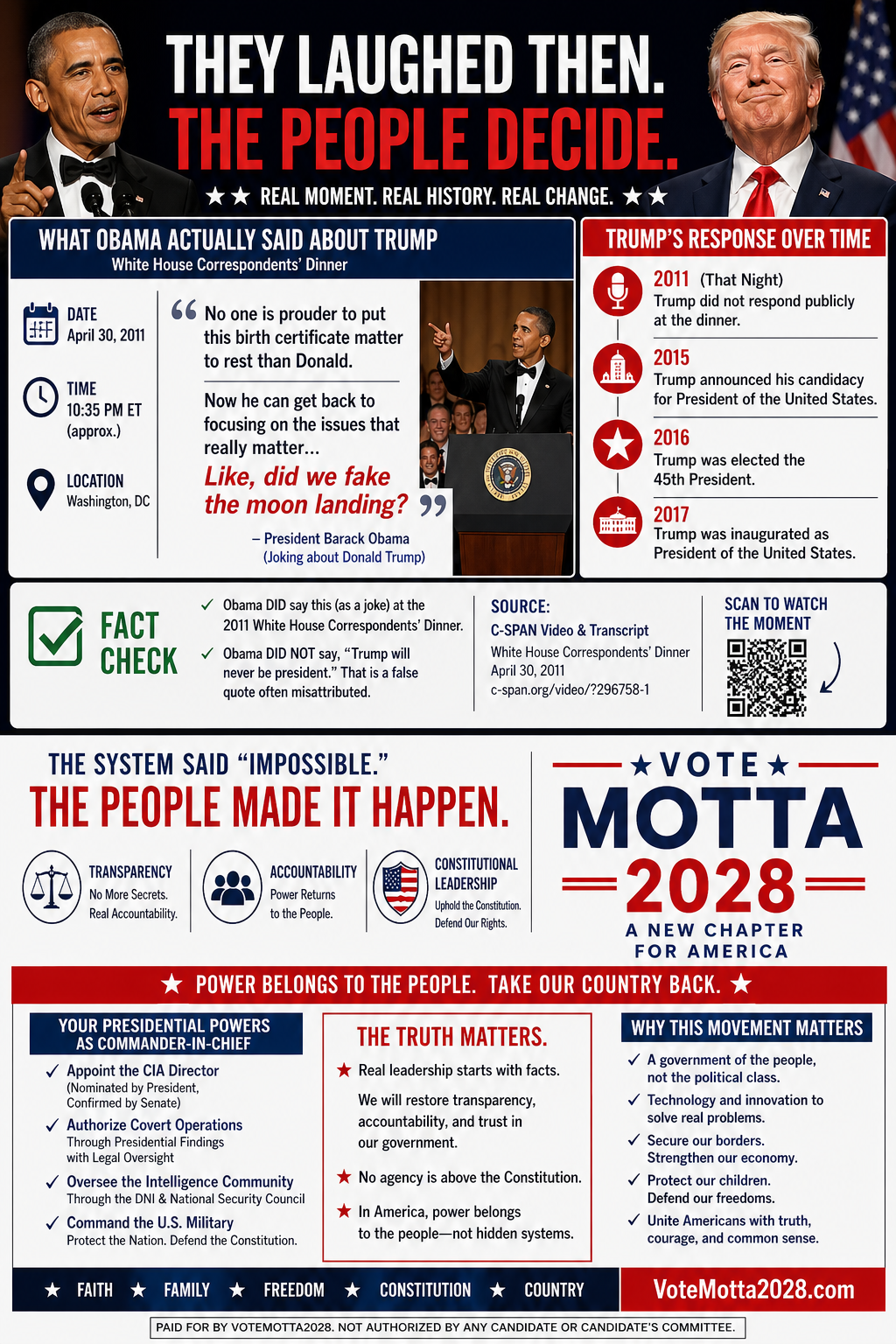
IdeasToInvent.com is a citizen-inventor platform for sketches, prototypes, 3D concepts, AI-assisted study, patent research, energy ideas, aerospace concepts, medical tools, and future science proposals.
Bold ideas should be tested fairly, not buried by gatekeeping or sold as fantasy before proof.
A practical, patriotic pathway for inventors, veterans, students, mechanics, engineers, coders, scientists, farmers, builders, and curious citizens.
Write the problem, the solution, the sketch, the parts list, and the testable claim.
Use 3D design, diagrams, simulations, or AI-assisted study to make the idea easier to review.
Compare against known science, prior patents, safety limits, costs, and independent testing.
Turn a raw idea into a review-ready invention packet.
This form opens your email client and drafts a message to info@votemotta2028.com. It does not upload files or store data on this page.
Do not send classified information, stolen data, dangerous weapon instructions, private medical records, or anything you do not have the right to share.
For patent-sensitive ideas, consider filing a provisional patent application or consulting a qualified patent attorney before public disclosure.
Join email listInspired by public discussions about Salvatore Pais, Dr. Weiping Yu, fusion, plasma, AI, and advanced aerospace concepts — with careful separation of proven science from speculation.
| Area | What is established | What needs proof |
|---|---|---|
| Fusion | Fusion powers stars and is studied in laboratories. | Affordable, reliable grid-scale fusion electricity. |
| AI engineering | AI can organize, draft, model, and analyze. | Independent verification of AI-generated invention claims. |
| Spacetime concepts | Relativity links mass-energy and spacetime curvature. | Controlled wormholes, time travel, or “time weapons.” |
| Alternative theories | New theories can inspire questions. | Peer review, experiment, replication, and prediction. |
Innovation must protect people, inventors, and the public.
Keep clear records, dates, files, drawings, and agreements. Do not give away rights without understanding what you sign.
Ideas involving weapons, explosives, toxins, surveillance abuse, or illegal acts are not appropriate for public submission.
Great ideas deserve measurement, testing, replication, and honest failure analysis.
The highest goal is technology that lowers suffering, strengthens families, protects freedom, and improves life.
Use the buttons below to open your email client.
Help review ideas, organize files, build 3D models, or support the campaign.
Volunteer by emailA Wikipedia-style reader feature exploring the vanished flight, the technology workers onboard, intelligence questions, and the difference between evidence, speculation, and civic responsibility.
Summary: Malaysia Airlines Flight MH370 disappeared on March 8, 2014, while flying from Kuala Lumpur to Beijing with 239 people aboard. The disappearance remains one of modern aviation’s most discussed mysteries. Some commentators connect the case to scientists, espionage, military technology, or intelligence agencies. This article walks the reader through those claims while separating known facts from unverified theories.
MH370 was a Boeing 777-200ER operated by Malaysia Airlines. It departed Kuala Lumpur International Airport for Beijing Capital International Airport and later disappeared from civilian radar. Subsequent analysis indicated that the aircraft changed course and likely continued flying for hours.
The following embedded videos are included for readers who want to examine mainstream documentary coverage and public discussion. These videos are not endorsements of every claim made in them; they are included as research material.
One of the most repeated details about MH370 is that 20 employees of Freescale Semiconductor were aboard. Twelve were reportedly from Malaysia and eight from China. This fact is real, but online discussions often expand it into claims that the passengers were “quantum scientists” or secret weapons engineers.
The better description is more careful: they were technology employees connected to semiconductors and electronics. Semiconductor knowledge is important to national security and economic competition, but that does not prove the flight was targeted.
Ashton Forbes is known online for promoting alternative theories about MH370, including claims involving unusual video evidence and advanced technology. His work has drawn attention because it offers a dramatic answer to an unresolved tragedy.
For readers, the fair question is not whether a theory is exciting. The fair question is whether it is supported by verifiable evidence. At present, no public investigation has confirmed claims that MH370 was teleported, seized by the U.S. military, or removed through a covert CIA operation.
Intelligence agencies do conduct espionage. Nations do compete for scientists, semiconductor capability, quantum research, artificial intelligence, and military technology. The United States, China, Russia, and other countries all treat high-end technical knowledge as strategically important.
However, that reality does not automatically validate every theory about MH370. A CIA operation involving a civilian aircraft with 239 people would require extraordinary evidence. Publicly available evidence has not established that such an operation occurred.
In an April 23, 2026 video, Ashton Forbes argued that the UFO community is looking in the wrong direction. Instead of beginning with aliens, he points readers toward Lockheed Martin’s Skunk Works, the CIA, and the U.S. Air Force. His central claim is simple: if advanced aerial technology exists, it may come from classified human engineering rather than extraterrestrial visitors.
Forbes cites Ben Rich’s memoir about Lockheed Skunk Works, emphasizing the line that Skunk Works functioned for years as the CIA’s unofficial “toy makers.” That historical point is real: Rich wrote that Skunk Works built highly advanced aircraft for secretive missions and that its principal customers included the Central Intelligence Agency and the U.S. Air Force.
The strongest part of Forbes’ argument is the historical pattern: secret aircraft, intelligence funding, contractor engineering, and long-term classification are all real features of U.S. national security history. The weakest part is the jump from that history to the specific conclusion that CIA “orbs” intercepted or removed MH370. That jump needs evidence that has not been publicly established.
For readers, Forbes’ argument is useful because it redirects the discussion from fantasy to institutions: contractors, budgets, classified programs, intelligence oversight, and military secrecy. Even if his MH370 conclusion is wrong, the broader civic question remains important: how much advanced technology can exist behind classification before democratic oversight becomes too weak?
In the United States, covert action generally requires presidential authorization and legal notification to congressional intelligence oversight committees. Individual senators do not personally “approve” CIA field operations. Figures such as Marco Rubio may have oversight roles depending on committee assignments and offices held, but oversight is not the same as operational command.
In Ashton Forbes’ “Once You Build for the CIA, You Never Stop” transcript, the free-energy idea appears as part of a larger claim about classified technology. Forbes argues that once a contractor builds advanced systems for the CIA, Air Force, or other secretive government customers, the technology can become trapped behind classification. In that model, a company may not be free to commercialize a breakthrough even if the breakthrough could benefit the public.
Forbes uses Lockheed Martin as the example. He points to Ben Rich’s Skunk Works history and argues that a long CIA–Lockheed relationship could create a hidden technology pipeline. His core claim is that a contractor might build advanced systems for classified missions, then lose the ability to turn related technology into public products. He frames this as one way a “breakaway civilization” could hoard technology outside ordinary markets.
Lockheed Martin did publicly announce a Compact Fusion Reactor concept in 2014. The announcement drew attention because it came from Skunk Works, a division famous for secret aircraft programs. The idea was bold: a much smaller fusion reactor that could someday deliver powerful, clean energy from a compact machine.
The public fact-check is more cautious. Lockheed’s compact fusion announcement was real, but there is no public proof that the company produced a working commercial fusion reactor. The projected timeline did not result in a publicly available power plant. That means the transcript’s idea can be discussed as a theory about classification and incentives, but it should not be presented as proven fact.
For a general audience, the phrase “free energy” needs careful language. In physics, energy is not created from nothing. Machines must obey thermodynamics. Reactors, turbines, panels, batteries, grids, and maintenance all cost money. But in civic language, “free energy” often means energy that is so abundant, clean, and cheap that ordinary families everywhere can live with far less hardship.
Fusion is the process that powers the Sun. It releases energy by joining light atoms together. Scientists want fusion because it could provide dense, low-carbon power with less long-lived waste than conventional nuclear fission. But Earth-based fusion is difficult. Plasma must be heated to extreme temperatures, confined, controlled, and converted into useful electricity.
Real progress exists. The National Ignition Facility has reported fusion ignition in laser-driven experiments, and international projects such as ITER continue to test magnetic confinement fusion. These are major scientific steps, but they are not the same as a finished power plant. A real fusion power plant must produce net electricity after all losses, operate repeatedly, survive harsh conditions, and compete economically.
If the goal is energy dignity for every human being, fusion is only one possible future path. The world can also expand technologies that already work. Solar, wind, hydroelectric power, geothermal systems, modern nuclear fission, grid upgrades, batteries, and efficiency improvements can all help reduce energy poverty now.
These videos help readers compare the promise of fusion with the engineering difficulty. They are included for education and are not endorsements of every claim.
A pro-America, pro-human energy policy should ask two questions at once: What is scientifically real? And who benefits? If a breakthrough exists, it should not become only a weapon, monopoly, or classified toy. If a technology is not proven, leaders should not sell fantasy. The goal should be honest science, lower bills, cleaner air, national security, and energy dignity for every family on Earth.
This module explains the Julian Dorey Podcast episode featuring Matthew Hedger and Shawnee Delaney. Hedger is presented in the episode as a former CIA “NOC” operative, while Delaney is presented as a former DIA clandestine operations officer. The conversation covers non-official cover, deep-cover identity building, covert finance, cartel infiltration, insider threats, AI-enabled espionage, and the moral gray zone of intelligence work.
In the transcript, Hedger explains that “NOC” means non-official cover. The term refers to an intelligence officer or operative who is not presented as a diplomat and does not have the protection of a diplomatic passport. In simple terms, a NOC lives under a civilian, business, or other non-government identity. If caught, the operative may be deniable.
The episode centers on two intelligence-world guests. Matthew Hedger describes a career involving deep cover, covert finance, criminal-world cover, and alleged cartel money-laundering access. Shawnee Delaney describes experience in Defense Intelligence Agency work, counterintelligence, cybersecurity, insider-threat programs, surveillance, investigations, and AI-related threats.
In the episode, “going black” means slipping away from the visible cover activity to conduct an operational act without the surrounding people realizing what happened. The cover group may think the person went for a run, attended a meeting, or handled ordinary business while the real mission occurs elsewhere.
A legend is the constructed identity and backstory behind a cover life. The transcript discusses backstopping details such as credit history, memberships, habits, and other records that make a fake identity feel real when investigated.
Hedger describes rehearsing fake memories until they can be recalled like real experiences. Instead of inventing a story under pressure, the operative can recall a rehearsed scene with details such as food, weather, location, and conversation.
This means engineering a meeting so the target feels it happened naturally. The transcript gives the example of using a target’s favorite book or hobby so the target initiates conversation and feels a sense of personal connection.
The conversation repeatedly returns to one idea: intelligence work is less like a movie chase and more like long-term human influence. The guests describe spotting a target, assessing access and vulnerability, developing trust, recruiting cooperation, handling the relationship, and eventually ending the relationship. Delaney compares this process to dating because each step depends on psychology, patience, trust, and timing.
In the transcript, targets are not always dramatic villains. Some are bankers, corporate employees, smugglers, family people, or ordinary-looking individuals with access. The episode argues that access matters more than movie-style toughness. A person who can move money, unlock a system, introduce a banker, or plug in a device can matter more than a violent criminal boss.
A major theme of the episode is covert finance. Hedger says part of his work involved moving money so it did not appear to come from the U.S. government. He describes why an intelligence service would need this: paying sources, funding operations, purchasing restricted technology, or operating in hostile environments where a direct U.S. government payment would expose people.
The transcript also covers alleged criminal-world cover. Hedger describes access to biker gangs, cartel-linked money movers, international banks, and laundering networks. Readers should treat the specific personal stories as claims from the guest. The broader concept is real: governments, criminals, banks, shell companies, trade networks, cash systems, and crypto can all intersect in illicit finance investigations.
Delaney emphasizes insider threat: the danger created when someone inside a trusted organization misuses access, gets compromised, clicks malicious links, leaks secrets, or helps an adversary. The episode uses the example of one disgruntled insider causing massive damage. It also discusses corporate security failures, employee vulnerability, and how ordinary human trust can be exploited.
The episode argues that AI has lowered the barrier for fraud, corporate espionage, and manipulation. Delaney describes voice cloning, deepfake scams, AI-assisted phishing, and tools that can analyze employee behavior for signs of risk. Hedger adds that AI can accelerate the creation of targeting packages by summarizing a person’s vulnerabilities, preferences, communications, and patterns.
These videos are included so readers can understand the vocabulary and compare this episode with broader public discussion of intelligence work. They are educational embeds, not endorsements of every claim.
A CIA NOC, as explained in the episode, is a deep-cover operator without diplomatic cover. The work described is not mainly glamorous action. It is identity construction, patience, psychological influence, risk management, and constant awareness that a single mistake can expose the person, the mission, or people around them.
This campaign module translates Ashton Forbes’ April 24, 2026 transcript into lawful, constitutional campaign language. Forbes speaks in a confrontational style, saying the public should learn how the CIA works, expose its weak points, and “take over the CIA.” In campaign terms, that message becomes: no agency is above the Constitution, no classified program should escape lawful oversight, and the President must appoint leaders who serve the American people.
Forbes argues that the CIA has rules, weaknesses, internal directorates, and vulnerabilities. He says the public can damage hidden power by talking openly about how the system operates. He highlights the Directorate of Science and Technology, covert action, presidential findings, compartmentalization, and classified technology. He also says “Ashton Forbes for CIA director” and notes that the CIA Director is an appointed position.
As President, a VoteMotta administration would have real appointment powers, but those powers operate through law. The President nominates the CIA Director, but the Senate must provide advice, consent, and confirmation. The CIA Director reports to the Director of National Intelligence and manages intelligence collection, analysis, covert action, counterintelligence, liaison relationships, personnel, operations, and budget.
As Commander-in-Chief, the President directs the armed forces. The CIA is not the military, but it is part of the national-security structure. A President can set intelligence priorities, appoint leadership, demand lawful briefings, issue lawful covert-action findings, and insist on oversight. A President cannot lawfully bypass Congress, ignore Senate confirmation, or personally run illegal operations.
A VoteMotta administration would consider outsiders, whistleblowers, technologists, veterans, investigators, and constitutional reformers for advisory roles. Ashton Forbes could be considered for a public-interest advisory role on intelligence transparency, classified technology, or citizen review of unexplained aerospace claims. Considering him for CIA Director would be framed as a serious question requiring vetting, qualifications review, ethics review, clearance review, and Senate confirmation—not as a guaranteed appointment.
Forbes’ strength is public pressure. He knows how to build attention, challenge official narratives, and force questions into the open. His weakness, as a formal nominee, is that there is no public record showing senior intelligence management, military command, Senate-confirmed office, or agency leadership experience. A credible campaign can say he is under consideration for an advisory or investigative role while reserving CIA Director for a fully vetted, Senate-confirmable national-security leader.
CIA Directors have come from different backgrounds: intelligence professionals, military leaders, legislators, diplomats, lawyers, and senior national-security officials. The lesson for voters is that the role requires more than curiosity. It requires discipline, legality, management ability, credibility with allies, and the independence to tell the President hard truths.
My fellow Americans,
For too long, the people have been told to trust hidden systems without being given enough reason to trust them. We need intelligence agencies. We need brave professionals who protect this nation from real threats. But in a constitutional republic, power must never become untouchable.
As President, I will nominate leaders who understand one simple truth: no agency is above the Constitution. The CIA, the Pentagon, the contractors, and the classified programs all exist to serve the American people—not the other way around.
Independent voices have warned that the public does not fully understand how powerful intelligence technology has become. We will not answer that concern with panic. We will answer it with lawful oversight, serious review, and patriotic transparency.
My administration will review classified technology programs, strengthen congressional oversight, protect whistleblowers who follow the law, and ensure that breakthrough science benefits Americans—not just hidden budgets and private monopolies.
We will defend America. We will protect secrets that truly must remain secret. But we will never accept a permanent shadow government that cannot be questioned. In America, power belongs to the people.
VoteMotta2028: truth, safety, accountability, and constitutional command.
The responsible campaign position is to investigate without prejudging. The Freescale employees aboard MH370 were real technology workers. Intelligence interest in advanced technology is real. U.S., Chinese, Russian, and other intelligence services do target science and technology. But those facts do not prove MH370 was a CIA operation.
The word conspiracy is often used in two very different ways. In everyday speech, it can mean a hidden plan by multiple people. In law, it has a much stricter meaning.
In the transcript context, the speaker explains that “collusion” is not a formal legal term, while conspiracy is a real crime with a high legal standard. fileciteturn10file0
Courts are designed to separate:
Across the United States, people sometimes believe courts, lawyers, banks, or agencies acted unfairly in their personal cases. These concerns can involve:
However, for readers, the key distinction remains:
VoteMotta2028 supports investigating fraud, waste, abuse, and misconduct. But it also supports the rule of law:
We will never ignore corruption. But we will never replace evidence with rumor. Justice means facts, records, and proof—applied equally to every American.
This VoteMotta2028 civic-education module explains what public servants swear to do, what courtroom integrity requires, and how a constitutional campaign can demand zero tolerance for fraud, waste, abuse, perjury, hidden evidence, retaliation, and politically motivated misuse of legal power.
Zero tolerance for fraud, waste, abuse, false evidence, hidden evidence, intimidation, retaliation, and political lawfare. Public office is not private property. Courtrooms are not weapons. Government power belongs under oath, under law, under evidence, and under public accountability.
American public service begins with an oath. The President swears to faithfully execute the office and preserve, protect, and defend the Constitution. Federal employees swear to support and defend the Constitution against enemies foreign and domestic. Federal judges swear to administer justice without respect to persons and to do equal right to the poor and the rich. Military enlistees swear to support and defend the Constitution while obeying lawful orders under regulations and the Uniform Code of Military Justice.
Lawyers are bound by professional-conduct rules in their jurisdictions. Prosecutors have special duties because they use the power of the state. ABA Model Rule 3.8 says prosecutors must not prosecute charges they know are unsupported by probable cause and must timely disclose evidence that tends to negate guilt or mitigate punishment. The ABA commentary says a prosecutor is a “minister of justice,” not merely an advocate.
| Rule / Case | Plain-English meaning | Source |
|---|---|---|
| Brady rule | Prosecutors must disclose material favorable evidence to the defense. | Cornell Wex: Brady rule |
| Giglio v. United States | Promises, benefits, or credibility issues involving key government witnesses can be impeachment evidence that must be disclosed. | Justia: Giglio |
| Napue v. Illinois | A prosecutor cannot allow known false testimony to go uncorrected. | Justia: Napue |
| Mooney v. Holohan | A conviction obtained through knowingly used perjured testimony violates due process. | Justia: Mooney |
| Judicial ethics | Federal judges should uphold integrity, avoid impropriety, and perform duties fairly, impartially, and diligently. | U.S. Courts: Code of Conduct |
The Code of Conduct for United States Judges says public confidence in the judiciary depends on integrity and independence. Judges should avoid impropriety and the appearance of impropriety, act impartially, and disqualify themselves when impartiality might reasonably be questioned. Chief Justice John Roberts warned in his 2024 year-end report that violence, intimidation, disinformation, and defiance of lawful court judgments threaten judicial independence and the rule of law.
Police officers often take state or local oaths, and many agencies use an oath of honor promising integrity, courage, respect for the Constitution, and public trust. In court, officer credibility matters. Under Brady and Giglio principles, impeachment information about law-enforcement witnesses can become important if it affects credibility, bias, truthfulness, or reliability.
Fraud, waste, and abuse are not slogans; they are oversight categories. Inspectors General exist to prevent and detect fraud, waste, and abuse and to promote economy, efficiency, and effectiveness in government programs. The False Claims Act is one of the federal government’s strongest tools for recovering taxpayer money from false claims; DOJ reported more than $2.68 billion in False Claims Act settlements and judgments in fiscal year 2023.
“Lawfare” is commonly used to describe the misuse of legal processes as a weapon. In campaign language, it should be defined carefully: not every prosecution of a political figure is lawfare, and not every acquittal proves corruption. The question is evidence, motive, procedure, equal treatment, and whether the same rules apply to powerful and ordinary people alike.
American history includes famous cases where many people doubt official accounts. The responsible campaign position is transparency without pretending suspicion is proof. For JFK, the National Archives continues publishing assassination records, and the Warren Commission identified Lee Harvey Oswald as the assassin while later public debate continued. For Dr. Martin Luther King Jr., the House Select Committee on Assassinations found that James Earl Ray fired the fatal shot, while also finding a likelihood of conspiracy based on available circumstantial evidence and separately stating that no federal, state, or local government agency was involved. For current defendants such as Tyler Robinson, the only constitutional answer is due process: presumption of innocence, public evidence, lawful discovery, fair jury, and no trial by rumor.
Great public speeches remind citizens that justice requires courage and service. Dr. Martin Luther King Jr. wrote from Birmingham Jail that “injustice anywhere is a threat to justice everywhere.” John F. Kennedy’s inaugural address called Americans to ask what they could do for their country. Theodore Roosevelt’s “Man in the Arena” praised the person who actually strives in a worthy cause. Dwight Eisenhower warned about the military-industrial complex and the danger of concentrated power.
My fellow Americans,
Every officer of this Republic serves under an oath. The oath does not belong to a party. It does not belong to a donor. It does not belong to a courtroom clique, a contractor, a lobbyist, or a political machine. The oath belongs to the Constitution and to the people.
When judges forget equal justice, when prosecutors hide evidence, when police lie, when officials waste taxpayer money, when agencies retaliate against whistleblowers, and when powerful people use the law as a weapon, the oath has been broken.
We will restore the oath. We will protect lawful judges from intimidation and hold corrupt officials accountable. We will protect honest police and expose dishonest ones. We will defend victims and the accused alike by demanding evidence, due process, and truth.
We will build a government where fraud, waste, and abuse meet zero tolerance; where justice is not for sale; where no citizen is framed by rumor; and where no official is too powerful to answer questions.
VoteMotta2028: the oath comes first.
This campaign module is designed for voters on the left, right, and center. Americans disagree on many things, but many share the same concern: no intelligence agency should be above the Constitution, above Congress, above courts, or above the American people.
Defend America. Follow the Constitution. End torture. Protect lawful whistleblowers. Stop political weaponization. Audit contractors. Declassify responsibly. Respect civil liberties. Tell the truth to the people.
Progressives often focus on civil liberties, torture, drones, secrecy, and whistleblower retaliation. Conservatives often focus on politicized intelligence, surveillance abuse, deep-state power, and border/national-security failures. Independents often focus on competence, waste, truth, and whether powerful institutions are accountable. A serious reform campaign can speak to all three groups without weakening national security.
| # | Issue | Why voters care | VoteMotta2028 position |
|---|---|---|---|
| 1 | Torture and black sites | The Senate torture report and later public reporting documented brutal interrogation practices and major contractor involvement. | No torture, no black sites, no rebranding cruelty as “enhanced interrogation.” |
| 2 | John Kiriakou and selective accountability | Kiriakou went to prison for disclosing classified information, while many architects or defenders of the torture program avoided comparable punishment. | Support a lawful pardon/clemency review if he has not already received one. |
| 3 | Section 702 and warrantless surveillance concerns | Section 702 surveillance targets foreigners but can incidentally collect Americans’ communications, creating bipartisan privacy concerns. | Protect foreign-intelligence capability while requiring stronger safeguards for Americans. |
| 4 | Politicization of intelligence | Voters fear intelligence can be shaped to serve presidents, parties, or narratives instead of truth. | Demand written dissent channels, protected analysts, and penalties for political manipulation. |
| 5 | Overclassification and declassification abuse | Too much secrecy hides mistakes, but reckless declassification can expose sources and methods. | Responsible declassification with independent review and source protection. |
| 6 | Whistleblower protection | Employees need safe lawful channels to report abuse, fraud, torture, illegal surveillance, or politicized intelligence. | Protect lawful whistleblowers; punish retaliation. |
| 7 | Contractor power and waste | The torture program showed how contractors can gain enormous power and profit inside secrecy. | Audit major intelligence contracts and ban conflicts of interest. |
| 8 | Covert action oversight | Secret operations can affect wars, foreign governments, civilians, and U.S. credibility. | Require lawful presidential findings and real congressional notification. |
| 9 | Election-interference intelligence | Foreign interference claims can be real, exaggerated, politicized, or underplayed. | Publish public evidence summaries whenever possible while protecting sensitive sources. |
| 10 | Accountability for leadership failures | Directors and senior officials often leave office, write books, join media, or enter private work after controversial programs. | Create post-service ethics rules, public accountability reports, and stronger oversight hearings. |
The transcript claims John Brennan helped drive the John Kiriakou prosecution and criticizes Brennan’s public position on torture. It also raises the question of why Donald Trump has not pardoned Kiriakou despite Trump’s public hostility toward Brennan. These are strong commentary claims, not court findings. The established public record is that Kiriakou was sentenced to 30 months in prison after pleading guilty to disclosing the identity of a covert officer, and that the Senate torture report documented extensive CIA abuses and contractor involvement.
CIA reform has never belonged to only one party. Senator Dianne Feinstein led the Senate torture investigation from the Democratic side. Senator John McCain, a Republican and torture survivor, strongly opposed torture. Civil-liberties Democrats and libertarian-leaning Republicans have challenged surveillance powers. National-security hawks in both parties argue that intelligence tools are necessary to stop terrorists, hostile states, cyberattacks, cartels, fentanyl networks, and foreign election interference. A serious president must listen to all sides while enforcing the Constitution.
America needs intelligence professionals who can stop real threats before they reach our families. But the CIA must never become a law unto itself.
We will defend this nation without torture. We will protect secrets without hiding corruption. We will support brave officers without protecting abusive leaders. We will gather intelligence without turning government power against the American people.
Left, right, and independent voters all deserve the same promise: the Constitution comes first.
VoteMotta2028: strong intelligence, clean hands, constitutional command.
This VoteMotta2028 campaign module is based on the Ashton Forbes interview with Salvatore Cezar Pais, where the discussion moves through Navy patents, fusion, spacetime manipulation, wormholes, time travel, MH370 claims, artificial intelligence, China, disclosure, and the question of whether breakthrough science can become either a human blessing or a doomsday weapon.
As a candidate for President and future Commander-in-Chief, Robert R. Motta will champion American inventors, military engineers, garage builders, independent scientists, and lawful whistleblowers. A VoteMotta administration will review breakthrough energy, propulsion, medical, and aerospace ideas through evidence, testing, national security safeguards, and public benefit—not ridicule, gatekeeping, or political favoritism.
Salvatore Cezar Pais is an aerospace engineer associated with the U.S. Navy and Naval Air Systems Command/Naval Air Warfare Center Aircraft Division in public patent and publication records. He is known for a controversial group of Navy-assigned patents often called the “UFO patents” in media coverage. These patents propose high-energy electromagnetic systems, inertial mass reduction, high-frequency gravitational wave generation, piezoelectricity-induced room-temperature superconductivity, and plasma-compression fusion.
In the transcript, Pais repeatedly emphasizes that he speaks as a private citizen and that his opinions are his own, not official statements of the Navy or Space Force. He says the technologies are “man-made tech,” not alien technology, and frames his purpose as human unification and survival rather than personal fame. fileciteturn14file0
The transcript contains dramatic language. Pais describes “weapons of time,” “wormhole weapons,” reverse temporal excursion, spacetime tearing, fusion power sources, artificial intelligence, and the possibility that advanced technology could be either an energy panacea or a doomsday weapon. He tells Congress-style questioners that the most important thing to understand is that this technology could be “a panacea to the energy needs of the entire mankind” or “one of the greatest doomsday weapons” ever designed. fileciteturn14file0
| # | Title | Public status / plain-English meaning | Source |
|---|---|---|---|
| 1 | Electromagnetic Field Generator and Method to Generate an Electromagnetic Field | Navy-assigned patent involving high-intensity electromagnetic field generation through vibration and electrical charging. | Google Patents: US10135366B2 |
| 2 | Craft Using an Inertial Mass Reduction Device | Navy-assigned patent describing a craft using microwave emitters and resonant cavities to create a local polarized vacuum outside the craft. | PubChem: US10144532B2 |
| 3 | High Frequency Gravitational Wave Generator | Navy-assigned patent describing gas-filled shells, microwave emitters, sound generators, charged vibrating surfaces, and gravitational-field fluctuations. | PubChem: US10322827B2 |
| 4 | Piezoelectricity-Induced Room Temperature Superconductor | Patent application describing a wire with an insulator core and metal coating, where pulsed current plus vibration is claimed to induce room-temperature superconductivity. | USPTO.report: US20190058105A1 |
| 5 | Plasma Compression Fusion Device | Patent application and related IEEE paper proposing plasma-compression-induced nuclear fusion using high magnetic-energy flux. | ResearchGate / IEEE paper record |
| 6 | The High Energy Electromagnetic Field Generator | Peer-reviewed 2015 paper associated with Pais’ broader electromagnetic-field ideas. | ResearchGate / Inderscience paper record |
Robert R. Motta’s campaign can honor Pais without overstating the science. The responsible position is not blind belief and not lazy dismissal. The responsible position is: test the claims, publish what can be published, protect what must be protected, and make sure any peaceful breakthrough benefits humanity.
A VoteMotta administration will propose a lawful Future Science Review Board involving the Navy, Air Force, Space Force, NASA, DARPA, DOE national laboratories, NSF, NSA, CIA, DIA, ODNI, university physicists, independent engineers, garage inventors, and ethical civilian observers. Its purpose will be to evaluate advanced energy, propulsion, AI, materials, and medical technologies under strict safety, classification, and public-benefit standards.
The campaign will support www.ideastoinvent.com as a citizen-inventor and AI-assisted study concept: a place where Americans can submit ideas, 3D models, prototypes, patent leads, scientific questions, and open-source evidence for structured review. The goal is to help inventors move from imagination to documentation: diagrams, physics assumptions, safety review, cost analysis, patent research, prototype pathways, and independent testing.
As President, Robert R. Motta could lawfully consider national honors for inventors and service members, including the Presidential Medal of Freedom for civilian contribution and military decorations through lawful Department of Defense processes where eligibility is met. The President cannot simply award a Nobel Prize; Nobel Prizes are awarded by independent Nobel institutions under their own nomination rules. A President can publicly advocate for recognition, support research, and encourage qualified nominators to consider deserving inventors.
As President, I will review Dr. Salvatore Cezar Pais and other military inventors for the highest lawful honors available to a President where evidence, service, and national benefit justify recognition. I will also advocate that peaceful breakthrough inventors—uniformed, civilian, university-based, or garage-built—receive serious consideration for the world’s highest scientific honors when their work is independently proven.
America must become the country where the next Nikola Tesla, the next Grace Hopper, the next Katherine Johnson, the next Sal Pais, or the next unknown garage inventor is not ignored, mocked, or buried, but tested fairly and honored when proven.
Dr. Weiping Yu is publicly described by the Motor & Drive Systems/Magnetics Conference as a NASA physicist and Crew Spacecraft Subsystem Manager at Kennedy Space Center. His Uon Theory of Everything proposes a magnetic-dipole foundation for matter, forces, fields, and charge. In public summaries, Yu argues that conventional particles such as electrons and protons are emergent constructs of deeper magnetic interactions. This is not mainstream consensus physics, and readers should treat it as an alternative theory requiring independent validation.
In the transcript, Pais says disclosure should happen “carefully” and “in steps,” not all at once. fileciteturn14file0 A VoteMotta administration will use that principle for advanced technology: protect national security, prevent panic, avoid weaponization, but refuse permanent secrecy when peaceful benefits can transform energy, medicine, transportation, and human survival.
My fellow Americans,
Our nation was built by inventors, engineers, soldiers, sailors, scientists, machinists, farmers, coders, dreamers, and citizens who refused to accept that the future had already been decided.
Dr. Salvatore Cezar Pais reminds us that bold ideas should not be laughed out of the room before they are tested. Dr. Weiping Yu reminds us that even the deepest assumptions in physics should be questioned with discipline and courage. Independent inventors remind us that genius does not always wear a badge, hold a chair at a university, or come from inside a federal laboratory.
As President and Commander-in-Chief, I will defend our nation, protect our service members, and demand that breakthrough science be reviewed with seriousness. If a technology can provide clean energy for humanity, heal disease, protect Earth, or move civilization forward, it must not be buried forever in fear, bureaucracy, or private monopoly.
But we will also be wise. We will not hand doomsday tools to the world without safeguards. We will not confuse speculation with proof. We will not sell fantasy to voters. We will test, verify, protect, and then build.
VoteMotta2028: invent the future, protect the people, honor the builders.
This module lists key equations for readers. It clearly separates established physics from speculative or patent-described ideas. No public record verifies working “time weapons.” Equations below are educational anchors so readers can understand what is known versus proposed.
| # | Equation | Meaning (plain English) |
|---|---|---|
| 1 | E = mc² | Mass–energy equivalence: a small amount of mass can convert to large energy. |
| 2 | F = ma | Newton’s Second Law: force equals mass times acceleration. |
| 3 | F = G m₁ m₂ / r² | Gravity between masses decreases with distance squared. |
| 4 | Maxwell’s Equations | Set of equations governing electric and magnetic fields. |
| 5 | Schrödinger Equation | Describes quantum wave behavior of particles. |
| 6 | Einstein Field Equation: G_{μν} = (8πG/c⁴) T_{μν} | Spacetime curvature relates to energy and momentum. |
| # | Equation | Meaning |
|---|---|---|
| 1 | E = Δm c² | Energy released in nuclear reactions from mass defect. |
| 2 | Binding Energy Curve | Shows why fission and fusion release energy. |
| 3 | Fusion Reaction (example) | D + T → He + n + energy |
| # | Equation | Meaning |
|---|---|---|
| 1 | Lawson Criterion | nTτ must exceed threshold for fusion ignition. |
| 2 | Magnetic Pressure: B² / (2μ₀) | Magnetic fields can confine plasma. |
| 3 | Plasma Frequency | Natural oscillation frequency of charged particles. |
These are not standard equations proven in physics textbooks. They are conceptual relationships described in patents and papers.
| # | Concept | Description |
|---|---|---|
| 1 | High Energy EM Field | Extremely high electromagnetic energy density altering local vacuum conditions. |
| 2 | Resonant Cavity Effects | Microwave or vibration-induced resonance affecting mass/energy interaction. |
| 3 | Inertial Mass Reduction (claimed) | Idea that effective mass could be altered via EM/plasma effects. |
| 4 | Plasma Compression Fusion | Using electromagnetic compression to trigger fusion. |
| # | Equation | Meaning |
|---|---|---|
| 1 | Time Dilation: t' = t / √(1 - v²/c²) | Time slows at high speeds. |
| 2 | Gravitational Time Dilation | Time passes slower in stronger gravity fields. |
The transcript references “weapons of time,” wormholes, and spacetime manipulation. These ideas would require solutions to Einstein’s equations involving extreme energy densities (e.g., exotic matter, negative energy). No experimental system has demonstrated this.
Equations are the foundation of truth in physics. If a technology works, it must be expressible, testable, and reproducible through equations and experiments. Claims without verifiable equations and results remain hypotheses, not proven science.
A patriotic approach does not require accepting every official answer, nor does it require believing every viral theory. A pro-America approach asks for truth, due process, transparency, and respect for the families who lost loved ones.
VoteMotta2028 theme: America is strongest when citizens ask hard questions, protect constitutional accountability, support honest investigation, and refuse to confuse speculation with proof.
MH370 remains an open wound for families and a profound mystery for the public. The semiconductor workers onboard are a real part of the story, and global technology competition is real. But the leap from those facts to a confirmed CIA or military operation has not been proven.
The most responsible position is curiosity with discipline: keep asking questions, but keep the line between evidence and imagination clear.
A Wikipedia-style reader feature exploring the vanished flight, the technology workers onboard, intelligence questions, and the difference between evidence, speculation, and civic responsibility.
Summary: Malaysia Airlines Flight MH370 disappeared on March 8, 2014, while flying from Kuala Lumpur to Beijing with 239 people aboard. The disappearance remains one of modern aviation’s most discussed mysteries. Some commentators connect the case to scientists, espionage, military technology, or intelligence agencies. This article walks the reader through those claims while separating known facts from unverified theories.
MH370 was a Boeing 777-200ER operated by Malaysia Airlines. It departed Kuala Lumpur International Airport for Beijing Capital International Airport and later disappeared from civilian radar. Subsequent analysis indicated that the aircraft changed course and likely continued flying for hours.
The following embedded videos are included for readers who want to examine mainstream documentary coverage and public discussion. These videos are not endorsements of every claim made in them; they are included as research material.
One of the most repeated details about MH370 is that 20 employees of Freescale Semiconductor were aboard. Twelve were reportedly from Malaysia and eight from China. This fact is real, but online discussions often expand it into claims that the passengers were “quantum scientists” or secret weapons engineers.
The better description is more careful: they were technology employees connected to semiconductors and electronics. Semiconductor knowledge is important to national security and economic competition, but that does not prove the flight was targeted.
Ashton Forbes is known online for promoting alternative theories about MH370, including claims involving unusual video evidence and advanced technology. His work has drawn attention because it offers a dramatic answer to an unresolved tragedy.
For readers, the fair question is not whether a theory is exciting. The fair question is whether it is supported by verifiable evidence. At present, no public investigation has confirmed claims that MH370 was teleported, seized by the U.S. military, or removed through a covert CIA operation.
Intelligence agencies do conduct espionage. Nations do compete for scientists, semiconductor capability, quantum research, artificial intelligence, and military technology. The United States, China, Russia, and other countries all treat high-end technical knowledge as strategically important.
However, that reality does not automatically validate every theory about MH370. A CIA operation involving a civilian aircraft with 239 people would require extraordinary evidence. Publicly available evidence has not established that such an operation occurred.
In an April 23, 2026 video, Ashton Forbes argued that the UFO community is looking in the wrong direction. Instead of beginning with aliens, he points readers toward Lockheed Martin’s Skunk Works, the CIA, and the U.S. Air Force. His central claim is simple: if advanced aerial technology exists, it may come from classified human engineering rather than extraterrestrial visitors.
Forbes cites Ben Rich’s memoir about Lockheed Skunk Works, emphasizing the line that Skunk Works functioned for years as the CIA’s unofficial “toy makers.” That historical point is real: Rich wrote that Skunk Works built highly advanced aircraft for secretive missions and that its principal customers included the Central Intelligence Agency and the U.S. Air Force.
The strongest part of Forbes’ argument is the historical pattern: secret aircraft, intelligence funding, contractor engineering, and long-term classification are all real features of U.S. national security history. The weakest part is the jump from that history to the specific conclusion that CIA “orbs” intercepted or removed MH370. That jump needs evidence that has not been publicly established.
For readers, Forbes’ argument is useful because it redirects the discussion from fantasy to institutions: contractors, budgets, classified programs, intelligence oversight, and military secrecy. Even if his MH370 conclusion is wrong, the broader civic question remains important: how much advanced technology can exist behind classification before democratic oversight becomes too weak?
In the United States, covert action generally requires presidential authorization and legal notification to congressional intelligence oversight committees. Individual senators do not personally “approve” CIA field operations. Figures such as Marco Rubio may have oversight roles depending on committee assignments and offices held, but oversight is not the same as operational command.
In Ashton Forbes’ “Once You Build for the CIA, You Never Stop” transcript, the free-energy idea appears as part of a larger claim about classified technology. Forbes argues that once a contractor builds advanced systems for the CIA, Air Force, or other secretive government customers, the technology can become trapped behind classification. In that model, a company may not be free to commercialize a breakthrough even if the breakthrough could benefit the public.
Forbes uses Lockheed Martin as the example. He points to Ben Rich’s Skunk Works history and argues that a long CIA–Lockheed relationship could create a hidden technology pipeline. His core claim is that a contractor might build advanced systems for classified missions, then lose the ability to turn related technology into public products. He frames this as one way a “breakaway civilization” could hoard technology outside ordinary markets.
Lockheed Martin did publicly announce a Compact Fusion Reactor concept in 2014. The announcement drew attention because it came from Skunk Works, a division famous for secret aircraft programs. The idea was bold: a much smaller fusion reactor that could someday deliver powerful, clean energy from a compact machine.
The public fact-check is more cautious. Lockheed’s compact fusion announcement was real, but there is no public proof that the company produced a working commercial fusion reactor. The projected timeline did not result in a publicly available power plant. That means the transcript’s idea can be discussed as a theory about classification and incentives, but it should not be presented as proven fact.
For a general audience, the phrase “free energy” needs careful language. In physics, energy is not created from nothing. Machines must obey thermodynamics. Reactors, turbines, panels, batteries, grids, and maintenance all cost money. But in civic language, “free energy” often means energy that is so abundant, clean, and cheap that ordinary families everywhere can live with far less hardship.
Fusion is the process that powers the Sun. It releases energy by joining light atoms together. Scientists want fusion because it could provide dense, low-carbon power with less long-lived waste than conventional nuclear fission. But Earth-based fusion is difficult. Plasma must be heated to extreme temperatures, confined, controlled, and converted into useful electricity.
Real progress exists. The National Ignition Facility has reported fusion ignition in laser-driven experiments, and international projects such as ITER continue to test magnetic confinement fusion. These are major scientific steps, but they are not the same as a finished power plant. A real fusion power plant must produce net electricity after all losses, operate repeatedly, survive harsh conditions, and compete economically.
If the goal is energy dignity for every human being, fusion is only one possible future path. The world can also expand technologies that already work. Solar, wind, hydroelectric power, geothermal systems, modern nuclear fission, grid upgrades, batteries, and efficiency improvements can all help reduce energy poverty now.
These videos help readers compare the promise of fusion with the engineering difficulty. They are included for education and are not endorsements of every claim.
A pro-America, pro-human energy policy should ask two questions at once: What is scientifically real? And who benefits? If a breakthrough exists, it should not become only a weapon, monopoly, or classified toy. If a technology is not proven, leaders should not sell fantasy. The goal should be honest science, lower bills, cleaner air, national security, and energy dignity for every family on Earth.
This module explains the Julian Dorey Podcast episode featuring Matthew Hedger and Shawnee Delaney. Hedger is presented in the episode as a former CIA “NOC” operative, while Delaney is presented as a former DIA clandestine operations officer. The conversation covers non-official cover, deep-cover identity building, covert finance, cartel infiltration, insider threats, AI-enabled espionage, and the moral gray zone of intelligence work.
In the transcript, Hedger explains that “NOC” means non-official cover. The term refers to an intelligence officer or operative who is not presented as a diplomat and does not have the protection of a diplomatic passport. In simple terms, a NOC lives under a civilian, business, or other non-government identity. If caught, the operative may be deniable.
The episode centers on two intelligence-world guests. Matthew Hedger describes a career involving deep cover, covert finance, criminal-world cover, and alleged cartel money-laundering access. Shawnee Delaney describes experience in Defense Intelligence Agency work, counterintelligence, cybersecurity, insider-threat programs, surveillance, investigations, and AI-related threats.
In the episode, “going black” means slipping away from the visible cover activity to conduct an operational act without the surrounding people realizing what happened. The cover group may think the person went for a run, attended a meeting, or handled ordinary business while the real mission occurs elsewhere.
A legend is the constructed identity and backstory behind a cover life. The transcript discusses backstopping details such as credit history, memberships, habits, and other records that make a fake identity feel real when investigated.
Hedger describes rehearsing fake memories until they can be recalled like real experiences. Instead of inventing a story under pressure, the operative can recall a rehearsed scene with details such as food, weather, location, and conversation.
This means engineering a meeting so the target feels it happened naturally. The transcript gives the example of using a target’s favorite book or hobby so the target initiates conversation and feels a sense of personal connection.
The conversation repeatedly returns to one idea: intelligence work is less like a movie chase and more like long-term human influence. The guests describe spotting a target, assessing access and vulnerability, developing trust, recruiting cooperation, handling the relationship, and eventually ending the relationship. Delaney compares this process to dating because each step depends on psychology, patience, trust, and timing.
In the transcript, targets are not always dramatic villains. Some are bankers, corporate employees, smugglers, family people, or ordinary-looking individuals with access. The episode argues that access matters more than movie-style toughness. A person who can move money, unlock a system, introduce a banker, or plug in a device can matter more than a violent criminal boss.
A major theme of the episode is covert finance. Hedger says part of his work involved moving money so it did not appear to come from the U.S. government. He describes why an intelligence service would need this: paying sources, funding operations, purchasing restricted technology, or operating in hostile environments where a direct U.S. government payment would expose people.
The transcript also covers alleged criminal-world cover. Hedger describes access to biker gangs, cartel-linked money movers, international banks, and laundering networks. Readers should treat the specific personal stories as claims from the guest. The broader concept is real: governments, criminals, banks, shell companies, trade networks, cash systems, and crypto can all intersect in illicit finance investigations.
Delaney emphasizes insider threat: the danger created when someone inside a trusted organization misuses access, gets compromised, clicks malicious links, leaks secrets, or helps an adversary. The episode uses the example of one disgruntled insider causing massive damage. It also discusses corporate security failures, employee vulnerability, and how ordinary human trust can be exploited.
The episode argues that AI has lowered the barrier for fraud, corporate espionage, and manipulation. Delaney describes voice cloning, deepfake scams, AI-assisted phishing, and tools that can analyze employee behavior for signs of risk. Hedger adds that AI can accelerate the creation of targeting packages by summarizing a person’s vulnerabilities, preferences, communications, and patterns.
These videos are included so readers can understand the vocabulary and compare this episode with broader public discussion of intelligence work. They are educational embeds, not endorsements of every claim.
A CIA NOC, as explained in the episode, is a deep-cover operator without diplomatic cover. The work described is not mainly glamorous action. It is identity construction, patience, psychological influence, risk management, and constant awareness that a single mistake can expose the person, the mission, or people around them.
This campaign module translates Ashton Forbes’ April 24, 2026 transcript into lawful, constitutional campaign language. Forbes speaks in a confrontational style, saying the public should learn how the CIA works, expose its weak points, and “take over the CIA.” In campaign terms, that message becomes: no agency is above the Constitution, no classified program should escape lawful oversight, and the President must appoint leaders who serve the American people.
Forbes argues that the CIA has rules, weaknesses, internal directorates, and vulnerabilities. He says the public can damage hidden power by talking openly about how the system operates. He highlights the Directorate of Science and Technology, covert action, presidential findings, compartmentalization, and classified technology. He also says “Ashton Forbes for CIA director” and notes that the CIA Director is an appointed position.
As President, a VoteMotta administration would have real appointment powers, but those powers operate through law. The President nominates the CIA Director, but the Senate must provide advice, consent, and confirmation. The CIA Director reports to the Director of National Intelligence and manages intelligence collection, analysis, covert action, counterintelligence, liaison relationships, personnel, operations, and budget.
As Commander-in-Chief, the President directs the armed forces. The CIA is not the military, but it is part of the national-security structure. A President can set intelligence priorities, appoint leadership, demand lawful briefings, issue lawful covert-action findings, and insist on oversight. A President cannot lawfully bypass Congress, ignore Senate confirmation, or personally run illegal operations.
A VoteMotta administration would consider outsiders, whistleblowers, technologists, veterans, investigators, and constitutional reformers for advisory roles. Ashton Forbes could be considered for a public-interest advisory role on intelligence transparency, classified technology, or citizen review of unexplained aerospace claims. Considering him for CIA Director would be framed as a serious question requiring vetting, qualifications review, ethics review, clearance review, and Senate confirmation—not as a guaranteed appointment.
Forbes’ strength is public pressure. He knows how to build attention, challenge official narratives, and force questions into the open. His weakness, as a formal nominee, is that there is no public record showing senior intelligence management, military command, Senate-confirmed office, or agency leadership experience. A credible campaign can say he is under consideration for an advisory or investigative role while reserving CIA Director for a fully vetted, Senate-confirmable national-security leader.
CIA Directors have come from different backgrounds: intelligence professionals, military leaders, legislators, diplomats, lawyers, and senior national-security officials. The lesson for voters is that the role requires more than curiosity. It requires discipline, legality, management ability, credibility with allies, and the independence to tell the President hard truths.
My fellow Americans,
For too long, the people have been told to trust hidden systems without being given enough reason to trust them. We need intelligence agencies. We need brave professionals who protect this nation from real threats. But in a constitutional republic, power must never become untouchable.
As President, I will nominate leaders who understand one simple truth: no agency is above the Constitution. The CIA, the Pentagon, the contractors, and the classified programs all exist to serve the American people—not the other way around.
Independent voices have warned that the public does not fully understand how powerful intelligence technology has become. We will not answer that concern with panic. We will answer it with lawful oversight, serious review, and patriotic transparency.
My administration will review classified technology programs, strengthen congressional oversight, protect whistleblowers who follow the law, and ensure that breakthrough science benefits Americans—not just hidden budgets and private monopolies.
We will defend America. We will protect secrets that truly must remain secret. But we will never accept a permanent shadow government that cannot be questioned. In America, power belongs to the people.
VoteMotta2028: truth, safety, accountability, and constitutional command.
The responsible campaign position is to investigate without prejudging. The Freescale employees aboard MH370 were real technology workers. Intelligence interest in advanced technology is real. U.S., Chinese, Russian, and other intelligence services do target science and technology. But those facts do not prove MH370 was a CIA operation.
The word conspiracy is often used in two very different ways. In everyday speech, it can mean a hidden plan by multiple people. In law, it has a much stricter meaning.
In the transcript context, the speaker explains that “collusion” is not a formal legal term, while conspiracy is a real crime with a high legal standard. fileciteturn10file0
Courts are designed to separate:
Across the United States, people sometimes believe courts, lawyers, banks, or agencies acted unfairly in their personal cases. These concerns can involve:
However, for readers, the key distinction remains:
VoteMotta2028 supports investigating fraud, waste, abuse, and misconduct. But it also supports the rule of law:
We will never ignore corruption. But we will never replace evidence with rumor. Justice means facts, records, and proof—applied equally to every American.
This VoteMotta2028 civic-education module explains what public servants swear to do, what courtroom integrity requires, and how a constitutional campaign can demand zero tolerance for fraud, waste, abuse, perjury, hidden evidence, retaliation, and politically motivated misuse of legal power.
Zero tolerance for fraud, waste, abuse, false evidence, hidden evidence, intimidation, retaliation, and political lawfare. Public office is not private property. Courtrooms are not weapons. Government power belongs under oath, under law, under evidence, and under public accountability.
American public service begins with an oath. The President swears to faithfully execute the office and preserve, protect, and defend the Constitution. Federal employees swear to support and defend the Constitution against enemies foreign and domestic. Federal judges swear to administer justice without respect to persons and to do equal right to the poor and the rich. Military enlistees swear to support and defend the Constitution while obeying lawful orders under regulations and the Uniform Code of Military Justice.
Lawyers are bound by professional-conduct rules in their jurisdictions. Prosecutors have special duties because they use the power of the state. ABA Model Rule 3.8 says prosecutors must not prosecute charges they know are unsupported by probable cause and must timely disclose evidence that tends to negate guilt or mitigate punishment. The ABA commentary says a prosecutor is a “minister of justice,” not merely an advocate.
| Rule / Case | Plain-English meaning | Source |
|---|---|---|
| Brady rule | Prosecutors must disclose material favorable evidence to the defense. | Cornell Wex: Brady rule |
| Giglio v. United States | Promises, benefits, or credibility issues involving key government witnesses can be impeachment evidence that must be disclosed. | Justia: Giglio |
| Napue v. Illinois | A prosecutor cannot allow known false testimony to go uncorrected. | Justia: Napue |
| Mooney v. Holohan | A conviction obtained through knowingly used perjured testimony violates due process. | Justia: Mooney |
| Judicial ethics | Federal judges should uphold integrity, avoid impropriety, and perform duties fairly, impartially, and diligently. | U.S. Courts: Code of Conduct |
The Code of Conduct for United States Judges says public confidence in the judiciary depends on integrity and independence. Judges should avoid impropriety and the appearance of impropriety, act impartially, and disqualify themselves when impartiality might reasonably be questioned. Chief Justice John Roberts warned in his 2024 year-end report that violence, intimidation, disinformation, and defiance of lawful court judgments threaten judicial independence and the rule of law.
Police officers often take state or local oaths, and many agencies use an oath of honor promising integrity, courage, respect for the Constitution, and public trust. In court, officer credibility matters. Under Brady and Giglio principles, impeachment information about law-enforcement witnesses can become important if it affects credibility, bias, truthfulness, or reliability.
Fraud, waste, and abuse are not slogans; they are oversight categories. Inspectors General exist to prevent and detect fraud, waste, and abuse and to promote economy, efficiency, and effectiveness in government programs. The False Claims Act is one of the federal government’s strongest tools for recovering taxpayer money from false claims; DOJ reported more than $2.68 billion in False Claims Act settlements and judgments in fiscal year 2023.
“Lawfare” is commonly used to describe the misuse of legal processes as a weapon. In campaign language, it should be defined carefully: not every prosecution of a political figure is lawfare, and not every acquittal proves corruption. The question is evidence, motive, procedure, equal treatment, and whether the same rules apply to powerful and ordinary people alike.
American history includes famous cases where many people doubt official accounts. The responsible campaign position is transparency without pretending suspicion is proof. For JFK, the National Archives continues publishing assassination records, and the Warren Commission identified Lee Harvey Oswald as the assassin while later public debate continued. For Dr. Martin Luther King Jr., the House Select Committee on Assassinations found that James Earl Ray fired the fatal shot, while also finding a likelihood of conspiracy based on available circumstantial evidence and separately stating that no federal, state, or local government agency was involved. For current defendants such as Tyler Robinson, the only constitutional answer is due process: presumption of innocence, public evidence, lawful discovery, fair jury, and no trial by rumor.
Great public speeches remind citizens that justice requires courage and service. Dr. Martin Luther King Jr. wrote from Birmingham Jail that “injustice anywhere is a threat to justice everywhere.” John F. Kennedy’s inaugural address called Americans to ask what they could do for their country. Theodore Roosevelt’s “Man in the Arena” praised the person who actually strives in a worthy cause. Dwight Eisenhower warned about the military-industrial complex and the danger of concentrated power.
My fellow Americans,
Every officer of this Republic serves under an oath. The oath does not belong to a party. It does not belong to a donor. It does not belong to a courtroom clique, a contractor, a lobbyist, or a political machine. The oath belongs to the Constitution and to the people.
When judges forget equal justice, when prosecutors hide evidence, when police lie, when officials waste taxpayer money, when agencies retaliate against whistleblowers, and when powerful people use the law as a weapon, the oath has been broken.
We will restore the oath. We will protect lawful judges from intimidation and hold corrupt officials accountable. We will protect honest police and expose dishonest ones. We will defend victims and the accused alike by demanding evidence, due process, and truth.
We will build a government where fraud, waste, and abuse meet zero tolerance; where justice is not for sale; where no citizen is framed by rumor; and where no official is too powerful to answer questions.
VoteMotta2028: the oath comes first.
This campaign module is designed for voters on the left, right, and center. Americans disagree on many things, but many share the same concern: no intelligence agency should be above the Constitution, above Congress, above courts, or above the American people.
Defend America. Follow the Constitution. End torture. Protect lawful whistleblowers. Stop political weaponization. Audit contractors. Declassify responsibly. Respect civil liberties. Tell the truth to the people.
Progressives often focus on civil liberties, torture, drones, secrecy, and whistleblower retaliation. Conservatives often focus on politicized intelligence, surveillance abuse, deep-state power, and border/national-security failures. Independents often focus on competence, waste, truth, and whether powerful institutions are accountable. A serious reform campaign can speak to all three groups without weakening national security.
| # | Issue | Why voters care | VoteMotta2028 position |
|---|---|---|---|
| 1 | Torture and black sites | The Senate torture report and later public reporting documented brutal interrogation practices and major contractor involvement. | No torture, no black sites, no rebranding cruelty as “enhanced interrogation.” |
| 2 | John Kiriakou and selective accountability | Kiriakou went to prison for disclosing classified information, while many architects or defenders of the torture program avoided comparable punishment. | Support a lawful pardon/clemency review if he has not already received one. |
| 3 | Section 702 and warrantless surveillance concerns | Section 702 surveillance targets foreigners but can incidentally collect Americans’ communications, creating bipartisan privacy concerns. | Protect foreign-intelligence capability while requiring stronger safeguards for Americans. |
| 4 | Politicization of intelligence | Voters fear intelligence can be shaped to serve presidents, parties, or narratives instead of truth. | Demand written dissent channels, protected analysts, and penalties for political manipulation. |
| 5 | Overclassification and declassification abuse | Too much secrecy hides mistakes, but reckless declassification can expose sources and methods. | Responsible declassification with independent review and source protection. |
| 6 | Whistleblower protection | Employees need safe lawful channels to report abuse, fraud, torture, illegal surveillance, or politicized intelligence. | Protect lawful whistleblowers; punish retaliation. |
| 7 | Contractor power and waste | The torture program showed how contractors can gain enormous power and profit inside secrecy. | Audit major intelligence contracts and ban conflicts of interest. |
| 8 | Covert action oversight | Secret operations can affect wars, foreign governments, civilians, and U.S. credibility. | Require lawful presidential findings and real congressional notification. |
| 9 | Election-interference intelligence | Foreign interference claims can be real, exaggerated, politicized, or underplayed. | Publish public evidence summaries whenever possible while protecting sensitive sources. |
| 10 | Accountability for leadership failures | Directors and senior officials often leave office, write books, join media, or enter private work after controversial programs. | Create post-service ethics rules, public accountability reports, and stronger oversight hearings. |
The transcript claims John Brennan helped drive the John Kiriakou prosecution and criticizes Brennan’s public position on torture. It also raises the question of why Donald Trump has not pardoned Kiriakou despite Trump’s public hostility toward Brennan. These are strong commentary claims, not court findings. The established public record is that Kiriakou was sentenced to 30 months in prison after pleading guilty to disclosing the identity of a covert officer, and that the Senate torture report documented extensive CIA abuses and contractor involvement.
CIA reform has never belonged to only one party. Senator Dianne Feinstein led the Senate torture investigation from the Democratic side. Senator John McCain, a Republican and torture survivor, strongly opposed torture. Civil-liberties Democrats and libertarian-leaning Republicans have challenged surveillance powers. National-security hawks in both parties argue that intelligence tools are necessary to stop terrorists, hostile states, cyberattacks, cartels, fentanyl networks, and foreign election interference. A serious president must listen to all sides while enforcing the Constitution.
America needs intelligence professionals who can stop real threats before they reach our families. But the CIA must never become a law unto itself.
We will defend this nation without torture. We will protect secrets without hiding corruption. We will support brave officers without protecting abusive leaders. We will gather intelligence without turning government power against the American people.
Left, right, and independent voters all deserve the same promise: the Constitution comes first.
VoteMotta2028: strong intelligence, clean hands, constitutional command.
This VoteMotta2028 campaign module is based on the Ashton Forbes interview with Salvatore Cezar Pais, where the discussion moves through Navy patents, fusion, spacetime manipulation, wormholes, time travel, MH370 claims, artificial intelligence, China, disclosure, and the question of whether breakthrough science can become either a human blessing or a doomsday weapon.
As a candidate for President and future Commander-in-Chief, Robert R. Motta will champion American inventors, military engineers, garage builders, independent scientists, and lawful whistleblowers. A VoteMotta administration will review breakthrough energy, propulsion, medical, and aerospace ideas through evidence, testing, national security safeguards, and public benefit—not ridicule, gatekeeping, or political favoritism.
Salvatore Cezar Pais is an aerospace engineer associated with the U.S. Navy and Naval Air Systems Command/Naval Air Warfare Center Aircraft Division in public patent and publication records. He is known for a controversial group of Navy-assigned patents often called the “UFO patents” in media coverage. These patents propose high-energy electromagnetic systems, inertial mass reduction, high-frequency gravitational wave generation, piezoelectricity-induced room-temperature superconductivity, and plasma-compression fusion.
In the transcript, Pais repeatedly emphasizes that he speaks as a private citizen and that his opinions are his own, not official statements of the Navy or Space Force. He says the technologies are “man-made tech,” not alien technology, and frames his purpose as human unification and survival rather than personal fame. fileciteturn14file0
The transcript contains dramatic language. Pais describes “weapons of time,” “wormhole weapons,” reverse temporal excursion, spacetime tearing, fusion power sources, artificial intelligence, and the possibility that advanced technology could be either an energy panacea or a doomsday weapon. He tells Congress-style questioners that the most important thing to understand is that this technology could be “a panacea to the energy needs of the entire mankind” or “one of the greatest doomsday weapons” ever designed. fileciteturn14file0
| # | Title | Public status / plain-English meaning | Source |
|---|---|---|---|
| 1 | Electromagnetic Field Generator and Method to Generate an Electromagnetic Field | Navy-assigned patent involving high-intensity electromagnetic field generation through vibration and electrical charging. | Google Patents: US10135366B2 |
| 2 | Craft Using an Inertial Mass Reduction Device | Navy-assigned patent describing a craft using microwave emitters and resonant cavities to create a local polarized vacuum outside the craft. | PubChem: US10144532B2 |
| 3 | High Frequency Gravitational Wave Generator | Navy-assigned patent describing gas-filled shells, microwave emitters, sound generators, charged vibrating surfaces, and gravitational-field fluctuations. | PubChem: US10322827B2 |
| 4 | Piezoelectricity-Induced Room Temperature Superconductor | Patent application describing a wire with an insulator core and metal coating, where pulsed current plus vibration is claimed to induce room-temperature superconductivity. | USPTO.report: US20190058105A1 |
| 5 | Plasma Compression Fusion Device | Patent application and related IEEE paper proposing plasma-compression-induced nuclear fusion using high magnetic-energy flux. | ResearchGate / IEEE paper record |
| 6 | The High Energy Electromagnetic Field Generator | Peer-reviewed 2015 paper associated with Pais’ broader electromagnetic-field ideas. | ResearchGate / Inderscience paper record |
Robert R. Motta’s campaign can honor Pais without overstating the science. The responsible position is not blind belief and not lazy dismissal. The responsible position is: test the claims, publish what can be published, protect what must be protected, and make sure any peaceful breakthrough benefits humanity.
A VoteMotta administration will propose a lawful Future Science Review Board involving the Navy, Air Force, Space Force, NASA, DARPA, DOE national laboratories, NSF, NSA, CIA, DIA, ODNI, university physicists, independent engineers, garage inventors, and ethical civilian observers. Its purpose will be to evaluate advanced energy, propulsion, AI, materials, and medical technologies under strict safety, classification, and public-benefit standards.
The campaign will support www.ideastoinvent.com as a citizen-inventor and AI-assisted study concept: a place where Americans can submit ideas, 3D models, prototypes, patent leads, scientific questions, and open-source evidence for structured review. The goal is to help inventors move from imagination to documentation: diagrams, physics assumptions, safety review, cost analysis, patent research, prototype pathways, and independent testing.
As President, Robert R. Motta could lawfully consider national honors for inventors and service members, including the Presidential Medal of Freedom for civilian contribution and military decorations through lawful Department of Defense processes where eligibility is met. The President cannot simply award a Nobel Prize; Nobel Prizes are awarded by independent Nobel institutions under their own nomination rules. A President can publicly advocate for recognition, support research, and encourage qualified nominators to consider deserving inventors.
As President, I will review Dr. Salvatore Cezar Pais and other military inventors for the highest lawful honors available to a President where evidence, service, and national benefit justify recognition. I will also advocate that peaceful breakthrough inventors—uniformed, civilian, university-based, or garage-built—receive serious consideration for the world’s highest scientific honors when their work is independently proven.
America must become the country where the next Nikola Tesla, the next Grace Hopper, the next Katherine Johnson, the next Sal Pais, or the next unknown garage inventor is not ignored, mocked, or buried, but tested fairly and honored when proven.
Dr. Weiping Yu is publicly described by the Motor & Drive Systems/Magnetics Conference as a NASA physicist and Crew Spacecraft Subsystem Manager at Kennedy Space Center. His Uon Theory of Everything proposes a magnetic-dipole foundation for matter, forces, fields, and charge. In public summaries, Yu argues that conventional particles such as electrons and protons are emergent constructs of deeper magnetic interactions. This is not mainstream consensus physics, and readers should treat it as an alternative theory requiring independent validation.
In the transcript, Pais says disclosure should happen “carefully” and “in steps,” not all at once. fileciteturn14file0 A VoteMotta administration will use that principle for advanced technology: protect national security, prevent panic, avoid weaponization, but refuse permanent secrecy when peaceful benefits can transform energy, medicine, transportation, and human survival.
My fellow Americans,
Our nation was built by inventors, engineers, soldiers, sailors, scientists, machinists, farmers, coders, dreamers, and citizens who refused to accept that the future had already been decided.
Dr. Salvatore Cezar Pais reminds us that bold ideas should not be laughed out of the room before they are tested. Dr. Weiping Yu reminds us that even the deepest assumptions in physics should be questioned with discipline and courage. Independent inventors remind us that genius does not always wear a badge, hold a chair at a university, or come from inside a federal laboratory.
As President and Commander-in-Chief, I will defend our nation, protect our service members, and demand that breakthrough science be reviewed with seriousness. If a technology can provide clean energy for humanity, heal disease, protect Earth, or move civilization forward, it must not be buried forever in fear, bureaucracy, or private monopoly.
But we will also be wise. We will not hand doomsday tools to the world without safeguards. We will not confuse speculation with proof. We will not sell fantasy to voters. We will test, verify, protect, and then build.
VoteMotta2028: invent the future, protect the people, honor the builders.
A patriotic approach does not require accepting every official answer, nor does it require believing every viral theory. A pro-America approach asks for truth, due process, transparency, and respect for the families who lost loved ones.
VoteMotta2028 theme: America is strongest when citizens ask hard questions, protect constitutional accountability, support honest investigation, and refuse to confuse speculation with proof.
MH370 remains an open wound for families and a profound mystery for the public. The semiconductor workers onboard are a real part of the story, and global technology competition is real. But the leap from those facts to a confirmed CIA or military operation has not been proven.
The most responsible position is curiosity with discipline: keep asking questions, but keep the line between evidence and imagination clear.
A Wikipedia-style reader feature exploring the vanished flight, the technology workers onboard, intelligence questions, and the difference between evidence, speculation, and civic responsibility.
Summary: Malaysia Airlines Flight MH370 disappeared on March 8, 2014, while flying from Kuala Lumpur to Beijing with 239 people aboard. The disappearance remains one of modern aviation’s most discussed mysteries. Some commentators connect the case to scientists, espionage, military technology, or intelligence agencies. This article walks the reader through those claims while separating known facts from unverified theories.
MH370 was a Boeing 777-200ER operated by Malaysia Airlines. It departed Kuala Lumpur International Airport for Beijing Capital International Airport and later disappeared from civilian radar. Subsequent analysis indicated that the aircraft changed course and likely continued flying for hours.
The following embedded videos are included for readers who want to examine mainstream documentary coverage and public discussion. These videos are not endorsements of every claim made in them; they are included as research material.
One of the most repeated details about MH370 is that 20 employees of Freescale Semiconductor were aboard. Twelve were reportedly from Malaysia and eight from China. This fact is real, but online discussions often expand it into claims that the passengers were “quantum scientists” or secret weapons engineers.
The better description is more careful: they were technology employees connected to semiconductors and electronics. Semiconductor knowledge is important to national security and economic competition, but that does not prove the flight was targeted.
Ashton Forbes is known online for promoting alternative theories about MH370, including claims involving unusual video evidence and advanced technology. His work has drawn attention because it offers a dramatic answer to an unresolved tragedy.
For readers, the fair question is not whether a theory is exciting. The fair question is whether it is supported by verifiable evidence. At present, no public investigation has confirmed claims that MH370 was teleported, seized by the U.S. military, or removed through a covert CIA operation.
Intelligence agencies do conduct espionage. Nations do compete for scientists, semiconductor capability, quantum research, artificial intelligence, and military technology. The United States, China, Russia, and other countries all treat high-end technical knowledge as strategically important.
However, that reality does not automatically validate every theory about MH370. A CIA operation involving a civilian aircraft with 239 people would require extraordinary evidence. Publicly available evidence has not established that such an operation occurred.
In an April 23, 2026 video, Ashton Forbes argued that the UFO community is looking in the wrong direction. Instead of beginning with aliens, he points readers toward Lockheed Martin’s Skunk Works, the CIA, and the U.S. Air Force. His central claim is simple: if advanced aerial technology exists, it may come from classified human engineering rather than extraterrestrial visitors.
Forbes cites Ben Rich’s memoir about Lockheed Skunk Works, emphasizing the line that Skunk Works functioned for years as the CIA’s unofficial “toy makers.” That historical point is real: Rich wrote that Skunk Works built highly advanced aircraft for secretive missions and that its principal customers included the Central Intelligence Agency and the U.S. Air Force.
The strongest part of Forbes’ argument is the historical pattern: secret aircraft, intelligence funding, contractor engineering, and long-term classification are all real features of U.S. national security history. The weakest part is the jump from that history to the specific conclusion that CIA “orbs” intercepted or removed MH370. That jump needs evidence that has not been publicly established.
For readers, Forbes’ argument is useful because it redirects the discussion from fantasy to institutions: contractors, budgets, classified programs, intelligence oversight, and military secrecy. Even if his MH370 conclusion is wrong, the broader civic question remains important: how much advanced technology can exist behind classification before democratic oversight becomes too weak?
In the United States, covert action generally requires presidential authorization and legal notification to congressional intelligence oversight committees. Individual senators do not personally “approve” CIA field operations. Figures such as Marco Rubio may have oversight roles depending on committee assignments and offices held, but oversight is not the same as operational command.
In Ashton Forbes’ “Once You Build for the CIA, You Never Stop” transcript, the free-energy idea appears as part of a larger claim about classified technology. Forbes argues that once a contractor builds advanced systems for the CIA, Air Force, or other secretive government customers, the technology can become trapped behind classification. In that model, a company may not be free to commercialize a breakthrough even if the breakthrough could benefit the public.
Forbes uses Lockheed Martin as the example. He points to Ben Rich’s Skunk Works history and argues that a long CIA–Lockheed relationship could create a hidden technology pipeline. His core claim is that a contractor might build advanced systems for classified missions, then lose the ability to turn related technology into public products. He frames this as one way a “breakaway civilization” could hoard technology outside ordinary markets.
Lockheed Martin did publicly announce a Compact Fusion Reactor concept in 2014. The announcement drew attention because it came from Skunk Works, a division famous for secret aircraft programs. The idea was bold: a much smaller fusion reactor that could someday deliver powerful, clean energy from a compact machine.
The public fact-check is more cautious. Lockheed’s compact fusion announcement was real, but there is no public proof that the company produced a working commercial fusion reactor. The projected timeline did not result in a publicly available power plant. That means the transcript’s idea can be discussed as a theory about classification and incentives, but it should not be presented as proven fact.
For a general audience, the phrase “free energy” needs careful language. In physics, energy is not created from nothing. Machines must obey thermodynamics. Reactors, turbines, panels, batteries, grids, and maintenance all cost money. But in civic language, “free energy” often means energy that is so abundant, clean, and cheap that ordinary families everywhere can live with far less hardship.
Fusion is the process that powers the Sun. It releases energy by joining light atoms together. Scientists want fusion because it could provide dense, low-carbon power with less long-lived waste than conventional nuclear fission. But Earth-based fusion is difficult. Plasma must be heated to extreme temperatures, confined, controlled, and converted into useful electricity.
Real progress exists. The National Ignition Facility has reported fusion ignition in laser-driven experiments, and international projects such as ITER continue to test magnetic confinement fusion. These are major scientific steps, but they are not the same as a finished power plant. A real fusion power plant must produce net electricity after all losses, operate repeatedly, survive harsh conditions, and compete economically.
If the goal is energy dignity for every human being, fusion is only one possible future path. The world can also expand technologies that already work. Solar, wind, hydroelectric power, geothermal systems, modern nuclear fission, grid upgrades, batteries, and efficiency improvements can all help reduce energy poverty now.
These videos help readers compare the promise of fusion with the engineering difficulty. They are included for education and are not endorsements of every claim.
A pro-America, pro-human energy policy should ask two questions at once: What is scientifically real? And who benefits? If a breakthrough exists, it should not become only a weapon, monopoly, or classified toy. If a technology is not proven, leaders should not sell fantasy. The goal should be honest science, lower bills, cleaner air, national security, and energy dignity for every family on Earth.
This module explains the Julian Dorey Podcast episode featuring Matthew Hedger and Shawnee Delaney. Hedger is presented in the episode as a former CIA “NOC” operative, while Delaney is presented as a former DIA clandestine operations officer. The conversation covers non-official cover, deep-cover identity building, covert finance, cartel infiltration, insider threats, AI-enabled espionage, and the moral gray zone of intelligence work.
In the transcript, Hedger explains that “NOC” means non-official cover. The term refers to an intelligence officer or operative who is not presented as a diplomat and does not have the protection of a diplomatic passport. In simple terms, a NOC lives under a civilian, business, or other non-government identity. If caught, the operative may be deniable.
The episode centers on two intelligence-world guests. Matthew Hedger describes a career involving deep cover, covert finance, criminal-world cover, and alleged cartel money-laundering access. Shawnee Delaney describes experience in Defense Intelligence Agency work, counterintelligence, cybersecurity, insider-threat programs, surveillance, investigations, and AI-related threats.
In the episode, “going black” means slipping away from the visible cover activity to conduct an operational act without the surrounding people realizing what happened. The cover group may think the person went for a run, attended a meeting, or handled ordinary business while the real mission occurs elsewhere.
A legend is the constructed identity and backstory behind a cover life. The transcript discusses backstopping details such as credit history, memberships, habits, and other records that make a fake identity feel real when investigated.
Hedger describes rehearsing fake memories until they can be recalled like real experiences. Instead of inventing a story under pressure, the operative can recall a rehearsed scene with details such as food, weather, location, and conversation.
This means engineering a meeting so the target feels it happened naturally. The transcript gives the example of using a target’s favorite book or hobby so the target initiates conversation and feels a sense of personal connection.
The conversation repeatedly returns to one idea: intelligence work is less like a movie chase and more like long-term human influence. The guests describe spotting a target, assessing access and vulnerability, developing trust, recruiting cooperation, handling the relationship, and eventually ending the relationship. Delaney compares this process to dating because each step depends on psychology, patience, trust, and timing.
In the transcript, targets are not always dramatic villains. Some are bankers, corporate employees, smugglers, family people, or ordinary-looking individuals with access. The episode argues that access matters more than movie-style toughness. A person who can move money, unlock a system, introduce a banker, or plug in a device can matter more than a violent criminal boss.
A major theme of the episode is covert finance. Hedger says part of his work involved moving money so it did not appear to come from the U.S. government. He describes why an intelligence service would need this: paying sources, funding operations, purchasing restricted technology, or operating in hostile environments where a direct U.S. government payment would expose people.
The transcript also covers alleged criminal-world cover. Hedger describes access to biker gangs, cartel-linked money movers, international banks, and laundering networks. Readers should treat the specific personal stories as claims from the guest. The broader concept is real: governments, criminals, banks, shell companies, trade networks, cash systems, and crypto can all intersect in illicit finance investigations.
Delaney emphasizes insider threat: the danger created when someone inside a trusted organization misuses access, gets compromised, clicks malicious links, leaks secrets, or helps an adversary. The episode uses the example of one disgruntled insider causing massive damage. It also discusses corporate security failures, employee vulnerability, and how ordinary human trust can be exploited.
The episode argues that AI has lowered the barrier for fraud, corporate espionage, and manipulation. Delaney describes voice cloning, deepfake scams, AI-assisted phishing, and tools that can analyze employee behavior for signs of risk. Hedger adds that AI can accelerate the creation of targeting packages by summarizing a person’s vulnerabilities, preferences, communications, and patterns.
These videos are included so readers can understand the vocabulary and compare this episode with broader public discussion of intelligence work. They are educational embeds, not endorsements of every claim.
A CIA NOC, as explained in the episode, is a deep-cover operator without diplomatic cover. The work described is not mainly glamorous action. It is identity construction, patience, psychological influence, risk management, and constant awareness that a single mistake can expose the person, the mission, or people around them.
This campaign module translates Ashton Forbes’ April 24, 2026 transcript into lawful, constitutional campaign language. Forbes speaks in a confrontational style, saying the public should learn how the CIA works, expose its weak points, and “take over the CIA.” In campaign terms, that message becomes: no agency is above the Constitution, no classified program should escape lawful oversight, and the President must appoint leaders who serve the American people.
Forbes argues that the CIA has rules, weaknesses, internal directorates, and vulnerabilities. He says the public can damage hidden power by talking openly about how the system operates. He highlights the Directorate of Science and Technology, covert action, presidential findings, compartmentalization, and classified technology. He also says “Ashton Forbes for CIA director” and notes that the CIA Director is an appointed position.
As President, a VoteMotta administration would have real appointment powers, but those powers operate through law. The President nominates the CIA Director, but the Senate must provide advice, consent, and confirmation. The CIA Director reports to the Director of National Intelligence and manages intelligence collection, analysis, covert action, counterintelligence, liaison relationships, personnel, operations, and budget.
As Commander-in-Chief, the President directs the armed forces. The CIA is not the military, but it is part of the national-security structure. A President can set intelligence priorities, appoint leadership, demand lawful briefings, issue lawful covert-action findings, and insist on oversight. A President cannot lawfully bypass Congress, ignore Senate confirmation, or personally run illegal operations.
A VoteMotta administration would consider outsiders, whistleblowers, technologists, veterans, investigators, and constitutional reformers for advisory roles. Ashton Forbes could be considered for a public-interest advisory role on intelligence transparency, classified technology, or citizen review of unexplained aerospace claims. Considering him for CIA Director would be framed as a serious question requiring vetting, qualifications review, ethics review, clearance review, and Senate confirmation—not as a guaranteed appointment.
Forbes’ strength is public pressure. He knows how to build attention, challenge official narratives, and force questions into the open. His weakness, as a formal nominee, is that there is no public record showing senior intelligence management, military command, Senate-confirmed office, or agency leadership experience. A credible campaign can say he is under consideration for an advisory or investigative role while reserving CIA Director for a fully vetted, Senate-confirmable national-security leader.
CIA Directors have come from different backgrounds: intelligence professionals, military leaders, legislators, diplomats, lawyers, and senior national-security officials. The lesson for voters is that the role requires more than curiosity. It requires discipline, legality, management ability, credibility with allies, and the independence to tell the President hard truths.
My fellow Americans,
For too long, the people have been told to trust hidden systems without being given enough reason to trust them. We need intelligence agencies. We need brave professionals who protect this nation from real threats. But in a constitutional republic, power must never become untouchable.
As President, I will nominate leaders who understand one simple truth: no agency is above the Constitution. The CIA, the Pentagon, the contractors, and the classified programs all exist to serve the American people—not the other way around.
Independent voices have warned that the public does not fully understand how powerful intelligence technology has become. We will not answer that concern with panic. We will answer it with lawful oversight, serious review, and patriotic transparency.
My administration will review classified technology programs, strengthen congressional oversight, protect whistleblowers who follow the law, and ensure that breakthrough science benefits Americans—not just hidden budgets and private monopolies.
We will defend America. We will protect secrets that truly must remain secret. But we will never accept a permanent shadow government that cannot be questioned. In America, power belongs to the people.
VoteMotta2028: truth, safety, accountability, and constitutional command.
The responsible campaign position is to investigate without prejudging. The Freescale employees aboard MH370 were real technology workers. Intelligence interest in advanced technology is real. U.S., Chinese, Russian, and other intelligence services do target science and technology. But those facts do not prove MH370 was a CIA operation.
The word conspiracy is often used in two very different ways. In everyday speech, it can mean a hidden plan by multiple people. In law, it has a much stricter meaning.
In the transcript context, the speaker explains that “collusion” is not a formal legal term, while conspiracy is a real crime with a high legal standard. fileciteturn10file0
Courts are designed to separate:
Across the United States, people sometimes believe courts, lawyers, banks, or agencies acted unfairly in their personal cases. These concerns can involve:
However, for readers, the key distinction remains:
VoteMotta2028 supports investigating fraud, waste, abuse, and misconduct. But it also supports the rule of law:
We will never ignore corruption. But we will never replace evidence with rumor. Justice means facts, records, and proof—applied equally to every American.
This VoteMotta2028 civic-education module explains what public servants swear to do, what courtroom integrity requires, and how a constitutional campaign can demand zero tolerance for fraud, waste, abuse, perjury, hidden evidence, retaliation, and politically motivated misuse of legal power.
Zero tolerance for fraud, waste, abuse, false evidence, hidden evidence, intimidation, retaliation, and political lawfare. Public office is not private property. Courtrooms are not weapons. Government power belongs under oath, under law, under evidence, and under public accountability.
American public service begins with an oath. The President swears to faithfully execute the office and preserve, protect, and defend the Constitution. Federal employees swear to support and defend the Constitution against enemies foreign and domestic. Federal judges swear to administer justice without respect to persons and to do equal right to the poor and the rich. Military enlistees swear to support and defend the Constitution while obeying lawful orders under regulations and the Uniform Code of Military Justice.
Lawyers are bound by professional-conduct rules in their jurisdictions. Prosecutors have special duties because they use the power of the state. ABA Model Rule 3.8 says prosecutors must not prosecute charges they know are unsupported by probable cause and must timely disclose evidence that tends to negate guilt or mitigate punishment. The ABA commentary says a prosecutor is a “minister of justice,” not merely an advocate.
| Rule / Case | Plain-English meaning | Source |
|---|---|---|
| Brady rule | Prosecutors must disclose material favorable evidence to the defense. | Cornell Wex: Brady rule |
| Giglio v. United States | Promises, benefits, or credibility issues involving key government witnesses can be impeachment evidence that must be disclosed. | Justia: Giglio |
| Napue v. Illinois | A prosecutor cannot allow known false testimony to go uncorrected. | Justia: Napue |
| Mooney v. Holohan | A conviction obtained through knowingly used perjured testimony violates due process. | Justia: Mooney |
| Judicial ethics | Federal judges should uphold integrity, avoid impropriety, and perform duties fairly, impartially, and diligently. | U.S. Courts: Code of Conduct |
The Code of Conduct for United States Judges says public confidence in the judiciary depends on integrity and independence. Judges should avoid impropriety and the appearance of impropriety, act impartially, and disqualify themselves when impartiality might reasonably be questioned. Chief Justice John Roberts warned in his 2024 year-end report that violence, intimidation, disinformation, and defiance of lawful court judgments threaten judicial independence and the rule of law.
Police officers often take state or local oaths, and many agencies use an oath of honor promising integrity, courage, respect for the Constitution, and public trust. In court, officer credibility matters. Under Brady and Giglio principles, impeachment information about law-enforcement witnesses can become important if it affects credibility, bias, truthfulness, or reliability.
Fraud, waste, and abuse are not slogans; they are oversight categories. Inspectors General exist to prevent and detect fraud, waste, and abuse and to promote economy, efficiency, and effectiveness in government programs. The False Claims Act is one of the federal government’s strongest tools for recovering taxpayer money from false claims; DOJ reported more than $2.68 billion in False Claims Act settlements and judgments in fiscal year 2023.
“Lawfare” is commonly used to describe the misuse of legal processes as a weapon. In campaign language, it should be defined carefully: not every prosecution of a political figure is lawfare, and not every acquittal proves corruption. The question is evidence, motive, procedure, equal treatment, and whether the same rules apply to powerful and ordinary people alike.
American history includes famous cases where many people doubt official accounts. The responsible campaign position is transparency without pretending suspicion is proof. For JFK, the National Archives continues publishing assassination records, and the Warren Commission identified Lee Harvey Oswald as the assassin while later public debate continued. For Dr. Martin Luther King Jr., the House Select Committee on Assassinations found that James Earl Ray fired the fatal shot, while also finding a likelihood of conspiracy based on available circumstantial evidence and separately stating that no federal, state, or local government agency was involved. For current defendants such as Tyler Robinson, the only constitutional answer is due process: presumption of innocence, public evidence, lawful discovery, fair jury, and no trial by rumor.
Great public speeches remind citizens that justice requires courage and service. Dr. Martin Luther King Jr. wrote from Birmingham Jail that “injustice anywhere is a threat to justice everywhere.” John F. Kennedy’s inaugural address called Americans to ask what they could do for their country. Theodore Roosevelt’s “Man in the Arena” praised the person who actually strives in a worthy cause. Dwight Eisenhower warned about the military-industrial complex and the danger of concentrated power.
My fellow Americans,
Every officer of this Republic serves under an oath. The oath does not belong to a party. It does not belong to a donor. It does not belong to a courtroom clique, a contractor, a lobbyist, or a political machine. The oath belongs to the Constitution and to the people.
When judges forget equal justice, when prosecutors hide evidence, when police lie, when officials waste taxpayer money, when agencies retaliate against whistleblowers, and when powerful people use the law as a weapon, the oath has been broken.
We will restore the oath. We will protect lawful judges from intimidation and hold corrupt officials accountable. We will protect honest police and expose dishonest ones. We will defend victims and the accused alike by demanding evidence, due process, and truth.
We will build a government where fraud, waste, and abuse meet zero tolerance; where justice is not for sale; where no citizen is framed by rumor; and where no official is too powerful to answer questions.
VoteMotta2028: the oath comes first.
This campaign module is designed for voters on the left, right, and center. Americans disagree on many things, but many share the same concern: no intelligence agency should be above the Constitution, above Congress, above courts, or above the American people.
Defend America. Follow the Constitution. End torture. Protect lawful whistleblowers. Stop political weaponization. Audit contractors. Declassify responsibly. Respect civil liberties. Tell the truth to the people.
Progressives often focus on civil liberties, torture, drones, secrecy, and whistleblower retaliation. Conservatives often focus on politicized intelligence, surveillance abuse, deep-state power, and border/national-security failures. Independents often focus on competence, waste, truth, and whether powerful institutions are accountable. A serious reform campaign can speak to all three groups without weakening national security.
| # | Issue | Why voters care | VoteMotta2028 position |
|---|---|---|---|
| 1 | Torture and black sites | The Senate torture report and later public reporting documented brutal interrogation practices and major contractor involvement. | No torture, no black sites, no rebranding cruelty as “enhanced interrogation.” |
| 2 | John Kiriakou and selective accountability | Kiriakou went to prison for disclosing classified information, while many architects or defenders of the torture program avoided comparable punishment. | Support a lawful pardon/clemency review if he has not already received one. |
| 3 | Section 702 and warrantless surveillance concerns | Section 702 surveillance targets foreigners but can incidentally collect Americans’ communications, creating bipartisan privacy concerns. | Protect foreign-intelligence capability while requiring stronger safeguards for Americans. |
| 4 | Politicization of intelligence | Voters fear intelligence can be shaped to serve presidents, parties, or narratives instead of truth. | Demand written dissent channels, protected analysts, and penalties for political manipulation. |
| 5 | Overclassification and declassification abuse | Too much secrecy hides mistakes, but reckless declassification can expose sources and methods. | Responsible declassification with independent review and source protection. |
| 6 | Whistleblower protection | Employees need safe lawful channels to report abuse, fraud, torture, illegal surveillance, or politicized intelligence. | Protect lawful whistleblowers; punish retaliation. |
| 7 | Contractor power and waste | The torture program showed how contractors can gain enormous power and profit inside secrecy. | Audit major intelligence contracts and ban conflicts of interest. |
| 8 | Covert action oversight | Secret operations can affect wars, foreign governments, civilians, and U.S. credibility. | Require lawful presidential findings and real congressional notification. |
| 9 | Election-interference intelligence | Foreign interference claims can be real, exaggerated, politicized, or underplayed. | Publish public evidence summaries whenever possible while protecting sensitive sources. |
| 10 | Accountability for leadership failures | Directors and senior officials often leave office, write books, join media, or enter private work after controversial programs. | Create post-service ethics rules, public accountability reports, and stronger oversight hearings. |
The transcript claims John Brennan helped drive the John Kiriakou prosecution and criticizes Brennan’s public position on torture. It also raises the question of why Donald Trump has not pardoned Kiriakou despite Trump’s public hostility toward Brennan. These are strong commentary claims, not court findings. The established public record is that Kiriakou was sentenced to 30 months in prison after pleading guilty to disclosing the identity of a covert officer, and that the Senate torture report documented extensive CIA abuses and contractor involvement.
CIA reform has never belonged to only one party. Senator Dianne Feinstein led the Senate torture investigation from the Democratic side. Senator John McCain, a Republican and torture survivor, strongly opposed torture. Civil-liberties Democrats and libertarian-leaning Republicans have challenged surveillance powers. National-security hawks in both parties argue that intelligence tools are necessary to stop terrorists, hostile states, cyberattacks, cartels, fentanyl networks, and foreign election interference. A serious president must listen to all sides while enforcing the Constitution.
America needs intelligence professionals who can stop real threats before they reach our families. But the CIA must never become a law unto itself.
We will defend this nation without torture. We will protect secrets without hiding corruption. We will support brave officers without protecting abusive leaders. We will gather intelligence without turning government power against the American people.
Left, right, and independent voters all deserve the same promise: the Constitution comes first.
VoteMotta2028: strong intelligence, clean hands, constitutional command.
A patriotic approach does not require accepting every official answer, nor does it require believing every viral theory. A pro-America approach asks for truth, due process, transparency, and respect for the families who lost loved ones.
VoteMotta2028 theme: America is strongest when citizens ask hard questions, protect constitutional accountability, support honest investigation, and refuse to confuse speculation with proof.
MH370 remains an open wound for families and a profound mystery for the public. The semiconductor workers onboard are a real part of the story, and global technology competition is real. But the leap from those facts to a confirmed CIA or military operation has not been proven.
The most responsible position is curiosity with discipline: keep asking questions, but keep the line between evidence and imagination clear.
Robert R. Motta
Candidate for President of the United States
VoteMotta2028
My fellow Americans,
The United States must never become the thing it claims to fight.
The CIA’s post-9/11 detention and interrogation program remains one of the darkest chapters in modern American national-security history. The Senate Intelligence Committee found that the program was more brutal than previously disclosed, poorly managed, and ineffective in producing unique intelligence. (Brennan Center for Justice)
The public record also confirms that CIA contractors James Mitchell and Bruce Jessen were paid about $81 million for work connected to the interrogation program. (PolitiFact)
John Kiriakou, a former CIA officer, was prosecuted and sentenced to 30 months in prison after pleading guilty to disclosing the identity of a covert CIA officer. (Department of Justice) He is widely known as one of the few CIA figures imprisoned after the torture-era controversy, while many officials involved in designing, approving, or defending the program faced no comparable criminal punishment.
As of the latest reporting I found, Kiriakou has not received a presidential pardon and has continued seeking one. (WIRED)
If John Kiriakou has not already been pardoned, I would support a full review for pardon or clemency.
I do not say this because classified identities are unimportant. They are important. But justice must be balanced, not selective. If the only person punished is the person who helped expose torture, while the torture system itself escapes meaningful accountability, then the American people have every right to question the system.
John Brennan served as CIA Director and publicly responded to the Senate torture report. He acknowledged that some CIA tactics were “abhorrent,” while disputing parts of the Senate report and saying the relationship between enhanced interrogation and useful intelligence was “unknowable.” (CBS News)
The transcript you provided calls Brennan a criminal and claims he drove the Kiriakou prosecution. That is a serious allegation. My campaign will not declare any person a criminal without due process, evidence, and lawful findings.
But we will say this clearly:
Any official who authorized, defended, concealed, or misrepresented torture must be subject to full lawful review.
As President, I will oppose torture without exception.
No waterboarding.
No black sites.
No secret legal loopholes.
No contractor-run abuse programs.
No “enhanced interrogation” branding to hide cruelty.
America can be strong without being cruel.
No agency above the Constitution.
No torture in America’s name.
No selective justice.
No punishment for truth while power escapes review.
Robert R. Motta
VoteMotta2028 🇺🇸
Robert R. Motta
Candidate for President of the United States (48th)
Commander-in-Chief Designate
My fellow Americans,
Our nation has spent years divided by conflicting narratives surrounding the Russia investigation, the Trump administration, and the role of intelligence and law enforcement in our democracy.
The American people deserve clarity.
They deserve truth grounded in facts — not headlines, not political spin, and not unproven accusations.
The official investigations confirmed that:
Russia interfered in the 2016 election in a sweeping and systematic manner
Individuals associated with the Trump campaign had contacts with Russian-linked figures
The term “collusion” is not a legal crime under United States law
Most importantly:
No criminal conspiracy between the Trump campaign and Russia was charged or proven in court
At the same time:
The investigation did not fully exonerate the President on obstruction-related questions
These facts must be understood together — not selectively.
Claims that any President of the United States was a foreign intelligence asset have not been established by official investigation or court of law.
In America, we do not declare guilt based on opinion.
We require evidence.
Public officials, including Attorneys General such as Bill Barr, operate within systems of law, interpretation, and responsibility. Disagreements about decisions, summaries, or conclusions are part of a functioning democracy — but they must be evaluated through evidence, not assumption.
The American people have the right to question power.
They also have the responsibility to demand proof.
This moment is not only about one investigation.
It is about something deeper:
Trust in government
Confidence in the justice system
Transparency in intelligence operations
Accountability across all levels of power
When Americans can read the same report and come away with completely different conclusions, that signals a breakdown in trust — not just disagreement.
As a candidate for President, and as future Commander-in-Chief, I make this commitment:
No agency will stand above the Constitution
No official will stand above the law
No accusation will be accepted without evidence
No wrongdoing will be ignored if proven
We will strengthen oversight, protect due process, and ensure that truth is not buried beneath politics.
In the United States of America:
We do not determine truth by narrative.
We determine truth by evidence.
We must move beyond division fueled by speculation and return to a standard that protects every citizen equally:
Evidence over assumption
Law over politics
Accountability over power
That is how we restore trust.
That is how we protect our Republic.
Robert R. Motta
Candidate for President of the United States (48th)
VoteMotta2028 🇺🇸
A Wikipedia-style reader feature exploring the vanished flight, the technology workers onboard, intelligence questions, and the difference between evidence, speculation, and civic responsibility.
Summary: Malaysia Airlines Flight MH370 disappeared on March 8, 2014, while flying from Kuala Lumpur to Beijing with 239 people aboard. The disappearance remains one of modern aviation’s most discussed mysteries. Some commentators connect the case to scientists, espionage, military technology, or intelligence agencies. This article walks the reader through those claims while separating known facts from unverified theories.
MH370 was a Boeing 777-200ER operated by Malaysia Airlines. It departed Kuala Lumpur International Airport for Beijing Capital International Airport and later disappeared from civilian radar. Subsequent analysis indicated that the aircraft changed course and likely continued flying for hours.
The following embedded videos are included for readers who want to examine mainstream documentary coverage and public discussion. These videos are not endorsements of every claim made in them; they are included as research material.
One of the most repeated details about MH370 is that 20 employees of Freescale Semiconductor were aboard. Twelve were reportedly from Malaysia and eight from China. This fact is real, but online discussions often expand it into claims that the passengers were “quantum scientists” or secret weapons engineers.
The better description is more careful: they were technology employees connected to semiconductors and electronics. Semiconductor knowledge is important to national security and economic competition, but that does not prove the flight was targeted.
Ashton Forbes is known online for promoting alternative theories about MH370, including claims involving unusual video evidence and advanced technology. His work has drawn attention because it offers a dramatic answer to an unresolved tragedy.
For readers, the fair question is not whether a theory is exciting. The fair question is whether it is supported by verifiable evidence. At present, no public investigation has confirmed claims that MH370 was teleported, seized by the U.S. military, or removed through a covert CIA operation.
Intelligence agencies do conduct espionage. Nations do compete for scientists, semiconductor capability, quantum research, artificial intelligence, and military technology. The United States, China, Russia, and other countries all treat high-end technical knowledge as strategically important.
However, that reality does not automatically validate every theory about MH370. A CIA operation involving a civilian aircraft with 239 people would require extraordinary evidence. Publicly available evidence has not established that such an operation occurred.
In an April 23, 2026 video, Ashton Forbes argued that the UFO community is looking in the wrong direction. Instead of beginning with aliens, he points readers toward Lockheed Martin’s Skunk Works, the CIA, and the U.S. Air Force. His central claim is simple: if advanced aerial technology exists, it may come from classified human engineering rather than extraterrestrial visitors.
Forbes cites Ben Rich’s memoir about Lockheed Skunk Works, emphasizing the line that Skunk Works functioned for years as the CIA’s unofficial “toy makers.” That historical point is real: Rich wrote that Skunk Works built highly advanced aircraft for secretive missions and that its principal customers included the Central Intelligence Agency and the U.S. Air Force.
The strongest part of Forbes’ argument is the historical pattern: secret aircraft, intelligence funding, contractor engineering, and long-term classification are all real features of U.S. national security history. The weakest part is the jump from that history to the specific conclusion that CIA “orbs” intercepted or removed MH370. That jump needs evidence that has not been publicly established.
For readers, Forbes’ argument is useful because it redirects the discussion from fantasy to institutions: contractors, budgets, classified programs, intelligence oversight, and military secrecy. Even if his MH370 conclusion is wrong, the broader civic question remains important: how much advanced technology can exist behind classification before democratic oversight becomes too weak?
In the United States, covert action generally requires presidential authorization and legal notification to congressional intelligence oversight committees. Individual senators do not personally “approve” CIA field operations. Figures such as Marco Rubio may have oversight roles depending on committee assignments and offices held, but oversight is not the same as operational command.
In Ashton Forbes’ “Once You Build for the CIA, You Never Stop” transcript, the free-energy idea appears as part of a larger claim about classified technology. Forbes argues that once a contractor builds advanced systems for the CIA, Air Force, or other secretive government customers, the technology can become trapped behind classification. In that model, a company may not be free to commercialize a breakthrough even if the breakthrough could benefit the public.
Forbes uses Lockheed Martin as the example. He points to Ben Rich’s Skunk Works history and argues that a long CIA–Lockheed relationship could create a hidden technology pipeline. His core claim is that a contractor might build advanced systems for classified missions, then lose the ability to turn related technology into public products. He frames this as one way a “breakaway civilization” could hoard technology outside ordinary markets.
Lockheed Martin did publicly announce a Compact Fusion Reactor concept in 2014. The announcement drew attention because it came from Skunk Works, a division famous for secret aircraft programs. The idea was bold: a much smaller fusion reactor that could someday deliver powerful, clean energy from a compact machine.
The public fact-check is more cautious. Lockheed’s compact fusion announcement was real, but there is no public proof that the company produced a working commercial fusion reactor. The projected timeline did not result in a publicly available power plant. That means the transcript’s idea can be discussed as a theory about classification and incentives, but it should not be presented as proven fact.
For a general audience, the phrase “free energy” needs careful language. In physics, energy is not created from nothing. Machines must obey thermodynamics. Reactors, turbines, panels, batteries, grids, and maintenance all cost money. But in civic language, “free energy” often means energy that is so abundant, clean, and cheap that ordinary families everywhere can live with far less hardship.
Fusion is the process that powers the Sun. It releases energy by joining light atoms together. Scientists want fusion because it could provide dense, low-carbon power with less long-lived waste than conventional nuclear fission. But Earth-based fusion is difficult. Plasma must be heated to extreme temperatures, confined, controlled, and converted into useful electricity.
Real progress exists. The National Ignition Facility has reported fusion ignition in laser-driven experiments, and international projects such as ITER continue to test magnetic confinement fusion. These are major scientific steps, but they are not the same as a finished power plant. A real fusion power plant must produce net electricity after all losses, operate repeatedly, survive harsh conditions, and compete economically.
If the goal is energy dignity for every human being, fusion is only one possible future path. The world can also expand technologies that already work. Solar, wind, hydroelectric power, geothermal systems, modern nuclear fission, grid upgrades, batteries, and efficiency improvements can all help reduce energy poverty now.
These videos help readers compare the promise of fusion with the engineering difficulty. They are included for education and are not endorsements of every claim.
A pro-America, pro-human energy policy should ask two questions at once: What is scientifically real? And who benefits? If a breakthrough exists, it should not become only a weapon, monopoly, or classified toy. If a technology is not proven, leaders should not sell fantasy. The goal should be honest science, lower bills, cleaner air, national security, and energy dignity for every family on Earth.
This module explains the Julian Dorey Podcast episode featuring Matthew Hedger and Shawnee Delaney. Hedger is presented in the episode as a former CIA “NOC” operative, while Delaney is presented as a former DIA clandestine operations officer. The conversation covers non-official cover, deep-cover identity building, covert finance, cartel infiltration, insider threats, AI-enabled espionage, and the moral gray zone of intelligence work.
In the transcript, Hedger explains that “NOC” means non-official cover. The term refers to an intelligence officer or operative who is not presented as a diplomat and does not have the protection of a diplomatic passport. In simple terms, a NOC lives under a civilian, business, or other non-government identity. If caught, the operative may be deniable.
The episode centers on two intelligence-world guests. Matthew Hedger describes a career involving deep cover, covert finance, criminal-world cover, and alleged cartel money-laundering access. Shawnee Delaney describes experience in Defense Intelligence Agency work, counterintelligence, cybersecurity, insider-threat programs, surveillance, investigations, and AI-related threats.
In the episode, “going black” means slipping away from the visible cover activity to conduct an operational act without the surrounding people realizing what happened. The cover group may think the person went for a run, attended a meeting, or handled ordinary business while the real mission occurs elsewhere.
A legend is the constructed identity and backstory behind a cover life. The transcript discusses backstopping details such as credit history, memberships, habits, and other records that make a fake identity feel real when investigated.
Hedger describes rehearsing fake memories until they can be recalled like real experiences. Instead of inventing a story under pressure, the operative can recall a rehearsed scene with details such as food, weather, location, and conversation.
This means engineering a meeting so the target feels it happened naturally. The transcript gives the example of using a target’s favorite book or hobby so the target initiates conversation and feels a sense of personal connection.
The conversation repeatedly returns to one idea: intelligence work is less like a movie chase and more like long-term human influence. The guests describe spotting a target, assessing access and vulnerability, developing trust, recruiting cooperation, handling the relationship, and eventually ending the relationship. Delaney compares this process to dating because each step depends on psychology, patience, trust, and timing.
In the transcript, targets are not always dramatic villains. Some are bankers, corporate employees, smugglers, family people, or ordinary-looking individuals with access. The episode argues that access matters more than movie-style toughness. A person who can move money, unlock a system, introduce a banker, or plug in a device can matter more than a violent criminal boss.
A major theme of the episode is covert finance. Hedger says part of his work involved moving money so it did not appear to come from the U.S. government. He describes why an intelligence service would need this: paying sources, funding operations, purchasing restricted technology, or operating in hostile environments where a direct U.S. government payment would expose people.
The transcript also covers alleged criminal-world cover. Hedger describes access to biker gangs, cartel-linked money movers, international banks, and laundering networks. Readers should treat the specific personal stories as claims from the guest. The broader concept is real: governments, criminals, banks, shell companies, trade networks, cash systems, and crypto can all intersect in illicit finance investigations.
Delaney emphasizes insider threat: the danger created when someone inside a trusted organization misuses access, gets compromised, clicks malicious links, leaks secrets, or helps an adversary. The episode uses the example of one disgruntled insider causing massive damage. It also discusses corporate security failures, employee vulnerability, and how ordinary human trust can be exploited.
The episode argues that AI has lowered the barrier for fraud, corporate espionage, and manipulation. Delaney describes voice cloning, deepfake scams, AI-assisted phishing, and tools that can analyze employee behavior for signs of risk. Hedger adds that AI can accelerate the creation of targeting packages by summarizing a person’s vulnerabilities, preferences, communications, and patterns.
These videos are included so readers can understand the vocabulary and compare this episode with broader public discussion of intelligence work. They are educational embeds, not endorsements of every claim.
A CIA NOC, as explained in the episode, is a deep-cover operator without diplomatic cover. The work described is not mainly glamorous action. It is identity construction, patience, psychological influence, risk management, and constant awareness that a single mistake can expose the person, the mission, or people around them.
This campaign module translates Ashton Forbes’ April 24, 2026 transcript into lawful, constitutional campaign language. Forbes speaks in a confrontational style, saying the public should learn how the CIA works, expose its weak points, and “take over the CIA.” In campaign terms, that message becomes: no agency is above the Constitution, no classified program should escape lawful oversight, and the President must appoint leaders who serve the American people.
Forbes argues that the CIA has rules, weaknesses, internal directorates, and vulnerabilities. He says the public can damage hidden power by talking openly about how the system operates. He highlights the Directorate of Science and Technology, covert action, presidential findings, compartmentalization, and classified technology. He also says “Ashton Forbes for CIA director” and notes that the CIA Director is an appointed position.
As President, a VoteMotta administration would have real appointment powers, but those powers operate through law. The President nominates the CIA Director, but the Senate must provide advice, consent, and confirmation. The CIA Director reports to the Director of National Intelligence and manages intelligence collection, analysis, covert action, counterintelligence, liaison relationships, personnel, operations, and budget.
As Commander-in-Chief, the President directs the armed forces. The CIA is not the military, but it is part of the national-security structure. A President can set intelligence priorities, appoint leadership, demand lawful briefings, issue lawful covert-action findings, and insist on oversight. A President cannot lawfully bypass Congress, ignore Senate confirmation, or personally run illegal operations.
A VoteMotta administration would consider outsiders, whistleblowers, technologists, veterans, investigators, and constitutional reformers for advisory roles. Ashton Forbes could be considered for a public-interest advisory role on intelligence transparency, classified technology, or citizen review of unexplained aerospace claims. Considering him for CIA Director would be framed as a serious question requiring vetting, qualifications review, ethics review, clearance review, and Senate confirmation—not as a guaranteed appointment.
Forbes’ strength is public pressure. He knows how to build attention, challenge official narratives, and force questions into the open. His weakness, as a formal nominee, is that there is no public record showing senior intelligence management, military command, Senate-confirmed office, or agency leadership experience. A credible campaign can say he is under consideration for an advisory or investigative role while reserving CIA Director for a fully vetted, Senate-confirmable national-security leader.
CIA Directors have come from different backgrounds: intelligence professionals, military leaders, legislators, diplomats, lawyers, and senior national-security officials. The lesson for voters is that the role requires more than curiosity. It requires discipline, legality, management ability, credibility with allies, and the independence to tell the President hard truths.
My fellow Americans,
For too long, the people have been told to trust hidden systems without being given enough reason to trust them. We need intelligence agencies. We need brave professionals who protect this nation from real threats. But in a constitutional republic, power must never become untouchable.
As President, I will nominate leaders who understand one simple truth: no agency is above the Constitution. The CIA, the Pentagon, the contractors, and the classified programs all exist to serve the American people—not the other way around.
Independent voices have warned that the public does not fully understand how powerful intelligence technology has become. We will not answer that concern with panic. We will answer it with lawful oversight, serious review, and patriotic transparency.
My administration will review classified technology programs, strengthen congressional oversight, protect whistleblowers who follow the law, and ensure that breakthrough science benefits Americans—not just hidden budgets and private monopolies.
We will defend America. We will protect secrets that truly must remain secret. But we will never accept a permanent shadow government that cannot be questioned. In America, power belongs to the people.
VoteMotta2028: truth, safety, accountability, and constitutional command.
The responsible campaign position is to investigate without prejudging. The Freescale employees aboard MH370 were real technology workers. Intelligence interest in advanced technology is real. U.S., Chinese, Russian, and other intelligence services do target science and technology. But those facts do not prove MH370 was a CIA operation.
This VoteMotta2028 civic-education module explains what public servants swear to do, what courtroom integrity requires, and how a constitutional campaign can demand zero tolerance for fraud, waste, abuse, perjury, hidden evidence, retaliation, and politically motivated misuse of legal power.
Zero tolerance for fraud, waste, abuse, false evidence, hidden evidence, intimidation, retaliation, and political lawfare. Public office is not private property. Courtrooms are not weapons. Government power belongs under oath, under law, under evidence, and under public accountability.
American public service begins with an oath. The President swears to faithfully execute the office and preserve, protect, and defend the Constitution. Federal employees swear to support and defend the Constitution against enemies foreign and domestic. Federal judges swear to administer justice without respect to persons and to do equal right to the poor and the rich. Military enlistees swear to support and defend the Constitution while obeying lawful orders under regulations and the Uniform Code of Military Justice.
Lawyers are bound by professional-conduct rules in their jurisdictions. Prosecutors have special duties because they use the power of the state. ABA Model Rule 3.8 says prosecutors must not prosecute charges they know are unsupported by probable cause and must timely disclose evidence that tends to negate guilt or mitigate punishment. The ABA commentary says a prosecutor is a “minister of justice,” not merely an advocate.
| Rule / Case | Plain-English meaning | Source |
|---|---|---|
| Brady rule | Prosecutors must disclose material favorable evidence to the defense. | Cornell Wex: Brady rule |
| Giglio v. United States | Promises, benefits, or credibility issues involving key government witnesses can be impeachment evidence that must be disclosed. | Justia: Giglio |
| Napue v. Illinois | A prosecutor cannot allow known false testimony to go uncorrected. | Justia: Napue |
| Mooney v. Holohan | A conviction obtained through knowingly used perjured testimony violates due process. | Justia: Mooney |
| Judicial ethics | Federal judges should uphold integrity, avoid impropriety, and perform duties fairly, impartially, and diligently. | U.S. Courts: Code of Conduct |
The Code of Conduct for United States Judges says public confidence in the judiciary depends on integrity and independence. Judges should avoid impropriety and the appearance of impropriety, act impartially, and disqualify themselves when impartiality might reasonably be questioned. Chief Justice John Roberts warned in his 2024 year-end report that violence, intimidation, disinformation, and defiance of lawful court judgments threaten judicial independence and the rule of law.
Police officers often take state or local oaths, and many agencies use an oath of honor promising integrity, courage, respect for the Constitution, and public trust. In court, officer credibility matters. Under Brady and Giglio principles, impeachment information about law-enforcement witnesses can become important if it affects credibility, bias, truthfulness, or reliability.
Fraud, waste, and abuse are not slogans; they are oversight categories. Inspectors General exist to prevent and detect fraud, waste, and abuse and to promote economy, efficiency, and effectiveness in government programs. The False Claims Act is one of the federal government’s strongest tools for recovering taxpayer money from false claims; DOJ reported more than $2.68 billion in False Claims Act settlements and judgments in fiscal year 2023.
“Lawfare” is commonly used to describe the misuse of legal processes as a weapon. In campaign language, it should be defined carefully: not every prosecution of a political figure is lawfare, and not every acquittal proves corruption. The question is evidence, motive, procedure, equal treatment, and whether the same rules apply to powerful and ordinary people alike.
American history includes famous cases where many people doubt official accounts. The responsible campaign position is transparency without pretending suspicion is proof. For JFK, the National Archives continues publishing assassination records, and the Warren Commission identified Lee Harvey Oswald as the assassin while later public debate continued. For Dr. Martin Luther King Jr., the House Select Committee on Assassinations found that James Earl Ray fired the fatal shot, while also finding a likelihood of conspiracy based on available circumstantial evidence and separately stating that no federal, state, or local government agency was involved. For current defendants such as Tyler Robinson, the only constitutional answer is due process: presumption of innocence, public evidence, lawful discovery, fair jury, and no trial by rumor.
Great public speeches remind citizens that justice requires courage and service. Dr. Martin Luther King Jr. wrote from Birmingham Jail that “injustice anywhere is a threat to justice everywhere.” John F. Kennedy’s inaugural address called Americans to ask what they could do for their country. Theodore Roosevelt’s “Man in the Arena” praised the person who actually strives in a worthy cause. Dwight Eisenhower warned about the military-industrial complex and the danger of concentrated power.
My fellow Americans,
Every officer of this Republic serves under an oath. The oath does not belong to a party. It does not belong to a donor. It does not belong to a courtroom clique, a contractor, a lobbyist, or a political machine. The oath belongs to the Constitution and to the people.
When judges forget equal justice, when prosecutors hide evidence, when police lie, when officials waste taxpayer money, when agencies retaliate against whistleblowers, and when powerful people use the law as a weapon, the oath has been broken.
We will restore the oath. We will protect lawful judges from intimidation and hold corrupt officials accountable. We will protect honest police and expose dishonest ones. We will defend victims and the accused alike by demanding evidence, due process, and truth.
We will build a government where fraud, waste, and abuse meet zero tolerance; where justice is not for sale; where no citizen is framed by rumor; and where no official is too powerful to answer questions.
VoteMotta2028: the oath comes first.
A patriotic approach does not require accepting every official answer, nor does it require believing every viral theory. A pro-America approach asks for truth, due process, transparency, and respect for the families who lost loved ones.
VoteMotta2028 theme: America is strongest when citizens ask hard questions, protect constitutional accountability, support honest investigation, and refuse to confuse speculation with proof.
MH370 remains an open wound for families and a profound mystery for the public. The semiconductor workers onboard are a real part of the story, and global technology competition is real. But the leap from those facts to a confirmed CIA or military operation has not been proven.
The most responsible position is curiosity with discipline: keep asking questions, but keep the line between evidence and imagination clear.

A Wikipedia-style reader feature exploring the vanished flight, the technology workers onboard, intelligence questions, and the difference between evidence, speculation, and civic responsibility.
Summary: Malaysia Airlines Flight MH370 disappeared on March 8, 2014, while flying from Kuala Lumpur to Beijing with 239 people aboard. The disappearance remains one of modern aviation’s most discussed mysteries. Some commentators connect the case to scientists, espionage, military technology, or intelligence agencies. This article walks the reader through those claims while separating known facts from unverified theories.
MH370 was a Boeing 777-200ER operated by Malaysia Airlines. It departed Kuala Lumpur International Airport for Beijing Capital International Airport and later disappeared from civilian radar. Subsequent analysis indicated that the aircraft changed course and likely continued flying for hours.
The following embedded videos are included for readers who want to examine mainstream documentary coverage and public discussion. These videos are not endorsements of every claim made in them; they are included as research material.
One of the most repeated details about MH370 is that 20 employees of Freescale Semiconductor were aboard. Twelve were reportedly from Malaysia and eight from China. This fact is real, but online discussions often expand it into claims that the passengers were “quantum scientists” or secret weapons engineers.
The better description is more careful: they were technology employees connected to semiconductors and electronics. Semiconductor knowledge is important to national security and economic competition, but that does not prove the flight was targeted.
Ashton Forbes is known online for promoting alternative theories about MH370, including claims involving unusual video evidence and advanced technology. His work has drawn attention because it offers a dramatic answer to an unresolved tragedy.
For readers, the fair question is not whether a theory is exciting. The fair question is whether it is supported by verifiable evidence. At present, no public investigation has confirmed claims that MH370 was teleported, seized by the U.S. military, or removed through a covert CIA operation.
Intelligence agencies do conduct espionage. Nations do compete for scientists, semiconductor capability, quantum research, artificial intelligence, and military technology. The United States, China, Russia, and other countries all treat high-end technical knowledge as strategically important.
However, that reality does not automatically validate every theory about MH370. A CIA operation involving a civilian aircraft with 239 people would require extraordinary evidence. Publicly available evidence has not established that such an operation occurred.
In an April 23, 2026 video, Ashton Forbes argued that the UFO community is looking in the wrong direction. Instead of beginning with aliens, he points readers toward Lockheed Martin’s Skunk Works, the CIA, and the U.S. Air Force. His central claim is simple: if advanced aerial technology exists, it may come from classified human engineering rather than extraterrestrial visitors.
Forbes cites Ben Rich’s memoir about Lockheed Skunk Works, emphasizing the line that Skunk Works functioned for years as the CIA’s unofficial “toy makers.” That historical point is real: Rich wrote that Skunk Works built highly advanced aircraft for secretive missions and that its principal customers included the Central Intelligence Agency and the U.S. Air Force.
The strongest part of Forbes’ argument is the historical pattern: secret aircraft, intelligence funding, contractor engineering, and long-term classification are all real features of U.S. national security history. The weakest part is the jump from that history to the specific conclusion that CIA “orbs” intercepted or removed MH370. That jump needs evidence that has not been publicly established.
For readers, Forbes’ argument is useful because it redirects the discussion from fantasy to institutions: contractors, budgets, classified programs, intelligence oversight, and military secrecy. Even if his MH370 conclusion is wrong, the broader civic question remains important: how much advanced technology can exist behind classification before democratic oversight becomes too weak?
In the United States, covert action generally requires presidential authorization and legal notification to congressional intelligence oversight committees. Individual senators do not personally “approve” CIA field operations. Figures such as Marco Rubio may have oversight roles depending on committee assignments and offices held, but oversight is not the same as operational command.
In Ashton Forbes’ “Once You Build for the CIA, You Never Stop” transcript, the free-energy idea appears as part of a larger claim about classified technology. Forbes argues that once a contractor builds advanced systems for the CIA, Air Force, or other secretive government customers, the technology can become trapped behind classification. In that model, a company may not be free to commercialize a breakthrough even if the breakthrough could benefit the public.
Forbes uses Lockheed Martin as the example. He points to Ben Rich’s Skunk Works history and argues that a long CIA–Lockheed relationship could create a hidden technology pipeline. His core claim is that a contractor might build advanced systems for classified missions, then lose the ability to turn related technology into public products. He frames this as one way a “breakaway civilization” could hoard technology outside ordinary markets.
Lockheed Martin did publicly announce a Compact Fusion Reactor concept in 2014. The announcement drew attention because it came from Skunk Works, a division famous for secret aircraft programs. The idea was bold: a much smaller fusion reactor that could someday deliver powerful, clean energy from a compact machine.
The public fact-check is more cautious. Lockheed’s compact fusion announcement was real, but there is no public proof that the company produced a working commercial fusion reactor. The projected timeline did not result in a publicly available power plant. That means the transcript’s idea can be discussed as a theory about classification and incentives, but it should not be presented as proven fact.
For a general audience, the phrase “free energy” needs careful language. In physics, energy is not created from nothing. Machines must obey thermodynamics. Reactors, turbines, panels, batteries, grids, and maintenance all cost money. But in civic language, “free energy” often means energy that is so abundant, clean, and cheap that ordinary families everywhere can live with far less hardship.
Fusion is the process that powers the Sun. It releases energy by joining light atoms together. Scientists want fusion because it could provide dense, low-carbon power with less long-lived waste than conventional nuclear fission. But Earth-based fusion is difficult. Plasma must be heated to extreme temperatures, confined, controlled, and converted into useful electricity.
Real progress exists. The National Ignition Facility has reported fusion ignition in laser-driven experiments, and international projects such as ITER continue to test magnetic confinement fusion. These are major scientific steps, but they are not the same as a finished power plant. A real fusion power plant must produce net electricity after all losses, operate repeatedly, survive harsh conditions, and compete economically.
If the goal is energy dignity for every human being, fusion is only one possible future path. The world can also expand technologies that already work. Solar, wind, hydroelectric power, geothermal systems, modern nuclear fission, grid upgrades, batteries, and efficiency improvements can all help reduce energy poverty now.
These videos help readers compare the promise of fusion with the engineering difficulty. They are included for education and are not endorsements of every claim.
A pro-America, pro-human energy policy should ask two questions at once: What is scientifically real? And who benefits? If a breakthrough exists, it should not become only a weapon, monopoly, or classified toy. If a technology is not proven, leaders should not sell fantasy. The goal should be honest science, lower bills, cleaner air, national security, and energy dignity for every family on Earth.
This module explains the Julian Dorey Podcast episode featuring Matthew Hedger and Shawnee Delaney. Hedger is presented in the episode as a former CIA “NOC” operative, while Delaney is presented as a former DIA clandestine operations officer. The conversation covers non-official cover, deep-cover identity building, covert finance, cartel infiltration, insider threats, AI-enabled espionage, and the moral gray zone of intelligence work.
In the transcript, Hedger explains that “NOC” means non-official cover. The term refers to an intelligence officer or operative who is not presented as a diplomat and does not have the protection of a diplomatic passport. In simple terms, a NOC lives under a civilian, business, or other non-government identity. If caught, the operative may be deniable.
The episode centers on two intelligence-world guests. Matthew Hedger describes a career involving deep cover, covert finance, criminal-world cover, and alleged cartel money-laundering access. Shawnee Delaney describes experience in Defense Intelligence Agency work, counterintelligence, cybersecurity, insider-threat programs, surveillance, investigations, and AI-related threats.
In the episode, “going black” means slipping away from the visible cover activity to conduct an operational act without the surrounding people realizing what happened. The cover group may think the person went for a run, attended a meeting, or handled ordinary business while the real mission occurs elsewhere.
A legend is the constructed identity and backstory behind a cover life. The transcript discusses backstopping details such as credit history, memberships, habits, and other records that make a fake identity feel real when investigated.
Hedger describes rehearsing fake memories until they can be recalled like real experiences. Instead of inventing a story under pressure, the operative can recall a rehearsed scene with details such as food, weather, location, and conversation.
This means engineering a meeting so the target feels it happened naturally. The transcript gives the example of using a target’s favorite book or hobby so the target initiates conversation and feels a sense of personal connection.
The conversation repeatedly returns to one idea: intelligence work is less like a movie chase and more like long-term human influence. The guests describe spotting a target, assessing access and vulnerability, developing trust, recruiting cooperation, handling the relationship, and eventually ending the relationship. Delaney compares this process to dating because each step depends on psychology, patience, trust, and timing.
In the transcript, targets are not always dramatic villains. Some are bankers, corporate employees, smugglers, family people, or ordinary-looking individuals with access. The episode argues that access matters more than movie-style toughness. A person who can move money, unlock a system, introduce a banker, or plug in a device can matter more than a violent criminal boss.
A major theme of the episode is covert finance. Hedger says part of his work involved moving money so it did not appear to come from the U.S. government. He describes why an intelligence service would need this: paying sources, funding operations, purchasing restricted technology, or operating in hostile environments where a direct U.S. government payment would expose people.
The transcript also covers alleged criminal-world cover. Hedger describes access to biker gangs, cartel-linked money movers, international banks, and laundering networks. Readers should treat the specific personal stories as claims from the guest. The broader concept is real: governments, criminals, banks, shell companies, trade networks, cash systems, and crypto can all intersect in illicit finance investigations.
Delaney emphasizes insider threat: the danger created when someone inside a trusted organization misuses access, gets compromised, clicks malicious links, leaks secrets, or helps an adversary. The episode uses the example of one disgruntled insider causing massive damage. It also discusses corporate security failures, employee vulnerability, and how ordinary human trust can be exploited.
The episode argues that AI has lowered the barrier for fraud, corporate espionage, and manipulation. Delaney describes voice cloning, deepfake scams, AI-assisted phishing, and tools that can analyze employee behavior for signs of risk. Hedger adds that AI can accelerate the creation of targeting packages by summarizing a person’s vulnerabilities, preferences, communications, and patterns.
These videos are included so readers can understand the vocabulary and compare this episode with broader public discussion of intelligence work. They are educational embeds, not endorsements of every claim.
A CIA NOC, as explained in the episode, is a deep-cover operator without diplomatic cover. The work described is not mainly glamorous action. It is identity construction, patience, psychological influence, risk management, and constant awareness that a single mistake can expose the person, the mission, or people around them.
This campaign module translates Ashton Forbes’ April 24, 2026 transcript into lawful, constitutional campaign language. Forbes speaks in a confrontational style, saying the public should learn how the CIA works, expose its weak points, and “take over the CIA.” In campaign terms, that message becomes: no agency is above the Constitution, no classified program should escape lawful oversight, and the President must appoint leaders who serve the American people.
Forbes argues that the CIA has rules, weaknesses, internal directorates, and vulnerabilities. He says the public can damage hidden power by talking openly about how the system operates. He highlights the Directorate of Science and Technology, covert action, presidential findings, compartmentalization, and classified technology. He also says “Ashton Forbes for CIA director” and notes that the CIA Director is an appointed position.
As President, a VoteMotta administration would have real appointment powers, but those powers operate through law. The President nominates the CIA Director, but the Senate must provide advice, consent, and confirmation. The CIA Director reports to the Director of National Intelligence and manages intelligence collection, analysis, covert action, counterintelligence, liaison relationships, personnel, operations, and budget.
As Commander-in-Chief, the President directs the armed forces. The CIA is not the military, but it is part of the national-security structure. A President can set intelligence priorities, appoint leadership, demand lawful briefings, issue lawful covert-action findings, and insist on oversight. A President cannot lawfully bypass Congress, ignore Senate confirmation, or personally run illegal operations.
A VoteMotta administration would consider outsiders, whistleblowers, technologists, veterans, investigators, and constitutional reformers for advisory roles. Ashton Forbes could be considered for a public-interest advisory role on intelligence transparency, classified technology, or citizen review of unexplained aerospace claims. Considering him for CIA Director would be framed as a serious question requiring vetting, qualifications review, ethics review, clearance review, and Senate confirmation—not as a guaranteed appointment.
Forbes’ strength is public pressure. He knows how to build attention, challenge official narratives, and force questions into the open. His weakness, as a formal nominee, is that there is no public record showing senior intelligence management, military command, Senate-confirmed office, or agency leadership experience. A credible campaign can say he is under consideration for an advisory or investigative role while reserving CIA Director for a fully vetted, Senate-confirmable national-security leader.
CIA Directors have come from different backgrounds: intelligence professionals, military leaders, legislators, diplomats, lawyers, and senior national-security officials. The lesson for voters is that the role requires more than curiosity. It requires discipline, legality, management ability, credibility with allies, and the independence to tell the President hard truths.
My fellow Americans,
For too long, the people have been told to trust hidden systems without being given enough reason to trust them. We need intelligence agencies. We need brave professionals who protect this nation from real threats. But in a constitutional republic, power must never become untouchable.
As President, I will nominate leaders who understand one simple truth: no agency is above the Constitution. The CIA, the Pentagon, the contractors, and the classified programs all exist to serve the American people—not the other way around.
Independent voices have warned that the public does not fully understand how powerful intelligence technology has become. We will not answer that concern with panic. We will answer it with lawful oversight, serious review, and patriotic transparency.
My administration will review classified technology programs, strengthen congressional oversight, protect whistleblowers who follow the law, and ensure that breakthrough science benefits Americans—not just hidden budgets and private monopolies.
We will defend America. We will protect secrets that truly must remain secret. But we will never accept a permanent shadow government that cannot be questioned. In America, power belongs to the people.
VoteMotta2028: truth, safety, accountability, and constitutional command.
The responsible campaign position is to investigate without prejudging. The Freescale employees aboard MH370 were real technology workers. Intelligence interest in advanced technology is real. U.S., Chinese, Russian, and other intelligence services do target science and technology. But those facts do not prove MH370 was a CIA operation.
A patriotic approach does not require accepting every official answer, nor does it require believing every viral theory. A pro-America approach asks for truth, due process, transparency, and respect for the families who lost loved ones.
VoteMotta2028 theme: America is strongest when citizens ask hard questions, protect constitutional accountability, support honest investigation, and refuse to confuse speculation with proof.
MH370 remains an open wound for families and a profound mystery for the public. The semiconductor workers onboard are a real part of the story, and global technology competition is real. But the leap from those facts to a confirmed CIA or military operation has not been proven.
The most responsible position is curiosity with discipline: keep asking questions, but keep the line between evidence and imagination clear.
A New Direction for America
Donate Join CampaignAmerica is at a crossroads. This campaign is about restoring strength, transparency, and opportunity for every citizen. We need leadership grounded in reality, focused on results, and committed to the future—not politics as usual.
This campaign is built on leadership, accountability, and a commitment to putting the American people first. The goal is to bring practical solutions to national challenges while restoring trust in government institutions.
Lower inflation, support small business, and create sustainable job growth across all states.
Invest in domestic energy production while advancing next-generation technologies.
Increase access, reduce costs, and improve transparency in pricing.
Focus on skills, trade programs, and modern workforce preparation.
America’s security depends on strong intelligence agencies, proper oversight, and accountability. The administration will:
A strong economy requires:
Your support helps build a stronger future.
Donate NowJoin the movement. Volunteer, organize, and help bring real change.
Sign UpEmail: info@votemotta2028.com
Press: press@votemotta2028.com
A reader-friendly, source-backed analysis of the 2008 non-prosecution agreement, the claim that Epstein “belonged to intelligence,” and whether Epstein fits the definition of a CIA NOC or another intelligence-linked role.
Bottom line: Epstein received an unusually lenient 2008 deal that was widely criticized. A later DOJ Office of Professional Responsibility review said Alexander Acosta used “poor judgment,” but found no professional misconduct and no evidence that Epstein was a cooperating witness or intelligence asset. The public record does not prove Epstein was CIA, Mossad, MI6, FBI, or a CIA NOC. The intelligence theory remains a hypothesis, not a documented fact.
| Term | Meaning | Reader note |
|---|---|---|
| NPA | Non-prosecution agreement. | A deal where prosecutors agree not to bring certain charges if conditions are met. |
| CIA NOC | Central Intelligence Agency non-official cover officer or employee. | Someone operating without visible diplomatic or official government cover. |
| Asset | A person used by an intelligence service for access, information, influence, or support. | An asset is not necessarily a formal officer. |
| Cutout | An intermediary used to create distance between parties. | A cutout can protect identities or obscure relationships. |
| Kompromat | Compromising material used for leverage or blackmail. | Often discussed in intelligence, politics, and organized-crime contexts. |
In 2008, Epstein pleaded guilty in Florida state court to prostitution-related offenses involving a minor after a federal investigation. The federal government agreed not to prosecute him under a non-prosecution agreement. He served about 13 months, much of it with work-release privileges.
The DOJ Office of Professional Responsibility reviewed how federal prosecutors handled the Epstein case. The review concluded that Acosta exercised poor judgment in approving the NPA and in the treatment of victims, but did not find professional misconduct. The same review reported no evidence that Epstein was a cooperating witness or intelligence asset.
A widely repeated claim says Acosta was told Epstein “belonged to intelligence” and to “leave it alone.” This claim is generally traced to journalist Vicky Ward’s reporting, where an anonymous source said Acosta made that statement during vetting for a Trump administration role.
A NOC is a non-official cover officer or employee. Unlike official-cover personnel who may be attached to an embassy or government post, a NOC appears to live and work outside government, such as in business, academia, consulting, or another civilian identity.

Epstein does not fit the publicly proven definition of a CIA NOC because there is no public evidence that he was a trained CIA officer or employee under non-official cover. However, some of his characteristics do resemble the kinds of access that intelligence services may value.
The most accurate wording is not “Epstein was a CIA NOC.” The more careful question is: Was Epstein an intelligence asset, cutout, protected source, kompromat hub, or useful access broker? Public evidence does not answer that question conclusively.
| Agency / Service | Why people mention it | Evidence status |
|---|---|---|
| CIA | U.S. prosecution context, Acosta claim, elite American access. | No public proof Epstein was CIA or a CIA NOC. |
| Mossad / Israeli intelligence | Robert Maxwell rumors, Ghislaine Maxwell’s background, Israel-related speculation. | No official public confirmation that Epstein was Mossad. |
| MI6 / UK intelligence | Robert Maxwell’s UK role and Ghislaine Maxwell’s British background. | No public proof Epstein worked for MI6. |
| FBI / U.S. law enforcement | Prior investigations and informant speculation. | No public proof the abuse network was an FBI operation. |
| Private intelligence / security networks | Wealthy people often use private investigators, fixers, and security firms. | Plausible category, but specific claims need records. |
A reader-friendly, source-backed explanation of non-official cover, human intelligence, social engineering, pretexting, and the staged “chance meeting” concept described by Matthew Hedger.
Summary: A CIA NOC is an intelligence officer or employee under non-official cover, meaning the person is not openly attached to an embassy, diplomatic post, or official government role. A perceived serendipitous encounter is a planned interaction designed to feel like a natural coincidence to the target. In plain language: the meeting looks accidental to one person, but it is prepared by the other.
| Term | Definition | Simple example |
|---|---|---|
| CIA | The Central Intelligence Agency, the U.S. civilian foreign-intelligence service. | An agency that collects and analyzes foreign intelligence. |
| NOC | Non-official cover. A cover status not tied to an embassy, consulate, or visible official government job. | A person appears to be a businessperson rather than a diplomat. |
| HUMINT | Human intelligence: intelligence gathered through people, sources, conversations, and interpersonal contact. | Learning information from a human source instead of a satellite. |
| Pretext | A believable cover story or reason for interaction. | “I am here for a business meeting,” or “I also read that rare book.” |
| Social engineering | Using human interaction, trust, authority, fear, curiosity, or politeness to gain information or access. | A person pretends to be legitimate so someone shares information. |
| Perceived serendipitous encounter | A planned meeting that feels accidental to the target. | A target thinks, “What a coincidence,” while the other person prepared the encounter. |
A CIA Reading Room document contrasts official cover with nonofficial cover. It says official cover is usually arranged with another federal component, while nonofficial cover may involve CIA-created business entities, devised facilities, or sometimes bona fide private firms.
A separate CIA Reading Room record is titled “Non-Official Cover Payroll System” and refers to the CIA’s NOC pay process, confirming that NOC is an internal administrative category.
Source: CIA Reading Room, “Non-Official Cover Payroll System”
CISA defines social engineering as an attacker using human interaction and social skills to obtain or compromise information about an organization or computer systems.
Source: CISA, “Avoiding Social Engineering and Phishing Attacks”
IBM defines pretexting as the use of a fabricated story, or pretext, to gain trust and manipulate someone into sharing sensitive information, sending money, downloading malware, or otherwise harming themselves or their organization.
In intelligence language, official cover usually means the person has a visible government role, often diplomatic or military. Non-official cover means the person’s visible identity is not tied to an official U.S. government post.
A perceived serendipitous encounter is a prepared meeting that is designed to feel spontaneous. The word serendipitous means lucky or pleasantly accidental. The word perceived matters because the “luck” exists in the target’s perception, not necessarily in reality.
In the Hedger transcript, this phrase is used to describe a staged “bump” with a bank official. The public-source connection is not that the CIA publishes this exact phrase as doctrine. The connection is conceptual: intelligence relationships and social-engineering attacks often depend on believable cover, human trust, pretext, and gradual relationship-building.
People are more relaxed when they believe they chose a conversation themselves. A person who thinks “I started this” may feel less defensive than a person who feels approached, pressured, or investigated. That is why staged coincidence appears in spy stories, con-artist cases, undercover work, sales psychology, and cyber pretexting.
Modern cybersecurity sources use the word pretexting for a related idea. A pretext is a fabricated scenario that makes a request feel believable. CISA’s definition of social engineering focuses on human interaction used to obtain or compromise information. IBM, CrowdStrike, Palo Alto Networks, Trend Micro, CSO Online, and McAfee all describe pretexting as a trust-building deception built around a believable story.
| Source | Receipt | Why it matters here |
|---|---|---|
| CISA | Social engineering uses human interaction to obtain or compromise information. | Shows the public cybersecurity category behind trust-based manipulation. |
| IBM | Pretexting uses a fabricated story to gain trust and manipulate action. | Matches the “believable scenario” part of a staged encounter. |
| CrowdStrike | Pretexting can happen through online or in-person communication. | Shows this is not only email phishing; it can be face-to-face. |
| Palo Alto Networks | Pretexting is conversational, calculated, and often multistep. | Matches gradual relationship-building rather than a one-time request. |
| Trend Micro | Pretexting creates a situation that convinces a target to reveal valuable information. | Explains the practical goal of the false scenario. |
The useful lesson for readers is defensive awareness. A person does not need to become paranoid, but they should recognize that some “coincidences” can be engineered.
A reader-friendly, source-backed explanation of non-official cover, human intelligence, social engineering, pretexting, and the staged “chance meeting” concept described by Matthew Hedger.
Summary: A CIA NOC is an intelligence officer or employee under non-official cover, meaning the person is not openly attached to an embassy, diplomatic post, or official government role. A perceived serendipitous encounter is a planned interaction designed to feel like a natural coincidence to the target. In plain language: the meeting looks accidental to one person, but it is prepared by the other.
| Term | Definition | Simple example |
|---|---|---|
| CIA | The Central Intelligence Agency, the U.S. civilian foreign-intelligence service. | An agency that collects and analyzes foreign intelligence. |
| NOC | Non-official cover. A cover status not tied to an embassy, consulate, or visible official government job. | A person appears to be a businessperson rather than a diplomat. |
| HUMINT | Human intelligence: intelligence gathered through people, sources, conversations, and interpersonal contact. | Learning information from a human source instead of a satellite. |
| Pretext | A believable cover story or reason for interaction. | “I am here for a business meeting,” or “I also read that rare book.” |
| Social engineering | Using human interaction, trust, authority, fear, curiosity, or politeness to gain information or access. | A person pretends to be legitimate so someone shares information. |
| Perceived serendipitous encounter | A planned meeting that feels accidental to the target. | A target thinks, “What a coincidence,” while the other person prepared the encounter. |
A CIA Reading Room document contrasts official cover with nonofficial cover. It says official cover is usually arranged with another federal component, while nonofficial cover may involve CIA-created business entities, devised facilities, or sometimes bona fide private firms.
A separate CIA Reading Room record is titled “Non-Official Cover Payroll System” and refers to the CIA’s NOC pay process, confirming that NOC is an internal administrative category.
Source: CIA Reading Room, “Non-Official Cover Payroll System”
CISA defines social engineering as an attacker using human interaction and social skills to obtain or compromise information about an organization or computer systems.
Source: CISA, “Avoiding Social Engineering and Phishing Attacks”
IBM defines pretexting as the use of a fabricated story, or pretext, to gain trust and manipulate someone into sharing sensitive information, sending money, downloading malware, or otherwise harming themselves or their organization.
In intelligence language, official cover usually means the person has a visible government role, often diplomatic or military. Non-official cover means the person’s visible identity is not tied to an official U.S. government post.
A perceived serendipitous encounter is a prepared meeting that is designed to feel spontaneous. The word serendipitous means lucky or pleasantly accidental. The word perceived matters because the “luck” exists in the target’s perception, not necessarily in reality.
In the Hedger transcript, this phrase is used to describe a staged “bump” with a bank official. The public-source connection is not that the CIA publishes this exact phrase as doctrine. The connection is conceptual: intelligence relationships and social-engineering attacks often depend on believable cover, human trust, pretext, and gradual relationship-building.
People are more relaxed when they believe they chose a conversation themselves. A person who thinks “I started this” may feel less defensive than a person who feels approached, pressured, or investigated. That is why staged coincidence appears in spy stories, con-artist cases, undercover work, sales psychology, and cyber pretexting.
Modern cybersecurity sources use the word pretexting for a related idea. A pretext is a fabricated scenario that makes a request feel believable. CISA’s definition of social engineering focuses on human interaction used to obtain or compromise information. IBM, CrowdStrike, Palo Alto Networks, Trend Micro, CSO Online, and McAfee all describe pretexting as a trust-building deception built around a believable story.
| Source | Receipt | Why it matters here |
|---|---|---|
| CISA | Social engineering uses human interaction to obtain or compromise information. | Shows the public cybersecurity category behind trust-based manipulation. |
| IBM | Pretexting uses a fabricated story to gain trust and manipulate action. | Matches the “believable scenario” part of a staged encounter. |
| CrowdStrike | Pretexting can happen through online or in-person communication. | Shows this is not only email phishing; it can be face-to-face. |
| Palo Alto Networks | Pretexting is conversational, calculated, and often multistep. | Matches gradual relationship-building rather than a one-time request. |
| Trend Micro | Pretexting creates a situation that convinces a target to reveal valuable information. | Explains the practical goal of the false scenario. |
The useful lesson for readers is defensive awareness. A person does not need to become paranoid, but they should recognize that some “coincidences” can be engineered.
A reader-focused breakdown of the transcript: what “NOC” means, how the guests describe covert finance, how Shawnee explains the human-intelligence cycle, and whether Hedger answered what happens if a bank official calls police.
Summary for readers: In the transcript, Julian Dorey refers to Matthew Hedger’s story as a “CIA knock,” but the corrected intelligence term is CIA NOC, pronounced like “knock.” NOC means non-official cover. Hedger describes it as cover that is not diplomatic: no embassy job, no diplomatic passport, and no official appearance as a U.S. diplomat. Shawnee Delaney later describes the broader human-intelligence relationship cycle: Spot → Assess → Develop → Recruit → Handle → Terminate.
| Transcript role | Correct spelling | Reader note |
|---|---|---|
| Male CIA NOC guest | Matthew Hedger | The transcript and episode description identify him as a former CIA NOC. |
| Host | Julian Dorey | Host of the Julian Dorey Podcast. |
| Female intelligence guest | Shawnee Delaney | Presented as a former DIA clandestine operations officer and security expert. |
| Misheard term | “CIA knock” | This is the pronunciation of NOC, not the formal spelling. |
| Correct term | NOC | Non-official cover. |
Julian asks Hedger to explain “what a knock is” for listeners who did not hear the earlier episode. Hedger answers that NOC is an umbrella term for anything that is not diplomatic cover. In his explanation, the person is not disguised as an embassy official, not carrying a diplomatic passport, and not officially claimed as a U.S. diplomat.
Julian frames Hedger’s work as infiltrating international criminal organizations, including cartel-linked and biker-gang environments. Hedger pushes back slightly. He says the job was not simply to infiltrate criminal groups. He describes the primary mission as covert finance operations: moving government-linked money without it appearing to be U.S. government money, paying people without exposing them, and purchasing restricted technology or weapon systems from adversaries.
Hedger explains that being seen with criminal groups can strengthen a commercial or criminal cover. The logic, as he presents it, is that adversaries may think: a person hanging around cartel figures cannot be law enforcement or intelligence. That perception makes the cover more believable.
Later in the episode, Julian asks about a high-level bank official. Hedger says the person was one of the top employees at a major international bank and that he eventually became “on the take.” Julian asks directly whether Hedger convinced the man to go on the take, and Hedger answers yes.
The key transcript point is this: the banker allegedly did not know he was dealing with the U.S. government. Hedger says the banker thought he was helping money laundering. In the story, the operational danger came from the fact that Hedger was not revealing CIA affiliation. He was instead letting the banker conclude that he was dealing with a shady corporate figure or money launderer.
Short answer: not fully. Hedger acknowledges the risk. He says the banker could have called the police and that this would have been “very bad.” But he does not describe a formal NOC rescue plan, legal procedure, extraction process, or official emergency protocol.
Shawnee Delaney explains the human-intelligence relationship cycle by comparing it to dating. She describes the process as moving through stages: Spot → Assess → Develop → Recruit → Handle → Terminate. This is not presented as a cute acronym. It is presented as a sequence for how intelligence relationships are built and managed.
In Hedger’s banker story, the cycle appears in practical form. The banker is spotted because of access. He is assessed for suitability and vulnerability. He is developed through staged contact and commonality. Recruitment occurs when he agrees to help. Handling would be the ongoing management of that cooperation. Termination is not fully discussed in the excerpt.
Public CIA records and intelligence-history sources support the basic distinction between official cover and non-official cover. Official-cover personnel may have a visible government role. Non-official-cover personnel may use private business, proprietary-company, or other non-government-facing cover. Public CIA material also notes that non-official cover can create communication and administrative complications because the person is outside an official installation.
| Claim | Status | Reader explanation |
|---|---|---|
| “CIA knock” means NOC. | Supported as pronunciation. | NOC is commonly pronounced “knock.” |
| NOC means non-official cover. | Supported. | This matches public intelligence usage. |
| NOC is not diplomatic cover. | Supported. | Public definitions contrast non-official cover with diplomatic or official cover. |
| Hedger’s job was mainly covert finance, not merely cartel infiltration. | Supported by transcript. | He explicitly reframes the mission this way. |
| The banker could have called police. | Supported by transcript. | Hedger acknowledges that risk. |
| Hedger gives the official NOC procedure if police are called. | Not supported. | He does not disclose a formal procedure. |
| Shawnee gives the human-intelligence cycle. | Supported by transcript. | She describes Spot, Assess, Develop, Recruit, Handle, Terminate. |
A careful reader guide to Epstein, Donald Barr, Robert Maxwell, Ghislaine Maxwell, blackmail theories, possible intelligence links, U.S. presidents, and why speculation must be separated from evidence.
Central question: Could Jeffrey Epstein have functioned like a non-official-cover asset, intelligence cutout, or blackmail operator? The public record proves Epstein was a convicted sex offender who cultivated powerful people. It does not publicly prove that he was a CIA, Mossad, MI6, or other intelligence officer. This page explains the theory, the evidence people cite, and the limits of what is known.
Jeffrey Epstein was an American financier and convicted sex offender. He moved through elite circles involving politicians, scientists, academics, financiers, royalty, media figures, and business leaders. Because his crimes involved sexual exploitation, elite access, and vulnerable victims, many observers suspect that his network may have also served an intelligence or blackmail purpose.
Epstein cultivated wealthy and powerful figures and was prosecuted for sex crimes. He died in federal custody in 2019 while awaiting trial on sex trafficking charges. The Justice Department inspector general later reported that the medical examiner determined Epstein died by suicide, while also criticizing failures by jail staff.
Donald Barr was the headmaster of the Dalton School in New York. Epstein briefly taught at Dalton despite lacking a college degree. Barr is often discussed because his son, William Barr, later became U.S. attorney general. The public record does not prove that Donald Barr recruited Epstein for intelligence work.
Robert Maxwell was a British media magnate, former soldier, politician, and father of Ghislaine Maxwell. He died in 1991 after falling from his yacht. Allegations that Maxwell had ties to Israeli intelligence have circulated for decades, but official confirmation is not public.
Ghislaine Maxwell, daughter of Robert Maxwell, was convicted in federal court for helping Epstein traffic and abuse underage girls. She is in federal custody. Public reporting has confirmed her transfer to Federal Prison Camp Bryan, Texas.

A CIA NOC is a non-official-cover officer: someone operating without a visible diplomatic or government identity. Epstein does not fit the publicly proven profile of a known CIA officer. But people use “NOC” loosely to ask a broader question: could he have been an asset, cutout, access agent, kompromat collector, or protected source?
Different commentators have proposed different agencies. The following list explains the claims and the public-evidence status.
| Agency / Service | Why people mention it | Evidence status |
|---|---|---|
| CIA | Epstein operated in U.S. elite circles; prior leniency and opaque wealth raise questions. | No public proof he was a CIA officer or asset. |
| Mossad / Israeli intelligence | Robert Maxwell’s rumored ties, Ghislaine’s background, and Epstein’s Israel-linked contacts are often cited. | Alleged and debated; no official public confirmation. |
| MI6 / British intelligence | Robert Maxwell’s UK media/political life and Ghislaine’s British background fuel speculation. | No public proof of Epstein working for MI6. |
| Russian intelligence | Some analysts discuss elite kompromat generally and Russia’s known use of kompromat. | No public proof Epstein worked for Russian intelligence. |
| FBI / U.S. law enforcement | Epstein’s prior prosecutions and informant speculation are often discussed. | No public proof that Epstein’s sex trafficking network was a law-enforcement operation. |
| Private intelligence / security networks | Wealthy people sometimes use private investigators, fixers, and security firms. | Plausible as a category, but specific claims need documents. |
Kompromat is compromising material that can be used to pressure, recruit, silence, or control someone. Epstein’s abuse network had obvious blackmail potential because it involved sex crimes, minors, elite guests, private islands, private aircraft, and social settings where reputation-destroying material could exist.
The existence of blackmail potential does not prove that blackmail was systematically used by an intelligence service. It does show why investigators and readers continue asking questions.
The two U.S. presidents with the most documented Epstein associations are Bill Clinton and Donald Trump. “Linked” does not mean criminally implicated. It means there is documented social contact, travel, photographs, public statements, or records placing them in Epstein’s orbit.
| President | Documented link | Caution |
|---|---|---|
| Bill Clinton | Traveled on Epstein’s aircraft and had post-presidential association with Epstein-linked philanthropy/social circles. | Clinton has denied knowledge of Epstein’s crimes. |
| Donald Trump | Knew Epstein socially in Palm Beach/New York circles; photographs and public quotes document prior association. | Trump later said he cut ties with Epstein; allegations and political claims remain disputed. |
| Other U.S. presidents | No equally strong public record of direct Epstein association comparable to Clinton or Trump. | Absence of known records is not proof of anything beyond the current public record. |
During Trump’s current term, Epstein records have remained a major political issue. Public reporting says the Justice Department released millions of pages under the Epstein files law, while the Justice Department inspector general opened a review of the identification, redaction, and release process. Reporting also described fallout involving former Attorney General Pam Bondi, Acting Attorney General Todd Blanche, and FBI/Justice Department leadership disputes over file handling.
Some readers compare Epstein’s elite-access network to Elon Musk’s access through SpaceX, NASA, the Pentagon, and national-security contracting. The comparison should be handled carefully. Musk’s SpaceX receives government contracts in public aerospace and defense procurement. That does not make Musk a NOC. Government contracting is not the same as covert intelligence cover.
.jpg)
True NOC identities are often classified, so a “hall of fame” must rely on public cases of non-official cover, deep cover, or famous espionage roles. This list is educational, not a ranking of confirmed CIA NOCs.
| # | Name | Why included |
|---|---|---|
| 1 | Valerie Plame Wilson | Best-known public U.S. NOC-related case after her CIA identity was exposed. |
| 2 | Virginia Hall | Legendary OSS officer who operated behind enemy lines in World War II. |
| 3 | William Donovan | OSS founder; not a NOC, but central to U.S. covert-intelligence history. |
| 4 | Aldrich Ames | CIA officer turned Soviet/Russian mole; included as a counterintelligence cautionary case. |
| 5 | Robert Hanssen | FBI agent turned Soviet/Russian mole; not a NOC, but key to spy history. |
| 6 | Kim Philby | British intelligence officer and Soviet mole; famous double-agent case. |
| 7 | Oleg Penkovsky | Soviet GRU officer who passed intelligence to the West. |
| 8 | Aldrich Hazen Ames victims / Soviet assets | Represents the danger faced by exposed sources and covert assets. |
| 9 | Joseph Wilson / Plame case figures | Included for public debate about covert identity exposure and law. |
| 10 | Modern unnamed NOCs | Most real NOCs remain unknown; that secrecy is part of the role. |
Some theories claim Epstein is still alive or that Ghislaine Maxwell is not really in prison. These claims are popular online, but public evidence does not support them. The official record says Epstein died by suicide in federal custody in 2019. Public reporting confirms Maxwell remains in federal custody.
These videos are included to help readers learn more. They are not endorsements of every claim.
A reader-friendly guide to what a CIA NOC is, how non-official cover differs from diplomatic cover, where the idea comes from, and why it matters in modern intelligence history.
Non-official cover, often shortened to NOC, refers to an intelligence officer or operative who works without an official government or diplomatic identity. Unlike an embassy-based officer, a NOC may pose as a businessperson, academic, consultant, journalist, aid worker, or private citizen. The advantage is deeper access. The danger is that if caught, the person may lack diplomatic immunity and may be publicly denied.
A NOC is an intelligence officer operating under non-official cover. The cover identity is designed not to appear connected to the officer’s home government. In popular language, this is sometimes called “deep cover,” although the exact meaning varies by agency and context.
The core idea is simple: an embassy officer may be suspected of intelligence work because diplomatic missions often contain intelligence personnel. A NOC is harder to identify because the person appears to belong to the private world rather than the government world.
Non-official cover did not begin with the modern CIA. It belongs to the older history of espionage, where merchants, travelers, soldiers, missionaries, journalists, diplomats, and defectors often carried information across borders. The American lineage runs through the Office of Strategic Services (OSS) during World War II and into the Central Intelligence Agency after 1947.
A NOC identity must be more than a fake name. It needs a believable life. That life may require work history, financial records, social habits, travel patterns, professional contacts, digital presence, and consistent personal behavior.
The benefit of NOC work is access. The cost is risk. Because a NOC does not appear as an official government employee, the person may not receive the same protections as a diplomat. If a foreign government arrests a suspected NOC, the case may be handled as espionage rather than a diplomatic dispute.
Valerie Plame Wilson is one of the most widely known public examples connected to CIA non-official cover. Her CIA affiliation was revealed in 2003 after her husband, former diplomat Joseph Wilson, publicly challenged claims used in the run-up to the Iraq War. The exposure led to a federal investigation and a long-running political scandal.

During World War II, OSS personnel operated in multiple kinds of cover and clandestine roles. The OSS produced training material on operating behind enemy lines, including the declassified film Undercover. OSS history matters because it shaped later CIA culture and tradecraft.
Modern cover is harder than Cold War cover in several ways. A person must survive travel databases, phone metadata, social media absence or inconsistency, facial recognition, credit histories, leaked databases, and commercial data brokers. In the digital era, a fake life must be both human-believable and machine-believable.
The following videos are included to help readers learn more. They are educational references, not endorsements of every statement made in each video.
A Wikipedia-style reader feature exploring the vanished flight, the technology workers onboard, intelligence questions, and the difference between evidence, speculation, and civic responsibility.
Summary: Malaysia Airlines Flight MH370 disappeared on March 8, 2014, while flying from Kuala Lumpur to Beijing with 239 people aboard. The disappearance remains one of modern aviation’s most discussed mysteries. Some commentators connect the case to scientists, espionage, military technology, or intelligence agencies. This article walks the reader through those claims while separating known facts from unverified theories.
MH370 was a Boeing 777-200ER operated by Malaysia Airlines. It departed Kuala Lumpur International Airport for Beijing Capital International Airport and later disappeared from civilian radar. Subsequent analysis indicated that the aircraft changed course and likely continued flying for hours.
The following embedded videos are included for readers who want to examine mainstream documentary coverage and public discussion. These videos are not endorsements of every claim made in them; they are included as research material.
One of the most repeated details about MH370 is that 20 employees of Freescale Semiconductor were aboard. Twelve were reportedly from Malaysia and eight from China. This fact is real, but online discussions often expand it into claims that the passengers were “quantum scientists” or secret weapons engineers.
The better description is more careful: they were technology employees connected to semiconductors and electronics. Semiconductor knowledge is important to national security and economic competition, but that does not prove the flight was targeted.
Ashton Forbes is known online for promoting alternative theories about MH370, including claims involving unusual video evidence and advanced technology. His work has drawn attention because it offers a dramatic answer to an unresolved tragedy.
For readers, the fair question is not whether a theory is exciting. The fair question is whether it is supported by verifiable evidence. At present, no public investigation has confirmed claims that MH370 was teleported, seized by the U.S. military, or removed through a covert CIA operation.
Intelligence agencies do conduct espionage. Nations do compete for scientists, semiconductor capability, quantum research, artificial intelligence, and military technology. The United States, China, Russia, and other countries all treat high-end technical knowledge as strategically important.
However, that reality does not automatically validate every theory about MH370. A CIA operation involving a civilian aircraft with 239 people would require extraordinary evidence. Publicly available evidence has not established that such an operation occurred.
In an April 23, 2026 video, Ashton Forbes argued that the UFO community is looking in the wrong direction. Instead of beginning with aliens, he points readers toward Lockheed Martin’s Skunk Works, the CIA, and the U.S. Air Force. His central claim is simple: if advanced aerial technology exists, it may come from classified human engineering rather than extraterrestrial visitors.
Forbes cites Ben Rich’s memoir about Lockheed Skunk Works, emphasizing the line that Skunk Works functioned for years as the CIA’s unofficial “toy makers.” That historical point is real: Rich wrote that Skunk Works built highly advanced aircraft for secretive missions and that its principal customers included the Central Intelligence Agency and the U.S. Air Force.
The strongest part of Forbes’ argument is the historical pattern: secret aircraft, intelligence funding, contractor engineering, and long-term classification are all real features of U.S. national security history. The weakest part is the jump from that history to the specific conclusion that CIA “orbs” intercepted or removed MH370. That jump needs evidence that has not been publicly established.
For readers, Forbes’ argument is useful because it redirects the discussion from fantasy to institutions: contractors, budgets, classified programs, intelligence oversight, and military secrecy. Even if his MH370 conclusion is wrong, the broader civic question remains important: how much advanced technology can exist behind classification before democratic oversight becomes too weak?
In the United States, covert action generally requires presidential authorization and legal notification to congressional intelligence oversight committees. Individual senators do not personally “approve” CIA field operations. Figures such as Marco Rubio may have oversight roles depending on committee assignments and offices held, but oversight is not the same as operational command.
In Ashton Forbes’ “Once You Build for the CIA, You Never Stop” transcript, the free-energy idea appears as part of a larger claim about classified technology. Forbes argues that once a contractor builds advanced systems for the CIA, Air Force, or other secretive government customers, the technology can become trapped behind classification. In that model, a company may not be free to commercialize a breakthrough even if the breakthrough could benefit the public.
Forbes uses Lockheed Martin as the example. He points to Ben Rich’s Skunk Works history and argues that a long CIA–Lockheed relationship could create a hidden technology pipeline. His core claim is that a contractor might build advanced systems for classified missions, then lose the ability to turn related technology into public products. He frames this as one way a “breakaway civilization” could hoard technology outside ordinary markets.
Lockheed Martin did publicly announce a Compact Fusion Reactor concept in 2014. The announcement drew attention because it came from Skunk Works, a division famous for secret aircraft programs. The idea was bold: a much smaller fusion reactor that could someday deliver powerful, clean energy from a compact machine.
The public fact-check is more cautious. Lockheed’s compact fusion announcement was real, but there is no public proof that the company produced a working commercial fusion reactor. The projected timeline did not result in a publicly available power plant. That means the transcript’s idea can be discussed as a theory about classification and incentives, but it should not be presented as proven fact.
For a general audience, the phrase “free energy” needs careful language. In physics, energy is not created from nothing. Machines must obey thermodynamics. Reactors, turbines, panels, batteries, grids, and maintenance all cost money. But in civic language, “free energy” often means energy that is so abundant, clean, and cheap that ordinary families everywhere can live with far less hardship.
Fusion is the process that powers the Sun. It releases energy by joining light atoms together. Scientists want fusion because it could provide dense, low-carbon power with less long-lived waste than conventional nuclear fission. But Earth-based fusion is difficult. Plasma must be heated to extreme temperatures, confined, controlled, and converted into useful electricity.
Real progress exists. The National Ignition Facility has reported fusion ignition in laser-driven experiments, and international projects such as ITER continue to test magnetic confinement fusion. These are major scientific steps, but they are not the same as a finished power plant. A real fusion power plant must produce net electricity after all losses, operate repeatedly, survive harsh conditions, and compete economically.
If the goal is energy dignity for every human being, fusion is only one possible future path. The world can also expand technologies that already work. Solar, wind, hydroelectric power, geothermal systems, modern nuclear fission, grid upgrades, batteries, and efficiency improvements can all help reduce energy poverty now.
These videos help readers compare the promise of fusion with the engineering difficulty. They are included for education and are not endorsements of every claim.
A pro-America, pro-human energy policy should ask two questions at once: What is scientifically real? And who benefits? If a breakthrough exists, it should not become only a weapon, monopoly, or classified toy. If a technology is not proven, leaders should not sell fantasy. The goal should be honest science, lower bills, cleaner air, national security, and energy dignity for every family on Earth.
This module explains the Julian Dorey Podcast episode featuring Matthew Hedger and Shawnee Delaney. Hedger is presented in the episode as a former CIA “NOC” operative, while Delaney is presented as a former DIA clandestine operations officer. The conversation covers non-official cover, deep-cover identity building, covert finance, cartel infiltration, insider threats, AI-enabled espionage, and the moral gray zone of intelligence work.
In the transcript, Hedger explains that “NOC” means non-official cover. The term refers to an intelligence officer or operative who is not presented as a diplomat and does not have the protection of a diplomatic passport. In simple terms, a NOC lives under a civilian, business, or other non-government identity. If caught, the operative may be deniable.
The episode centers on two intelligence-world guests. Matthew Hedger describes a career involving deep cover, covert finance, criminal-world cover, and alleged cartel money-laundering access. Shawnee Delaney describes experience in Defense Intelligence Agency work, counterintelligence, cybersecurity, insider-threat programs, surveillance, investigations, and AI-related threats.
In the episode, “going black” means slipping away from the visible cover activity to conduct an operational act without the surrounding people realizing what happened. The cover group may think the person went for a run, attended a meeting, or handled ordinary business while the real mission occurs elsewhere.
A legend is the constructed identity and backstory behind a cover life. The transcript discusses backstopping details such as credit history, memberships, habits, and other records that make a fake identity feel real when investigated.
Hedger describes rehearsing fake memories until they can be recalled like real experiences. Instead of inventing a story under pressure, the operative can recall a rehearsed scene with details such as food, weather, location, and conversation.
This means engineering a meeting so the target feels it happened naturally. The transcript gives the example of using a target’s favorite book or hobby so the target initiates conversation and feels a sense of personal connection.
The conversation repeatedly returns to one idea: intelligence work is less like a movie chase and more like long-term human influence. The guests describe spotting a target, assessing access and vulnerability, developing trust, recruiting cooperation, handling the relationship, and eventually ending the relationship. Delaney compares this process to dating because each step depends on psychology, patience, trust, and timing.
In the transcript, targets are not always dramatic villains. Some are bankers, corporate employees, smugglers, family people, or ordinary-looking individuals with access. The episode argues that access matters more than movie-style toughness. A person who can move money, unlock a system, introduce a banker, or plug in a device can matter more than a violent criminal boss.
A major theme of the episode is covert finance. Hedger says part of his work involved moving money so it did not appear to come from the U.S. government. He describes why an intelligence service would need this: paying sources, funding operations, purchasing restricted technology, or operating in hostile environments where a direct U.S. government payment would expose people.
The transcript also covers alleged criminal-world cover. Hedger describes access to biker gangs, cartel-linked money movers, international banks, and laundering networks. Readers should treat the specific personal stories as claims from the guest. The broader concept is real: governments, criminals, banks, shell companies, trade networks, cash systems, and crypto can all intersect in illicit finance investigations.
Delaney emphasizes insider threat: the danger created when someone inside a trusted organization misuses access, gets compromised, clicks malicious links, leaks secrets, or helps an adversary. The episode uses the example of one disgruntled insider causing massive damage. It also discusses corporate security failures, employee vulnerability, and how ordinary human trust can be exploited.
The episode argues that AI has lowered the barrier for fraud, corporate espionage, and manipulation. Delaney describes voice cloning, deepfake scams, AI-assisted phishing, and tools that can analyze employee behavior for signs of risk. Hedger adds that AI can accelerate the creation of targeting packages by summarizing a person’s vulnerabilities, preferences, communications, and patterns.
These videos are included so readers can understand the vocabulary and compare this episode with broader public discussion of intelligence work. They are educational embeds, not endorsements of every claim.
A CIA NOC, as explained in the episode, is a deep-cover operator without diplomatic cover. The work described is not mainly glamorous action. It is identity construction, patience, psychological influence, risk management, and constant awareness that a single mistake can expose the person, the mission, or people around them.
A patriotic approach does not require accepting every official answer, nor does it require believing every viral theory. A pro-America approach asks for truth, due process, transparency, and respect for the families who lost loved ones.
VoteMotta2028 theme: America is strongest when citizens ask hard questions, protect constitutional accountability, support honest investigation, and refuse to confuse speculation with proof.
MH370 remains an open wound for families and a profound mystery for the public. The semiconductor workers onboard are a real part of the story, and global technology competition is real. But the leap from those facts to a confirmed CIA or military operation has not been proven.
The most responsible position is curiosity with discipline: keep asking questions, but keep the line between evidence and imagination clear.
A Wikipedia-style reader feature exploring the vanished flight, the technology workers onboard, intelligence questions, and the difference between evidence, speculation, and civic responsibility.
Summary: Malaysia Airlines Flight MH370 disappeared on March 8, 2014, while flying from Kuala Lumpur to Beijing with 239 people aboard. The disappearance remains one of modern aviation’s most discussed mysteries. Some commentators connect the case to scientists, espionage, military technology, or intelligence agencies. This article walks the reader through those claims while separating known facts from unverified theories.
MH370 was a Boeing 777-200ER operated by Malaysia Airlines. It departed Kuala Lumpur International Airport for Beijing Capital International Airport and later disappeared from civilian radar. Subsequent analysis indicated that the aircraft changed course and likely continued flying for hours.
The following embedded videos are included for readers who want to examine mainstream documentary coverage and public discussion. These videos are not endorsements of every claim made in them; they are included as research material.
One of the most repeated details about MH370 is that 20 employees of Freescale Semiconductor were aboard. Twelve were reportedly from Malaysia and eight from China. This fact is real, but online discussions often expand it into claims that the passengers were “quantum scientists” or secret weapons engineers.
The better description is more careful: they were technology employees connected to semiconductors and electronics. Semiconductor knowledge is important to national security and economic competition, but that does not prove the flight was targeted.
Ashton Forbes is known online for promoting alternative theories about MH370, including claims involving unusual video evidence and advanced technology. His work has drawn attention because it offers a dramatic answer to an unresolved tragedy.
For readers, the fair question is not whether a theory is exciting. The fair question is whether it is supported by verifiable evidence. At present, no public investigation has confirmed claims that MH370 was teleported, seized by the U.S. military, or removed through a covert CIA operation.
Intelligence agencies do conduct espionage. Nations do compete for scientists, semiconductor capability, quantum research, artificial intelligence, and military technology. The United States, China, Russia, and other countries all treat high-end technical knowledge as strategically important.
However, that reality does not automatically validate every theory about MH370. A CIA operation involving a civilian aircraft with 239 people would require extraordinary evidence. Publicly available evidence has not established that such an operation occurred.
In an April 23, 2026 video, Ashton Forbes argued that the UFO community is looking in the wrong direction. Instead of beginning with aliens, he points readers toward Lockheed Martin’s Skunk Works, the CIA, and the U.S. Air Force. His central claim is simple: if advanced aerial technology exists, it may come from classified human engineering rather than extraterrestrial visitors.
Forbes cites Ben Rich’s memoir about Lockheed Skunk Works, emphasizing the line that Skunk Works functioned for years as the CIA’s unofficial “toy makers.” That historical point is real: Rich wrote that Skunk Works built highly advanced aircraft for secretive missions and that its principal customers included the Central Intelligence Agency and the U.S. Air Force.
The strongest part of Forbes’ argument is the historical pattern: secret aircraft, intelligence funding, contractor engineering, and long-term classification are all real features of U.S. national security history. The weakest part is the jump from that history to the specific conclusion that CIA “orbs” intercepted or removed MH370. That jump needs evidence that has not been publicly established.
For readers, Forbes’ argument is useful because it redirects the discussion from fantasy to institutions: contractors, budgets, classified programs, intelligence oversight, and military secrecy. Even if his MH370 conclusion is wrong, the broader civic question remains important: how much advanced technology can exist behind classification before democratic oversight becomes too weak?
In the United States, covert action generally requires presidential authorization and legal notification to congressional intelligence oversight committees. Individual senators do not personally “approve” CIA field operations. Figures such as Marco Rubio may have oversight roles depending on committee assignments and offices held, but oversight is not the same as operational command.
In Ashton Forbes’ “Once You Build for the CIA, You Never Stop” transcript, the free-energy idea appears as part of a larger claim about classified technology. Forbes argues that once a contractor builds advanced systems for the CIA, Air Force, or other secretive government customers, the technology can become trapped behind classification. In that model, a company may not be free to commercialize a breakthrough even if the breakthrough could benefit the public.
Forbes uses Lockheed Martin as the example. He points to Ben Rich’s Skunk Works history and argues that a long CIA–Lockheed relationship could create a hidden technology pipeline. His core claim is that a contractor might build advanced systems for classified missions, then lose the ability to turn related technology into public products. He frames this as one way a “breakaway civilization” could hoard technology outside ordinary markets.
Lockheed Martin did publicly announce a Compact Fusion Reactor concept in 2014. The announcement drew attention because it came from Skunk Works, a division famous for secret aircraft programs. The idea was bold: a much smaller fusion reactor that could someday deliver powerful, clean energy from a compact machine.
The public fact-check is more cautious. Lockheed’s compact fusion announcement was real, but there is no public proof that the company produced a working commercial fusion reactor. The projected timeline did not result in a publicly available power plant. That means the transcript’s idea can be discussed as a theory about classification and incentives, but it should not be presented as proven fact.
For a general audience, the phrase “free energy” needs careful language. In physics, energy is not created from nothing. Machines must obey thermodynamics. Reactors, turbines, panels, batteries, grids, and maintenance all cost money. But in civic language, “free energy” often means energy that is so abundant, clean, and cheap that ordinary families everywhere can live with far less hardship.
Fusion is the process that powers the Sun. It releases energy by joining light atoms together. Scientists want fusion because it could provide dense, low-carbon power with less long-lived waste than conventional nuclear fission. But Earth-based fusion is difficult. Plasma must be heated to extreme temperatures, confined, controlled, and converted into useful electricity.
Real progress exists. The National Ignition Facility has reported fusion ignition in laser-driven experiments, and international projects such as ITER continue to test magnetic confinement fusion. These are major scientific steps, but they are not the same as a finished power plant. A real fusion power plant must produce net electricity after all losses, operate repeatedly, survive harsh conditions, and compete economically.
If the goal is energy dignity for every human being, fusion is only one possible future path. The world can also expand technologies that already work. Solar, wind, hydroelectric power, geothermal systems, modern nuclear fission, grid upgrades, batteries, and efficiency improvements can all help reduce energy poverty now.
These videos help readers compare the promise of fusion with the engineering difficulty. They are included for education and are not endorsements of every claim.
A pro-America, pro-human energy policy should ask two questions at once: What is scientifically real? And who benefits? If a breakthrough exists, it should not become only a weapon, monopoly, or classified toy. If a technology is not proven, leaders should not sell fantasy. The goal should be honest science, lower bills, cleaner air, national security, and energy dignity for every family on Earth.
A patriotic approach does not require accepting every official answer, nor does it require believing every viral theory. A pro-America approach asks for truth, due process, transparency, and respect for the families who lost loved ones.
VoteMotta2028 theme: America is strongest when citizens ask hard questions, protect constitutional accountability, support honest investigation, and refuse to confuse speculation with proof.
MH370 remains an open wound for families and a profound mystery for the public. The semiconductor workers onboard are a real part of the story, and global technology competition is real. But the leap from those facts to a confirmed CIA or military operation has not been proven.
The most responsible position is curiosity with discipline: keep asking questions, but keep the line between evidence and imagination clear.
A Wikipedia-style reader feature exploring the vanished flight, the technology workers onboard, intelligence questions, and the difference between evidence, speculation, and civic responsibility.
Summary: Malaysia Airlines Flight MH370 disappeared on March 8, 2014, while flying from Kuala Lumpur to Beijing with 239 people aboard. The disappearance remains one of modern aviation’s most discussed mysteries. Some commentators connect the case to scientists, espionage, military technology, or intelligence agencies. This article walks the reader through those claims while separating known facts from unverified theories.
MH370 was a Boeing 777-200ER operated by Malaysia Airlines. It departed Kuala Lumpur International Airport for Beijing Capital International Airport and later disappeared from civilian radar. Subsequent analysis indicated that the aircraft changed course and likely continued flying for hours.
The following embedded videos are included for readers who want to examine mainstream documentary coverage and public discussion. These videos are not endorsements of every claim made in them; they are included as research material.
One of the most repeated details about MH370 is that 20 employees of Freescale Semiconductor were aboard. Twelve were reportedly from Malaysia and eight from China. This fact is real, but online discussions often expand it into claims that the passengers were “quantum scientists” or secret weapons engineers.
The better description is more careful: they were technology employees connected to semiconductors and electronics. Semiconductor knowledge is important to national security and economic competition, but that does not prove the flight was targeted.
Ashton Forbes is known online for promoting alternative theories about MH370, including claims involving unusual video evidence and advanced technology. His work has drawn attention because it offers a dramatic answer to an unresolved tragedy.
For readers, the fair question is not whether a theory is exciting. The fair question is whether it is supported by verifiable evidence. At present, no public investigation has confirmed claims that MH370 was teleported, seized by the U.S. military, or removed through a covert CIA operation.
Intelligence agencies do conduct espionage. Nations do compete for scientists, semiconductor capability, quantum research, artificial intelligence, and military technology. The United States, China, Russia, and other countries all treat high-end technical knowledge as strategically important.
However, that reality does not automatically validate every theory about MH370. A CIA operation involving a civilian aircraft with 239 people would require extraordinary evidence. Publicly available evidence has not established that such an operation occurred.
In an April 23, 2026 video, Ashton Forbes argued that the UFO community is looking in the wrong direction. Instead of beginning with aliens, he points readers toward Lockheed Martin’s Skunk Works, the CIA, and the U.S. Air Force. His central claim is simple: if advanced aerial technology exists, it may come from classified human engineering rather than extraterrestrial visitors.
Forbes cites Ben Rich’s memoir about Lockheed Skunk Works, emphasizing the line that Skunk Works functioned for years as the CIA’s unofficial “toy makers.” That historical point is real: Rich wrote that Skunk Works built highly advanced aircraft for secretive missions and that its principal customers included the Central Intelligence Agency and the U.S. Air Force.
The strongest part of Forbes’ argument is the historical pattern: secret aircraft, intelligence funding, contractor engineering, and long-term classification are all real features of U.S. national security history. The weakest part is the jump from that history to the specific conclusion that CIA “orbs” intercepted or removed MH370. That jump needs evidence that has not been publicly established.
For readers, Forbes’ argument is useful because it redirects the discussion from fantasy to institutions: contractors, budgets, classified programs, intelligence oversight, and military secrecy. Even if his MH370 conclusion is wrong, the broader civic question remains important: how much advanced technology can exist behind classification before democratic oversight becomes too weak?
In the United States, covert action generally requires presidential authorization and legal notification to congressional intelligence oversight committees. Individual senators do not personally “approve” CIA field operations. Figures such as Marco Rubio may have oversight roles depending on committee assignments and offices held, but oversight is not the same as operational command.
Elon Musk appears in the Ashton Forbes transcript as a counterpoint. Forbes argues that Musk misunderstands why older aerospace contractors might not commercialize breakthrough systems. Musk’s public position is different: he has repeatedly said he has not seen evidence of aliens, alien technology, or UFOs requiring SpaceX to maneuver around them.
.jpg)
Elon Reeve Musk was born in Pretoria, South Africa, on June 28, 1971. He later moved to Canada and then the United States. He studied at Queen’s University in Ontario before transferring to the University of Pennsylvania, where he earned degrees in physics and economics/business. His career moved from internet software to payments, electric vehicles, rockets, satellites, tunnels, brain-machine interfaces, artificial intelligence, and social media.
.jpg)
Musk’s mother, Maye Musk, is a model, dietitian, and author. His father, Errol Musk, is a South African businessman and engineer. Elon’s siblings are also entrepreneurs: Kimbal Musk is involved in restaurants, food systems, and urban farming; Tosca Musk is a filmmaker and streaming entrepreneur. Elon has fathered many children; public reporting places the number at at least fourteen, one of whom died in infancy.
Kimbal Musk helped Elon launch Zip2 in the 1990s, the software company that gave the brothers their first major business success when it was acquired by Compaq. Kimbal later built a career in food, restaurants, school gardens, urban farming, and board service. He has served on the boards of Tesla and SpaceX, tying the family story directly to Elon’s technology empire.

During President Donald Trump’s second term, Musk became closely associated with the Department of Government Efficiency, widely called DOGE. The White House described DOGE as an effort to modernize federal technology and software to increase efficiency and productivity. Musk’s involvement was controversial: supporters saw it as a needed attack on waste, while critics warned about agency disruption, data access, federal worker cuts, and limited transparency.
Later reporting described Musk as stepping back from the role and calling the project only “somewhat successful.” For readers, DOGE raises a practical civic question: how should a democracy modernize government technology while still protecting privacy, oversight, federal workers, and constitutional accountability?
Musk’s basic answer has been consistent: he says he has not seen evidence of aliens or alien technology. In public interviews, he has pointed to SpaceX and Starlink as a practical reason for skepticism. SpaceX operates thousands of satellites, and Musk has said that Starlink has not had to maneuver around a UFO. His position is not “nothing strange exists.” His position is closer to: extraordinary claims require evidence, and he has not seen that evidence.
These videos are included so readers can hear Musk’s public remarks and compare them with independent commentary. They are not endorsements of every claim made by every speaker.
In the MH370 debate, Musk matters because he represents the modern aerospace entrepreneur: rockets, satellites, reusable launch systems, AI, and massive engineering scale. Ashton Forbes argues that older contractors, especially those tied to classified programs, may know things Musk does not. Musk’s own answer is simpler: if alien or UFO evidence were obvious in space operations, he believes SpaceX would have encountered it by now.
A patriotic approach does not require accepting every official answer, nor does it require believing every viral theory. A pro-America approach asks for truth, due process, transparency, and respect for the families who lost loved ones.
VoteMotta2028 theme: America is strongest when citizens ask hard questions, protect constitutional accountability, support honest investigation, and refuse to confuse speculation with proof.
MH370 remains an open wound for families and a profound mystery for the public. The semiconductor workers onboard are a real part of the story, and global technology competition is real. But the leap from those facts to a confirmed CIA or military operation has not been proven.
The most responsible position is curiosity with discipline: keep asking questions, but keep the line between evidence and imagination clear.
A Wikipedia-style reader feature exploring the vanished flight, the technology workers onboard, intelligence questions, and the difference between evidence, speculation, and civic responsibility.
Summary: Malaysia Airlines Flight MH370 disappeared on March 8, 2014, while flying from Kuala Lumpur to Beijing with 239 people aboard. The disappearance remains one of modern aviation’s most discussed mysteries. Some commentators connect the case to scientists, espionage, military technology, or intelligence agencies. This article walks the reader through those claims while separating known facts from unverified theories.
MH370 was a Boeing 777-200ER operated by Malaysia Airlines. It departed Kuala Lumpur International Airport for Beijing Capital International Airport and later disappeared from civilian radar. Subsequent analysis indicated that the aircraft changed course and likely continued flying for hours.
The following embedded videos are included for readers who want to examine mainstream documentary coverage and public discussion. These videos are not endorsements of every claim made in them; they are included as research material.
One of the most repeated details about MH370 is that 20 employees of Freescale Semiconductor were aboard. Twelve were reportedly from Malaysia and eight from China. This fact is real, but online discussions often expand it into claims that the passengers were “quantum scientists” or secret weapons engineers.
The better description is more careful: they were technology employees connected to semiconductors and electronics. Semiconductor knowledge is important to national security and economic competition, but that does not prove the flight was targeted.
Ashton Forbes is known online for promoting alternative theories about MH370, including claims involving unusual video evidence and advanced technology. His work has drawn attention because it offers a dramatic answer to an unresolved tragedy.
For readers, the fair question is not whether a theory is exciting. The fair question is whether it is supported by verifiable evidence. At present, no public investigation has confirmed claims that MH370 was teleported, seized by the U.S. military, or removed through a covert CIA operation.
Intelligence agencies do conduct espionage. Nations do compete for scientists, semiconductor capability, quantum research, artificial intelligence, and military technology. The United States, China, Russia, and other countries all treat high-end technical knowledge as strategically important.
However, that reality does not automatically validate every theory about MH370. A CIA operation involving a civilian aircraft with 239 people would require extraordinary evidence. Publicly available evidence has not established that such an operation occurred.
In an April 23, 2026 video, Ashton Forbes argued that the UFO community is looking in the wrong direction. Instead of beginning with aliens, he points readers toward Lockheed Martin’s Skunk Works, the CIA, and the U.S. Air Force. His central claim is simple: if advanced aerial technology exists, it may come from classified human engineering rather than extraterrestrial visitors.
Forbes cites Ben Rich’s memoir about Lockheed Skunk Works, emphasizing the line that Skunk Works functioned for years as the CIA’s unofficial “toy makers.” That historical point is real: Rich wrote that Skunk Works built highly advanced aircraft for secretive missions and that its principal customers included the Central Intelligence Agency and the U.S. Air Force.
The strongest part of Forbes’ argument is the historical pattern: secret aircraft, intelligence funding, contractor engineering, and long-term classification are all real features of U.S. national security history. The weakest part is the jump from that history to the specific conclusion that CIA “orbs” intercepted or removed MH370. That jump needs evidence that has not been publicly established.
For readers, Forbes’ argument is useful because it redirects the discussion from fantasy to institutions: contractors, budgets, classified programs, intelligence oversight, and military secrecy. Even if his MH370 conclusion is wrong, the broader civic question remains important: how much advanced technology can exist behind classification before democratic oversight becomes too weak?
In the United States, covert action generally requires presidential authorization and legal notification to congressional intelligence oversight committees. Individual senators do not personally “approve” CIA field operations. Figures such as Marco Rubio may have oversight roles depending on committee assignments and offices held, but oversight is not the same as operational command.
A patriotic approach does not require accepting every official answer, nor does it require believing every viral theory. A pro-America approach asks for truth, due process, transparency, and respect for the families who lost loved ones.
VoteMotta2028 theme: America is strongest when citizens ask hard questions, protect constitutional accountability, support honest investigation, and refuse to confuse speculation with proof.
MH370 remains an open wound for families and a profound mystery for the public. The semiconductor workers onboard are a real part of the story, and global technology competition is real. But the leap from those facts to a confirmed CIA or military operation has not been proven.
The most responsible position is curiosity with discipline: keep asking questions, but keep the line between evidence and imagination clear.
A Wikipedia-style reader feature exploring the vanished flight, the technology workers onboard, intelligence questions, and the difference between evidence, speculation, and civic responsibility.
Summary: Malaysia Airlines Flight MH370 disappeared on March 8, 2014, while flying from Kuala Lumpur to Beijing with 239 people aboard. The disappearance remains one of modern aviation’s most discussed mysteries. Some commentators connect the case to scientists, espionage, military technology, or intelligence agencies. This article walks the reader through those claims while separating known facts from unverified theories.
MH370 was a Boeing 777-200ER operated by Malaysia Airlines. It departed Kuala Lumpur International Airport for Beijing Capital International Airport and later disappeared from civilian radar. Subsequent analysis indicated that the aircraft changed course and likely continued flying for hours.
The following embedded videos are included for readers who want to examine mainstream documentary coverage and public discussion. These videos are not endorsements of every claim made in them; they are included as research material.
One of the most repeated details about MH370 is that 20 employees of Freescale Semiconductor were aboard. Twelve were reportedly from Malaysia and eight from China. This fact is real, but online discussions often expand it into claims that the passengers were “quantum scientists” or secret weapons engineers.
The better description is more careful: they were technology employees connected to semiconductors and electronics. Semiconductor knowledge is important to national security and economic competition, but that does not prove the flight was targeted.
Ashton Forbes is known online for promoting alternative theories about MH370, including claims involving unusual video evidence and advanced technology. His work has drawn attention because it offers a dramatic answer to an unresolved tragedy.
For readers, the fair question is not whether a theory is exciting. The fair question is whether it is supported by verifiable evidence. At present, no public investigation has confirmed claims that MH370 was teleported, seized by the U.S. military, or removed through a covert CIA operation.
Intelligence agencies do conduct espionage. Nations do compete for scientists, semiconductor capability, quantum research, artificial intelligence, and military technology. The United States, China, Russia, and other countries all treat high-end technical knowledge as strategically important.
However, that reality does not automatically validate every theory about MH370. A CIA operation involving a civilian aircraft with 239 people would require extraordinary evidence. Publicly available evidence has not established that such an operation occurred.
In the United States, covert action generally requires presidential authorization and legal notification to congressional intelligence oversight committees. Individual senators do not personally “approve” CIA field operations. Figures such as Marco Rubio may have oversight roles depending on committee assignments and offices held, but oversight is not the same as operational command.
A patriotic approach does not require accepting every official answer, nor does it require believing every viral theory. A pro-America approach asks for truth, due process, transparency, and respect for the families who lost loved ones.
VoteMotta2028 theme: America is strongest when citizens ask hard questions, protect constitutional accountability, support honest investigation, and refuse to confuse speculation with proof.
MH370 remains an open wound for families and a profound mystery for the public. The semiconductor workers onboard are a real part of the story, and global technology competition is real. But the leap from those facts to a confirmed CIA or military operation has not been proven.
The most responsible position is curiosity with discipline: keep asking questions, but keep the line between evidence and imagination clear.
FOR IMMEDIATE RELEASE
Date: April 25, 2026
Location: United States
Presidential Candidate for the 48th President of the United States
The campaign of Robert R. Motta today released its official national message centered on a renewed vision of American patriotism—rooted in history, strengthened by unity, and focused on the future.
Approved by Mr. Motta and issued by his national press team, the statement outlines a forward-looking campaign grounded in the enduring values that shaped the United States since its founding during the American Revolution.
“From the earliest patriots of 1776 to the citizens of today, America has always been defined not just by its ideals—but by those willing to act on them.
Patriotism is not a slogan. It is service. It is responsibility. It is unity.
I am running for President to help lead a new generation of American patriots—committed not only to preserving our nation, but strengthening it for the future.
Together, we will move forward—stronger, united, and prepared for the challenges ahead.”
— Robert R. Motta
The Motta campaign defines modern patriotism as:
Service to country and community
Commitment to unity over division
Respect for American history and democratic institutions
Responsibility to future generations
Drawing inspiration from leaders such as George Washington and Abraham Lincoln, the campaign emphasizes steady leadership, national cohesion, and civic responsibility.
“Vote Motta — Lead Like a Patriot”
“Patriot Leadership for America’s Future”
“One Nation. Stronger Together.”
“Service. Unity. Strength.”
“A New Generation of American Leadership”
As a candidate for Commander-in-Chief, Mr. Motta’s campaign highlights:
Commitment to national security
Support for service members and veterans
Responsible global leadership
Stability in times of uncertainty
Campaign Message:
“Strong leadership abroad. Unity at home.”
The campaign will launch a national civic education initiative encouraging Americans of all ages to engage with U.S. history and democratic values.
This initiative will include:
Educational content on the founding era
Stories of everyday Americans demonstrating service
Youth engagement programs focused on civic participation
The campaign acknowledges the role of American history in culture, including films such as The Patriot, which reflect the spirit—though dramatized—of early American resistance and sacrifice.
The Motta campaign emphasizes that patriotism is not limited by background, age, or political identity.
Core Voter Message:
“Patriotism belongs to every American.
It is not where you come from—but what you are willing to do for your country.”
As the nation looks toward the future, the campaign of Robert R. Motta calls on Americans to reflect on the principles that have guided the country since its founding—and to take part in shaping what comes next.
“The future of America will not be decided by history alone—but by those willing to lead, serve, and unite today.”
Media Contact:
Motta 2028 Presidential Campaign
National Press Office
Science, physics, math, seasons, spectacular landscapes, and embedded videos celebrating the beauty of our home world.
Earth is the third planet from the Sun, a rocky world with liquid water, active geology, a protective atmosphere, and a biosphere full of life.
Oceans and atmosphere make Earth glow blue from space.

The atmosphere shields life and helps regulate climate.

Water, rock, air, sunlight, and life are connected systems.
Earth’s gravity pulls matter toward its center, holding oceans, atmosphere, people, and mountains to the planet.
Earth spins on its axis. The side facing the Sun has day; the side turned away has night.
Earth travels around the Sun. Leap years help keep calendars aligned with this orbit.
Sunlight warms Earth. Earth radiates heat to space. Greenhouse gases influence how much heat stays near the surface.
Approx. 510 million km².
Approx. 1.08321 × 10¹² km³.
Angular speed describes Earth’s daily rotation.
          .-''''-.
       .-'  🌍     '-.        Earth rotates → day/night
      /  oceans + life \       Earth orbits Sun → year
      \  rock + clouds /       axial tilt → seasons
       '-.        .-'
          '-....-'
              \
               \________ around the Sun ☀️
Earth is like a huge spinning spaceship. Gravity is invisible glue. Clouds are water in the sky. Seasons happen because Earth is tilted while it travels around the Sun.
Earth’s habitability depends on liquid water, atmospheric chemistry, plate tectonics, solar energy, magnetic shielding, and biological feedback loops.
Earth is an oblate spheroid with differentiated layers, a convecting mantle, active plate tectonics, a dynamo-generated magnetosphere, and climate governed by radiative transfer, fluid dynamics, orbital cycles, and biosphere feedbacks.
These videos are embedded with standard iframe code. Visitors can watch them directly on your hosted webpage when the video owner allows embedding.
Beautiful ISS views of Earth from orbit.
A cinematic travel-style beauty reel.
Explains axial tilt and seasonal sunlight.
Live streams may occasionally be offline depending on the provider.
A curated global list mixing mountains, reefs, forests, deserts, islands, canyons, glaciers, and ancient landscapes.
Seasons mainly happen because Earth’s axis is tilted about 23.44°. A hemisphere tilted toward the Sun receives more direct light and longer days: summer. Tilted away: winter.

Seasons are not just temperature changes. They are sunlight geometry made visible through snow, flowers, heat, harvests, migrations, and color.
STATEMENT BY ROBERT R. MOTTA
On Veterans, Toxic Exposure, and Military Accountability
My fellow Americans,
I speak to you not only as a candidate for President and Commander in Chief —
But as the son of a United States Marine.
My father, Raymond E. Motta, served in Vietnam and was awarded the Purple Heart. Like so many veterans, he answered the call of duty. And like too many veterans, he and others came home to a system that did not fully protect them from the long-term consequences of their service.
That must change.
For decades, American service members have been exposed to harmful substances:
Used by the U.S. military between 1962–1971
Contained dioxin, one of the most toxic chemicals known
Linked to cancers, birth defects, and chronic illness
The U.S. Department of Veterans Affairs recognizes multiple diseases as connected to Agent Orange exposure and provides compensation to affected veterans.
Yet for years:
Veterans had to fight for recognition
Many were denied care or compensation
Veterans who worked in classified or restricted areas — including Nevada test ranges — have reported exposure to:
Radiation
Toxic chemicals
Experimental materials
The U.S. Department of Energy and federal programs acknowledge radiation exposure risks tied to nuclear testing and weapons development.
Programs like the Radiation Exposure Compensation Act (RECA) were created to address some of these harms — but many veterans and workers have argued coverage is incomplete.
Recent reporting and interviews — including discussions covered in outlets like NewsNation — have brought renewed attention to these concerns.
The pattern is clear:
Exposure happens first
Recognition comes later
Accountability comes last
And veterans are left in the middle.
Let me be clear:
No American should serve their country and then be left to fight their own government for healthcare.
As President, I will:
Immediate review of all military toxic exposure programs
Expand recognition of exposure-related illnesses
No more delay in acknowledging harm
Fast-track VA claims for toxic exposure
Expand eligibility for:
burn pit exposure
radiation exposure
chemical exposure
The PACT Act of 2022 expanded benefits for exposed veterans — but implementation must be faster and more complete.
No suppression of data
No delay in releasing findings
Independent panels outside political pressure
Streamlined claims process
Automatic eligibility where evidence is clear
Declassify exposure records where possible
Inform veterans of risks they were never told
Americans are losing trust in institutions.
The U.S. Food and Drug Administration plays a critical role in protecting public health — but concerns exist about:
Speed vs. safety decisions
Influence of industry
Lack of transparency in some approvals
My administration will:
Strengthen independent review
Increase transparency in approvals
Ensure decisions are based on science, not pressure
My loyalty is to:
Veterans
Active-duty service members
Military families
Those who risk everything for this country
Not bureaucracy.
Not delay.
Not denial.
My fellow Americans,
We send our men and women into harm’s way.
The least we can do is stand by them when they come home.
No more waiting.
No more denial.
No more forgotten veterans.
I will fight for those who fought for us.
Robert R. Motta
For our veterans.
For our families.
For the American people.
ROBERT R. MOTTA 2028 CAMPAIGN STATEMENT
Independent Media, Truth, Science, and Government Transparency
My fellow Americans,
The American people are no longer getting all their information from corporate television. Millions now listen to independent creators because they believe mainstream media ignores the questions people actually want answered.
Channels like Redacted have reached about 2.88 million subscribers and over 950 million total views. Sabby Sabs has reached about 383,000 subscribers and about 98 million total views. That tells me something important: Americans want voices outside donor-controlled media. (Social Blade)
I will not dismiss independent media. I will listen, verify, investigate, and act.
As President, I will support:
Full Epstein transparency
Public release of government records when national security allows
Protection for whistleblowers
Investigation of unexplained deaths involving scientists and public-interest research
Open review of emerging aviation, energy, and physics claims
Federal support for inventors and patents
Scientific review panels outside political control
Stronger FOIA compliance
Anti-corruption audits
A government that answers the people
Recent reporting shows Epstein survivors continue demanding accountability and broader document disclosure. Reports also show Ghislaine Maxwell has made new legal filings and sent material to DOJ, while Melania Trump has publicly denied close ties to Epstein and Maxwell. These matters should be handled by evidence, public records, and sworn testimony — not rumor. (The Guardian)
On claims involving missing or deceased scientists, I will not jump to conclusions. Some online projects list cases and raise questions, but many remain unverified or unresolved. As President, I would direct appropriate agencies to review credible patterns involving national security, classified research, aviation, fusion, nuclear science, and advanced technology. (whokilledthescientists.com)
On MH370, Ashton Forbes, “teleporting plane” claims, and breakthrough physics: I will not declare unproven theories true. But I will make sure serious claims can be tested by qualified scientists without ridicule, censorship, or political pressure.
My administration will support inventors through the patent system, including ideas submitted through platforms like IdeasToInvent.com, if they can be tested, replicated, and made useful for the American people.
America does not need controlled narratives.
America needs truth, science, transparency, and accountability.
Vote Robert R. Motta.
Not left. Not right.
For the American people.
ROBERT R. MOTTA 2028 CAMPAIGN STATEMENT
A President Who Works With Local Officials for the People
My fellow Americans,
As President of the United States and Commander in Chief, my duty will be to protect this country, enforce the law, and make government work for the people — not political parties, insiders, or waste networks.
The Constitution makes the President Commander in Chief of the armed forces and requires the President to take care that the laws are faithfully executed. (Justia Law)
Past presidents have too often made promises while problems grew: debt, waste, weak oversight, unaffordable healthcare, unsafe communities, broken infrastructure, and government programs that spend more but deliver less.
I will do it differently.
I will work with federal, state, county, and local officials — including in Will County and Illinois — to deliver results for citizens of all ages.
In Will County, officials I can work with include County Executive Jennifer Bertino-Tarrant, County Board Chair Judy Ogalla, Auditor Duffy Blackburn, Treasurer Tim Brophy, Sheriff Mike Kelley, State’s Attorney James Glasgow, County Clerk Annette Parker, Circuit Clerk Andrea Lynn Chasteen, Recorder Karen Stukel, Coroner Laurie Summers, and Regional Superintendent Dr. Lisa Caparelli-Ruff. (Will County)
At the Illinois state level, the constitutional officers include Governor JB Pritzker, Lieutenant Governor Juliana Stratton, Attorney General Kwame Raoul, Secretary of State Alexi Giannoulias, Comptroller Susana Mendoza, and Treasurer Michael Frerichs. Illinois’ executive branch includes those statewide elected offices under the state constitution. (Illinois General Assembly)
My administration will work with local and state officials on:
Lower cost of living
Safer communities
Better healthcare access
Protection for seniors and disabled Americans
Stronger schools and trade training
Infrastructure and road repairs
Clean water
Veterans’ services
Transparent government spending
Fraud, waste, and abuse audits
I will respect federalism. I will not pretend the President can run every county or state. But I will use lawful federal authority to require accountability for every federal dollar sent to states, counties, cities, agencies, contractors, and nonprofits.
That means real audits, real reporting, real consequences, and real results.
America does not need more speeches.
America needs a President who will work with anyone — Democrat, Republican, independent, local, state, or federal — when the goal is helping the American people.
Vote Robert R. Motta.
Not left. Not right.
For the American people.
ROBERT R. MOTTA 2028 CAMPAIGN STATEMENT
How We Unfix California — And Fix Every State
My fellow Americans,
The lesson from California is simple:
When government spends more, hides more, audits less, and changes the meaning of words, the people lose.
In the transcript, the California controller’s job is described as preventing fraud by pre-auditing and post-auditing payments, controlling the flow of money to counties, cities, agencies, and other recipients. The core reform proposed is “radical transparency”: daily transaction-level reporting, public audit trails, and AI review of spending patterns.
That is how we “unfix” California.
And that is how we fix America.
The federal government reported $162 billion in improper payments in FY2024, and GAO says federal improper payments since FY2003 total about $2.8 trillion. GAO also explains that improper payments include overpayments, errors, and fraud risk — not every improper payment is fraud, but every dollar must be tracked. (GAO)
California is not alone. Every state receives federal money. Every state has counties, cities, school systems, nonprofits, contractors, Medicaid programs, housing programs, transportation projects, and emergency funds. The Census Bureau says its state government finance data tracks revenues, spending, and debt for each state, and NASBO reports state spending across Medicaid, education, corrections, transportation, and other major categories. (Census.gov)
As President, I will require:
Every federal dollar tracked
Every grant recipient audited
Every state, county, city, agency, NGO, and contractor held accountable
Daily transaction-level reporting for major federal funds
AI fraud detection
Public spending dashboards
Clawbacks for fraud, waste, or abuse
No more blank checks
No more self-attestation without verification
No more politics over results
California’s high-speed rail is a warning. The U.S. Department of Transportation terminated about $4 billion in unspent federal funding in 2025, citing years of delay, cost growth, and failure to deliver high-speed track; California’s rail authority disputed that action and called termination unjustified. (Department of Transportation)
That is exactly why America needs federal accountability that is fair, transparent, and not partisan.
My policy is not anti-California.
It is pro-taxpayer.
It is pro-worker.
It is pro-family.
It is pro-results.
When I am elected President in 2028, I will help California and every state become financially stronger by making government prove where the money went and what the people received in return.
No more slogans.
No more hidden ledgers.
No more political excuses.
Vote Robert R. Motta.
Not left. Not right.
For the American people.
ROBERT R. MOTTA — 2028 POLICY STATEMENT
Restoring Constitutional Accountability in California and America
My fellow Americans,
California shows what happens when government changes the meaning of words, calls a budget “balanced” when the math does not work, spends more money while results get worse, and blocks the people from seeing where their tax dollars go.
California’s Constitution requires the Governor to submit a budget each year, and if spending exceeds estimated revenues, the Governor must recommend funding sources to cover the gap. (dof.ca.gov) California law also gives the State Controller power to audit claims and disbursements of state money for correctness, legality, and authority for payment. (FindLaw)
But in 2011, Controller John Chiang withheld lawmakers’ pay after finding their budget was not balanced. A Sacramento judge later ruled the Controller could not decide whether the Legislature’s budget was balanced and could not block lawmakers’ pay, citing separation of powers. (CBS News)
That is the problem: voters wanted accountability, but politicians and courts narrowed enforcement.
As President, I will respect the U.S. Constitution. Congress controls appropriations: no money may be drawn from the Treasury except by law, and public receipts and expenditures must be published. (Legal Information Institute) The President must “take Care that the Laws be faithfully executed.” (Legal Information Institute)
That means I will not act like a king. I will act like a constitutional executive.
I will:
Require real-time tracking of federal grants to states, counties, cities, agencies, and NGOs.
Require transaction-level reporting before future funds are released.
Use AI fraud detection and independent audits to flag waste, abuse, and improper payments.
Suspend or claw back funds from entities that refuse lawful reporting.
Refer fraud to DOJ inspectors general and prosecutors.
Publish clear public spending dashboards.
Work with Congress to strengthen grant conditions and anti-waste laws.
Protect honest local governments and nonprofits while exposing corrupt ones.
Support state-level controller reforms like daily transaction reporting.
Restore plain-language government: balanced means balanced, audit means audit, fraud means fraud, woman means woman, and public money belongs to the public.
The federal government reported $162 billion in improper payments in fiscal year 2024, and GAO estimates federal fraud losses may range from $233 billion to $521 billion annually. (GAO)
This is not left or right.
This is math.
This is truth.
This is accountability.
When I am elected in 2028, I will use every lawful constitutional power of the presidency to make sure federal money serves the American people — not political machines, insiders, waste networks, or fake accountability systems.
Vote Robert R. Motta.
Not left. Not right.
For the American people.
From the Adam Carolla & Dr. Drew Show #2083 transcript:
The role of a state controller is described as:
Pre-auditing and post-auditing government spending
Oversight of fund flows to cities, counties, agencies
A claim made in the discussion:
$425 billion in fraud, waste, abuse, and inefficiency over ~5 years in California
Concerns raised about NGOs (Nonprofits):
Government funds are often distributed through NGOs rather than direct services
Allegation that lack of oversight allows misuse or diversion of funds
Example claims include:
High percentages of misuse in some programs
Lack of transaction-level accountability
Structural issue identified:
Government sends large funds without real-time transparency
Oversight systems described as outdated (paper reports, self-attestation)
Some statements in the transcript are:
Opinions or allegations (not proven facts)
Based on political viewpoints or advocacy positions
Your campaign must:
Treat these as concerns raised, not proven conclusions
Pair them with verifiable government reports when possible
My fellow Americans,
We are not here to argue left vs. right.
We are here to answer one question:
👉 Where is your money going?
Across this country — not just California — Americans see:
Rising costs
Declining services
Massive government spending
And they are asking:
“Why are results getting worse while spending goes up?”
That is a fair question.
Based on public discussions and reports:
Government sends billions to agencies and NGOs
But often lacks:
Real-time tracking
Transaction-level visibility
Independent auditing enforcement
This creates risk for:
Waste
Mismanagement
Abuse of taxpayer funds
Even when programs are well-intentioned.
Let me be clear:
✅ Many nonprofits do critical, life-saving work
❌ The system they operate in lacks accountability
When:
Money is distributed
But not tracked properly
You don’t just get inefficiency —
👉 You lose public trust.
Inspired by modern financial systems, I will implement:
Every federal dollar tracked in real time
Public visibility (with privacy protections)
Immutable records of spending
No retroactive manipulation
Identify abnormal spending patterns instantly
Flag misuse before billions are lost
No entity (government or NGO) receives funds without:
Full reporting compliance
Audit accessibility
Across left, right, and independent voters, the top concerns consistently include:
Cost of living
Healthcare affordability
Government waste
Housing affordability
Public safety
Jobs and wages
Border and immigration policy
Education quality
Infrastructure
Trust in government
👉 These are not partisan issues
👉 These are American issues
The transcript highlights concerns about:
High spending with poor outcomes
Weak financial controls
Lack of accountability mechanisms
Whether every number is exact or not, the pattern matters:
👉 Spending is rising
👉 Trust is falling
That is happening nationwide.
I, Robert R. Motta, am not running:
For a political party
For donors
For special interests
I am running for:
🇺🇸 The American worker
🇺🇸 The elderly
🇺🇸 The disabled
🇺🇸 Families trying to survive
This is not about ideology.
This is about something simple:
👉 If the government spends your money, you deserve to see where it goes.
My fellow Americans,
We don’t need more speeches.
We don’t need more slogans.
We need:
Transparency
Accountability
Results
That is how we rebuild trust.
That is how we rebuild America.
Vote Robert R. Motta
Not left. Not right.
👉 For the American people.
🔍 ANALYSIS OF TRANSCRIPT (GEORGE WEBB)
Independent investigative commentator
Focuses on intelligence, geopolitics, covert networks
Often presents patterns and interpretations.
George uses the term “assassins” to describe:
“bringing in an assassin… from the old ISIS network… from Syria… from the old al-Qaeda network”
👉 In his framing:
These are foreign operatives
Connected to:
ISIS
al-Qaeda
Iran-linked actors
⚠️ Important:
👉 This is his interpretation, not proven in court
He says:
“national counterterrorism… supposed to stop terrorists… [but] bringing the terrorists in”
👉 His claim:
Systems meant to stop threats
Are instead allowing or enabling entry
He alleges:
“bringing in an Iranian… recruiting assassins to kill Trump… and they let those meetings go on”
👉 His narrative:
Foreign actors allegedly present
Authorities allegedly aware
No action taken
⚠️ This is an allegation, not established fact
He claims:
“a dozen… had foreknowledge of the assassination… on Discord”
👉 Meaning:
He believes there was advance knowledge
Again:
⚠️ Not verified — this is his claim
He explains:
“bag man… with a million dollars… to hire somebody to kill Trump”
👉 In his analogy:
“Bagman” = someone who delivers money for operations
He says:
“not national counterterrorism… but national aiding and abetting terrorism”
👉 This is his central claim
He connects events to:
“pipeline… from Syria to Iran… British petroleum… overthrowing Mossadegh”
👉 His theory:
Energy routes drive geopolitics
Intelligence operations linked to pipelines
These are:
Claims / interpretations
Not court-proven facts
Not confirmed by official investigations
👉 Important for your credibility:
Use them as concerns / questions
Not as proven accusations
STATEMENT BY ROBERT R. MOTTA
On Security, Accountability, and Protecting the American People
My fellow Americans,
I want to speak to you about something serious.
Not rumors.
Not politics.
But trust.
Trust in whether the systems designed to protect us are actually working for us.
Independent investigators and former insiders have raised concerns about:
Foreign operatives entering the United States
Failures in counterterrorism systems
The possibility of threats not being stopped in time
As one investigator described:
systems that are supposed to “counter terrorism” instead appearing to allow dangerous actors through
These are serious concerns.
They demand answers.
Let me be clear:
I am not here to spread fear.
I am here to say:
👉 If there are failures — we fix them
👉 If there are gaps — we close them
👉 If there is negligence — we hold people accountable
As President, I will ensure:
Terrorists are stopped — not enabled
Intelligence systems protect Americans — not fail them
No threat is ignored
No warning is dismissed
My loyalty is to:
The American people
Our families
Our communities
Our safety
Not to:
Bureaucracies
Political games
Foreign interests
Independent audits of counterterrorism agencies
Review of visa and entry processes
If failures occurred — consequences will follow
The American people deserve answers
Prevent threats before they happen
My fellow Americans,
You deserve to feel safe in your own country.
You deserve a government that:
Protects you
Tells you the truth
Puts your safety first
I will not ignore concerns.
I will not dismiss questions.
I will act.
Robert R. Motta
Not left. Not right.
For the American people.
My fellow Americans,
I want to speak plainly about something many Americans feel — but few leaders are willing to say out loud.
There is a growing divide in this country.
Not just left versus right.
But power versus the people.
Former CIA officer John Kiriakou — someone who worked inside the intelligence system — described something deeply concerning about how power and money now operate.
He explained that:
“there’s how many trillions of dollars missing… Price Waterhouse Cooper just gave up and said we don’t know where this money went. It’s just gone.”
Think about that.
👉 Trillions of dollars
👉 Unaccounted for
👉 No answers
Kiriakou also described how intelligence agencies funded private companies that became massive global powers:
“Palantir… now a trillion dollar company… makes most of its money contracting with the CIA.”
And he warned about the consequences:
“I worry… about the violation of our civil liberties very much.”
He made a point that should resonate with every American:
“the future isn’t left vs right… it’s up vs down… elite and everyone else.”
That is what people are feeling.
Not Democrat vs Republican.
👉 The powerful vs the people
Kiriakou also spoke about the scale of modern wealth and influence:
“men are becoming countries… he’s a country… worth a trillion dollars”
When individuals or corporations reach that level of power:
They influence policy
They influence markets
They influence governments
Let me be clear:
I am not against success.
I am not against innovation.
But I am against:
Unaccountable power
Secret government spending
Corporate-government collusion
Systems that leave Americans behind
As President, I will fight for:
Audit government spending
Track where taxpayer money goes
End “missing trillions”
Separate government and corporate influence
End insider contracts that concentrate power
No mass surveillance of Americans
No abuse of data by government or contractors
Workers before corporations
Families before elites
Veterans before global interests
Seniors before government waste
America was never meant to be run by:
Billionaires
Intelligence insiders
Political elites
It was meant to be run by:
👉 The American people
My fellow Americans,
This is not about left or right.
It is about:
Accountability
Transparency
Fairness
We must take our country back from systems that serve power instead of people.
I am not running for elites.
I am running for you.
Robert R. Motta
Not left. Not right.
For the American people.
My fellow Americans,
I want to speak to you about something serious — something that goes beyond politics.
War.
Intelligence power.
And who is really influencing decisions in Washington.
Former CIA officer John Kiriakou spoke openly about pressures inside U.S. foreign policy — especially regarding Iran.
He stated:
“every president… the Israelis asked us to bomb Iran… and every single president said, ‘No, we’re not bombing Iran.’”
That means:
This pressure has existed for decades
Across multiple administrations
Regardless of political party
Kiriakou also described a moment of extreme escalation:
“if you don’t bomb Iran… we’re going to use nuclear weapons.”
And the reasoning behind the decision:
“bombing Iran might actually save us from the start of World War II.”
Think about that.
👉 Decisions involving nuclear threats
👉 Framed as preventing larger war
👉 Made under pressure
He warned clearly:
“we would never bomb Iran… because that would be the start of World War II.”
And:
“I think it’s something that we do have to fear… nuclear war.”
Kiriakou also described capabilities revealed in Vault 7:
“the CIA had developed hacking capability… hack the system and then leave traces… so it looks like another country did it.”
And:
“take over your car remotely… drive you off a bridge”
And:
“take over a smart TV… turn the speaker into a microphone.”
He also revealed something deeply concerning about government spending:
“there’s how many trillions of dollars missing… we don’t know where this money went. It’s just gone.”
And:
“Congress appropriates more money than requested… year after year.”
Kiriakou also stated:
“of course they spy on the United States… especially… American defense contractors.”
Let me be absolutely clear:
I will not take America to war for:
Foreign governments
Intelligence pressure
Political agendas
Hidden deals
I will not allow:
Nuclear brinkmanship
Endless wars
Secret influence over American decisions
My loyalty is to:
The American people
Our families
Our veterans
Our workers
Our elderly
Our disabled
Our future generations
Not to:
Foreign governments
Intelligence insiders
Billionaires
Political elites
As President, I will:
No war without full Congressional accountability
No war based on foreign pressure
Audit intelligence agencies
Track where taxpayer money goes
End “missing trillions”
End abuse of surveillance technology
Reinforce constitutional protections
Declassify information when possible
Inform the American people
Put American interests first
Ensure all allies are accountable
My fellow Americans,
This is not about left or right.
This is about:
War or peace
Power or accountability
Control or freedom
We cannot allow decisions that affect millions of lives to be made without transparency, without accountability, and without putting Americans first.
I will not be influenced.
I will not be controlled.
I will serve you.
Robert R. Motta
Not left. Not right.
For the American people.
My fellow Americans,
I stand before you with a simple belief:
The future of America will be decided not just by politics — but by innovation, science, and our willingness to think beyond what we are told is possible.
For too long, our country has fallen behind in energy, infrastructure, and scientific leadership. While other nations invest in new technologies, we remain stuck in outdated systems, high energy costs, and limited opportunity.
That must change.
Throughout history, the greatest breakthroughs came from those willing to challenge accepted ideas.
Today, there are scientists and researchers — including individuals like Dr. Weiping Yu — who are exploring new ways of understanding physics, energy, and the universe.
In his work, concepts such as Uon Theory suggest that:
Matter may be fundamentally magnetic
Light and electricity may be forms of vibration
The forces we observe could be unified in simpler ways
As described in his presentation:
“The universe only has one fundamental force… magnetic force… all other forces are manifestations of this.”
These ideas are not yet proven or accepted by mainstream science — but neither were many discoveries when they first began.
As President, I will not declare theories true or false.
But I will ensure:
New ideas are allowed to be tested
Scientists are free to innovate
Breakthroughs are not ignored or suppressed
America must be the place where innovation is explored — not shut down.
Americans deserve:
Lower energy costs
Reliable power
Independence from foreign energy
My administration will:
Fusion research
Advanced energy systems
Breakthrough technologies
Upgrade infrastructure
Improve reliability
Reduce long-term costs
Strengthen access through the United States Patent and Trademark Office
Protect independent researchers
Encourage new ideas
There are many ideas being discussed today — including:
Alternative fuel systems
Water-based energy concepts
Low-cost or highly efficient technologies
As President, I will:
Support research and testing
Require scientific validation
Ensure real breakthroughs reach the public
We will pursue innovation — responsibly and honestly.
Every American deserves access to safe water.
My administration will:
Invest in modern water purification systems
Upgrade infrastructure in every state
Support new technologies for clean water
We must restore America as the global leader in science and innovation.
That means:
Supporting scientists and engineers
Encouraging new ideas
Removing barriers to progress
My fellow Americans,
We do not need to choose between skepticism and innovation.
We need both.
We need:
Open minds
Strong science
Real results
And leadership that is willing to move this country forward.
I am not running for a political party.
I am running for:
The American worker
The struggling family
The elderly
The disabled
The next generation
Vote Robert R. Motta
Not left. Not right.
For the American people.
.My fellow Americans,
I want to speak to you about something that affects every single one of us — whether you realize it or not.
Power.
Government power. Intelligence power. Surveillance power.
And whether it is being used to protect you — or used without accountability.
John Kiriakou is a former CIA officer and whistleblower who became known for exposing government practices after 9/11, including interrogation programs and intelligence operations.
He is not a politician.
He is not running for office.
He is someone who worked inside the system — and later spoke out about what he saw.
In discussing the Vault 7 disclosures, he described capabilities that should concern every American.
According to Kiriakou:
Intelligence agencies developed tools to hack foreign systems and disguise the source
They could leave digital traces to make it appear another country carried out an attack
Technology existed to remotely access devices, including:
vehicles
smart TVs
Surveillance capabilities extended far beyond what most Americans understand
As he explained:
Intelligence tools could be used to “hack the system and then leave traces… in Cyrillic or Mandarin so it looks like another country did it.”
He also stated that these capabilities included the ability to:
“take over your car remotely… or turn a smart TV into a microphone.”
Whether every capability is used or not is not the point.
The point is:
👉 These capabilities exist
👉 Oversight is limited
👉 The public often does not know
And even more concerning:
“Congress appropriates more money than requested… and we don’t even know where it all goes.”
Let me be clear:
I support strong intelligence agencies.
We need them to protect America.
But I do NOT support:
Unchecked surveillance
Violations of civil liberties
Secret programs without accountability
Government acting above the law
No one is above the law.
Not politicians.
Not agencies.
Not intelligence officials.
As President, I will:
Ensure Congress has real visibility into intelligence programs
Require accountability for misuse of authority
Reinforce laws against spying on Americans without proper authorization
Limit abuse of data collection
Declassify information where possible
Inform the public without compromising national security
No use of intelligence tools for political purposes
No manipulation of information to mislead the public
We are at a turning point in America.
Technology is advancing faster than laws.
Power is growing faster than oversight.
And the gap between government and the people is widening.
My fellow Americans,
We can have both:
Security
Freedom
We do not have to choose.
But we must demand accountability.
We must demand transparency.
And we must ensure that the government serves the people — not the other way around.
I am running to restore that balance.
Robert R. Motta
Not left. Not right.
For the American people.
Americans are skeptical of Trump’s Iran policy, increasingly negative toward Israel/Netanyahu, and concerned about foreign influence. Pew found only 35% had confidence in Trump on U.S. policy toward Iran, 60% viewed Israel unfavorably, and 59% had little or no confidence in Netanyahu. (Pew Research Center) A Democracy Institute poll reported by Daily Caller found 63% of likely voters said Israel has too much influence over U.S. foreign policy, including 51% of Republicans. (The Daily Caller)
I would not take America to war with Iran for Netanyahu, Israel, donors, lobbyists, Epstein-connected elites, or any foreign power.
My loyalty is to the American people: our families, veterans, workers, elderly, disabled citizens, taxpayers, and future generations.
America First means America decides — not foreign governments, not billionaires, not blackmail networks, not corrupt insiders.
I would review all foreign aid, all foreign influence, and all nuclear double standards. Israel should be held accountable like every other country, including full review of nuclear sites and intelligence activity affecting U.S. national security.
Trump did not pardon Jonathan Pollard, but he did pardon Aviem Sella, Pollard’s Israeli handler, after support from Benjamin Netanyahu and others, according to the archived White House clemency statement. (Trump White House Archives) Pollard’s case involved espionage for Israel and serious U.S. national security harm. (CIA)
Robert R. Motta stands for:
No war for foreign leaders
No blank checks to foreign governments
Veterans before foreign aid
Workers before lobbyists
Seniors before war spending
Healthcare before endless conflict
Full Epstein transparency
Nuclear accountability for all nations
Congress voting before war
America’s interests first — always
Not left. Not right. Not Israel. Not Bibi. Not Epstein.
For the American people.
Vote Robert R. Motta.
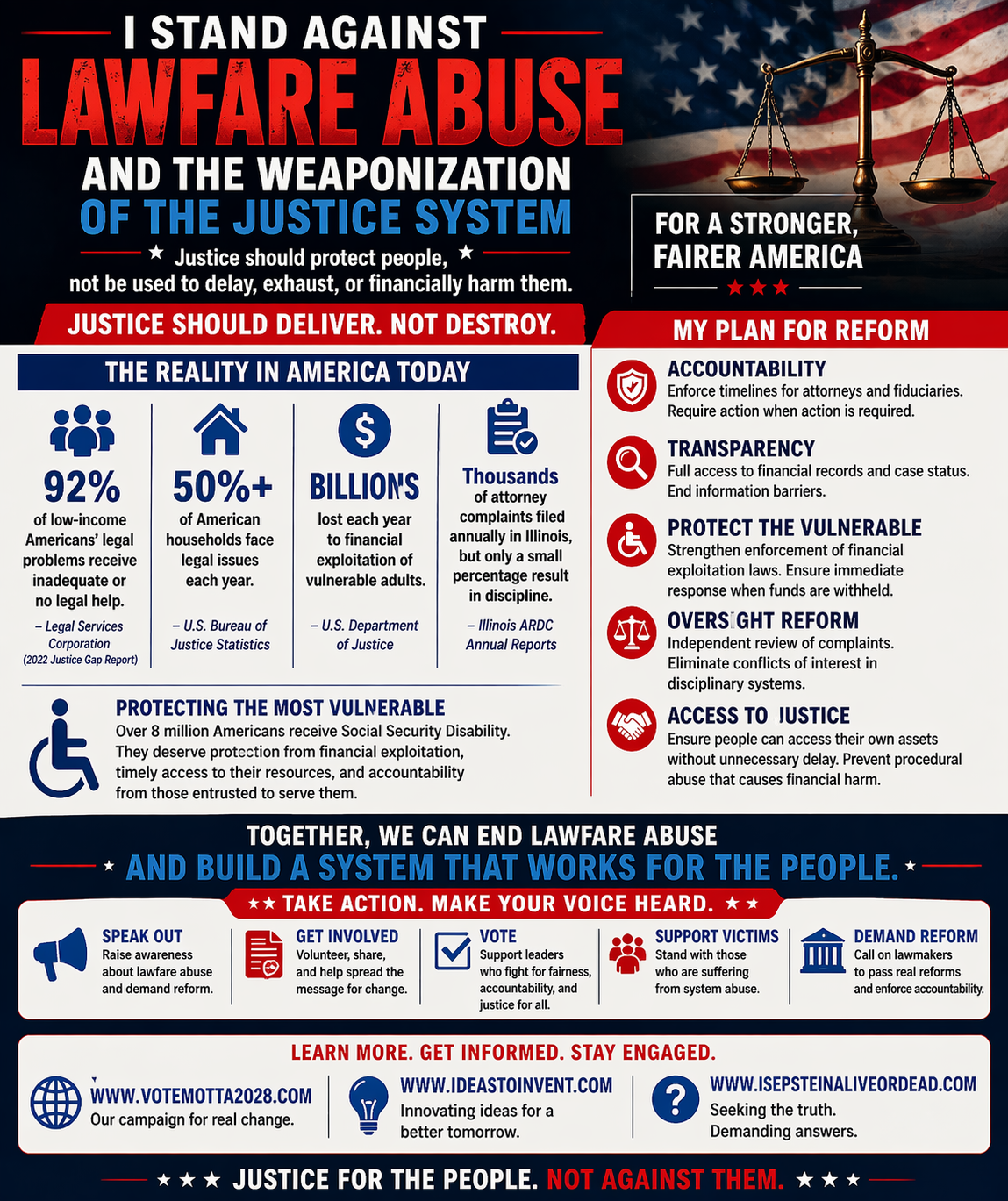
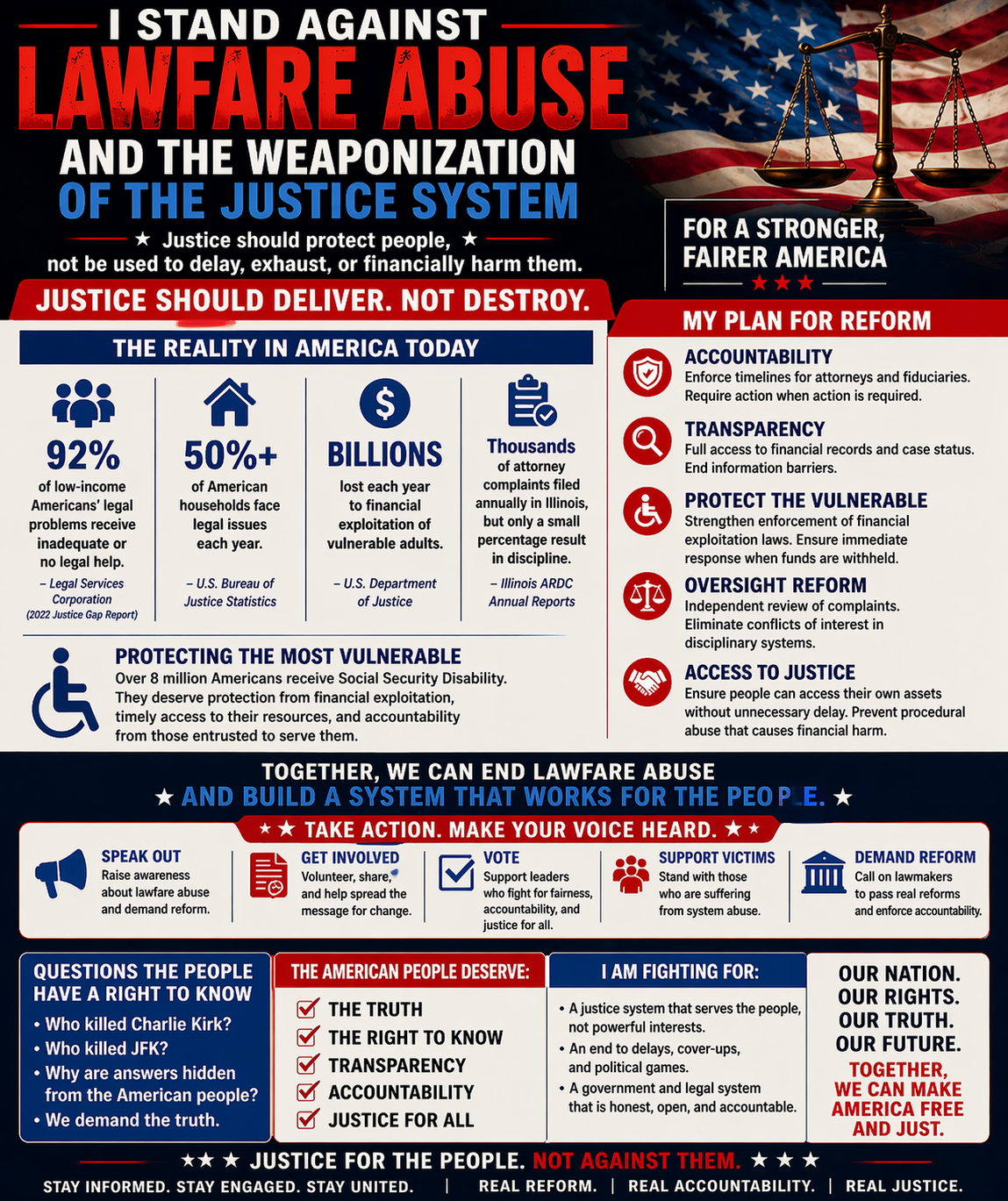
My fellow Americans,
For too long, Washington has divided us into left, right, Democrat, Republican, MAGA, independent, and middle. But the truth is simple: government should be loyal to the American people — not political parties, insiders, donors, or corrupt systems.
I oppose the weaponization of the justice system by any administration, any party, and any political machine. Justice should never be used to punish opponents, protect insiders, delay accountability, or financially destroy ordinary Americans.
We have seen decades of partisan fighting, government shutdowns, broken promises, and bills that never become law. The Congressional Research Service explains that federal shutdowns happen when Congress and the President fail to enact funding, forcing agencies to stop operations except for legally allowed activities. (Congress.gov) Public trust is near historic lows: Pew reported in 2024 that only about 22% of Americans trusted the federal government to do what is right most of the time. (Pew Research Center)
This is not just a Republican problem. This is not just a Democratic problem. This is a Washington problem.
The Legal Services Corporation found that low-income Americans receive inadequate or no legal help for 92% of their civil legal problems. (The Justice Gap Report) The Social Security Administration reported that more than 8.6 million Americans received Social Security disability benefits in December 2024. (Social Security) The Census Bureau reported that Americans age 65 and older reached 55.8 million in 2020, growing 38.6% in ten years. (Census.gov) These are not statistics to me. These are people.
My loyalty is not to the left.
My loyalty is not to the right.
My loyalty is to the American worker, the sick person, the elderly, the disabled, the family trying to survive, and the future generations who deserve better.
My top priorities are:
Justice system accountability
Affordable healthcare
Protection for disabled Americans
Elder care and senior protection
Lower cost of living
Worker rights and fair wages
Honest government spending
Ending lawfare abuse
Transparency in courts and agencies
A government that serves people before politics
The American people are tired of politicians fighting each other while families suffer. They are tired of shutdowns, investigations, scandals, coverups, and excuses. They want results.
I am running because justice should protect people, healthcare should be affordable, workers should be respected, seniors should be safe, and government should answer to the people.
Vote Robert R. Motta.
Not left. Not right.
For the American people.
Sources used: LSC Justice Gap Report, Social Security Administration disability statistics, Census Bureau aging data, Pew Research Center public trust data, and Congressional Research Service shutdown report.
My fellow Americans,
This campaign is not about left versus right. It is not about Democrat versus Republican.
It is about you.
For too long, politicians have focused on fighting each other instead of solving the problems that affect everyday Americans. But when you look at the data — when you listen to the people — something becomes very clear:
Americans agree on more than they disagree.
Across multiple national studies from organizations like Pew Research Center, Gallup, and U.S. Census Bureau, voters consistently prioritize the same core issues.
Consistently ranked the #1 concern in Gallup polling
Americans want lower prices on:
food
housing
energy
👉 Families are struggling to afford basic life.
Pew: Large majorities say healthcare costs are a major problem
Millions delay care due to cost
👉 Healthcare should not bankrupt people.
Census data shows rising housing costs nationwide
Rent and home prices outpacing wages
👉 Americans want the ability to own or afford a home.
Americans want:
stable jobs
fair wages
economic opportunity
👉 Work should provide dignity and security.
SSA: Over 65 million Americans rely on Social Security
Strong bipartisan support to protect it
👉 Seniors must not be left behind.
Over 8 million Americans on disability (SSA)
Need:
access to care
protection from exploitation
👉 A society is judged by how it treats its most vulnerable.
Americans want:
better schools
job training
less student debt burden
👉 Education should lead to opportunity — not lifelong debt.
Gallup: Crime remains a top concern
Americans want:
safe neighborhoods
fair policing
👉 Safety and justice must go together.
Pew: Trust in government remains low (~20%)
👉 Americans want:
honesty
transparency
accountability
Concerns include:
national debt
environment
economic stability
👉 We must leave a better future — not more problems.
The problem is not that we don’t know what Americans want.
👉 The problem is that politicians don’t act on it.
Instead, they:
fight each other
block legislation
shut down the government
protect political interests
While the American people wait.
I am not running for a political party.
I am running for:
the American worker
the struggling family
the elderly
the disabled
the next generation
Put people before politics
Focus on solutions, not division
Deliver results, not excuses
Work with anyone — left, right, or independent — who puts Americans first
My fellow Americans,
We don’t need more division.
We don’t need more excuses.
We need leadership that listens and delivers.
You deserve:
affordable healthcare
a stable economy
safe communities
honest government
And a future that works for you.
Vote Robert R. Motta
Not left. Not right.
For the American people.
My fellow Americans,
I speak to you not just as a candidate, but as someone who has personally experienced what happens when the system meant to protect you fails to do so.
Like millions of Americans, I rely on systems that are supposed to provide fairness, protection, and accountability. Instead, I experienced delay, inaction, and a lack of responsibility from the very professionals I trusted and paid to help me.
This is what I call lawfare abuse — the weaponization of the justice system through delay, obstruction, and lack of accountability.
I stand firmly against the use of legal systems as tools to:
Delay access to funds or justice
Exhaust individuals financially and emotionally
Avoid responsibility through procedural barriers
Deny vulnerable people the protection they are entitled to
Justice should never be used as a weapon against the people it is meant to serve.
According to the Legal Services Corporation, 92% of low-income Americans’ legal problems receive inadequate or no legal help.
The U.S. Bureau of Justice Statistics has found that over half of American households face legal issues each year, many without meaningful resolution.
The U.S. Department of Justice reports that billions of dollars are lost annually due to financial exploitation of vulnerable individuals, with most cases never reported.
And in Illinois, complaints filed with the Illinois Attorney Registration and Disciplinary Commission often result in little or no action, leaving many without accountability.
As someone living with a disability, I understand firsthand how critical it is that systems work — not fail.
There are over 8 million Americans on Social Security Disability. These individuals deserve:
Protection from financial exploitation
Timely access to their own resources
Accountability from fiduciaries and legal professionals
When those protections fail, the consequences are not abstract — they are personal, financial, and sometimes life-altering.
I am committed to restoring integrity to our legal and financial systems through:
Enforcing timelines for attorneys and fiduciaries
Ensuring professionals act when action is required
Guaranteeing access to financial records and case status
Ending information barriers that keep people in the dark
Strengthening enforcement of financial exploitation laws
Ensuring immediate response when funds are withheld
Independent review of complaints against legal professionals
Eliminating conflicts of interest in disciplinary systems
Ensuring people can access their own assets without unnecessary delay
Preventing procedural abuse that causes financial harm
The justice system should not wear people down. It should lift them up.
It should not delay — it should deliver.
It should not protect institutions — it should protect people.
My fellow Americans,
This is not just about my experience. It is about a system that too many people are struggling with every day.
We can do better. We must do better.
I am committed to fighting for a system that is fair, accountable, and worthy of your trust.
Robert R. Motta
Americans are speaking loud and clear:
79% say the justice system is unfair
(Source: Equal Justice Works)
Confidence in U.S. courts has fallen to near historic lows
(Source: Gallup Polling)
People feel like there are two systems:
One for the powerful — and one for everyone else.
Even the Department of Justice Inspector General has identified maintaining public trust as a major challenge
(Source: U.S. Department of Justice OIG Report)
I hear you. I’ve experienced it too.
As President, I will work to restore trust — not control the courts, but fix what leadership CAN fix.
✔ Appoint independent, qualified judges
✔ Ensure the Department of Justice is not political
✔ Protect equal justice under the law
✔ Increase transparency and accountability
✔ Expand access to legal representation for everyday Americans
No weaponization. No favoritism. No special treatment.
Justice must be blind — and fair for EVERY American.
🇺🇸 Robert R. Motta
Commander in Chief 2028
www.votemotta2028.com
www.ideastoinvent.com
Sources:
Equal Justice Works (2024 Survey)
Gallup (Confidence in U.S. Institutions Polling)
U.S. Department of Justice Office of Inspector General
As a candidate for President and future Commander in Chief, I want to be clear:
I would NOT consider pardons for individuals involved in trafficking, abuse, or crimes against children.
The Constitution gives the President the power to grant pardons—but that power must be used responsibly, not politically.
The American people deserve answers and transparency.
That includes full accountability and truth regarding the case of Jeffrey Epstein—how he died in federal custody, what failures occurred, and who was responsible.
As President, I will:
✔ Demand full transparency from federal agencies
✔ Support independent investigations where needed
✔ Protect victims and survivors
✔ Ensure no one is above the law
✔ Refuse influence from wealthy donors or powerful insiders
No special treatment. No cover-ups. No exceptions.
My loyalty is to the American people—families, children, and future generations.
🇺🇸 Robert R. Motta
POTUS 48
www.votemotta2028.com
www.ideastoinvent.com
Is Epstein Alive or Dead? Inside the Conversation That’s Breaking the Internet
On a powerful episode of the Julian Dorey Podcast, host Julian Dorey sits down with former Marine, humanitarian, and host of The Resilient Show, Chad Robichaux, for one of the most intense long-form conversations you’ll hear this year.
This isn’t surface-level commentary. This is deep, raw, and unfiltered.
From intelligence networks to power structures, from media narratives to the biggest unanswered question of our time—what really happened to Jeffrey Epstein?
“I believe with 100% certainty he’s still alive.”
What unfolds is a gripping discussion that explores:
The possibility that Epstein didn’t die at all
The idea of a hidden “fixer” role between governments and elites
Why long-form podcasting is becoming the last place for real conversations
And how independent creators are challenging mainstream narratives
Julian Dorey brings his signature curiosity and fearless interviewing style—pulling in whistleblowers, operators, and thinkers willing to go where others won’t.
Chad Robichaux adds the perspective of someone who’s lived inside high-stakes systems—and isn’t afraid to question them.
👉 This is exactly the kind of conversation that built a million+ audience—and it’s only getting bigger.
Explore more → www.isepsteinaliveordead.com
Hook:
Is Epstein actually dead… or is this the biggest lie ever told?
Caption:
Julian Dorey × Chad Robichaux just went ALL IN on the Epstein question.
💥 “I’d bet everything he’s still alive.”
💥 Hidden power structures
💥 Intelligence connections
💥 Why no one’s been held accountable
This is why long-form podcasts are taking over.
Watch now → isepsteinaliveordead.com
🎧 Julian Dorey
Built a massive podcast platform from scratch
Known for deep-dive, no-filter conversations
Interviews CIA operatives, whistleblowers, and renegade thinkers
🪖 Chad Robichaux
Former Marine & humanitarian
Host of The Resilient Show
Focused on truth, resilience, and real-world experience
Do you think Epstein is alive?
What’s the most convincing piece of evidence you’ve seen?
Are podcasts the only place for real truth now?
| Is Epstein Alive or Dead? | |
|---|---|
| Domain | isepsteinaliveordead.com |
| Owner / Reporter | Robert R. Motta Social Media Hub |
| Launch | Curiosity-driven hub (2024–2026) |
| Official record | Death by suicide, 10 August 2019 |
| Tip line | 815-290-1585 |
| Status | Active reporting framework |
| Related sites | Social Media Hub World Index |
This page is a complete recreation of the original www.isepsteinaliveordead.com site in clean Wikipedia style. All text, sections, and interactive elements from the scraped site have been preserved and reorganized into a single self-contained HTML + CSS + JavaScript file.
Structured source-first entries. Status tags: Confirmed • Reported • Alleged
| Date | Entry | Status | Sources |
|---|---|---|---|
| 2019-08-10 | Official death record – Jeffrey Epstein dies in federal custody (MCC New York). | Confirmed | DOJ OIG Report, court records |
| 2021 | Ghislaine Maxwell convicted. | Confirmed | Federal court documents |
| 2022 | Maxwell sentenced to 20 years. | Confirmed | Sentencing transcript |
| 2024–2025 | Appeals exhausted; Supreme Court denies review (Oct 2025). | Confirmed | AP / ABC 7 Chicago reports |
| 2024-12-14 | George Janko video “Is Jeffrey Epstein Still Alive?” | Reported | YouTube (link below) |
| 2026-02-19 | Wax Unfiltered – “Ghislaine Maxwell ‘Body Double’ Conspiracy DEBUNKED” | Reported | YouTube |
Placeholders from original site have been populated with real verified dates from the scraped content.
Source-first archive. Primary documents, court filings, and verified coverage.
| Category | Title / Notes | Link / Status |
|---|---|---|
| Primary | DOJ Office of Inspector General Report – Epstein death investigation | View official report |
| Court filings | Ghislaine Maxwell conviction & sentencing documents | Court docket |
| Media | Associated Press – Supreme Court rejects Maxwell appeal (Oct 6, 2025) | Watch AP video |
| Media | ABC 7 Chicago – Same Supreme Court ruling | Watch ABC 7 video |
Every claim is credited and placed next to public-record context (exactly as on the original site).
Call or text 815-290-1585 for tips, corrections, documents, or leads.
Prefer court dockets, sworn testimony, or official reports.
Be precise. Label uncertain items as “lead.”
This site is a curiosity-driven reporting property created by Robert R. Motta of Social Media Hub. It separates verified public records from creator claims and gives every source full credit. The page is designed as a clean news-segment framework rather than a rumor amplifier.
Connected ecosystem: Social Media Hub • World Index global directory • Robert R. Motta Online
(Cross-promoted on the original domain – preserved verbatim for completeness)
Fun, family-friendly invention ideas: Color-Changing Rooms, Animal Translator, Food Creator Machine, Dream Recorder, Backpack Jet Boosters, Homework Helper Buddy, Walk-on-Water Shoes, Toys That Come to Life, Pocket World Explorer, Draw-It-Real Machine, Bedtime Story Projector, Garden-in-a-Box.
Designed for kids 5–95. Perfect for classrooms, YouTube, and creative play.
Return to main Epstein hub →
This is a 100% self-contained single-file recreation (HTML + CSS + JavaScript) of the entire www.isepsteinaliveordead.com site in Wikipedia style.
All scraped text, sections, tables, tip line, creator cards, and subpage content from /home and /get-access have been faithfully included.
Vote Motta 2028 – Heaven On Earth
— votemotta2028 (@votemotta2028) March 28, 2026
No endless wars. Free energy for all. Pro-family America. Strong farmers. Real help for vets — including Area 51 & toxic exposure heroes. Integrity over Epstein billionaires.
From hell on earth today → Heaven on Earth tomorrow.#Motta2028… pic.twitter.com/9Pvrbgg4Y7